
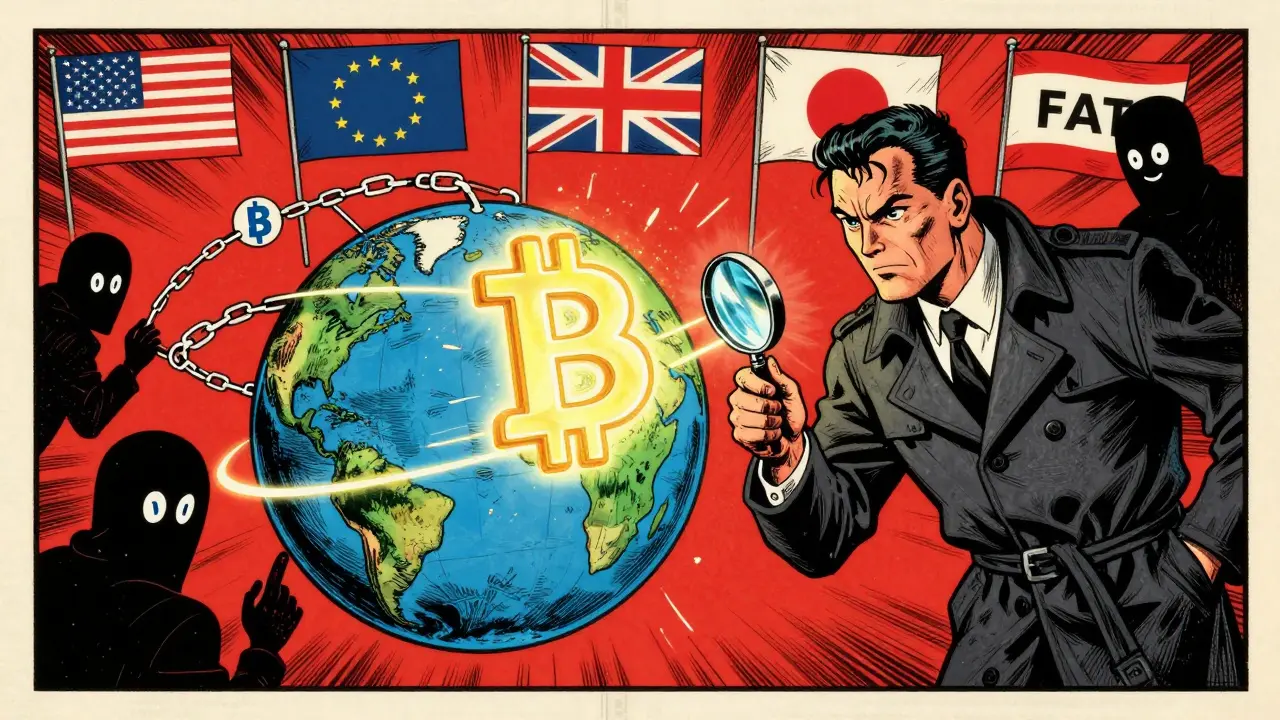
Why governments are watching every crypto transfer across borders
Imagine sending $5,000 in Bitcoin to a friend in another country. It feels private, right? But in 2025, that transaction is being tracked-not by hackers or spies, but by governments working together across continents. Cross-border crypto monitoring isn’t science fiction anymore. It’s the new normal. And if you’re using crypto internationally, you’re already part of it.
The goal? Stop criminals. Not just drug dealers or hackers, but those using crypto to dodge sanctions, fund terrorism, or launder money from corruption. The Financial Action Task Force (FATF), a global watchdog made up of 39 countries including the U.S., EU, UK, Japan, and Australia, set the rules. And they’ve made it clear: crypto isn’t a loophole. It’s a financial instrument, just like cash or wire transfers.
The Travel Rule: The backbone of global crypto tracking
At the heart of all this is something called the Travel Rule. It’s not new-it’s been around since the 1990s for banks. But now it applies to crypto too. If you send $3,000 or more in Bitcoin, Ethereum, or any other digital asset across borders, the exchange or wallet provider you use must share specific details with the recipient’s provider.
What gets shared? Your full name, physical address, the recipient’s name and address, the exact amount, the date, and wallet addresses involved. This isn’t optional. It’s legally required under the Bank Secrecy Act in the U.S., MiCA in the EU, and similar laws in over 100 countries. The rule applies whether you’re sending from Coinbase to Binance, or from a U.S. exchange to a wallet in Singapore.
Some people think this violates privacy. But regulators argue: if you can send $10,000 in cash across borders and banks have to report it, why should crypto be any different? The system isn’t designed to spy on everyday users. It’s built to catch those trying to hide large sums.
How countries are enforcing it differently
Not every country plays by the same rules-even if they’re all following FATF. The European Union went further with MiCA, requiring all licensed crypto firms to have real-time transaction monitoring tools, mandatory risk assessments, and regular audits. They also banned anonymous crypto wallets outright for businesses.
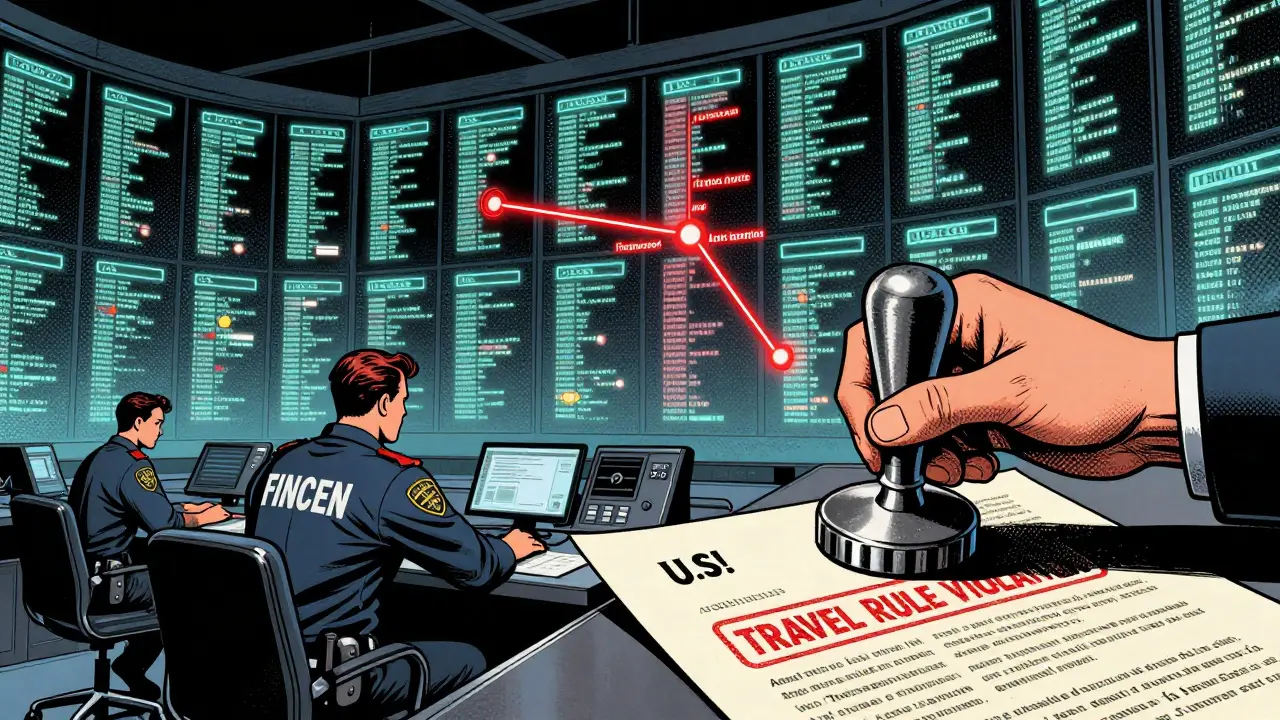
The U.S. took a different path. FinCEN, the financial crimes unit under the Treasury Department, proposed a rule in 2025 that would require banks and money services businesses to report any transaction involving unhosted wallets (like MetaMask or Ledger) if the sender or receiver is linked to a sanctioned entity. That means if your wallet ever received funds from a wallet tied to a Russian bank under sanctions-even if you didn’t know it-you could trigger a report.
The UK, meanwhile, is working closely with the U.S. through the Transatlantic Task Force. They’re aligning licensing rules, stablecoin standards, and reporting formats so crypto firms operating in both regions don’t have to navigate conflicting systems. It’s a rare example of global coordination.
Where the system still breaks down
For all the progress, the system has glaring holes. The biggest? Unhosted wallets. If you send crypto from a personal wallet to another personal wallet, and neither side is a licensed exchange, there’s no one collecting your ID. That’s where criminals go.
Here’s how it works in practice: A person in Iran buys $100,000 worth of Bitcoin on a non-KYC exchange using cash. They send it to a mixer service that shuffles it through dozens of wallets across different blockchains. Then it lands in a wallet linked to a Ukrainian charity-except the charity’s wallet was previously used by a sanctioned Russian entity. The trail is broken. The charity doesn’t know. The bank doesn’t know. The regulator doesn’t know-until someone flags the wallet later.
Another problem: VPNs. People use them to hide their location when signing up for exchanges. A Russian national might sign up for a U.S.-based exchange using a Canadian IP address. The exchange sees Canada. The regulator sees Canada. But the real person? Still in Moscow. That’s why OFSI (the UK’s sanctions office) called this one of the top five threats in their 2025 report.
What happens if you don’t comply?
Penalties are getting serious. In 2024, a major crypto exchange paid $60 million in fines for failing to report cross-border transactions tied to sanctioned individuals. In 2025, the U.S. Treasury fined another firm $45 million for letting users bypass Travel Rule requirements by splitting large transfers into multiple $2,999 transactions-a practice called “structuring.”
It’s not just about fines. Exchanges that don’t comply get blocked. In 2025, the U.S. blocked three offshore crypto platforms from processing payments through U.S. banks. That meant users couldn’t withdraw funds. Businesses lost millions. Individuals got locked out of their own money.
Even if you’re not a business, you’re still affected. If you’re sending crypto from a regulated exchange and the recipient’s wallet triggers a red flag, your transaction can be frozen for weeks while investigators check it out. No warning. No explanation. Just silence.
How to stay compliant without getting caught in the net
You don’t need to be a criminal to get flagged. Sometimes, it’s just bad luck. Here’s how to avoid trouble:
- Use only licensed exchanges like Coinbase, Kraken, or Bitstamp for international transfers. They handle compliance automatically.
- Avoid mixing services, tumblers, or privacy coins like Monero. Even if they’re legal in your country, they’re automatic red flags globally.
- Never send large amounts to unhosted wallets unless you know the recipient’s full identity. If you’re sending to a friend, ask them to receive it on a licensed exchange first.
- Keep records of every cross-border crypto transaction-especially if it’s over $3,000. You might need to prove it was legitimate.
- Don’t use VPNs to sign up for exchanges. Your location matters, and regulators are getting better at detecting it.
Bottom line: If you’re doing legitimate things with crypto, compliance won’t hurt you. It’ll protect you-from fraud, from freezes, and from being mistaken for a criminal.
The future: More control, more tech, less gray area
By 2026, expect more countries to require real-time reporting of all cross-border crypto transactions-not just those over $3,000. Some experts predict the threshold will drop to $1,000. Others say regulators will start using AI to scan blockchain patterns and flag suspicious behavior before the transaction even completes.
Central banks are also rolling out digital currencies. The ECB’s digital euro, China’s digital yuan, and the Fed’s pilot programs all come with built-in monitoring. That means in the near future, even if you avoid crypto, you might still be using a government-tracked digital dollar.
The message is clear: Crypto isn’t anonymous. It’s not untraceable. And the world is no longer willing to let it be. The tools are here. The laws are tightening. The only question left is: Are you ready to play by the new rules?


There are 18 Comments
Daniel Verreault
Jacky Baltes
Ian Koerich Maciel
Andy Reynolds
Alex Strachan
Antonio Snoddy
Rajappa Manohar
Johnny Delirious
Bianca Martins
alvin mislang
Alexandra Wright
Jackson Storm
Prateek Chitransh
Michelle Slayden
christopher charles
Vernon Hughes
Alison Hall
Amy Garrett
Write a comment
Your email address will not be published. Required fields are marked *