
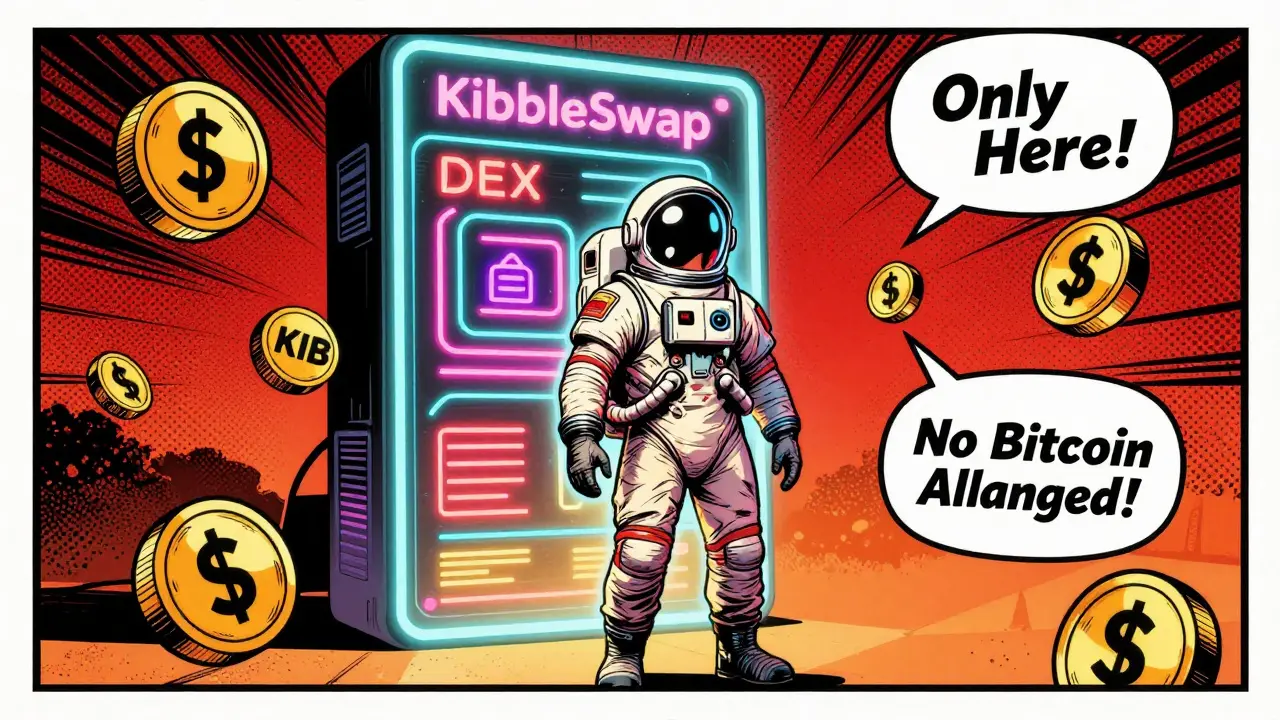
Most crypto users know Uniswap or PancakeSwap. But what if you're only trading tokens on DogeChain? That’s where KibbleSwap comes in. It’s not another big-name DEX trying to do everything. It’s built for one thing: swapping DogeChain-native tokens. If you’re deep into the DogeChain ecosystem, KibbleSwap might be your only real option. If you’re not? You’ll likely find better tools elsewhere.
What Is KibbleSwap?
KibbleSwap is the native decentralized exchange (DEX) on DogeChain. Unlike Uniswap or SushiSwap that run across multiple blockchains, KibbleSwap only works on DogeChain. That means you can’t trade Bitcoin, Ethereum, or Solana tokens here. You can only swap tokens built on DogeChain itself - like $KIB, $DOGECHAIN, or any other token issued on that chain.
This isn’t a flaw. It’s the whole point. KibbleSwap was designed to be the go-to swap platform for DogeChain users. It’s not trying to compete with giants. It’s trying to serve a small, specific group of people who want to trade DogeChain assets without leaving the network.
How KibbleSwap Works
KibbleSwap uses the same automated market maker (AMM) model as most DEXs. You connect your wallet - usually MetaMask configured for DogeChain - and swap tokens directly from your wallet. There’s no order book. No middleman. Just smart contracts that match buyers and sellers using liquidity pools.
When you swap tokens, you pay a 0.3% fee. That’s standard. Half of that fee goes to liquidity providers. The other half is used to buy back and burn $KIB tokens. That’s how the $KIB token stays deflationary. Every trade reduces the total supply slightly. It’s a simple, proven model.
You can also stake $KIB to earn more $KIB. It’s not high yield. You’re not going to double your money in a week. But it’s a way to earn passive rewards just by holding the platform’s native token. No complex DeFi strategies needed.
The $KIB Token - What It Actually Does
$KIB is the heartbeat of KibbleSwap. It’s not just a utility token. It’s governance. It’s rewards. It’s the reason the platform exists.
As of early 2026, $KIB trades at around $0.0000000147. That sounds ridiculous. But it’s not unusual for niche tokens. Compare that to UNI ($6.50) or CAKE ($4.10). $KIB’s value comes from its role, not its price. If DogeChain grows, $KIB could rise. If DogeChain dies, $KIB goes to zero.
Here’s the reality: $KIB has no major exchange listings. You can’t buy it on Binance, Coinbase, or Kraken. You can only get it by swapping on KibbleSwap, or from other users on DogeChain. That limits liquidity. It also means price swings are wild. A single large trade can move the price 20% in minutes.
Why KibbleSwap Is Different
Most DEXs are like supermarkets. They sell everything. KibbleSwap is a specialty shop. It only carries DogeChain products.
That gives it two big advantages:
- Lower slippage - Because everyone trading on KibbleSwap is trading DogeChain tokens, liquidity is concentrated. You won’t get 10% worse prices because the pool is shallow.
- Native rewards - If you’re active on DogeChain, you’ll earn $KIB just by swapping. No need to bridge assets or jump between platforms.
But the trade-off is obvious: no cross-chain support. If you want to swap DogeChain tokens for Solana tokens? You can’t. You’ll need to use a bridge, then go to another DEX. KibbleSwap doesn’t help you there.
Who Should Use KibbleSwap?
You should use KibbleSwap if:
- You hold DogeChain-native tokens and want to trade them
- You’re already using DogeChain for DeFi or NFTs
- You want to earn $KIB rewards without complicated staking
- You’re comfortable with a small, niche ecosystem
You should avoid KibbleSwap if:
- You want to trade Bitcoin, Ethereum, or other major coins
- You need high liquidity for large trades
- You’re new to crypto and need tutorials, customer support, or a simple UI
- You’re looking for a safe, regulated, or widely recognized platform
There’s no middle ground. KibbleSwap isn’t for beginners. It’s not for traders who want options. It’s for DogeChain loyalists.
Security and Audits - The Big Unknown
This is the biggest red flag.
There’s no public record of KibbleSwap’s smart contracts being audited by a reputable firm like CertiK, Hacken, or SlowMist. No GitHub commits. No team disclosures. No press releases about security upgrades.
That’s not normal. Even the smallest DEXs get audited. It’s basic trust-building. KibbleSwap doesn’t even pretend to care. If you’re using it, you’re trusting code that hasn’t been reviewed by anyone outside the team.
And there’s zero regulatory info. No KYC. No compliance. No legal entity listed. That’s common for DEXs - but it’s still risky. If something goes wrong, you have no recourse.
There are no known hacks or exploits tied to KibbleSwap - but that’s because almost no one is using it. Low traffic means low visibility. Not low risk.
User Experience and Support
The interface is basic. It looks like a 2021 DEX. No dark mode. No analytics. No price charts. Just a swap button, a pool tab, and a staking section.
There’s no help center. No live chat. No Discord server with dedicated support. If you get stuck, you’re on your own. Most users rely on DogeChain’s general community forums - which are quiet and under-maintained.
Getting started requires configuring your wallet for DogeChain. That’s not hard if you’ve done it before. But if you’ve never used a custom RPC? You’ll need to look up the network settings. KibbleSwap doesn’t walk you through it.
Market Position and Future Outlook
KibbleSwap doesn’t appear on most DEX rankings. It’s not in CoinGecko’s top 100. It’s not in YouTube’s “Best DEXs 2025” videos. It’s invisible to mainstream crypto.
Its only real metric is the $KIB token price. CoinDataFlow predicted a 90% price increase by 2025. That’s speculative. It’s based on zero user data, no adoption metrics, and no development activity.
The DogeChain ecosystem is tiny. It has less than 10,000 daily active users. Compare that to Uniswap, which does over $1 billion in daily volume. KibbleSwap’s entire trading volume likely doesn’t hit $1 million per day.
Without new features, partnerships, or marketing, KibbleSwap won’t grow. It’s stuck. It’s a niche tool for a niche group. And if DogeChain fades - as so many meme chains do - KibbleSwap fades with it.
Final Verdict: Worth It?
Here’s the truth: KibbleSwap isn’t a bad platform. It does exactly what it says it does. It lets you swap DogeChain tokens. It rewards you with $KIB. It’s simple.
But it’s also fragile. No audits. No support. No growth. No visibility.
If you’re already using DogeChain and you want to trade $KIB or other native tokens - then yes, use KibbleSwap. It’s your only real option.
If you’re curious, or you’re looking for a new DeFi play - skip it. You’ll waste time. You’ll risk your funds. And you won’t get anything back except maybe a few extra $KIB tokens - worth pennies.
KibbleSwap isn’t a scam. But it’s not a safe bet either. It’s a gamble on a dying ecosystem. Only bring what you can afford to lose.
Is KibbleSwap safe to use?
KibbleSwap has no public smart contract audits, no regulatory compliance, and no known security team. It operates like most DEXs - trustless and permissionless - but with less transparency. If you’re comfortable with the risks of DeFi and you’re only trading DogeChain tokens, it’s usable. But never deposit large amounts. Treat it like a high-risk experiment.
Can I buy $KIB on Binance or Coinbase?
No. $KIB is only available on DogeChain-based platforms. You can’t buy it on centralized exchanges. You must connect your wallet to KibbleSwap and swap another DogeChain token for it. Or find someone who already holds it and trade peer-to-peer.
Does KibbleSwap have a mobile app?
No. KibbleSwap has no official mobile app. You can access it through your mobile browser if you have a Web3 wallet like MetaMask configured for DogeChain. But the interface isn’t optimized for mobile. It’s clunky and slow on small screens.
What’s the difference between KibbleSwap and PancakeSwap?
PancakeSwap runs on BNB Chain and supports hundreds of tokens across multiple chains. KibbleSwap only works on DogeChain and only supports DogeChain-native tokens. PancakeSwap has millions of users, audits, and a team. KibbleSwap has a handful of users, no audits, and no public team. They’re not competitors - they’re in entirely different worlds.
How do I connect my wallet to KibbleSwap?
First, add DogeChain to your wallet. Use these settings: Network Name: DogeChain, RPC URL: https://rpc.dogechain.dog, Chain ID: 2000, Currency Symbol: DOGE, Block Explorer: https://dogechain.info. Then go to KibbleSwap’s website, click ‘Connect Wallet,’ and select MetaMask or another Web3 wallet. Once connected, you can swap or stake.


There are 20 Comments
Samantha Stultz
KibbleSwap is a textbook example of niche utility done right. The AMM model is sound, the fee structure is transparent, and the $KIB burn mechanism is elegantly simple. Most people don’t get it because they’re conditioned to think bigger is better. But in DeFi, specialization beats aggregation every time. The liquidity concentration on DogeChain means lower slippage than you’d get on a multi-chain DEX trying to serve 500 tokens. This isn’t a prototype-it’s a precision tool. If you’re in the ecosystem, you’re already using it. If you’re not, you don’t need it. End of story.
Robert Conmy
Stop pretending this isn’t a graveyard. No audits? No team? No transparency? You call that DeFi? This isn’t a DEX-it’s a honeypot. Someone’s already rug-pulled this and we’re just waiting for the chain to go silent. I’ve seen this movie before. First it’s ‘niche,’ then it’s ‘dead,’ then it’s ‘scam.’ Don’t be the last one holding $KIB when the last miner disconnects.
Lilly Markou
I find the entire premise of KibbleSwap profoundly unsettling. The emotional weight of trusting unaudited smart contracts with one’s assets is not to be underestimated. The absence of formal governance structures, coupled with the complete lack of institutional accountability, creates a vacuum of ethical responsibility. One cannot simply aestheticize risk as ‘niche utility.’ Human vulnerability is not a feature of decentralized systems-it is their most critical vulnerability.
precious Ncube
Tracy Peterson
There’s beauty in doing one thing well. Most projects chase growth like it’s a religion. KibbleSwap just exists. It doesn’t need to be on CoinGecko. It doesn’t need VC money. It doesn’t need a Discord with 50k bots. It just serves the people who actually use DogeChain. That’s radical in a world where every DEX tries to be everything to everyone. Maybe the future isn’t about scale. Maybe it’s about sincerity.
Dianna Bethea
For anyone trying to use this for the first time-don’t overthink it. Add the DogeChain RPC, connect MetaMask, and swap. The UI is barebones but functional. No need to panic about audits. Most small DEXs operate like this. The real risk isn’t the code-it’s the liquidity. If you’re trading small amounts, you’re fine. If you’re trying to dump 100k $KIB? That’s when things get spicy. Also, staking $KIB gives you about 2% APY. Not life-changing. But it’s free money if you’re already in the ecosystem.
Alyssa Herndon
I admire how quiet this project is. No hype. No influencers. No whitepapers with diagrams of rockets. Just a simple tool for a simple need. It reminds me of early Bitcoin-before the ads, before the ETFs, before everyone wanted a piece. Maybe the most honest innovations are the ones that don’t try to convince you they matter. They just work. And if you need them, you find them.
Kenneth Genodiala
It’s fascinating how the crypto world has become so obsessed with scale. KibbleSwap is a quiet rebellion against the cult of growth. It doesn’t need to be big. It doesn’t need to be popular. It just needs to be reliable for the 2,000 people who actually trade on DogeChain every day. That’s more than enough. The real tragedy isn’t that KibbleSwap is small-it’s that the entire industry has forgotten what ‘enough’ means.
Don B.
Neeti Sharma
Fiona Monroe
While the operational model of KibbleSwap is technically sound, its complete absence of third-party security validation constitutes an unacceptable risk profile for any rational actor engaging in financial transactions. The lack of a publicly verifiable audit trail, coupled with non-disclosure of development personnel, renders the platform non-compliant with even the most minimal standards of fiduciary transparency in digital asset ecosystems. I would categorically advise against its use unless one is prepared to assume total, unmitigated risk.
Maggie House
Elizabeth Smith
There is no such thing as a safe crypto project. Every chain is a gamble. Every token is a prayer. KibbleSwap doesn’t lie about it. It doesn’t pretend to be a bank. It doesn’t sell you dreams. It just exists. And in a world full of lies, isn’t that honesty worth something? Maybe the real scam is believing that safety comes from branding. Maybe safety comes from knowing what you’re risking-and choosing anyway.
Robert Kromberg
I think people are missing the point. KibbleSwap isn’t meant to be a gateway. It’s meant to be a home. If you’re not living in DogeChain, you don’t need it. But if you are? It’s the only place that doesn’t make you jump through hoops. No bridges. No wrappers. No 12-step process just to swap two tokens. It’s clean. It’s quiet. And honestly? That’s rare.
Daisy Boliaan
OMG I just lost 5000 $KIB on this thing and I’m so mad 😭 I thought it was safe but then the price dropped 30% in 10 mins and the gas fees were insane. Why is there no warning? Why is there no help? I’m crying right now. Someone please help me. I just wanted to support the chain 😭😭😭
Jessica Carvajal montiel
Let me guess-this is all part of the Fed’s plan. DogeChain is a decoy. KibbleSwap is a honeypot to track crypto users before the CBDC rollout. The ‘no audits’? That’s intentional. The low volume? That’s because they’re waiting for the right moment. You think this is about tokens? No. This is about identity. They’re collecting wallet addresses. Every swap. Every stake. Every transaction. And when the time comes, you won’t even know you’ve been tagged. Wake up. This isn’t DeFi. It’s surveillance.
maya keta
Ugh this is so basic. I’ve been on Solana for 3 years. Why would I use some dog chain DEX with no liquidity? $KIB is worth less than a meme. If you’re not on a real chain, you’re not even playing the game. This isn’t innovation-it’s a digital garage sale. And nobody wants your used tokens.
Curtis Dunnett-Jones
The argument that KibbleSwap is ‘not for beginners’ is precisely why it deserves respect. Most projects cater to the lowest common denominator. They over-simplify. They gamify. They turn finance into a TikTok trend. KibbleSwap assumes competence. It assumes you’ve done your homework. It assumes you understand risk. In a world of infantilized users, that’s revolutionary. You don’t need a help center if you’re not trying to attract the clueless.
Sean Logue
As someone who’s been in crypto since 2017, I’ve seen a hundred chains rise and die. DogeChain might be one of them. But if KibbleSwap survives, it’ll be because it never tried to be anything else. It didn’t chase users. It didn’t chase hype. It just stayed true to the few who needed it. That’s the kind of project that outlasts the noise. Not because it’s big. But because it’s real.
Carl Gaard
Just swapped 200 $KIB and staked it 🤞✨ I love how simple this is. No ads. No popups. Just me and the chain. I don’t care if it’s not on CoinGecko. I care that it works. And it does. 🙌🔥 DogeChain forever! 🐶💎
Write a comment
Your email address will not be published. Required fields are marked *