Right now, your Bitcoin wallet, your Ethereum transactions, and every encrypted message on a blockchain are protected by math that quantum computers will soon break. It’s not science fiction. It’s a countdown.
What’s at stake? Your blockchain data is already being harvested
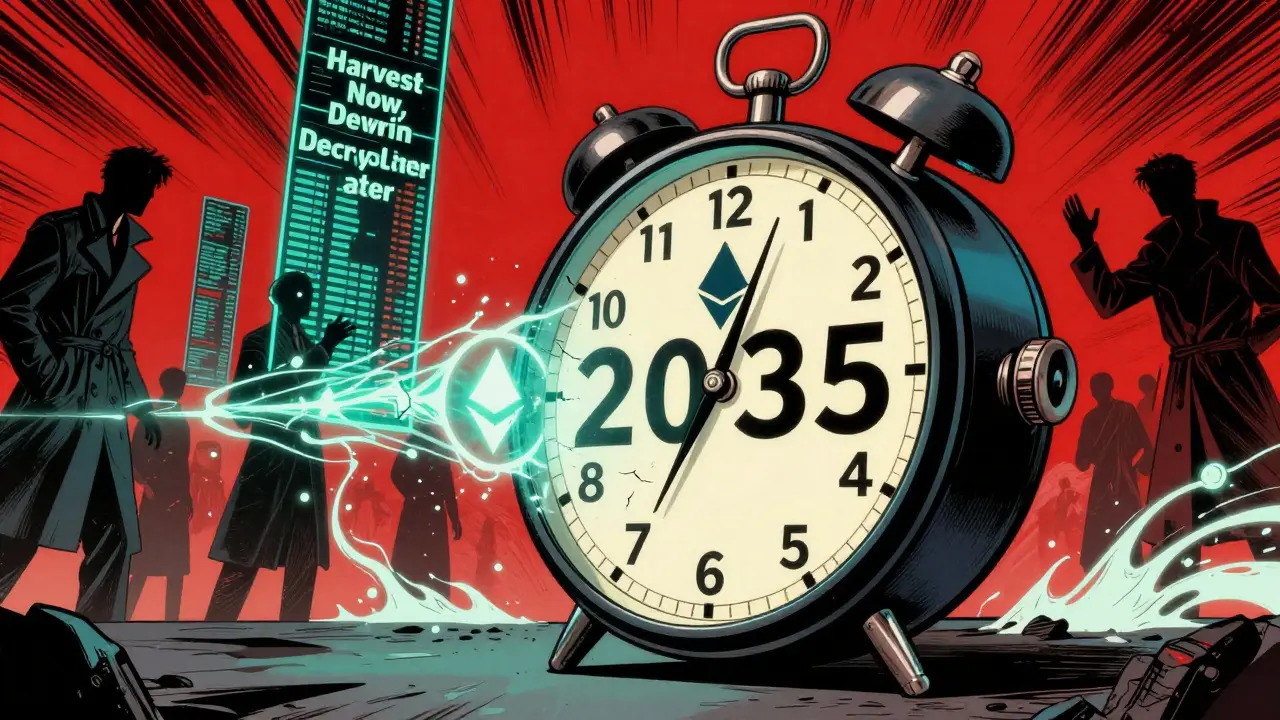
Most blockchains today rely on RSA 2048 and ECDSA for digital signatures. These are the same algorithms that secure your online banking and government records. They work because factoring large numbers or solving discrete logarithms is too slow for classical computers. But quantum computers? They use Shor’s algorithm to solve these problems in minutes - not millennia. The scary part? Attackers don’t need to break your keys today. They’re already collecting encrypted blockchain data - your transaction history, wallet addresses, signed messages - and storing it. This is called “harvest now, decrypt later.” Once a cryptographically relevant quantum computer (CRQC) is built, all that data becomes readable. Your private keys, your holdings, your identity on-chain - all exposed.When will quantum computers break encryption?
There’s no single date, but the range is narrowing. Experts now agree: the threat could arrive between 2030 and 2040. The Global Risk Institute’s 2024 report gives us the clearest picture: a 17% to 34% chance a CRQC can break RSA 2048 by 2034. By 2044, that jumps to 79%. That’s not speculation - it’s modeled from real progress in qubit stability, error correction, and gate fidelity. Some labs are already hitting milestones that used to seem decades away. In 2025, researchers demonstrated logical qubits with error rates low enough to scale. Microsoft and IBM are both reporting quantum volume increases of over 10x per year. If that pace continues, a machine capable of running Shor’s algorithm on RSA 2048 could be online by 2035. Even the most cautious estimates - like MITRE’s 2025 projection of 2055 - are being questioned. Why? Because quantum computing doesn’t follow a straight line. It’s exponential. One breakthrough in error correction can unlock years of progress overnight.Government deadlines are forcing action
While experts debate exact dates, governments aren’t waiting. The U.S. National Security Memorandum 10 (NSM-10) requires all federal systems to switch to quantum-resistant crypto by 2035. The Department of Homeland Security wants it done by 2030. The Commercial National Security Algorithm Suite 2.0 (CNSA 2.0) demands adoption between 2030 and 2033 for national security systems. These aren’t suggestions. They’re legal mandates. And they’re shaping what every organization - including blockchain projects - must do now. If you’re building a new blockchain protocol or upgrading an old one, you can’t afford to wait for the attack to happen. You need to build for a world where quantum computers exist.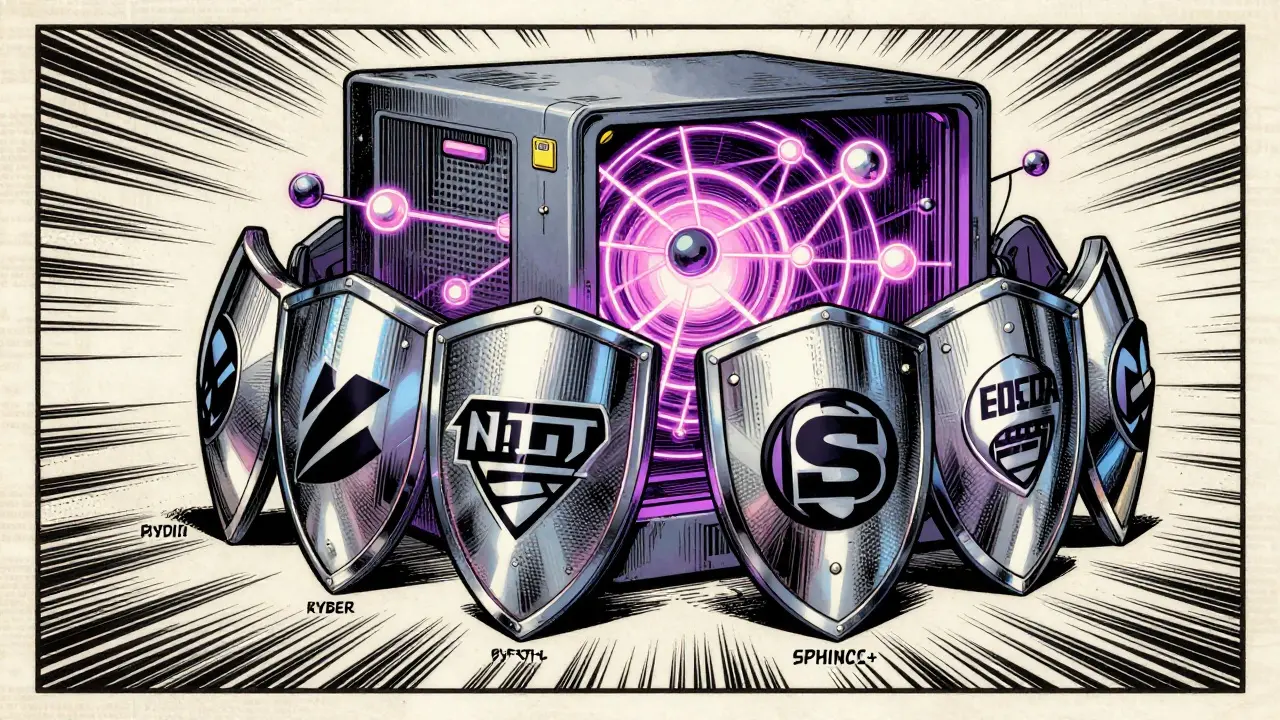
What’s being done? NIST’s post-quantum standards
In 2024, NIST released the first official set of post-quantum cryptography (PQC) standards. These aren’t theoretical. They’re ready to use. The four approved algorithms are:- CRYSTALS-Kyber - for encryption and key exchange
- CRYSTALS-Dilithium - for digital signatures
- FALCON - compact signatures for space-limited systems
- SPHINCS+ - hash-based, ultra-conservative backup
Why AES isn’t the problem - but it’s still a concern
You might hear that AES-256 is safe from quantum attacks. That’s mostly true. Grover’s algorithm can speed up brute-force searches, but it only cuts the security in half - so AES-256 becomes as strong as AES-128 today. That’s still secure for now. But here’s the catch: most blockchains don’t use AES alone. They use it alongside RSA or ECDSA for key exchange and authentication. If those are broken, AES doesn’t matter. An attacker doesn’t need to crack your encrypted data - they just need to steal your private key. And that’s what Shor’s algorithm does.What should blockchain projects do today?
If you’re running a blockchain, running a wallet, or building a dApp, here’s what you need to do right now:- Inventory your crypto assets - List every algorithm you use. Where is RSA? Where is ECDSA? Which parts of your system rely on them?
- Map your data’s shelf life - How long will your on-chain data stay valuable? If it’s more than 10 years, you’re already at risk.
- Start testing PQC - Integrate NIST’s Kyber or Dilithium into a testnet. See how it affects gas fees, transaction size, and node performance.
- Plan your migration - Will you hard fork? Will you use hybrid signatures (old + new)? Can you phase it in over 2-3 years?
- Engage your users - Wallet providers need to update. Users need to migrate keys. This isn’t a silent upgrade.
Organizations are already moving
Deloitte’s 2025 survey found that 52% of companies are actively measuring their quantum risk. Another 30% are already deploying solutions. In finance - where blockchain adoption is growing fast - every major executive now understands the threat. They’re not asking if they should act. They’re asking how fast they can. One hedge fund in Singapore quietly migrated its custody infrastructure to hybrid RSA/Dilithium signatures in late 2024. They didn’t announce it. They didn’t need to. Their clients didn’t notice - but their assets are now quantum-safe.Don’t wait for the breach
The blockchain was built to be trustless, transparent, and permanent. But if the math behind it becomes obsolete, permanence turns into vulnerability. Every transaction ever recorded on Ethereum, Bitcoin, Solana, or any other chain could be rewritten - not by a hacker, but by a machine. This isn’t a future problem. It’s a planning problem. And the clock is ticking faster than most realize. The next five years are your window to act. Not ten. Not fifteen. Five. After that, you’re not upgrading - you’re reacting to a disaster you could have prevented.What happens if you do nothing?
If you ignore the quantum threat, here’s what you risk:- All public keys on your chain become readable - attackers can trace wallets, link identities, and steal funds.
- Smart contracts with time-locked funds become exploitable.
- Decentralized identity systems collapse - if your signature is broken, your identity is fake.
- Trust in your blockchain evaporates overnight.
Can quantum computers break Bitcoin today?
No, not yet. Current quantum computers have fewer than 1,000 physical qubits and aren’t stable enough to run Shor’s algorithm on RSA-2048 or ECDSA. But they’re improving fast. The threat isn’t today - it’s the data being stored now for future decryption.
Is Ethereum moving to post-quantum cryptography?
Yes. The Ethereum Foundation has formed a dedicated PQC working group. They’re testing NIST’s Dilithium and Kyber in testnets. The goal is to integrate quantum-resistant signatures into future upgrades, likely starting with the post-merge consensus layer. Wallets like MetaMask are already preparing updates.
What’s the difference between Kyber and Dilithium?
Kyber is used for encrypting data and exchanging keys - like replacing Diffie-Hellman. Dilithium replaces digital signatures - like ECDSA. Think of Kyber as the lock and Dilithium as the signature stamp. Most blockchain systems need both.
Can I just upgrade my wallet later?
Not if you care about your funds. Once a CRQC is live, anyone with your public key can derive your private key. If you haven’t migrated, your coins are vulnerable - even if you never touch your wallet again. The time to act is before the attack, not after.
Are small blockchain projects at risk?
Yes - maybe more than big ones. Large projects have teams and funding to migrate. Small chains often use off-the-shelf crypto libraries that haven’t been updated. If your project uses ECDSA and has no migration plan, you’re a sitting target. Quantum threats don’t care about size - they care about weak math.