
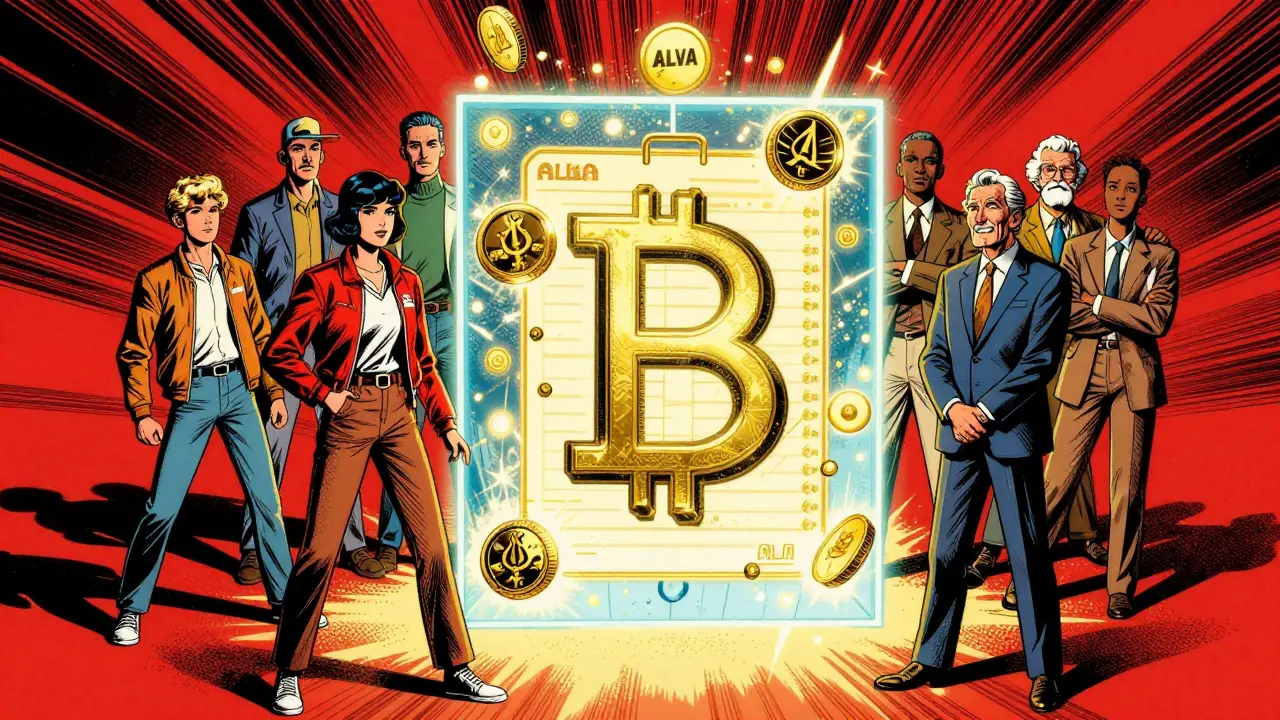
Alvara Protocol (ALVA) isn’t another meme coin or copycat blockchain project. It’s a real attempt to change how everyday people manage investments in crypto - without needing a financial advisor, a brokerage account, or even a deep understanding of markets. At its core, ALVA is the native token of a decentralized system that lets anyone create their own tokenized investment basket - like a mini ETF you can build in minutes, fully on-chain.
What Exactly Is a Tokenized Investment Basket?
Think of a basket as a pre-packaged mix of crypto assets. Maybe you believe in five coins that track DeFi growth. Or ten stablecoins with different yields. You pick them, you set rules for how they’re managed, and then you turn the whole thing into a single token called a BTS token. That token becomes tradable. Anyone can buy it, contribute to it, or withdraw from it - all without you ever touching their money.
This isn’t theoretical. Alvara Protocol launched on March 3, 2024, and built it on Ethereum using a new standard called ERC-7621, also known as the Basket Token Standard. Unlike traditional DeFi protocols that require governance votes to add new funds, Alvara lets anyone deploy a basket with zero approval needed. That’s the big difference. No gatekeepers. No committees. Just you, your strategy, and the blockchain.
How Does ALVA Fit Into This System?
The ALVA token is the glue holding the whole network together. It’s not used to buy baskets directly. Instead, it’s the governance and utility token. Fund managers use ALVA to propose changes to their baskets - like swapping out an asset or adjusting fees. Investors vote on those changes using their BTS LP tokens (the shares they own in the basket). But ALVA is needed to pay for certain administrative actions, like updating a basket’s rules or triggering a system-wide audit.
Here’s the breakdown of its supply:
- Total supply: 198.84 million ALVA
- Circulating supply: 80.18 million ALVA (as of June 2024)
- Maximum supply: 200 million ALVA
That means there’s still room for more tokens to enter circulation, mostly through rewards for early adopters and liquidity providers. As of early 2026, ALVA trades on about 21 exchanges, with daily volume fluctuating between $170,000 and $300,000. Its market cap sits around $2.4 million - tiny compared to giants like Index Coop, but growing.
Why Is This Different From Other DeFi Protocols?
Most DeFi asset managers - like Yearn Finance or Index Coop - operate with a central team or council that approves new funds. You can’t just launch your own basket. You have to convince a group of people it’s a good idea. That slows things down. It also means your strategy might never get seen if it’s too niche.
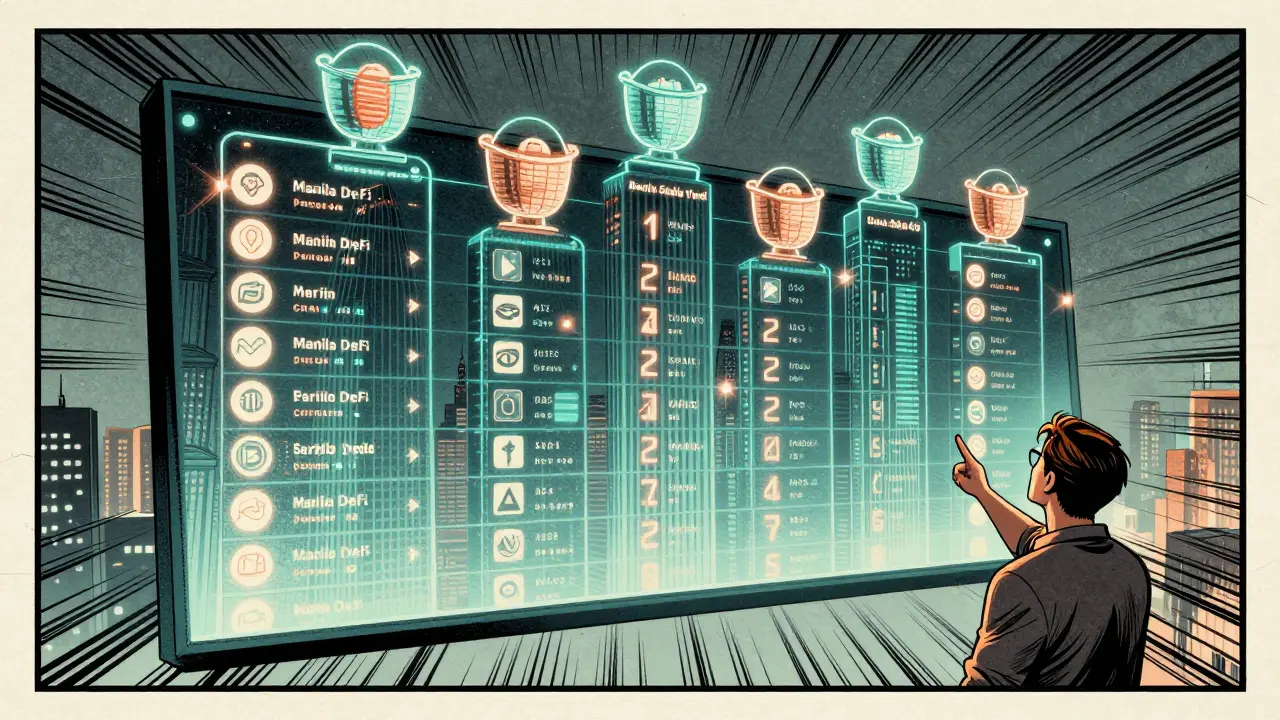
Alvara flips that. Anyone can deploy a basket. A student in Manila can create a basket of Southeast Asian DeFi tokens. A retiree in Berlin can build one with stablecoins and yield-generating assets. A trader in Wellington can make a basket of altcoins they think are undervalued. All of them get their own BTS token. All of them show up on the public leaderboard. Investors can browse, compare performance, and choose where to put their money.
This creates a kind of meritocracy. The best baskets rise to the top. The worst fade away. No one needs to vote on whether you’re allowed to try. You just do it.
Who Is This For? And Who Should Stay Away?
Alvara Protocol isn’t for beginners. If you’ve never connected a wallet, swapped tokens, or paid gas fees on Ethereum, this will feel overwhelming. You need to understand:
- How to use MetaMask or Trust Wallet
- What gas fees are and how they spike on Ethereum
- How slippage works when buying multiple assets at once
- Why some baskets have high fees and others don’t
According to user feedback on GitHub, it takes 8-12 hours of hands-on testing to feel comfortable. The documentation is solid - rated 3.8/5 by 47 users - but there are no beginner videos. You’re on your own.
It’s perfect for:
- Experienced DeFi users who want to monetize their trading ideas
- Investors tired of passive index funds and want to back real people’s strategies
- Developers who want to build tools on top of a transparent, open protocol
It’s risky for:
- People who want quick returns - ALVA’s price has swung from $2.31 to $0.11 in under a year
- Those who can’t afford to lose money - liquidity is thin, and large trades can tank prices
- Anyone expecting instant support - Discord response times average 47 minutes
Performance and Risks
As of June 2024, Alvara had 168 unique baskets live. That’s up 22% month-over-month, which suggests real adoption. But here’s the catch: only 7,660 unique wallets hold ALVA tokens. That’s a tiny community. Most of the trading volume comes from speculative bots, not long-term holders.
The biggest risk? Ethereum. Every basket creation, contribution, or withdrawal costs gas. During network congestion, fees can spike to $50 or more per transaction. That makes small investors nervous. A basket with frequent rebalancing could cost more in fees than it earns in returns.
There’s also no regulatory shield. The SEC hasn’t said whether tokenized baskets are securities. Alvara’s decentralized design might help - no company controls the protocol - but that’s untested in court.
Price predictions are all over the map:
- WalletInvestor: $0.1947 by 2030
- TradingBeast: $0.042-$0.315 by 2026
- PricePrediction.net: $0.3857 by 2025
That’s not a forecast. That’s a lottery ticket. ALVA’s price dropped 95% from its all-time high. It’s volatile. It’s risky. But it’s also one of the few protocols where the tech actually matches the promise.
What’s Next for Alvara Protocol?
The team isn’t sitting still. In May 2024, they cut gas costs by 18.7% through code optimizations. That’s a big win for users. Their roadmap includes:
- Integration with Avalanche by Q3 2024 - this could slash transaction fees by 40%
- Expanding the public leaderboard with advanced filters (performance, fees, asset types)
- Partnering with established DeFi protocols to boost liquidity
If they hit 1,000 active baskets by the end of 2024 - as Delphi Digital predicts - they’ll have crossed a critical threshold. Right now, they’re a niche experiment. But if adoption grows, this could become the foundation for a new kind of decentralized asset management industry.
How to Get Started
If you’re still interested, here’s the bare minimum you need:
- Get an Ethereum-compatible wallet (MetaMask or Trust Wallet)
- Fund it with ETH for gas fees - at least 0.1 ETH to start
- Go to alvara.xyz and connect your wallet
- Either create your own basket (if you have a strategy) or browse the leaderboard to invest in someone else’s
- Watch the performance. Track fees. Adjust as you learn.
There’s no signup. No KYC. No middleman. You’re in control. But you’re also fully responsible.
Is Alvara Protocol (ALVA) a good investment?
There’s no simple yes or no. ALVA is a high-risk, high-potential asset. Its value depends entirely on whether more people start using the protocol to create and invest in tokenized baskets. Right now, it’s small, illiquid, and volatile. If adoption grows - especially with Avalanche integration - it could rise. If not, it could fade. Only invest what you can afford to lose.
Can I create my own basket on Alvara Protocol?
Yes. Anyone with an Ethereum wallet and some ETH for gas can deploy a basket through the BTS Factory on alvara.xyz. You choose which assets to include, set management fees, and define rules for contributions and withdrawals. Once live, others can invest in it, and you earn fees from their activity.
What is the ERC-7621 token standard?
ERC-7621 is a new Ethereum token standard created specifically for Alvara Protocol. It defines how tokenized investment baskets work on-chain. Unlike standard ERC-20 tokens, ERC-7621 handles two types of tokens: BTS tokens (representing ownership of the basket) and BTS LP tokens (representing your share of the basket’s assets). This allows for dynamic ownership changes as people contribute or withdraw.
How does Alvara compare to Index Coop?
Index Coop is a curated platform - only approved baskets are listed, and changes require community votes. Alvara is permissionless - anyone can create a basket instantly. Index Coop has billions in assets and deep liquidity. Alvara has a few million and thin trading volume. Index Coop is safer and more stable. Alvara is more open and innovative - but riskier.
Why is ALVA’s price so volatile?
ALVA’s price swings because of low liquidity and speculative trading. With only 7,660 holders and daily volume under $300,000, even small trades can move the price dramatically. It’s also tied to the adoption of the underlying protocol - if basket creation slows, demand for ALVA drops. Its history shows a 95% drop from its peak, which is common for early-stage DeFi tokens with limited utility.
Is Alvara Protocol safe?
The code is open-source and audited, and the protocol runs on Ethereum, which is one of the most secure blockchains. But safety isn’t just about code - it’s about you. If you mismanage your wallet, send ETH to the wrong address, or invest in a poorly designed basket, you can lose money. There’s no customer support team to refund you. You’re fully responsible.
Can I use Alvara Protocol on mobile?
Yes, if you use a mobile wallet like Trust Wallet or MetaMask Mobile. The website (alvara.xyz) works on mobile browsers. But the interface is complex, and managing multi-asset baskets on a small screen is difficult. Most active users manage their baskets on desktop.
What happens if a basket I invested in fails?
If a basket’s performance drops or its manager stops managing it, your BTS LP tokens still represent your share of the underlying assets. You can withdraw them at any time - the protocol doesn’t lock your funds. But if the basket’s assets are worth less than when you invested, you’ll lose value. There’s no guarantee of returns.
Final Thoughts
Alvara Protocol doesn’t promise to make you rich. It promises something rarer: control. Control over your investment strategy. Control over who manages your money. Control over whether your idea gets seen or buried. That’s powerful in a world where finance is still controlled by banks, brokers, and algorithms.
It’s not perfect. It’s not easy. And it’s not for everyone. But if you’re tired of passive investing and want to be part of something new - where real people build real systems on the blockchain - then Alvara Protocol might be one of the few places worth looking.

There are 26 Comments
AJITH AERO
Bro, I just want to buy a sandwich, not become a DeFi wizard with a spreadsheet and a prayer.
Lisa Parker
Also, why does every crypto project think 'no KYC' = 'no consequences'? I miss when the internet was simpler. Like, when we just argued about memes.
Jennifer Riddalls
Yeah, the interface is clunky. Yeah, gas is wild. But imagine if this scales. Imagine if your grandma can set up a basket of yield-generating tokens and actually earn something while she naps. That’s not crypto bros. That’s real financial inclusion.
I’m not rich. I’m not a dev. But I’ve watched people in my community get their first real returns from stuff like this. It’s messy. It’s loud. But it’s theirs.
Ian Plunkett
168 baskets. 7,660 holders. $2.4M market cap. And you call this 'innovation'? This isn't DeFi. This is a graveyard of bad ideas with a fancy whitepaper.
ALVA dropped 95%. The team 'optimized' gas by 18.7%. Congrats. You just made it slightly less expensive to lose your money. 🤡
Next up: Alvara Protocol 2.0 - where you can stake your soul for LP rewards.
Nikki Howard
Furthermore, the volatility of ALVA, coupled with negligible liquidity, suggests that this protocol is currently operating in a speculative vacuum. Institutional adoption is nonexistent. Retail participation is transient. This is not a financial innovation. It is an experiment in distributed gambling.
Tarun Krishnakumar
Look at the wallet distribution. 7,660 holders? That’s 120 wallets holding 85% of the supply. The rest? Meme monkeys and confused grandmas who think 'BTS' stands for 'Big Time Savings'.
And don’t get me started on the 'Avalanche integration' - that’s just a delay tactic so they can pump again. They’re not building. They’re spinning. The whole thing is a honeypot for rug-pull artists with GitHub profiles.
jennifer jean
Like… what if I made a basket of just Indian meme coins? Or one with only African DeFi tokens? I don’t even know how to do it but the idea feels… alive?
Maybe I’ll try it. Maybe I’ll lose everything. But at least I tried. And that’s more than I did with my 401k.
Sasha Wynnters
It reflects the chaos of human ambition - the desperation to build something that isn’t owned by a boardroom, a bank, or a billionaire.
Some baskets will fail. Some will be scams. Some will be genius. That’s not a bug - it’s the point. We’ve spent decades outsourcing our financial agency to institutions that don’t care if we live or die. Here? You don’t need permission. You don’t need a degree. You just need ETH and the guts to hit deploy.
The market will sort it. The blockchain doesn’t lie. And for the first time… maybe we’re not just consumers anymore.
Rajib Hossaim
Jenn Estes
Let me guess - the whitepaper says 'empowering the masses' but the real users are all guys in their 20s with 3 wallets and 12 tabs open.
You call this financial freedom? I call it a tax on ignorance. And the worst part? You’re proud of it.
Lauren Brookes
Yeah, the price is trash. Yeah, the interface is a nightmare. But I’ve seen baskets that actually made money - like one guy in Jakarta who built a basket of local DeFi tokens and got 37% APY for three months. He didn’t have a degree. Didn’t have a VC. Just a phone and a hunch.
This isn’t for everyone. But it’s for someone. And sometimes… that’s enough.
Chris Thomas
And you think this competes with Index Coop? Index Coop has billion-dollar TVL and institutional backing. Alvara has 168 baskets and a Discord with 47 active users.
This isn’t DeFi 3.0. It’s DeFi 0.2 - the version before the beta even launched.
Alex Williams
But if you’ve swapped tokens before, paid gas without crying, and understand slippage? This is the most exciting thing in crypto right now.
I built a basket of 5 low-cap AI tokens last month. It’s up 140%. I didn’t need to convince anyone. I didn’t need a vote. I just clicked 'deploy' and now 12 people are in it.
This is what freedom looks like. No gatekeepers. No middlemen. Just code. And courage.
Nicole Stewart
ALVA is down 95%. The team hasn’t posted a real update in 6 months. The website looks like it was built in 2018.
Why are you still talking about this?
Alan Enfield
No hype. No influencers. Just people building. I’ve seen baskets from Nigeria, Poland, and Peru. People who don’t even speak English. They’re using this. Not because they think it’ll make them rich. But because it lets them try.
That’s worth something.
Kyle Tully
You spent all this time building a system that lets anyone create a basket - but you didn’t think to make a simple tutorial? Or a video? Or even a FAQ that doesn’t read like a PhD thesis?
And then you wonder why adoption is low?
This isn’t a revolution. It’s a closed-door club with a really cool name.
kieron reid
That’s not a project. That’s a graveyard.
Stop pretending this is innovation. It’s just another way to drain ETH from people who don’t know better.
Avantika Mann
This isn’t about price. It’s about agency. Even if it’s small. Even if it’s messy.
That’s worth more than any whitepaper.
yogesh negi
You don’t need permission to build. You don’t need a bank. You don’t need a license. You just need an idea and 0.1 ETH.
I’ve seen a 68-year-old woman in Kerala create a basket of gold-backed tokens. She didn’t know what 'liquidity' meant. But she knew she didn’t want her savings in a bank that charges 2% to move money.
This isn’t crypto. This is justice. And it’s happening right now - in villages, in dorm rooms, in tiny apartments.
Don’t sleep on it.
george chehwane
I call it 'permissionless chaos'.
Anyone can deploy a basket? Great. Now imagine 10,000 baskets. 5,000 of them are just 'BTC + ETH + DOGE + SHIB'.
Where’s the curation? Where’s the quality control? You don’t need a gatekeeper - you need a filter. Otherwise, you’re just drowning in noise.
This isn’t freedom. It’s a dumpster fire with a blockchain logo.
Scott McCrossan
168 baskets? More like 168 scams waiting to happen.
ALVA’s price is a joke. The team hasn’t done a Q&A in 6 months. The website is a relic. And you’re seriously calling this 'innovation'?
Wake up. This isn’t DeFi. It’s a Ponzi with a GitHub repo.
Angela Henderson
I didn’t understand half of it.
But I liked the part where a retiree in Berlin can build a basket of stablecoins. That’s the kind of thing that sticks with you.
Not the ERC standard. Not the market cap.
Just… a person. Trying. On their own terms.
Geet Kulkarni
Paul David Rillorta
ALVA is just a front for the NSA to track crypto wallets. They need a 'permissionless' system so they can say 'oh we didn’t control it' while they’re logging every single transaction.
And don’t even get me started on the 'Avalanche integration' - that’s just a cover for them to move the data to a private chain. I’ve seen the code. The contract has a hidden backdoor. I’m not crazy. I’ve read the bytecode. It’s there.
They’re building a global surveillance network… under the guise of 'financial freedom'.
andy donnachie
The interface is rough. The gas is brutal. But the transparency? Unmatched.
I’ve watched baskets rise and fall. I’ve seen people help each other. I’ve seen someone in Ireland explain slippage to a guy in Brazil. No one got paid. No one got famous.
This isn’t a coin. It’s a community. And it’s growing.
Sarah Shergold
Write a comment
Your email address will not be published. Required fields are marked *