
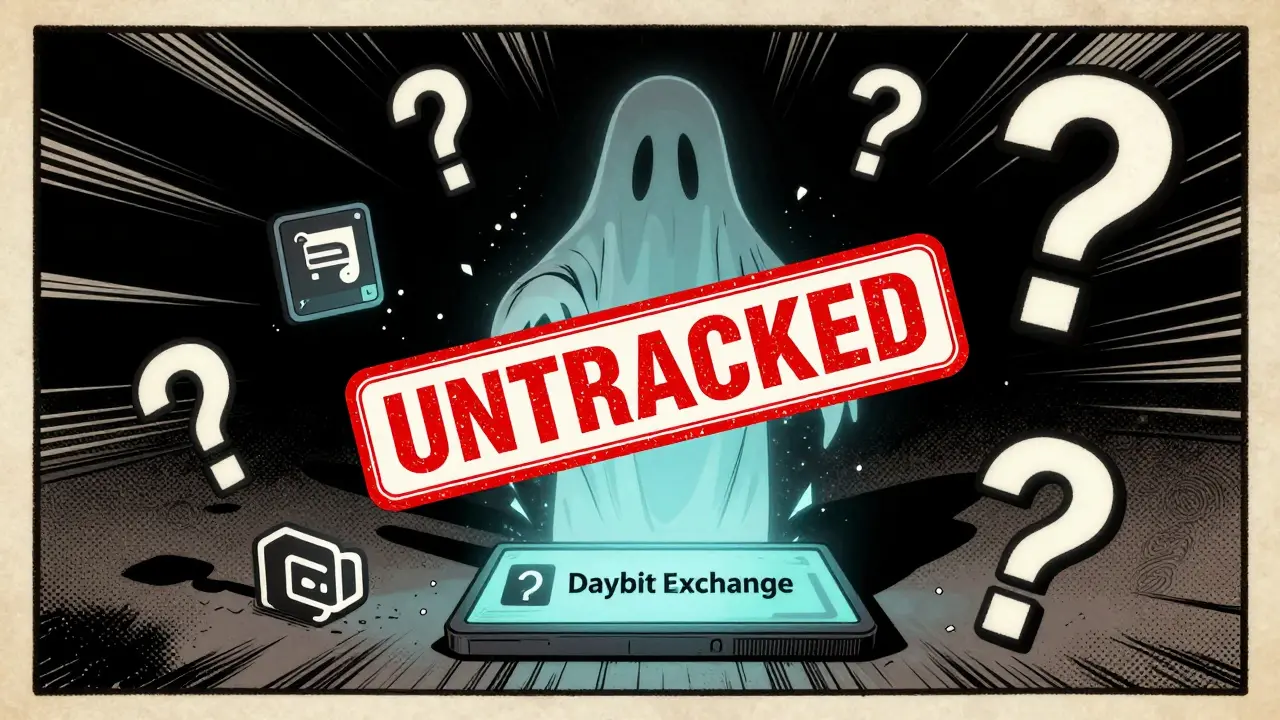
When you're looking for a crypto exchange in 2026, you want something that works - fast deposits, low fees, clear support, and real trading volume. But what do you do when you stumble across a platform like Daybit Exchange and can't find any solid answers? It’s not just quiet - it’s nearly invisible.
Daybit Exchange: A Ghost in the Crypto Market
Daybit Exchange doesn’t show up on CoinMarketCap as a tracked platform. It’s labeled as an "Untracked Listing," which means no one is monitoring its trades, no volume data exists, and no reserve balances are reported. That’s not normal. Even small exchanges like Kucoin or MEXC are tracked because they have users and activity. Daybit? Nothing. Zero. Not even a whisper. This isn’t a case of being new. Many exchanges launch quietly and grow. But Daybit has been around long enough that if it had traction, someone would’ve noticed. No Reddit threads. No Trustpilot reviews. No YouTube tutorials. No user complaints. That silence speaks louder than any marketing page.Fees Are High - And That’s the Least of Your Problems
According to Cryptowisser, Daybit’s trading fees are "a bit on the high end." That’s a polite way of saying they’re worse than most. The industry average in 2026 is around 0.10% per trade. Binance charges 0.08%. Bybit? 0.03%. Kucoin runs promotions with zero spot fees. Daybit? No public fee schedule, but user reports suggest it’s closer to 0.15% or higher. High fees matter when you’re trading regularly. But here’s the real issue: you can’t even fund your account easily.Only Korean Won? No Credit Cards. No Flexibility.
Daybit Exchange accepts only Korean Won (KRW). That’s it. No USD, no EUR, no GBP. If you don’t have access to a Korean bank account or a way to send KRW, you’re locked out. Most new crypto users rely on credit cards to buy their first Bitcoin or Ethereum. Daybit doesn’t allow credit card deposits. No PayPal. No bank wire from outside Korea. No crypto on-ramps. Compare that to exchanges like Bitpanda or Crypto.com, which let you buy crypto with a card in over 40 countries. Or even regional players like VALR in South Africa - they support ZAR, local bank transfers, and have customer service in English. Daybit offers none of that.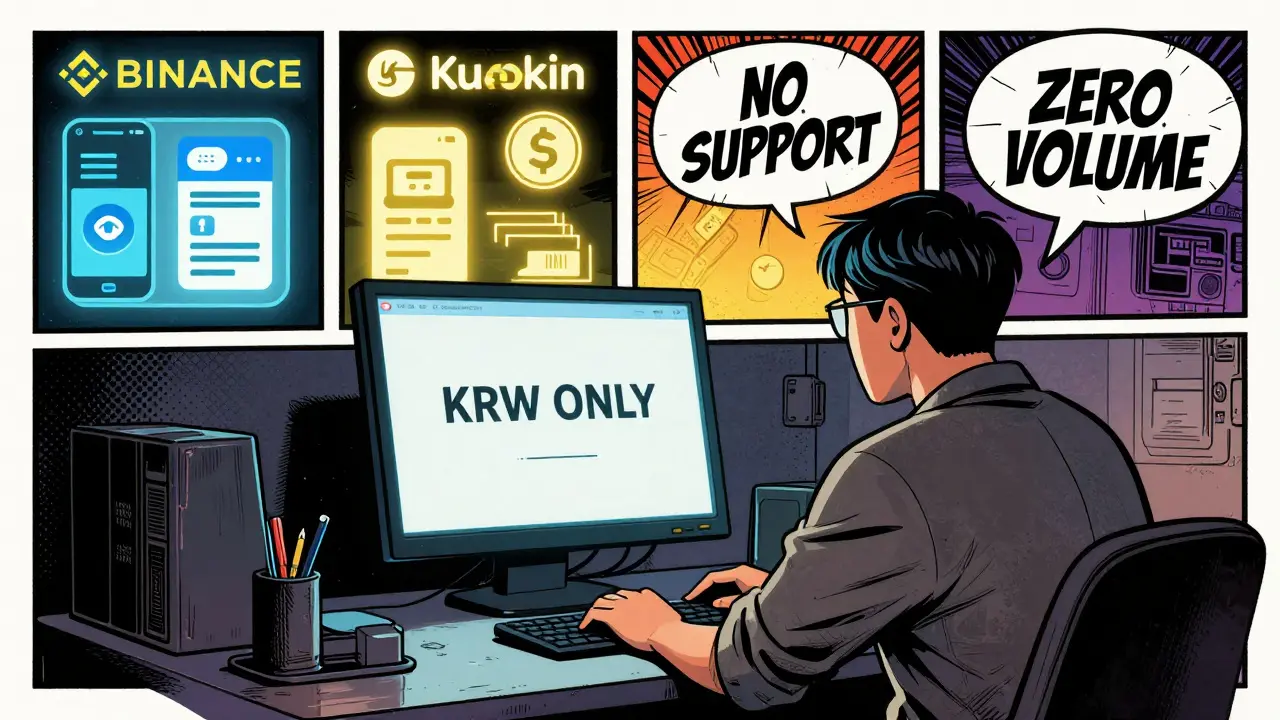
No Features. No Tools. No Future.
Top exchanges in 2026 don’t just let you buy and sell. They offer:- Futures and perpetual contracts
- Staking with 5-10% APY
- NFT marketplaces
- Copy trading
- API access for bots
- Mobile apps with push notifications
Confusion with DayBit.com
There’s another site: DayBit.com. It’s not the same thing. This site acts like a crypto review blog - it lists "trusted exchanges," promotes crypto casinos, and pushes "provably fair games" and bonuses. It’s not a trading platform. It’s a content site. Many people search for "Daybit Exchange" and end up on DayBit.com by accident. The names are too similar. This confusion makes it even harder to find real information about the actual exchange. If you’re trying to research Daybit, you’re likely hitting dead ends or misleading affiliate content.
Why No One Talks About It
Major crypto reviewers - CryptoBureau, CoinDesk, Forbes Adviser, CryptoAdventure - don’t mention Daybit. Not once. Not in 2025. Not in 2026. Meanwhile, exchanges like Bybit and Kucoin are featured in top 10 lists every month. Why? Because they have users, data, and transparency. Daybit has none of that. No volume. No support. No updates. No press releases. No roadmap. No team page. No LinkedIn. No Twitter. No GitHub. It’s not just small - it’s absent from the digital world.Who Is Daybit Even For?
The only plausible answer: Korean retail traders who can’t use global exchanges due to local restrictions. But even then, Korea has strong, regulated platforms like Upbit and Bithumb. Both have deep liquidity, English interfaces, mobile apps, and customer service. Why would someone choose a platform with higher fees, no features, and zero support over those? Unless you’re in Korea, have KRW, and have no other options - Daybit doesn’t offer a reason to exist.The Bottom Line: Avoid It
In 2026, the crypto exchange market is crowded, competitive, and transparent. You have hundreds of options with better fees, better tools, and real user support. Daybit Exchange offers none of that. It’s not just underperforming - it’s non-functional as a real trading platform. If you’re looking to trade crypto, skip Daybit. There are dozens of better alternatives that actually work.Is Daybit Exchange a scam?
There’s no proof Daybit Exchange is a scam - but there’s also no proof it’s legitimate. It doesn’t publish regulatory licenses, doesn’t disclose its company structure, and has no public leadership team. Most regulated exchanges clearly state their legal status. Daybit doesn’t. That lack of transparency is a major red flag. If it were operating legally, it would be listed on CoinMarketCap with verified volume. It isn’t.
Can I deposit USD or EUR into Daybit Exchange?
No. Daybit Exchange only accepts Korean Won (KRW). There are no options for USD, EUR, GBP, or any other fiat currency. This makes it unusable for anyone outside Korea who doesn’t already have KRW in a Korean bank account - which most people don’t.
Does Daybit Exchange have a mobile app?
There is no official mobile app for Daybit Exchange. No app exists on the Apple App Store or Google Play Store. Users report accessing the platform only through a mobile browser, which is unreliable and lacks features like push notifications or biometric login - standard on every major exchange today.
Why is Daybit not listed on CoinMarketCap as a tracked exchange?
CoinMarketCap only lists exchanges that provide verified trading volume and liquidity data. Daybit Exchange does not share this data, so it’s marked as "Untracked." This means its trading activity is either too low to measure, artificially inflated, or non-existent. Untracked exchanges are generally avoided by serious traders because there’s no way to know if prices are real or manipulated.
Are there any alternatives to Daybit Exchange for Korean users?
Yes. Upbit and Bithumb are the two largest and most trusted crypto exchanges in South Korea. Both are regulated, offer KRW deposits, have mobile apps, support hundreds of cryptocurrencies, and provide customer support in Korean and English. They also offer staking, futures trading, and NFT marketplaces - all features Daybit lacks.


There are 17 Comments
Beth Trittschuh
just... why does this exist? 🤔
like, i get that some exchanges are niche, but this feels like a ghost town built on a website template from 2017.
no volume, no app, no kyc, no nothing.
it’s not even a *bad* exchange-it’s an *absence*.
if i tried to trade here, i’d feel like i’m talking to a brick wall with a .com domain.
also, the fact that daybit.com is a crypto casino blog and not the exchange? that’s not a typo. that’s a scam vibe.
why do people even search for this? 😅
Benjamin Andrew
It is objectively indefensible to consider this platform as a viable trading venue. The absence of CoinMarketCap tracking, coupled with the total lack of regulatory disclosure, constitutes a material breach of fiduciary transparency standards in digital asset markets. Furthermore, the exclusive reliance on KRW-without any correspondent banking infrastructure for international liquidity-renders the platform functionally inert for any non-Korean participant. One must question the operational legitimacy of an entity that provides no corporate structure, no audit trail, and no public financial disclosures. This is not merely suboptimal-it is a systemic failure of market integrity.
Donna Patters
Oh honey. You didn’t just stumble upon a ghost exchange-you stumbled into a crypto graveyard.
High fees? Please. The real crime is the *audacity* of existing without any infrastructure.
Zero staking. Zero futures. Zero mobile app. Zero human on the other end of a support ticket.
This isn’t a platform. It’s a placeholder for a startup that died before launch.
And yet... people still search for it. 😭
Michelle Cochran
it’s not that daybit is bad-it’s that it’s a mirror. it reflects how broken the crypto space has become.
we used to build things that worked.
now we build websites that look like they work.
and then we wonder why no one trusts anything.
daybit isn’t a scam.
it’s a symptom.
and we’re all complicit for still clicking on it.
we keep searching for ghosts because we’re scared there’s nothing left to believe in.
maybe that’s worse than a scam.
maybe that’s the real rug pull.
Peggi shabaaz
honestly i think this is one of those weird little corners of the internet that just... exists.
like that one cafe in a town no one visits but still has a sign up.
maybe it’s for a few korean traders who just want to move krw without the noise of upbit.
or maybe it’s a ghost site from a failed project that got stuck in dns limbo.
either way, i’m not gonna judge.
if it helps someone, even a little, then who am i to say it’s worthless?
just don’t expect much. and don’t deposit more than you’d lose in a coffee machine.
Kaz Selbie
you know what’s wild? i’ve seen this site pop up in my google search results for like 3 years now.
every time i click it, i think ‘this has to be a scam’-but then i check the whois and it’s registered to some guy in seoul with a personal domain.
no company. no team. no address.
just a website that says ‘trade here’ with a 0.15% fee and no way to deposit anything.
it’s like a haunted vending machine that only accepts won.
why does this still exist?
who’s paying for the hosting?
is it a honeypot?
or is it just... someone’s weird side project?
Robbi Hess
daybit exchange? more like daybit *exits*.
why even bother? it’s like buying a car with no engine and calling it a ‘limited edition concept model.’
no app? no fees posted? no one talks about it? that’s not ‘niche’-that’s ‘dead.’
if you’re not on binance, kucoin, or upbit-you’re not trading. you’re just browsing.
Keturah Hudson
as someone who grew up in seoul, i can say this: there’s *something* here.
not much-but something.
there are still a few korean traders who avoid upbit because they don’t want to go through kyc.
they use daybit because it’s fast, no docs, no questions.
yes, fees are high.
yes, there’s no app.
but for small, anonymous krw-to-btc swaps? it works.
it’s not for you.
but it’s not meant for you.
Ace Crystal
you’re right to call this out-but don’t just say ‘avoid it.’
say ‘here’s what to use instead.’
if you’re in korea: upbit, bithumb, korbit.
if you’re outside: binance, bybit, kucoin, crypto.com.
if you want card deposits: bitpanda, coinbase, kraken.
if you want staking: coinbase, gate.io, okx.
daybit doesn’t fit anywhere.
so stop looking for it.
go build something better.
or just use one of the 500 others that actually work.
Brittany Meadows
so... daybit is a ghost?
cool.
so is my ex.
but at least my ex had a personality.
this site? it’s like a zombie with a website builder.
no one knows who owns it.
no one knows if it’s real.
but somehow... people still send money to it.
that’s not ignorance.
that’s cult energy.
and i’m scared.
🫣
krista muzer
i think people are missing the point. daybit might be weird but maybe it’s a quiet rebellion? like, all these big exchanges are so corporate now-kyc, taxes, tracking, fees, ads. daybit is just... a barebones site with krw. no ads. no notifications. no influencers. no ‘join our discord.’ maybe it’s the last real crypto? not the flashy kind. the quiet kind. the kind where you just send krw and get btc without the drama. i’m not saying it’s good. but maybe it’s honest? in its own broken way?
Tammy Chew
if you're still using daybit in 2026 you're either in korea with a korean bank account or you're a bot farm operator trying to fake volume
or you're just confused because you clicked daybit.com thinking it was the exchange
either way you're not trading
you're just feeding the void
Lindsey Elliott
lol daybit
remember when we all thought crypto was the future?
now we’re arguing over a site that doesn’t even have a mobile app
we’re living in the simulation
and daybit is the glitch
blake blackner
bro this is why i left crypto
you think you're trading
but you're just clicking on websites that look like they're from 2014
daybit? i've seen this before
it's the same site as the one that had 'buy bitcoin with amazon gift cards' in 2017
they just changed the logo
and now it's 'daybit exchange'
it's all the same
the game never changes
we just keep playing
Andrea Atzori
what fascinates me most is not daybit’s lack of features, but its persistence.
it’s been alive for years with zero marketing, zero traffic, zero press.
yet it still exists.
who is maintaining it?
why?
is it a testnet?
a honeypot?
a government experiment?
or is it just one lonely dev in seoul who refuses to shut it down?
there’s poetry in that.
and also, profound sadness.
Joe Osowski
you think this is bad? wait till you see what’s coming.
daybit is the *beginning*.
they’re not hiding-it’s the *future*.
they’re building a sovereign crypto ecosystem.
no kyc.
no fiat.
no surveillance.
just krw and anonymity.
you think it’s dead?
it’s a ghost because you’re not ready to see what’s real.
the global system is collapsing.
and daybit? it’s the first temple of the new economy.
you’ll thank me later.
Gaurav Mathur
daybit not listed on coinmarketcap because no volume
no volume because no users
no users because no trust
no trust because no info
no info because no one cares
so why care?
just use upbit
or binance
or anything else
daybit is not a choice
it is a mistake
Write a comment
Your email address will not be published. Required fields are marked *