
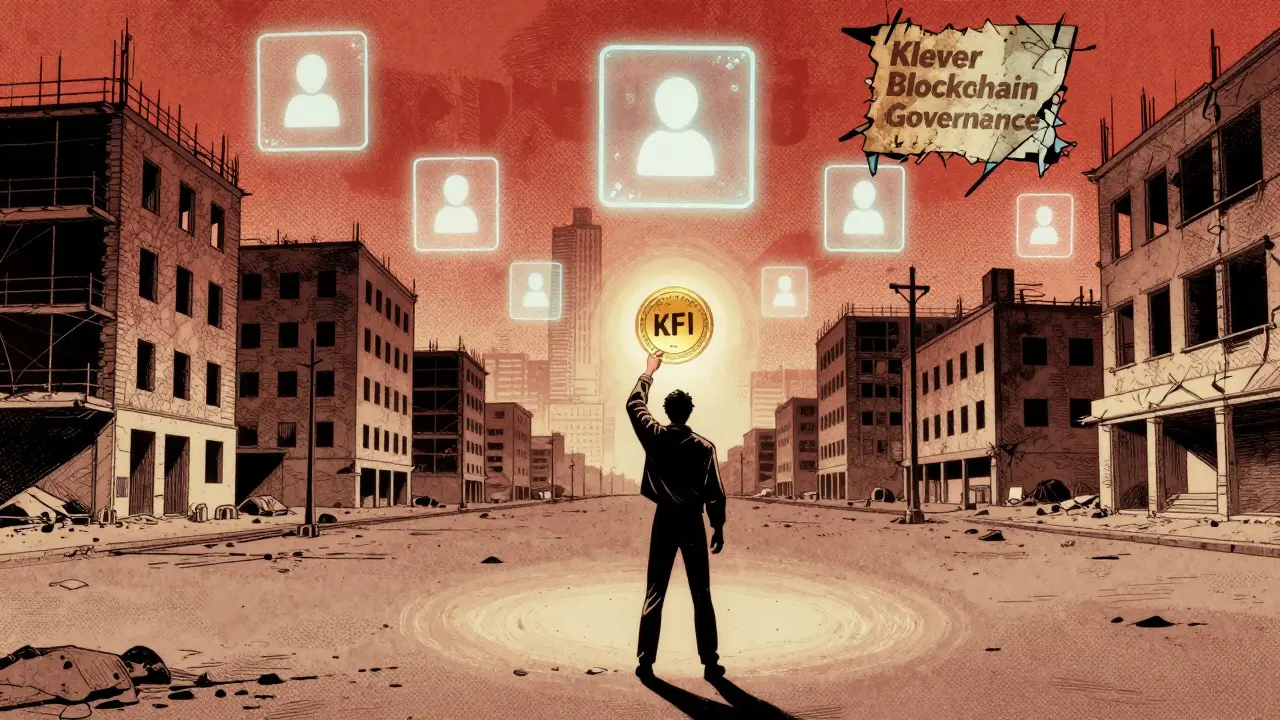
Klever Finance (KFI) isn’t a coin you trade for quick gains. It’s not even really a currency. It’s a voting card for a blockchain ecosystem that most people haven’t heard of-and even fewer can actually use. If you’re wondering what KFI is, you’re not alone. The token has almost no trading volume, barely any community discussion, and a market cap so small it doesn’t show up on most top lists. But behind the silence is a design that tries to do something unusual: let users control the entire Klever Blockchain through their holdings.
What KFI Actually Does
KFI isn’t meant to buy things. You can’t use it to pay for coffee, swap for Bitcoin, or send to a friend like you would with Bitcoin or Ethereum. Instead, KFI gives you a voice. If you hold KFI tokens, you can vote on changes to the Klever Blockchain. That includes things like:
- Changing how much fees apps on the network charge
- Approving or rejecting new decentralized apps (dApps) that get added to the platform
- Adjusting how the network’s security rules work
This is called governance. Other crypto projects like Uniswap (UNI) and MakerDAO (MKR) do the same thing. But KFI is different because it’s tied tightly to another token: KLV.
The KLV-KFI Relationship
KLV is the fuel of the Klever Blockchain. It’s what you pay to send transactions, run apps, or interact with the network. Think of it like Ethereum’s ETH-but only for Klever’s own system.
KFI, on the other hand, is the ballot. And here’s the twist: you don’t just buy KFI. You earn it by holding KLV. The system works like this:
- You hold KLV in your Klever Wallet.
- Every day, a portion of your KLV is used to mine KFI.
- That KLV gets burned-permanently removed from circulation.
- In return, you get new KFI tokens.
This creates a feedback loop. As more people mine KFI, the KLV supply shrinks. That’s supposed to make KLV scarcer and potentially more valuable over time. Meanwhile, KFI holders gain more control over the network. The idea is that users who care enough to hold KLV will naturally become invested in the system’s future.
But Here’s the Problem: No One’s Using It
Let’s be blunt. KFI doesn’t work because almost no one has it.
As of January 2026, KFI trades on just a handful of tiny exchanges. The daily trading volume hovers between $700 and $8,600. Compare that to UNI, which trades over $200 million a day. That’s a difference of 25,000 times.
Why does this matter? Because governance only works if people vote. If only 50 people hold KFI and 40 of them are from the Klever team, then “community governance” is just a slogan. Blockchain explorers show that over 70% of KFI tokens are locked in wallets controlled by the Klever foundation. That’s not decentralization. That’s centralized control with a fancy name.
Users on Reddit and Twitter say the same thing: “I tried staking KFI, but the rewards were worthless.” “I couldn’t even find a decent exchange to buy it.” “The roadmap is vague.”
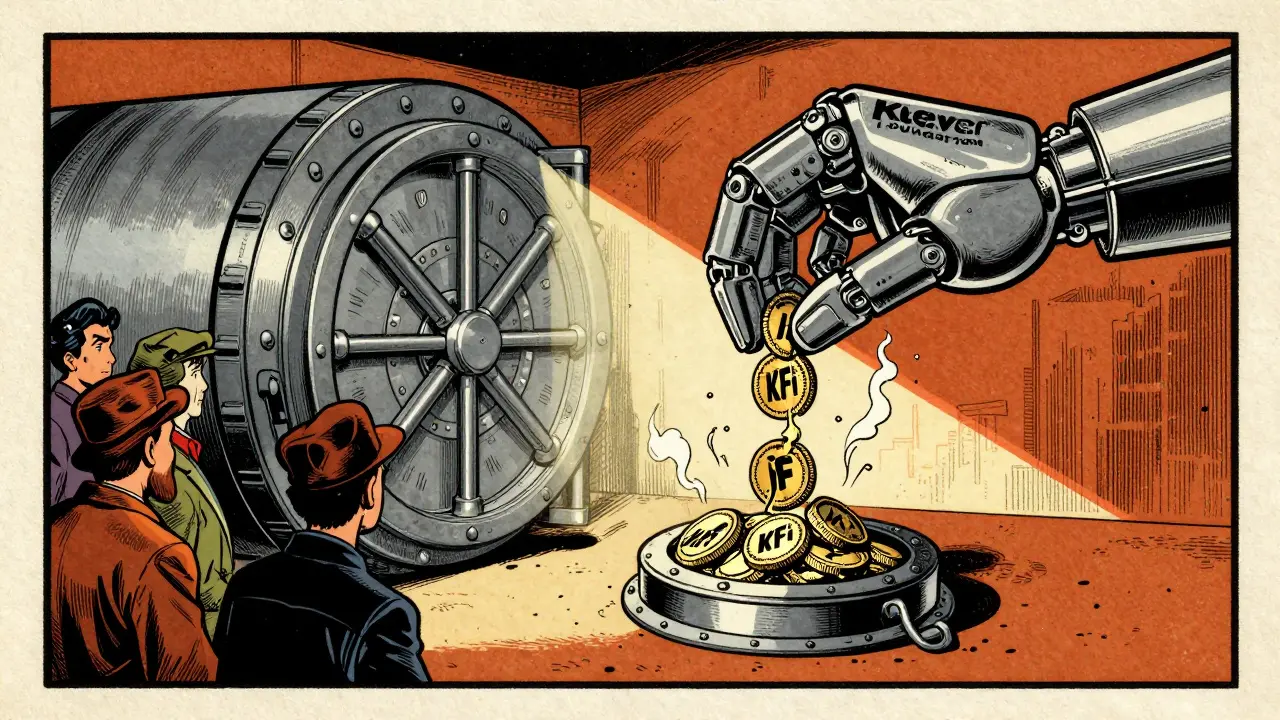
Market Numbers Don’t Lie
Here’s what the data says about KFI right now:
| Metric | Value |
|---|---|
| Price (CoinGecko) | $0.4926 |
| 24-Hour Volume | $728 - $8,600 |
| Max Supply | 1,000,000 (IQ.wiki) or 21,000,000 (CoinGecko) |
| Market Cap Rank | #4013 |
| Active Holders | ~2,300 |
| Primary Exchange | KleverSwap, MEXC, BitMart |
Notice something? The max supply numbers don’t even match. CoinGecko says 21 million. IQ.wiki says 1 million. That’s not a typo-it’s a sign of poor documentation. If the team can’t agree on basic facts, how can you trust their roadmap?
Is KFI a Security?
Legal experts are watching KFI closely. In the U.S., the Howey Test determines whether something is a security. One key part of that test: does the buyer expect profit from the efforts of others?
KFI fits that description. You’re not mining KFI to use it. You’re mining it because you expect its value to rise. And the Klever team controls the rules of the mining system, the voting thresholds, and the app approvals. That’s not a decentralized community-it’s a company running a token sale with voting rights attached.
Perkins Coie, a major blockchain law firm, flagged KFI in a 2023 report as a potential security under U.S. law. That means if the SEC ever decides to act, KFI could be pulled from U.S. exchanges overnight. And since Klever doesn’t have a clear legal strategy, there’s no backup plan.
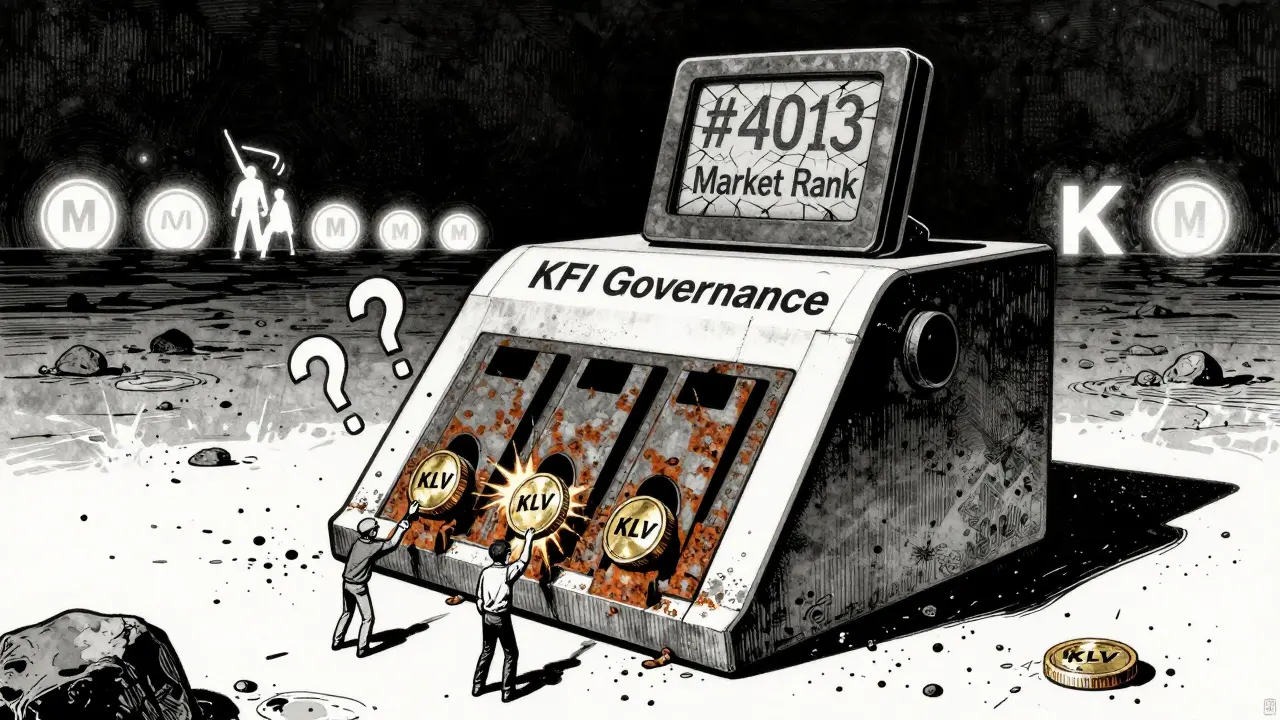
What’s Next for KFI?
Klever’s roadmap says they’re working on:
- KFI staking v2 (expected Q3 2024)
- Cross-chain governance (Q1 2025)
- Dynamic reward adjustments based on ecosystem growth
But here’s the catch: there’s no ecosystem to grow.
There are no major dApps on KleverChain. No DeFi protocols. No NFT marketplaces. No wallets besides their own. Without real users doing real things on the chain, KFI is just a digital trophy with no prize.
Analysts at Delphi Digital and Bernstein Research give KFI less than a 20% chance of surviving past 2026. Their reasoning? No liquidity. No adoption. No clear path to either.
Who Should Even Care About KFI?
If you’re a casual crypto investor? Skip it. The risk is sky-high, and the reward is theoretical.
If you’re a developer? There’s no reason to build on KleverChain. No users. No volume. No tools.
If you’re a believer in decentralized governance? Then KFI is a cautionary tale. It shows how a good idea-community control-can be ruined by poor execution. The tokenomics sound smart on paper. But without real participation, it’s just code with no purpose.
Right now, KFI doesn’t have a future. It has a hypothesis. And hypotheses need proof. So far, there’s none.
Final Thought: A Token Without a Network
KFI isn’t broken. It’s unfinished. And it might never finish.
It’s like having a voting system for a city that doesn’t exist. You can design the ballots, the rules, the elections-but if no one lives there, who’s voting? And why does it matter?
Klever Finance’s biggest problem isn’t the price. It’s not the liquidity. It’s not even the unclear supply numbers.
It’s that no one outside the team believes it’s real yet.

There are 23 Comments
Jack Petty
Crystal Underwood
Gustavo Gonzalez
christal Rodriguez
Moray Wallace
Freddy Wiryadi
Jeremy Dayde
Christopher Michael
Lori Quarles
William Hanson
Tressie Trezza
Joshua Clark
Parth Makwana
Elle M
Brianne Hurley
Calvin Tucker
Dylan Morrison
Raymond Pute
Rob Duber
Meenal Sharma
Katie Teresi
Kevin Thomas
Rico Romano
Write a comment
Your email address will not be published. Required fields are marked *