
The days of buying a digital monkey just to watch its price spike are largely behind us. In 2026, the conversation around Gaming NFTs is digital assets with real utility in video games, enabling true ownership and cross-platform transfer has shifted dramatically from speculation to sustainability. We aren't just talking about profile pictures anymore; we’re looking at a sector that generated $12.9 billion in revenue last year alone. For gamers, developers, and investors, understanding these current trends isn't optional-it’s essential for navigating what is quickly becoming one of the most dynamic corners of the internet.
From Speculation to Utility: The Core Shift
If you remember the wild rides of 2021, you know the pain points. High fees, clunky interfaces, and games that felt like cash grabs rather than fun experiences. That era is fading. The biggest trend defining the gaming NFT landscape right now is the move toward utility-driven applications. Players don’t want tokens that sit idle in a wallet; they want swords that get stronger as they use them, skins that work across multiple titles, and land that generates passive income through actual gameplay mechanics.
This shift is backed by hard data. According to DappRadar, 73% of gaming NFT transactions in recent reports are driven by actual gameplay needs rather than pure investment speculation. This is a massive departure from the art NFT space, where hold times often exceed 180 days. Gaming NFTs see average hold times of just 30 to 45 days, indicating high velocity and active engagement. The asset is being used, traded, and evolved within the ecosystem, not just hoarded.
Why does this matter? Because utility creates sustainable value. When an NFT has a function inside a game-whether it’s granting access to a rare raid, serving as a key to a virtual property, or evolving based on player stats-it retains value even when market hype cools down. This stability is attracting serious capital. Investment firms like Andreessen Horowitz (a16z) have allocated over $600 million specifically to gaming NFT startups, betting on the long-term viability of these utility models.
Infrastructure Maturation: Speed and Sustainability
You can’t build a thriving economy on a broken foundation. One of the most critical trends in 2026 is the maturation of the technical infrastructure supporting these games. Early blockchain gaming was plagued by slow transaction speeds and exorbitant gas fees on networks like Ethereum mainnet. Today, specialized Layer 2 solutions and dedicated gaming blockchains have solved many of these bottlenecks.
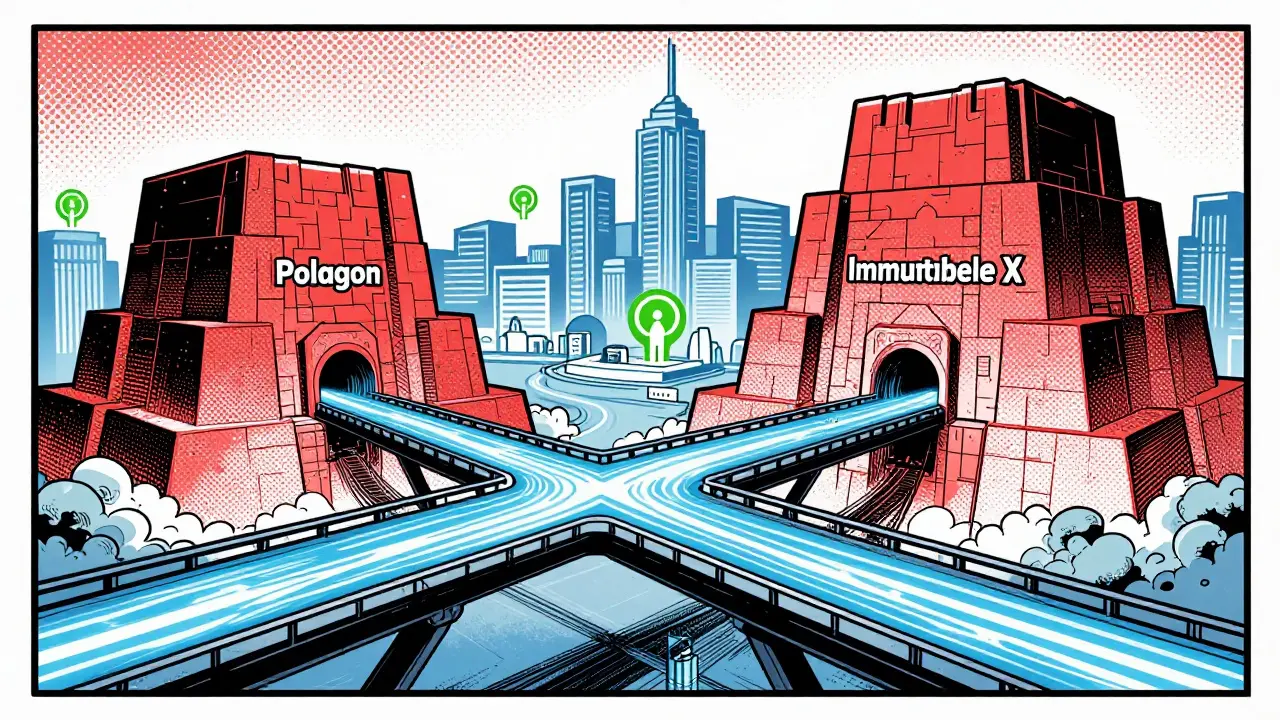
Networks like Polygon is a scaling solution for Ethereum that enables fast, low-cost transactions for dApps, Immutable X is a layer-2 marketplace protocol for NFTs that offers instant trades and zero gas fees, and Ronin is a sidechain built specifically for Axie Infinity and other gaming applications are now the backbone of major titles. These platforms allow for thousands of daily transactions without network congestion. More importantly, they rely on proof-of-stake consensus mechanisms, addressing the environmental concerns that once hindered mainstream adoption.
This infrastructure upgrade also enables complex features that were previously impossible. Smart contracts now handle automated royalty distribution, ensuring creators get paid every time their asset changes hands. They facilitate fractional ownership, allowing players to buy into high-value items collectively. Perhaps most exciting is the emergence of cross-chain functionality. Your sword earned in one game might soon be usable in another, thanks to protocols that bridge different blockchain ecosystems seamlessly.
The Rise of AI-Generated Dynamic Assets
Static images are out; dynamic, living assets are in. A fascinating trend emerging in 2026 is the integration of artificial intelligence with NFT generation. We are seeing the birth of procedurally generated in-game assets that evolve over time based on player behavior.
Imagine a companion character NFT that learns your playstyle. If you prefer stealth, its appearance might become more shadowy and agile. If you go for brute force, it grows larger and more armored. These changes are recorded on the blockchain, making each NFT truly unique and historically significant. This technology transforms NFTs from static collectibles into interactive story elements.
This convergence of AI and blockchain also helps solve content creation bottlenecks for developers. Instead of manually designing thousands of unique items, studios can use AI to generate infinite variations, each minted as a distinct NFT. This scales creativity while maintaining scarcity and verifiable ownership. It’s a win-win: players get deeper personalization, and developers reduce production costs while increasing engagement.
Mainstream Adoption and Regulatory Clarity
For years, regulatory uncertainty kept big players on the sidelines. That fog is lifting. The European Union’s Markets in Crypto-Assets (MiCA) regulation has provided clearer guidelines for NFT classification, reducing legal ambiguity for European developers. In the United States, while a federal framework is still pending, state-level approaches are stabilizing, encouraging more cautious but steady experimentation.
This clarity is inviting traditional giants to the table. Microsoft is actively exploring NFT integration for Xbox, potentially bringing blockchain features to hundreds of millions of console users. Sony has filed multiple blockchain gaming patents, signaling interest in decentralized economies within PlayStation ecosystems. Even Epic Games made headlines in late 2025 by integrating Polygon support for Fortnite and Unreal Engine, opening the door for 400+ million users to interact with blockchain assets without necessarily realizing it.
Apple’s iOS 17.5 update was another pivotal moment. By removing restrictions on NFT trading within mobile games, Apple unlocked access to 1.3 billion iPhone users globally. Mobile gaming is the largest segment of the global gaming market, and this policy change removes a massive barrier to entry. Expect to see a surge in mobile-first blockchain games designed for casual players who prioritize convenience over complex wallet management.
User Experience: Bridging the Gap
Despite technological advances, user experience remains the biggest hurdle. Surveys show that while 68% of surveyed users report positive experiences with play-to-earn mechanics, complaints about high transaction fees during peak times and complex wallet setups persist. The learning curve for traditional gamers averages 2 to 3 weeks to understand private key management and gas optimization.
To address this, developers are focusing on "invisible" blockchain integration. Wallet abstraction techniques allow players to log in with email or social accounts, with the underlying crypto operations handled in the background. Custodial wallets offered by game publishers provide a safer, simpler entry point for newcomers, though they sacrifice some degree of self-custody control. The goal is clear: make the blockchain feel like a feature, not a friction point.
Community sentiment is also shifting. While early critics argued that NFTs added unnecessary complexity, younger demographics are showing higher acceptance rates. On platforms like Reddit’s r/GameFi, discussions focus less on price pumps and more on game design quality and economic sustainability. Titles like Gods Unchained and The Sandbox continue to serve as benchmarks for how to balance fun with financial incentives.
| Platform | Primary Use Case | Transaction Speed | Gas Fees | Key Advantage |
|---|---|---|---|---|
| Ethereum | High-value assets, DeFi integration | Slow (15 sec - 1 min) | High ($5 - $50+) | Largest liquidity, security |
| Polygon | Mass-market games, mobile apps | Fast (< 2 sec) | Low (< $0.01) | Ethereum compatibility, scale |
| Immutable X | NFT marketplaces, trading | Instant | Zero | No gas fees, carbon neutral |
| Ronin | Play-to-earn ecosystems | Fast (< 1 sec) | Low (< $0.05) | Optimized for gaming UX |
Market Projections and Investment Landscape
The numbers paint a compelling picture. The global gaming NFT market, valued at $4.8 billion in 2024, is projected to grow at a compound annual growth rate (CAGR) of 24.8% through 2034. Some analysts, including Messari, project annual transaction volumes could hit $50 billion by 2027. This growth significantly outpaces the traditional gaming industry’s 8-12% annual increase.
Venture capital reflects this optimism. In 2025 alone, gaming NFT startups raised $3.2 billion, led by heavyweights like Sequoia Capital and Binance Labs. However, the market is consolidating. The top six companies-Activision Blizzard, Axie Infinity, Bandai Namco, Dapper Labs, Decentraland, and Electronic Arts-hold 15-20% combined market share. This concentration suggests that while opportunities exist, success will favor established brands or those with exceptional technological moats.
It’s important to note that this growth isn’t uniform. Virtual real estate within metaverses saw premium parcels fetch over $1 million in 2025, but standard plots remain affordable at $500 to $50,000. This tiered pricing allows both institutional investors and retail players to participate. Meanwhile, music and fashion NFTs, while growing, haven’t matched the ecosystem integration depth of gaming assets.
Challenges and Pitfalls to Avoid
Not everything is smooth sailing. Developers face significant implementation complexity. Building enterprise-level blockchain integration takes 6 to 18 months and requires $500,000 to $5 million in initial investment. Balancing game mechanics with tokenomics is notoriously difficult; poor economic design can lead to hyperinflation or death spirals, as seen in earlier play-to-earn failures.
Regulatory compliance varies wildly by jurisdiction. What’s legal in Singapore might be restricted in parts of the US or China. Developers must navigate a patchwork of laws regarding securities, gambling, and consumer protection. Additionally, security remains a concern. Smart contract vulnerabilities and phishing attacks continue to target inexperienced users. Education is paramount-players need to understand the risks of self-custody before diving in.
Finally, there’s the issue of game quality. Too many projects prioritize the blockchain aspect over actual fun. If the game isn’t enjoyable without the financial incentive, it won’t survive. The most successful titles treat blockchain as an enhancement to gameplay, not the core mechanic. As the market matures, expect stricter scrutiny on game design fundamentals.
Is the gaming NFT market saturated?
No, but it is maturing. While early speculative bubbles have burst, the current focus on utility and integration suggests room for growth. With only 4% of total gaming revenue currently coming from blockchain, there is significant untapped potential, especially as major platforms like Xbox and Epic Games integrate these technologies.
Which blockchain is best for gaming NFTs in 2026?
There is no single "best" chain, but Polygon and Immutable X are leading for mass-market adoption due to low fees and speed. Ronin remains strong for dedicated play-to-earn ecosystems. Ethereum is still preferred for high-value, secure assets but is less suitable for frequent micro-transactions due to cost.
Can I earn money playing gaming NFT titles?
Yes, but expectations should be realistic. Play-to-earn models offer supplemental income, particularly in developing countries where players have reported earning $200-$800 monthly. However, earnings depend on skill, time invested, and market demand for specific assets. It is not a guaranteed passive income stream.
What is the role of AI in gaming NFTs?
AI is enabling dynamic, procedurally generated assets that evolve based on player behavior. This creates unique, personalized NFTs that change over time, enhancing engagement and reducing manual content creation costs for developers. It bridges the gap between static digital art and interactive game elements.
Are gaming NFTs environmentally friendly?
Most modern gaming NFTs operate on proof-of-stake chains like Polygon or Immutable X, which are energy-efficient and carbon-neutral. This is a significant improvement over early proof-of-work systems. Always check the underlying blockchain of a project to verify its environmental impact.
There are 16 Comments
Albert Lee
Holy cow, this is actually exciting stuff! I mean, who knew we'd finally get to the point where my digital sword matters more than just a jpeg? The shift from speculation to utility is huge. It feels like the internet is finally growing up and treating gamers with some respect instead of just trying to drain our wallets for gas fees. I love that AI is making assets evolve based on how you play. Imagine having a companion that literally changes because you're a stealth master. That's not just gaming, that's storytelling. And the fact that big names like Microsoft and Sony are getting involved makes me feel like this isn't just a fad anymore. It’s legit. Let’s gooo!
Ankush Pokarana
the narrative here suggests a fundamental reorientation of value perception within digital ecosystems which is not merely technological but philosophical in nature as we move away from the ephemeral nature of speculative bubbles toward something that has weight and texture in the hands of the user it is interesting to consider how ownership when decoupled from physical scarcity takes on new meanings especially when those assets can change form based on interaction so perhaps the true value lies not in the static image but in the history embedded within the code itself
Bianca Vilas Boas Lourenço
Oh please 🙄 another article telling us how 'mature' the market is while ignoring the absolute circus that is still happening behind the scenes. You think I care about 'utility' when half these games crash if I blink wrong? And don't get me started on the 'invisible blockchain' nonsense. Nothing is invisible except the money disappearing from my account 😒. I'm tired of being told I'm part of the 'future' when I can't even log in without needing a degree in cryptography. Keep dreaming though, maybe next year they'll fix the bugs 🤡.
Yash Lodha
The subtle integration of surveillance capitalism into what is marketed as 'ownership' is deeply troubling to the discerning observer. One must question who truly controls the data generated by these 'evolving' AI assets. Is your playstyle being sold to advertisers under the guise of personalization? The cross-chain functionality mentioned is merely a sophisticated method for tracking user behavior across previously siloed environments. We are building a panopticon wrapped in the shiny packaging of decentralization. Be wary of the illusion of control.
Sarah C
I really appreciate how this breaks down the technical side without making it sound impossible to understand. It’s great to see that the focus is shifting towards actual gameplay rather than just financial incentives. I’ve been hesitant to try out NFT games because of the complexity, but the idea of wallet abstraction sounds promising. If I can just log in with my email, that removes a huge barrier for me. It would be nice to see more communities discussing game design quality rather than just price charts. Thanks for sharing this perspective!
Kimberly Herbstritt
Sure, utility is great and all, but let's not pretend that 'fun' isn't subjective. Just because a16z throws money at it doesn't mean the games are actually good. I've played enough 'play-to-earn' titles to know that most of them feel like chores with a crypto skin. The article mentions that game quality is a challenge, but honestly, it's the biggest hurdle. Until developers stop treating players like data points and start treating them like humans, this whole thing will remain niche. Don't buy the hype.
Sharada Vakkund
This is such a comprehensive overview! I love seeing how different platforms are finding their own niches. Polygon for mass market, Immutable X for trading, and Ronin for P2E. It’s fascinating how each chain solves specific pain points. I think the key takeaway here is inclusivity. By lowering barriers like gas fees and complex setups, we can welcome a wider range of players into the ecosystem. Let’s keep supporting projects that prioritize community and sustainability over quick profits. Who else is excited about the AI-generated assets?
Sudarshan Anbazhagan
it is imperative to recognize that the current trajectory of gaming nfts is fraught with peril for the uninitiated as the regulatory landscape remains a labyrinth of contradictions one must navigate with extreme caution the notion that utility drives value is theoretically sound yet practically volatile given the inherent instability of decentralized finance mechanisms furthermore the reliance on ai generation raises questions about intellectual property rights and the authenticity of creative output in a digital realm where provenance is paramount
John Gonzalez Bentham
typical clickbait title again. 'growth & key shifts' sounds like every other generic crypto bro post i've seen. nobody cares about $12.9 billion revenue when the average joe is still getting rug pulled by some anon dev. and dont even get me started on the 'mainstream adoption' part. microsoft exploring nft integration? yeah right. they probably just filed a patent to look busy. real gamers know that blockchain is just a distraction from bad game design. stay woke.
Ellie Riddell
Interesting read, though I find the optimism somewhat... quaint. The idea that AI will solve content creation bottlenecks ignores the fact that players crave human touch in narratives. Sure, a procedurally generated sword is neat, but does it have soul? Probably not. Also, the claim that younger demographics accept NFTs more readily is debatable. I see plenty of skepticism on Discord servers. But hey, if you want to believe that your digital monkey is an investment portfolio, more power to you. Just don't expect me to join the parade.
Destiny Kilby
i found the section on infrastructure maturation particularly insightful as it highlights the necessary evolution of underlying technologies to support sustainable growth the reduction in gas fees and transaction times is critical for user retention however one must also consider the long-term implications of centralized custodial solutions which may undermine the very principles of decentralization that attracted early adopters in the first place
Jerry CUNNINGHAM SR
It is refreshing to see a balanced discussion on both the opportunities and the challenges within the gaming NFT space. The emphasis on regulatory clarity is crucial for long-term stability. As someone who values ethical development practices, I appreciate the mention of environmental concerns and the shift towards proof-of-stake mechanisms. We must ensure that innovation does not come at the expense of security or user privacy. Let us continue to engage in constructive dialogue about how these technologies can benefit the broader gaming community.
Shelby Cantu
Love the focus on utility! Finally, we’re talking about things that actually matter in-game. The stats on hold times are super telling too. People are using these assets, not just hoarding them. This gives me hope for the future of game economies. Keep pushing for better UX though. We need seamless integration so non-crypto gamers don’t feel alienated. Great read!
Ruben Michel
A rather pedestrian analysis of a complex paradigm. While the author attempts to paint a rosy picture of 'utility,' they fail to acknowledge the profound structural flaws inherent in tokenomic models that rely on perpetual growth. The comparison to traditional gaming markets is misleading, as the liquidity dynamics are entirely different. Furthermore, the reliance on venture capital funding creates a bubble of artificial demand that will inevitably burst. Only those with a deep understanding of blockchain architecture should entertain these investments.
Gavin Wonnacott
You lot are absolutely deluded if you think this is anything but a scam designed to fleece the gullible. The 'regulatory clarity' mentioned is a joke; regulators are just waiting for the perfect moment to strike and wipe out retail investors. And don't bother defending the 'game quality' argument. I've played these titles, and they are trash. Pure garbage wrapped in buzzwords. Wake up sheeple before you lose everything.
Samara McCallum
hmm i wonder if the concept of ownership in a digital space is even possible or if it's just a construct we've agreed upon for convenience maybe the real value is in the shared experience of believing in these assets rather than the assets themselves its a bit existential isn't it like we're all just playing a game within a game and the only thing that matters is how we feel about it lol
Write a comment
Your email address will not be published. Required fields are marked *