
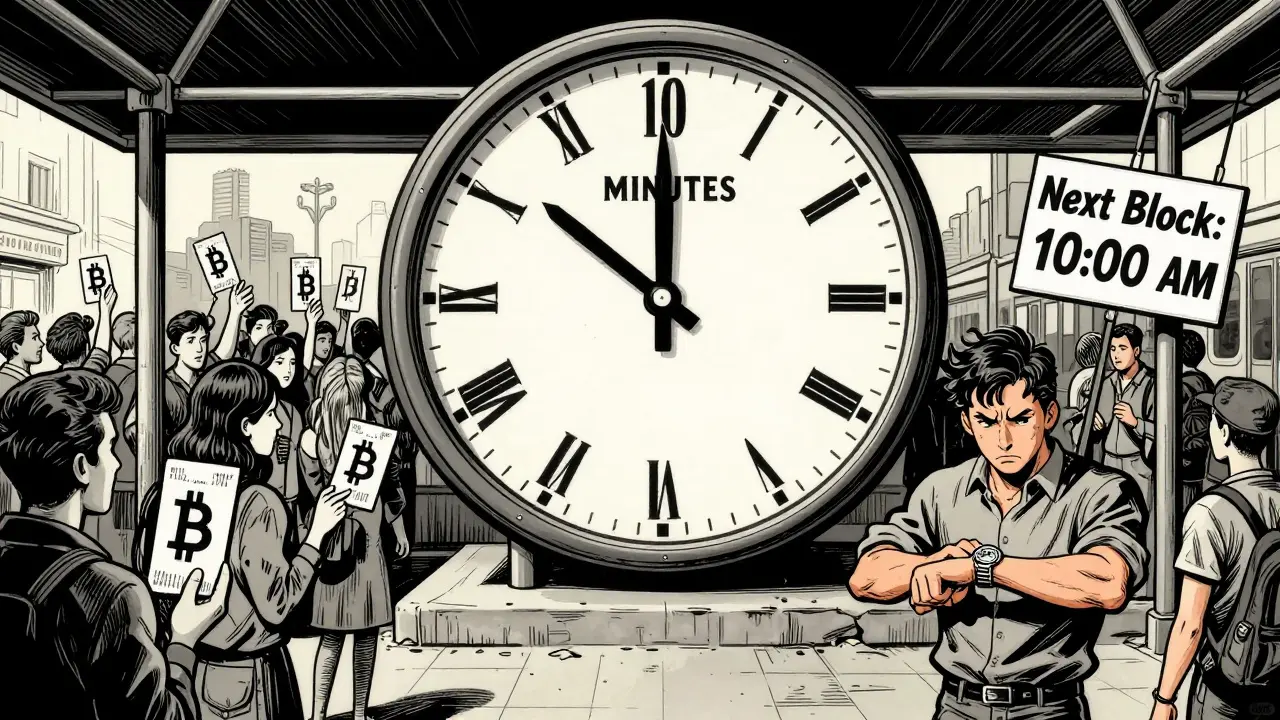
When you send Bitcoin, why does it take so long to show up? It’s not your internet. It’s not your wallet. It’s block time-the fixed waiting period between each new block added to the chain. This single number shapes everything about how fast your transaction moves, how secure it is, and even how much you pay in fees.
What Block Time Really Means
Block time is the average time it takes for miners to solve the cryptographic puzzle and add a new block to the blockchain. In Bitcoin, that number is 10 minutes. Not 8 minutes. Not 12. Exactly 10, on average. This isn’t random. It was chosen by Satoshi Nakamoto to balance two competing needs: speed and security.
Think of each block as a bus. Every 10 minutes, a new bus pulls up loaded with transactions. If you want to get on, you have to wait for the next one. If the bus is full, you might have to wait for the one after that. That’s why your transaction can take minutes-or hours-depending on network traffic.
Bitcoin’s 10-minute block time isn’t just a suggestion. It’s enforced by a built-in system called difficulty adjustment. Every 2,016 blocks (roughly every two weeks), the network checks how fast blocks were being mined. If miners were solving them too quickly, the puzzle gets harder. If it took too long, it gets easier. This keeps the 10-minute average locked in, no matter how many miners join or leave.
The Math Behind Transaction Speed
Bitcoin’s block size limit is 1 MB. Each transaction takes up about 250-500 bytes on average. That means each block can fit between 2,000 and 4,000 transactions. With a 10-minute block time, that gives Bitcoin a theoretical maximum of about 7 transactions per second.
Compare that to Visa, which handles over 1,700 transactions per second on average. Or even PayPal, which can process dozens per second. Bitcoin’s design doesn’t aim to compete with banks-it aims to outlast them. But that means if you’re trying to buy coffee with Bitcoin, you’re going to wait. And pay more.
During peak times, like when crypto prices spike or a popular NFT drops, the backlog grows. Suddenly, hundreds of transactions are waiting for the next bus. Miners prioritize transactions with higher fees. So if you only offer 5 satoshis per byte, your transaction might sit for hours. Pay 50 satoshis? It might clear in 10 minutes. Pay 200? You’re likely in the next block.
Why Not Just Make Block Time Shorter?
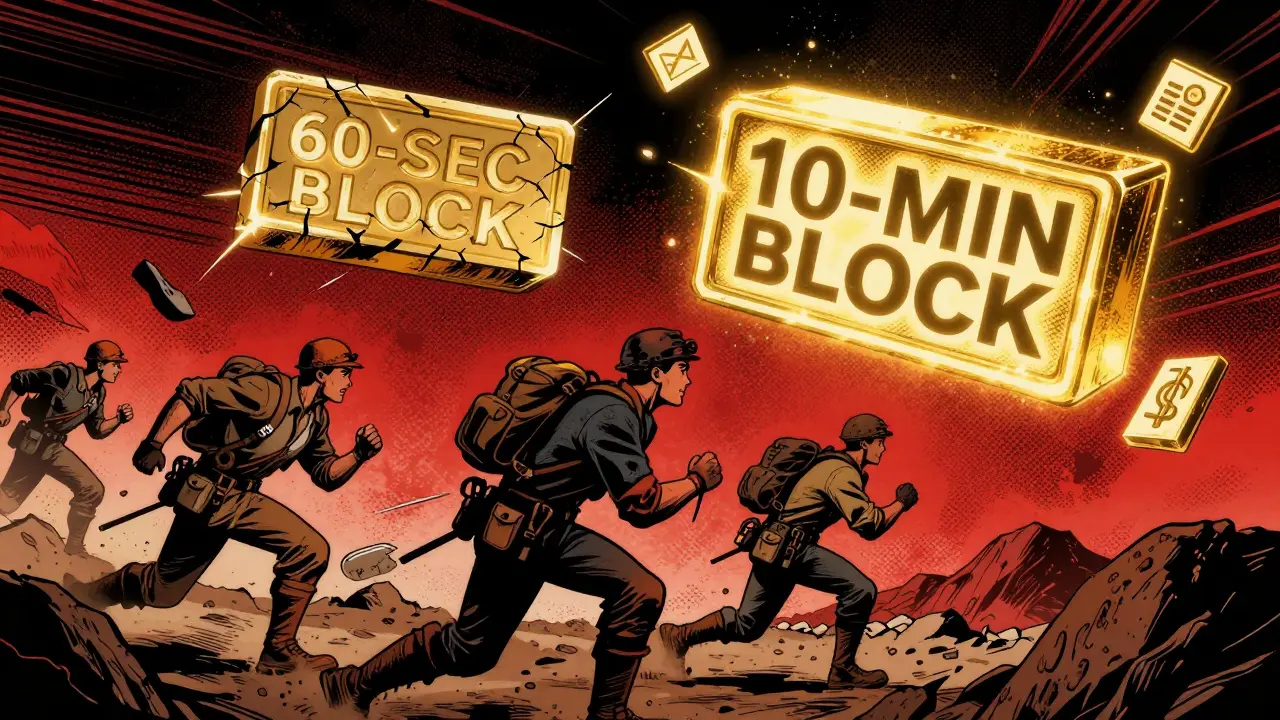
You might think: why not cut block time to 1 minute? Or 30 seconds? Faster blocks mean faster payments. More throughput. Better user experience. But here’s the catch: shorter block times create more forks.
A fork happens when two miners solve a block at almost the same time. The network has to pick one. If blocks come every 10 minutes, there’s plenty of time for the whole network to hear about the winning block before the next one is found. If blocks come every 30 seconds, you get more competing blocks. More orphaned blocks. More wasted mining work.
And orphaned blocks aren’t just inefficient-they’re dangerous. They weaken the chain’s security. If half the network is working on one block while the other half is working on another, a malicious actor has more opportunities to reverse transactions or double-spend.
Also, shorter block times require faster internet and more powerful hardware to propagate blocks. That pushes smaller miners out. Over time, mining becomes centralized around a few big players with data centers. That’s the opposite of what Bitcoin was built for.
How Other Blockchains Handle It
Not all blockchains use 10 minutes. Ethereum, for example, targets 12-14 seconds. That’s why you can send ETH and see it confirmed in under a minute. But Ethereum’s speed comes with trade-offs. It’s less resistant to long-range attacks and more vulnerable to centralization pressures.
Some newer chains, like Solana or Polygon, go even faster-under a second per block. But they rely on different consensus models, fewer validators, and centralized infrastructure. They’re fast, but they’re not Bitcoin. They’re not designed to be unhackable for decades.
This is the blockchain trilemma: you can’t have decentralization, security, and speed all at once. Bitcoin chose security and decentralization. Others chose speed. You can’t have all three.
What This Means for You
If you’re sending Bitcoin:
- For small amounts (under $100), one confirmation (10 minutes) is usually enough.
- For larger transfers, wait for six confirmations-that’s about an hour. That’s the industry standard for exchanges and wallets.
- Don’t panic if it takes 20 minutes. The network isn’t broken. It’s working as designed.
- Use fee estimators in your wallet. They’ll tell you how much to pay for confirmation in 10, 30, or 60 minutes.
If you’re building an app that uses Bitcoin:
- Never assume instant payment. Always design for delays.
- Communicate clearly: "Your payment will be confirmed in 10-60 minutes."
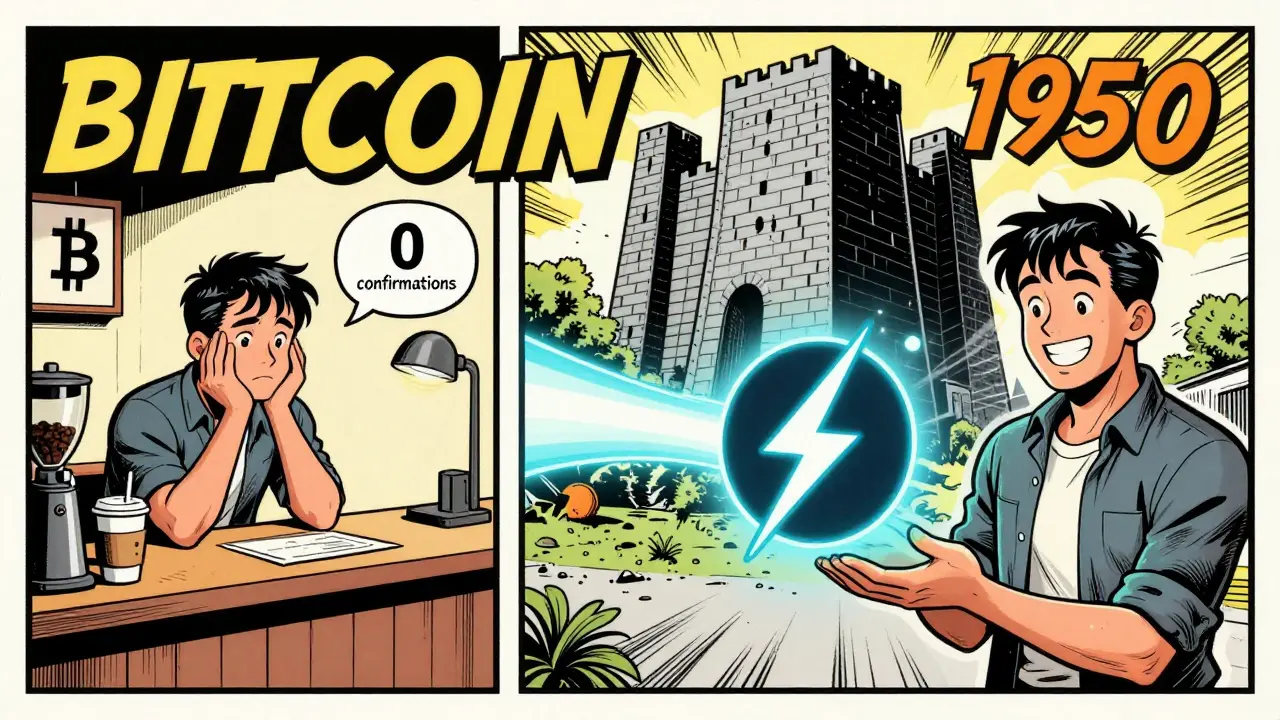
- For retail use, consider Layer 2 solutions like the Lightning Network. They move money off-chain and settle in seconds.
The Bigger Picture: Layer 2 Is the Real Answer
Bitcoin’s 10-minute block time isn’t a flaw-it’s a feature. But it’s not meant for daily spending. That’s why the Lightning Network exists. It lets you open a payment channel with someone, send dozens of transactions instantly, and only settle the final balance on Bitcoin once. It’s like using a debit card instead of writing a check every time you buy coffee.
Other Layer 2 solutions-sidechains, state channels, rollups-are doing the same thing. They take the pressure off Bitcoin’s base layer. Bitcoin becomes the secure, final settlement layer. The rest happens off-chain.
Today, over 5,000 BTC is locked in the Lightning Network. That’s not a drop in the ocean-but it’s growing. And it’s the real path to making Bitcoin usable for everyday transactions without changing the 10-minute rule.
What’s Next?
Don’t expect Bitcoin to change its block time. The community has tested this. Every proposal to shorten it has been rejected. Why? Because it works. It’s been running for 15 years without a single successful attack on its consensus. That’s unmatched in tech history.
The future isn’t faster blocks. It’s smarter layers. Faster apps. Better wallets that explain delays instead of hiding them. And users who understand: Bitcoin’s slowness is the price of its strength.



There are 15 Comments
Sahithi Reddy
Bitcoin wasn't built for your coffee run it was built to outlive empires
Manali Sovani
Konakuze Christopher
sai nikhil
George Hutchings
Steph Andrews
Prakash Patel
Zachary N
Tony Weaver
Brenda White
S F
Angelica Stovall
Taylor Holloman.
Like, yeah, it takes ten minutes. So what?
It’s still here.
While every other tech fad died in a blaze of hype, Bitcoin just… kept ticking.
Slowly.
Steadily.
Unshakably.
Maybe that’s the point.
Bryan Roth
Kira Dreamland
Write a comment
Your email address will not be published. Required fields are marked *