
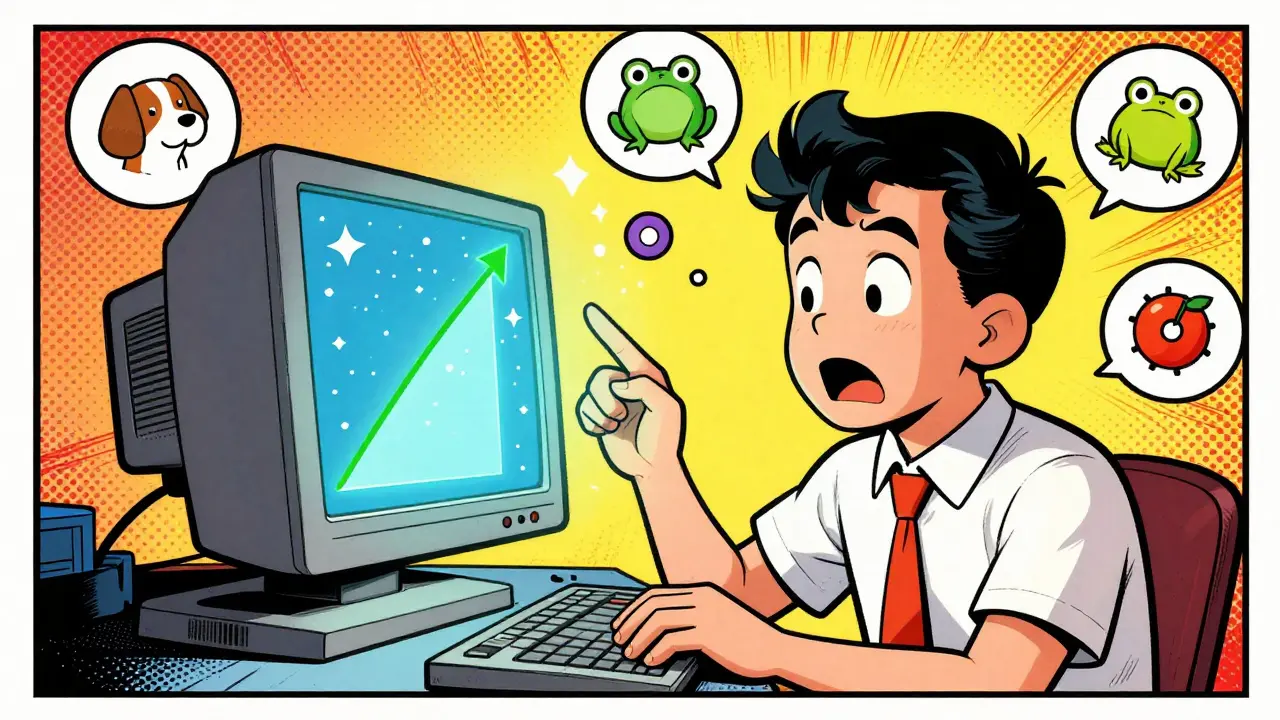
Imagine waking up to find a digital coin you bought for a few cents is suddenly worth thousands of dollars. It sounds like a dream, and for some, it was. But for every viral success story, there are thousands of people who watched their savings vanish in a single afternoon. This is the wild world of memecoin investment is the act of trading cryptocurrencies based on internet memes, social media trends, and celebrity endorsements rather than technical utility. These assets don't aim to solve global payment problems or revolutionize computing; they aim to capture a vibe.
If you're looking at coins like Dogecoin or Shiba Inu, you aren't investing in a company's earnings or a piece of real estate. You're betting on human attention. In the current market, where total memecoin valuations hit $35 billion by early 2025, the line between a legitimate community project and a total scam is thinner than ever. Here is what you actually need to know before putting your money into these digital jokes.
| Feature | Memecoins (e.g., PEPE, SHIB) | Utility Coins (e.g., ETH, SOL) |
|---|---|---|
| Primary Value Driver | Social Media Hype & Community | Technical Use Case & Ecosystem |
| Price Volatility | Extreme (often 150-200% weekly) | Moderate to High |
| Token Supply | Often inflated (quadrillions) | Fixed or managed inflation |
| Regulatory Status | Often viewed as 'Collectibles' | Varies (Securities/Commodities) |
The High-Stakes Rewards: How People Actually Make Money
The appeal of memecoins is simple: accessibility. Because these coins often launch with massive supplies, the price per token is incredibly low. Buying a million tokens for $10 feels a lot more exciting than buying 0.0001 of a Bitcoin. This psychological trick makes them a magnet for retail investors.
The real rewards come from "catching the wave." When a coin goes viral on X (formerly Twitter) or TikTok, the influx of new buyers creates a parabolic price spike. For example, some early investors in Pepe (PEPE) saw returns of over 600% in just a few weeks during its 2023 surge. These gains aren't based on a new software update or a partnership; they happen because a community decides the coin is "the next big thing." This is essentially social arbitrage-buying in when a trend is starting and selling when the hype reaches a fever pitch.
The Brutal Risks: Where Things Go Wrong
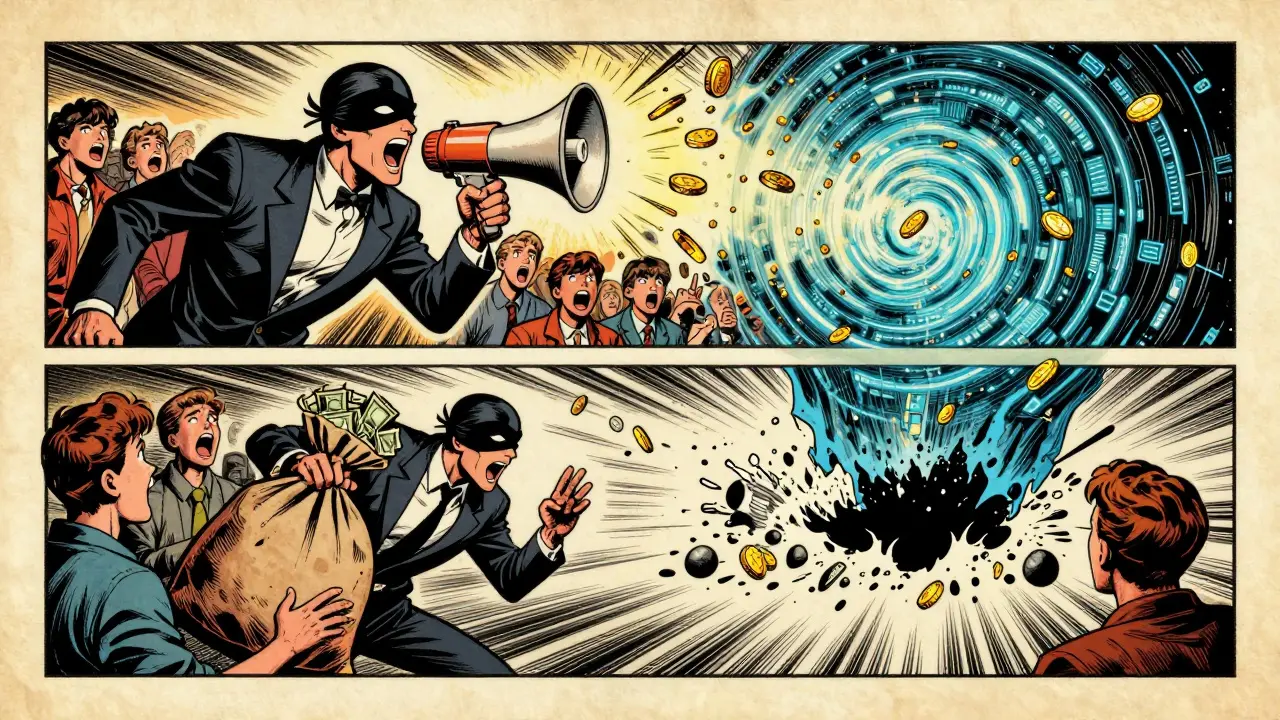
If the rewards are astronomical, the risks are catastrophic. The biggest danger is the "pump-and-dump." This happens when a group of insiders or a celebrity pushes a coin to drive the price up, only to sell their massive holdings at the top, leaving everyone else with worthless tokens. We saw this clearly with the $TRUMP token in early 2025. It hit a $27 billion market cap in 24 hours, only to crash and cause roughly $2 billion in cumulative losses by February.
Then there are the "rug pulls," where developers vanish with all the liquidity in the project. In 2024, CryptoScamDB noted that nearly 67% of all cryptocurrency scams were memecoin-related. Because most of these tokens are launched on existing networks like Ethereum or Solana using standard token templates, anyone can create a coin in ten minutes. There is no vetting process, no business plan, and often no actual developer behind the scenes.
Understanding the Regulatory Landscape
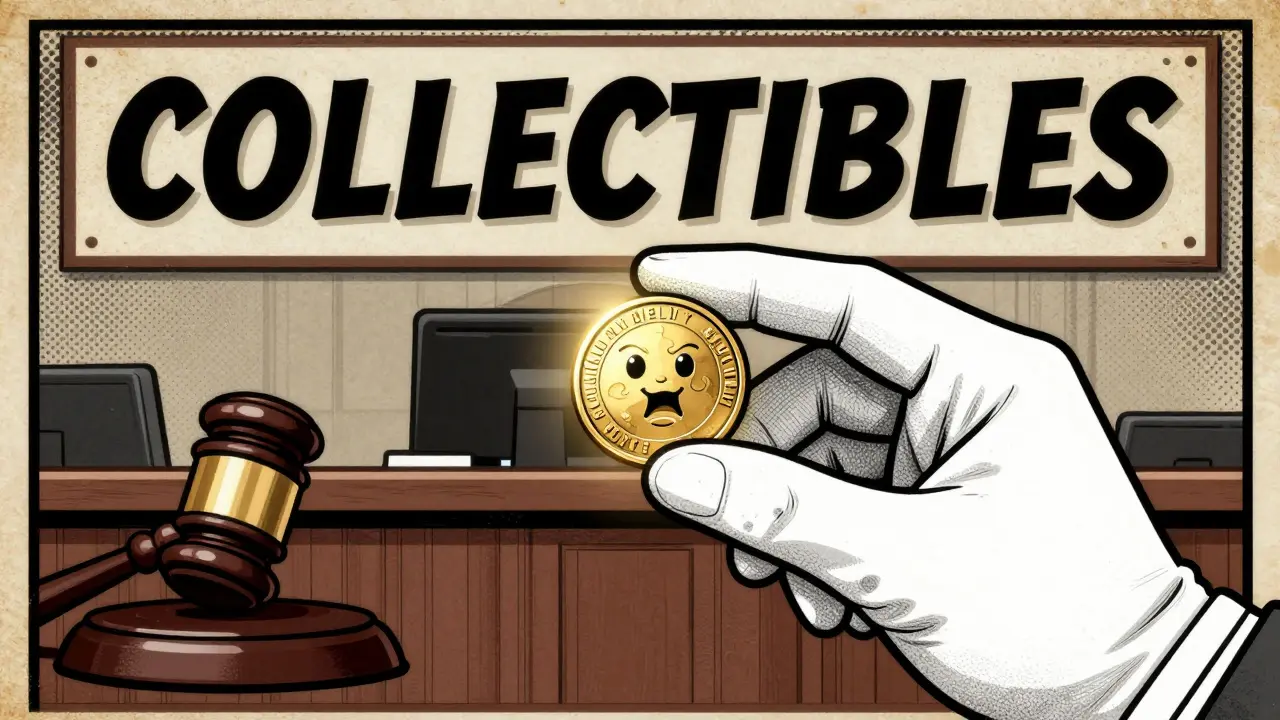
For a long time, it was unclear if memecoins were securities (like stocks) or commodities (like gold). In February 2025, the SEC provided some clarity. They essentially labeled most memecoins as "collectibles." Why? Because they don't provide a yield, they don't grant rights to business profits, and they usually have zero actual functionality.
While this might sound like a technicality, it's a huge warning sign for investors. If a coin is a "collectible," it means you have almost no legal protection if the project fails. You aren't an investor in a company; you're a collector of a digital image that people happened to agree had value for a week. This lack of fundamental value is why firms like Charles Schwab compare the memecoin craze to the Beanie Babies bubble of the 90s-once the trend dies, the value disappears.
Practical Survival Tips for Speculative Trading
If you still want to try your luck, you need to treat this like a trip to the casino, not a retirement plan. Most professional traders suggest a "moon bag" strategy: only invest an amount of money you are 100% comfortable losing. If that money disappeared tomorrow, your life should not change.
- Check the Liquidity: If a coin has a high market cap but very low liquidity, you might see a huge price on your screen but be unable to actually sell your tokens.
- Avoid "Celebrity" Coins: Tokens launched by influencers or politicians often have high insider ownership, making them prime targets for pump-and-dumps.
- Use Cold Storage: Don't leave your speculative assets on a small, unknown exchange. Use a secure wallet to avoid losing funds during a platform collapse.
- Verify the Community: A project with 100,000 bots on X is not the same as a project with 1,000 active, critical developers and users.
Can Memecoins Ever Become "Real" Assets?
There is a small segment of the market trying to move beyond the joke. Dogecoin is the prime example, as it has managed to build a level of merchant acceptance where some businesses actually accept it for goods and services. This creates a tiny sliver of "utility"-the coin is actually used for something.
However, this utility is often dwarfed by the speculative price swings. Even with some merchant use, the price is still driven by tweets and memes. For a memecoin to transition into a long-term asset, it would need to integrate into a broader ecosystem-like becoming a governance token for a decentralized app or providing a real service. Without this, they remain high-risk gambling vehicles that thrive on the fear of missing out (FOMO).
Are memecoins a safe long-term investment?
Generally, no. Because they lack fundamental utility or cash flows, their value depends entirely on social sentiment. Most financial analysts, including those from Charles Schwab, view them as highly speculative and susceptible to rapid value erosion.
What is a 'rug pull' in the context of memecoins?
A rug pull occurs when developers create a new token, pump up the price through marketing, and then suddenly withdraw all the liquidity (the funds backing the token), making it impossible for other investors to sell their coins. This results in the token value dropping to zero almost instantly.
Why do memecoins have such huge token supplies?
Inflated supplies (like the quadrillions of Shiba Inu tokens) are designed to keep the price per token very low. This makes the asset feel more affordable and accessible to retail investors, who are more likely to buy a million units for a few dollars than a fraction of a single expensive coin.
How does the SEC view memecoins?
As of February 2025, the SEC has categorized many memecoins as 'collectibles' rather than securities. This is because they typically do not offer rights to future income or profits, meaning they lack the characteristics of traditional investment contracts.
Which blockchain is best for memecoins?
Most memecoins are launched on Ethereum (via the ERC-20 standard) or Solana due to their massive user bases and existing infrastructure. While Dogecoin has its own blockchain, newer coins prefer these networks for easier deployment and higher trading volumes.
There are 16 Comments
Felix Eduardo Velasquez
The classification as 'collectibles' is the most critical part of this entire discussion. From a systemic perspective, we are seeing the financialization of irony. When an asset has no utility, its price is simply a reflection of the collective belief in the trend's longevity. This isn't just gambling; it's a social experiment in how we assign value to nothingness in a digital age. If you can't point to a single cash flow or a productive use case, you are essentially trading shares in a mood swing.
Kara Spadone
Honestly, the desperation for quick riches is just a symptom of a spiritual void 🌌. People are trying to buy a new life with a digital picture of a dog because they've forgotten how to find value in the present moment. It's all just an illusion of progress while the soul stays stagnant. So sad to see people gamble their peace for a chance at a fake moon 🌙✨.
Emily A
It is imperative to note that the 'moon bag' strategy is only effective if one possesses the discipline to actually sell. Most retail investors suffer from a cognitive bias where they hold onto their assets long after the peak, convinced that a further surge is inevitable. Consequently, they transform a short-term trade into a long-term loss through sheer stubbornness. One must be surgically precise with exit strategies in these markets.
Aaron Zeiler
just use a hardware wallet guys seriously dont leave it on the exchange if you dont want to get rekt
debra hoskins
Call me a fossil but this whole 'vibe' economy is just a flamboyant way of describing a Ponzi scheme. The sheer audacity of calling these collectibles is a joke. It is an absolute circus of greed where the clowns are the ones holding the bags. I find the obsession with 'community' in these projects to be a thin veil for collective delusion.
Livvy Cooper
Waste of time. Just another way to lose money fast.
Wayne Gillis
LITERALLY ME LAST YEAR!!! 🚀🚀🚀 I bought some random frog coin and it went 10x in two days!! Then I forgot my password to the wallet and now it's gone lol 😂 But seriously, just gamble the money you'd spend on coffee and hope for the best! 💎🙌
Pramendra Singh
It's quite interesting to see how these communities form. While the risks are high, the energy and excitement people bring to these projects can be quite inspiring in a strange way. Perhaps there's a lesson in how to build a loyal following, even if the asset itself is volatile.
its me
It is truly a tragedy of the modern era that we have replaced tangible labor with the pursuit of digital ghosts. We are essentially worshiping the algorithm now. The fact that people think they are 'investing' while ignoring the lack of fundamental value is a testament to the decline of critical thinking in our society.
Amanda Macy
Value is a subjective construct. If a million people agree that a meme has value, then for all practical purposes, it does. The danger isn't the lack of utility, but the assumption that the agreement will last forever.
Veronica Bago
I just watch the chaos from the sidelines and eat popcorn. It's kind of a wild ride to see which coin is the 'flavor of the week' lol.
Gabby Puche
Keep your heads up everyone! 🌟 Just remember to do your own research and stay safe out there. You can totally handle this if you just stick to the plan and don't let FOMO win! 💪💖
Lynne Teperman
digital gold rush but with more memes and less gold honestly just a wild ride for the bold
Rushell Perry
check the liquidity pool before you jump in guys and always use a burner wallet for the new stuff so your main funds stay safe
Rachel S
It is absolutely harrowing to witness the financial ruin of so many individuals!
The sheer volatility of these assets is nothing short of a nightmare! 😱 One moment you are a millionaire, and the next you are staring at a screen of zeros! It is a digital masquerade of the highest order! 🎭
AP Fisher
I wonder if there will ever be a way to make these things actually useful for everyone without the gambling part. Maybe some day the tech will catch up to the memes.
Write a comment
Your email address will not be published. Required fields are marked *