
Bytecoin is the first cryptocurrency built for complete privacy. Launched in July 2012, it wasn’t just another Bitcoin clone-it was designed from the ground up to hide who sent money, who received it, and how much was transferred. While Bitcoin transactions are public and traceable on a global ledger, Bytecoin makes those details invisible. It doesn’t just obscure data-it makes it mathematically impossible to link transactions to real identities. This isn’t marketing hype. It’s built into the code using something called the CryptoNote protocol, which no other coin had before Bytecoin.
How Bytecoin Makes Transactions Untraceable
Most cryptocurrencies reveal sender and receiver addresses, transaction amounts, and timestamps. Bytecoin changes that with three core features: ring signatures, one-time addresses, and hidden amounts.
Ring signatures mix your transaction with others, making it look like any one of several users could have sent it. If you send 10 BCN, the network shows that one of five people sent 10 BCN-but it can’t tell which one. That’s ring signatures in action.
One-time addresses mean every transaction uses a brand-new, unique address generated just for that payment. Your real wallet address never shows up on the blockchain. Even if someone watches your activity for months, they can’t connect your past transactions to your current ones.
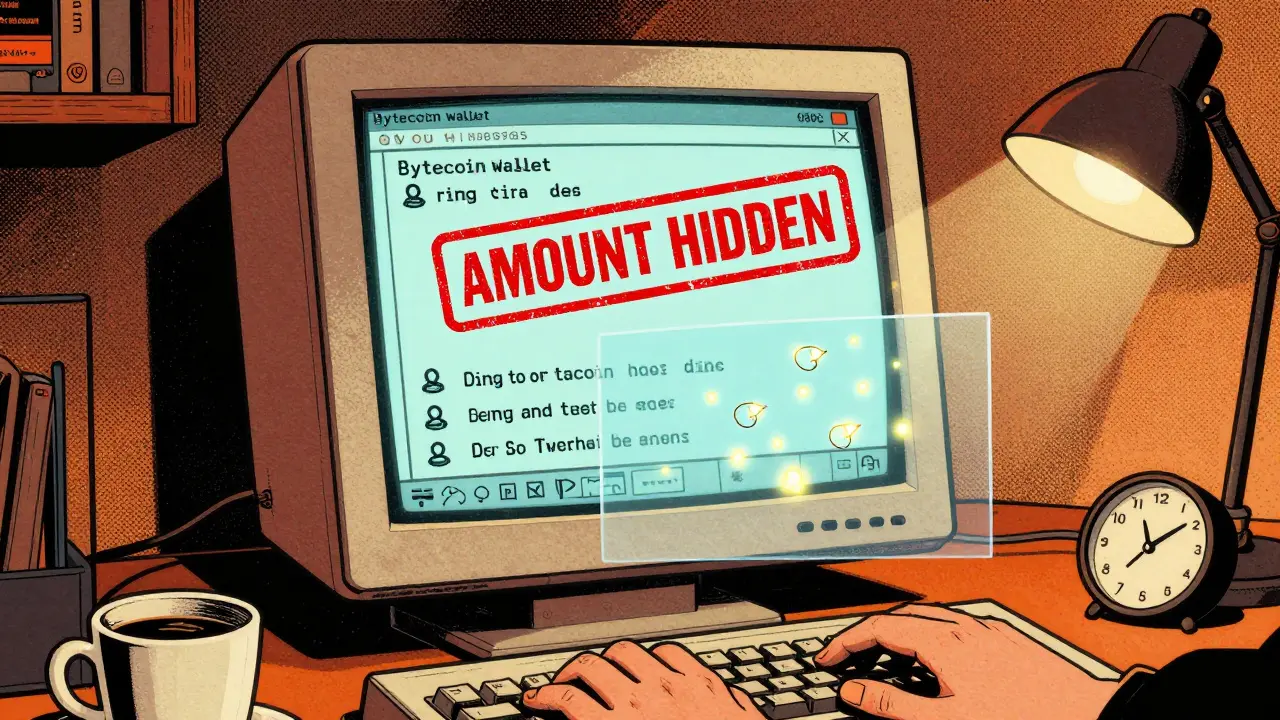
And unlike Bitcoin, where amounts are always visible, Bytecoin hides the transaction value. No one sees how much you sent-just that a transfer happened. Together, these features create what Bytecoin calls "absolute anonymity." It’s not perfect, but it was revolutionary in 2012 and still works today.
Technical Design: Built for Regular People to Mine
Bytecoin was designed to be mined on regular computers, not expensive mining rigs. It uses the CryptoNight algorithm, which was created specifically to resist ASIC and GPU dominance. That means if you have a modern laptop or desktop with an Intel or AMD processor, you can still mine Bytecoin profitably-especially if you have free electricity.
Each block is mined every two minutes, and the difficulty adjusts automatically after every block. This keeps mining stable even if the network’s total power changes. The block reward decreases slowly over time, following a mathematical formula: BaseReward = (MSupply - A) / 2^18. MSupply is the maximum possible coins (2^64 - 1 atomic units), and A is the total already mined. This smooth emission curve avoids the sudden halvings seen in Bitcoin, making supply predictable without sharp drops.
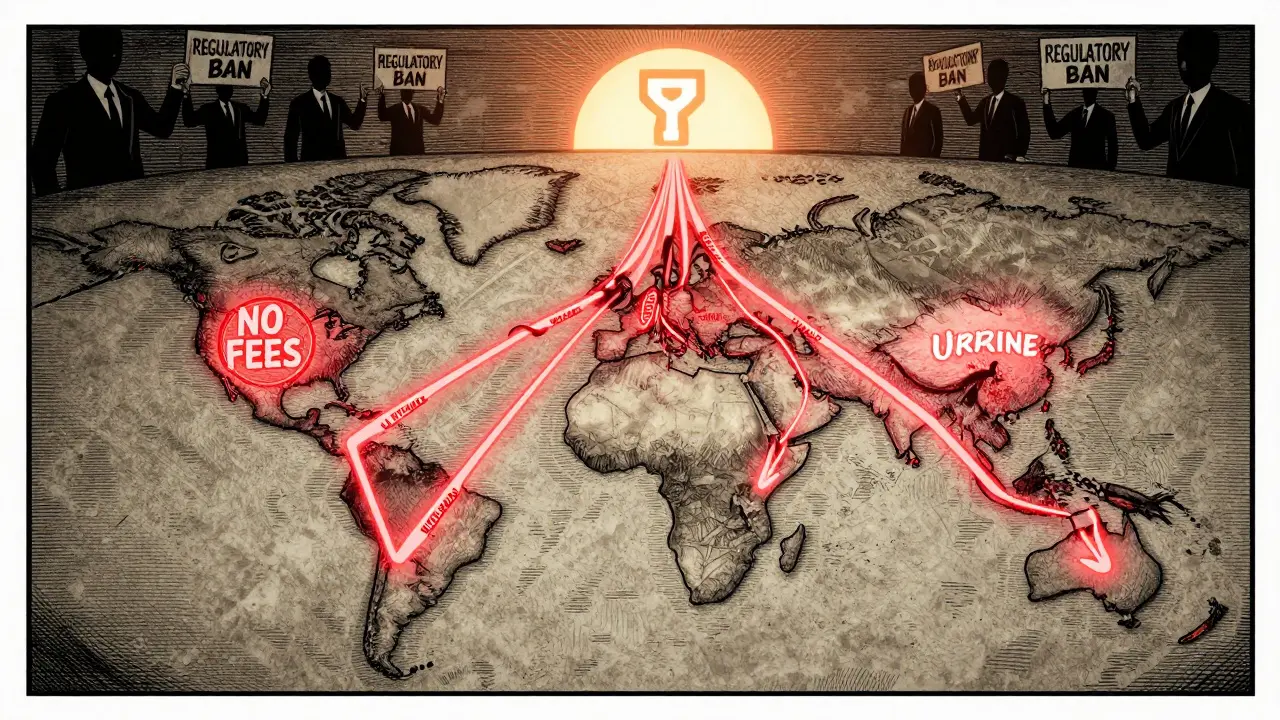
There are no transaction fees on Bytecoin. Sending money costs nothing, and confirmations take about 2-5 minutes. That’s faster than Bitcoin’s average 10 minutes and cheaper than most altcoins that charge fees to prioritize transactions.
Supply and Circulation: Over 184 Billion Coins
Bytecoin has a total supply of 184.47 billion BCN. That’s nearly 9,000 times more than Bitcoin’s 21 million cap. But unlike Bitcoin’s fixed supply, Bytecoin’s coins are released gradually over time. The emission slows down continuously, so the network will keep producing new coins for decades-just at a diminishing rate.
As of 2023, around 184.07 to 184.47 billion BCN are in circulation, depending on the source. That means nearly all coins are already mined. The remaining supply is tiny and will take many years to fully release. This makes Bytecoin very different from newer coins that still have large inflation rates.
How Bytecoin Compares to Monero
Monero (XMR) is the most popular privacy coin today, but it didn’t come first. Monero was forked from Bytecoin in 2014. Many of Monero’s privacy features were originally developed in Bytecoin’s codebase.
Monero improved on Bytecoin’s design. It introduced Ring Confidential Transactions (RingCT) in 2017, which hides amounts more securely and allows for larger ring sizes. It also switched mining algorithms multiple times to stay ASIC-resistant. Today, Monero has over 250 trading pairs, while Bytecoin has only about 15.
Market-wise, Monero’s value is over $2 billion. Bytecoin’s market cap hovers around $28 million. That’s a huge gap. But Bytecoin still holds an advantage in one area: CPU mining. While Monero’s latest algorithm changes made CPU mining less efficient, Bytecoin still allows everyday users to mine with standard hardware.
Privacy experts like Dr. Sarah Meiklejohn from UC San Diego have shown that older CryptoNote implementations, including early Bytecoin, can be vulnerable to statistical deanonymization under certain conditions. Bytecoin’s team acknowledged this and plans to increase ring signature sizes to 15 or more in its upcoming Protocol Upgrade 4.0, scheduled for Q2 2024.
Where You Can Use Bytecoin Today
Real-world use of Bytecoin is limited. Only about 50 merchants globally accept BCN directly. That’s a fraction of Monero’s 400+. Most people use Bytecoin for peer-to-peer transfers, especially across borders where traditional banking is slow or expensive.
Reddit users report success sending money to Nigeria, Ukraine, and Latin America with zero fees and no delays. One user described sending $500 equivalent to a family member in under 10 minutes-something that might take days through Western Union or Wise.
But the biggest problem is liquidity. If you want to turn BCN into USD, EUR, or BTC, you have very few options. Major exchanges like Binance, Kraken, and Coinbase dropped BCN between 2018 and 2021 due to regulatory pressure. Only 8 exchanges still list it, including HitBTC and Poloniex. Trustpilot reviews show 68% of users complain about difficulty converting BCN to fiat without losing value.
Wallets and Getting Started
Getting started with Bytecoin is simple. The official wallet is available for Windows, macOS, Linux, and Android. Setup takes about 90 seconds. You don’t need to download the full blockchain right away-the wallet can sync in the background while you use it.
For advanced users, the code is open-source on GitHub (github.com/bytecoin-project/bytecoin). There are over 1,200 stars and 380 forks, meaning developers are still tinkering with it. But unless you know C++, you won’t be modifying the core protocol.
Support is mixed. Official channels respond to about 78% of questions within 48 hours. But the Telegram community (3,200 members) is faster-92% of questions get answered in under 24 hours. New users often struggle with wallet sync times, especially on slower internet connections. About 42% report delays during initial setup.
Regulatory Challenges and Future Outlook
Privacy coins face growing regulatory pressure. Between 2019 and 2023, 14 major exchanges delisted Bytecoin because of AML/KYC rules. Governments see untraceable money as a risk for crime. That’s why most banks and payment processors avoid it.
Still, Bytecoin remains popular in parts of Europe, especially Germany and the Netherlands, where privacy rights are legally protected. Over 37% of Bytecoin transactions originate from EU countries.
Enterprise adoption is near zero. Only 12 businesses have integrated BCN into their systems. But Bytecoin’s code has inspired private fintech tools used by startups and decentralized platforms.
The future of Bytecoin is uncertain. Analysts at Messari rate its sustainability at 4.2 out of 10, citing low developer activity and exchange support. But the Bytecoin Foundation is pushing forward. Their 2023 roadmap includes Protocol Upgrade 4.0, a new merchant toolkit called Bytecoin Connect, and partnerships with privacy-focused fintech firms.
Will it become mainstream? Probably not. But it’s not trying to. Bytecoin’s goal has always been the same: to give people a way to send money without asking permission. In a world where every transaction is tracked, that’s still valuable.
Who Should Use Bytecoin?
Bytecoin isn’t for everyone. If you want to trade crypto daily, buy NFTs, or use DeFi apps, stick with Bitcoin or Ethereum.
But if you need to send money privately-especially across borders, without fees, and without a paper trail-Bytecoin still works. It’s slow, it’s niche, and it’s hard to cash out. But if privacy is your top priority, and you’re willing to work around the limits, it’s one of the few coins that delivers on its promise.
It’s not the best privacy coin today. But it was the first. And sometimes, being first matters.
Is Bytecoin still being mined?
Yes, Bytecoin is still being mined. New blocks are generated every 120 seconds, and the network continues to release coins slowly until it reaches its total supply of 184.47 billion BCN. Mining is still possible on regular CPUs, making it one of the few cryptocurrencies where everyday users can mine profitably without expensive hardware.
Can I buy Bytecoin on Coinbase or Binance?
No, Bytecoin is not available on Coinbase, Binance, or most major exchanges. It was delisted from these platforms between 2018 and 2021 due to regulatory concerns around privacy. You can still trade BCN on smaller exchanges like HitBTC, Poloniex, and a few others-but liquidity is low, and price slippage is common.
How is Bytecoin different from Bitcoin?
Bitcoin transactions are fully public-everyone can see who sent money and how much. Bytecoin hides all of that. It uses ring signatures, one-time addresses, and encrypted amounts to make transactions untraceable. Bitcoin has transaction fees; Bytecoin doesn’t. Bitcoin’s supply is capped at 21 million; Bytecoin’s is over 184 billion. They serve completely different purposes.
Is Bytecoin safe to use?
Technically, the protocol is secure. A 2022 audit found no critical vulnerabilities. But safety depends on how you use it. The main risks are low liquidity (hard to cash out), exchange delistings, and potential deanonymization attacks on older versions. If you use the latest wallet and avoid sketchy exchanges, it’s as safe as any privacy coin.
Why hasn’t Bytecoin become more popular?
Because it was ahead of its time and then overshadowed. Monero forked from Bytecoin and improved on its design. Monero got more developers, more exchanges, and more users. Bytecoin’s anonymous origins also raised early trust issues. Regulatory crackdowns on privacy coins further hurt its adoption. It’s still around, but it’s now a niche tool for those who need extreme privacy.
Can I mine Bytecoin on my phone?
No, you can’t mine Bytecoin profitably on a phone. While the algorithm is CPU-friendly, smartphones lack the processing power and cooling to mine efficiently. Mining on Android is possible with the official wallet, but it’s extremely slow and drains the battery. A modern laptop or desktop is the minimum for meaningful mining.

There are 21 Comments
Elvis Lam
Bytecoin was the OG privacy coin, no doubt. CryptoNote was a game-changer in 2012 - ring signatures, one-time addresses, hidden amounts. All of it. Monero just stole the blueprint and made it prettier. But let’s be real: Bytecoin’s still the only one where you can mine on a $200 laptop with free electricity. That’s not nostalgia, that’s accessibility.
Kayla Murphy
I love that Bytecoin doesn’t care about hype. It just quietly does its thing. No flashy ads, no influencers shilling it. Just people sending money across borders without asking anyone’s permission. That’s the dream, right? Not to get rich - to be free.
Abby Daguindal
Let’s not romanticize this. Bytecoin’s a ghost town. 15 trading pairs? 50 merchants? You’re telling me people are still using this like it’s 2014? The tech might’ve been ahead of its time, but the community’s stuck in it. If you’re not mining or hoarding, you’re just holding digital dust.
Patricia Amarante
My cousin sent cash to her mom in Ukraine last month using BCN. No fees, no delays. Said it was faster than Venmo. I didn’t even know it still worked. But it did. And that’s all that matters to some of us.
Timothy Slazyk
Privacy isn’t a feature - it’s a right. Bitcoin’s a public ledger. That’s not innovation, that’s surveillance with a blockchain. Bytecoin didn’t just hide transactions - it rejected the entire paradigm of financial transparency. And yeah, Monero improved it. But Bytecoin proved it could be done. That’s the real legacy. The rest is just implementation details.
When regulators push privacy coins out, they’re not protecting the system - they’re protecting control. Bytecoin’s failure to go mainstream isn’t a flaw. It’s a feature. If everyone used it, it wouldn’t be private anymore.
Madhavi Shyam
Proof-of-work with CryptoNight is obsolete. The ASIC resistance was a temporary exploit. Now it’s just legacy code. And the emission curve? Mathematically elegant but economically nonsensical. 184B coins with near-zero velocity? That’s not deflationary - it’s hyper-inflationary in utility.
Mark Cook
lol why are we still talking about this? 😂 I mined 50k BCN in 2013 and sold it for $200. Now it’s worth $0.0001. The only thing still mining it is a botnet in Moldova.
Jack Daniels
I used to mine this. Then I realized everyone else was using it to launder money. I deleted the wallet. Don’t touch it. It’s cursed.
Bradley Cassidy
man i still got my old bytecoin wallet open on my desktop from like 2015. its like a digital time capsule. i never cashed out but sometimes i just open it and stare at the balance like its a pet rock. bcn forever 🤘
Samantha West
One must consider the epistemological implications of decentralized anonymity in a post-nationalist financial landscape. The cryptographic architecture of Bytecoin represents a radical ontological rupture from the state-sanctioned monetary paradigm. To dismiss it as obsolete is to misunderstand the fundamental dialectic between liberty and control.
Its lack of adoption is not a failure - it is a testament to the systemic resistance of centralized institutions to ontological pluralism.
Craig Nikonov
Bytecoin was a CIA psyop to normalize privacy tech so they could later ban it. You think they’d let a coin that can’t be tracked live? Nah. They let it grow so they could say ‘see? This is why we need KYC.’ Now they’re pushing Monero as the ‘safe’ privacy coin. It’s all a setup.
Greg Knapp
Why do people still mine this? The wallet takes 3 hours to sync and crashes every time you look at it wrong. And the exchanges? Don’t even get me started. I lost $300 trying to cash out. It’s a graveyard.
Rebecca Kotnik
It’s important to recognize that Bytecoin’s design philosophy - prioritizing fungibility, privacy, and accessibility over market capitalization - represents a quiet rebellion against the commodification of financial technology. The fact that it persists, despite regulatory hostility, lack of liquidity, and near-total media silence, speaks to a deeper human desire: the right to economic sovereignty without institutional mediation.
While Monero has become the public face of privacy coins, Bytecoin remains the quiet architect. Its codebase, though outdated, laid the foundation for a movement that refuses to be erased. The real tragedy isn’t its market cap - it’s that no one remembers who built the first door to freedom.
Perhaps in another decade, when every transaction is monitored and every payment is taxed, people will look back and realize that Bytecoin didn’t fail - it was simply too early to be understood.
Terrance Alan
People still defending this? You’re literally supporting a coin that’s been dead for a decade. The only reason it still exists is because some basement-dwelling dev won’t shut up about it. And now you’re acting like it’s some noble cause? Wake up. It’s not privacy - it’s obsolescence with a cult.
Sally Valdez
USA invented the internet. China owns AI. And this? This is a Russian scam coin that got lucky with a name. Monero is real. Bytecoin? More like Byte-scam. And don’t even get me started on the devs - they’re all offshore and never respond to emails.
Sammy Tam
Used to mine BCN on my old i5 while watching Netflix. Didn’t make me rich, but it felt like I was part of something real. Like I was helping build a backdoor to freedom. Now I just keep the wallet open like a shrine. Not for the coins - for the memory.
Jonny Cena
If you’re new to privacy coins and curious about Bytecoin - don’t be scared. It’s not perfect. But if you need to send money without a paper trail, and you’ve got a decent CPU, give it a shot. Start small. Learn the wallet. Join the Telegram. The community’s small but real. And sometimes, that’s enough.
George Cheetham
The beauty of Bytecoin isn’t in its price or adoption - it’s in its persistence. In a world where everything is monetized, tracked, and optimized, here’s a coin that just… exists. No VC funding. No tokenomics. No roadmap to the moon. Just code. And quiet dignity.
It doesn’t need to win. It just needs to be there - a reminder that not every revolution needs a parade.
Sue Bumgarner
Bytecoin? That’s the one that got cloned by Monero, right? And now Monero’s the big kid on the block. Classic American innovation - someone else takes your idea, makes it better, and you get left behind with a bunch of worthless coins. Just like my last startup.
Chevy Guy
They say it’s still being mined but I bet 90% of the network is fake nodes run by the devs to inflate the blockchain. You think they’d let real people mine it? Nah. They’re just printing coins to dump on the next sucker.
Kelsey Stephens
My grandma sent $200 to her sister in Mexico using Bytecoin last week. Said it was easier than PayPal. No fees, no waiting. I didn’t believe her until I saw the receipt. Sometimes the quietest tech is the one that actually works.
Write a comment
Your email address will not be published. Required fields are marked *