
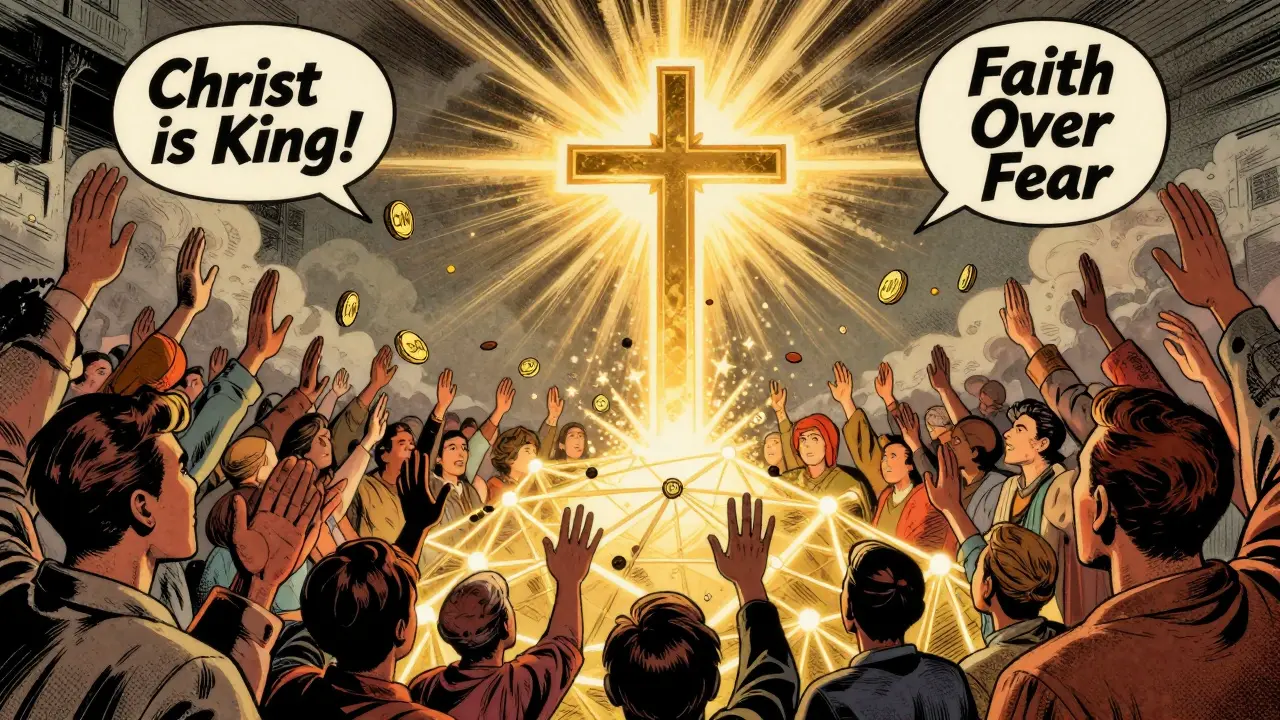
Christ is King (CIK) is a meme cryptocurrency launched in May 2025 that doesn’t just want to be another crypto joke-it wants to be a movement. Built for Christians who see faith and finance as connected, CIK markets itself as the first major crypto project designed to unite the world’s 2.4 billion Christians under a single blockchain. It’s not about Bitcoin’s scarcity or Ethereum’s smart contracts. It’s about identity. Belief. Community. And yes, it’s also about wild price swings.
CIK trades at around $0.0000008595 as of December 2025, down more than 82% from its all-time high of $0.00003951 in May. That’s not a typo. You need over a billion tokens to make a single dollar. But here’s the twist: people aren’t just buying it to flip. Many are holding because they believe in the mission. One Reddit user put it simply: "I bought CIK because of my faith, not for investment. The price drops hurt, but I believe in the mission."
Unlike Dogecoin or Shiba Inu, which have religious fans but weren’t built around faith, CIK’s entire identity is rooted in Christianity. The name, the logo, the community language-it’s all designed to resonate with believers. The project’s official slogan? "Christ is King." No ambiguity. No hidden agenda. Just a bold statement wrapped in a crypto token.
Technically, CIK runs on the Base blockchain, Coinbase’s Layer 2 network. That’s not random. Base offers low fees and fast transactions, which matters when you’re dealing with tiny token values. If CIK were on Ethereum mainnet, gas fees would eat up your entire purchase. Base makes it possible to buy, send, and hold without breaking the bank. The total supply is fixed at 777 billion tokens-all of them already in circulation. That’s a lot of zeros. And yes, that’s intentional. It mirrors the scale of the global Christian population and makes the token feel accessible-even if each unit is worth less than a penny.
One thing that sets CIK apart from most meme coins is that its team went through KYC (Know Your Customer) verification and got a Certik audit. That’s rare. Most meme coins are anonymous, launched overnight, and vanish when the hype dies. CIK’s team didn’t hide. They verified their identities. That doesn’t guarantee success, but it does signal a level of seriousness you don’t usually see in this space. It’s a signal to believers: this isn’t just a joke. Someone put effort into making this real.
As of now, CIK has over 202,000 token holders. That’s not a massive number compared to Bitcoin or Ethereum, but for a niche faith-based meme coin? It’s impressive. The community is active on Telegram with around 15,000 members and growing. There are regular AMAs with the team. People share prayer requests, Bible verses, and memes about Jesus riding a rocket. It’s a blend of worship and whimsy. But behind the fun, there’s a real question: can a meme coin built on faith survive when the market turns cold?
Why CIK is more than just a meme
Most meme coins die because they have no purpose beyond speculation. CIK tries to change that. In August 2025, the team launched a donation portal that lets token holders direct a portion of transaction fees to Christian charities. No official numbers have been released, but the idea is there: money moves, and so does mission. It’s not a DeFi protocol. It’s not a metaverse. But it’s an attempt to turn belief into action.
The roadmap also mentions plans for a faith-based NFT marketplace and a decentralized social media platform where believers can connect without censorship. So far, no code has been released. No beta. No testnet. Just promises. That’s the problem. Without real development, CIK risks becoming a digital banner-loud, proud, but empty. The market has already punished it. Its market cap has dropped from $30 million at launch to just $5.3 million. That’s a 82% decline in under six months.
Analysts at CoinCodex predict another 24.5% drop by early 2026. The Fear & Greed Index sits at neutral, but sentiment is bearish. Trading volume is only 1.5% of its market cap-meaning almost no one is actively buying or selling. That’s a red flag. High market cap with low volume means the price is held up by a few big wallets. If they sell, the price crashes.
Who’s buying CIK-and why
There are two main groups buying CIK: believers and speculators.
Believers see it as a digital expression of their faith. They’re not trying to get rich. They’re trying to belong. On Twitter, users post verses like Philippians 2:11 alongside CIK charts. On Reddit, r/CryptoChristianity has threads titled "Praying for CIK to rise" and "CIK and my daily devotional." For them, holding CIK is a spiritual act. Losing money? That’s a test of faith.
Speculators, on the other hand, see a volatile asset with low liquidity and high potential for short-term pumps. Some traders are even short-selling CIK, betting it will keep falling. RevenueBot says a $1,000 short position could net a 20% return by December 2025. That’s not investing. That’s gambling. And it’s exactly why secular critics call CIK a "pump-and-dump scheme wrapped in religious imagery."
There’s no middle ground. You’re either in it for the message or the money. But you can’t be both and expect to win long-term.
The risks are real
CIK faces three big problems:
- No utility-It doesn’t pay dividends, doesn’t power apps, and can’t be used to buy anything meaningful.
- Low liquidity-With only $81,610 traded in 24 hours, it’s easy for a single large sale to crash the price.
- Regulatory risk-Marketing a token as a "faith-based movement" could trigger securities investigations. If regulators decide CIK is an investment contract (and not just a meme), it could be shut down in the U.S. or EU.
And yet, it’s still alive. Why? Because community beats logic sometimes.
How to buy CIK
If you want to buy CIK, here’s how:
- Get a wallet that supports Base chain-MetaMask or Coinbase Wallet work.
- Add the Base network to your wallet using these settings: Network Name: Base, RPC URL: https://base-mainnet.infura.io/v3/YOUR-API-KEY, Chain ID: 8453, Symbol: ETH, Block Explorer: https://basescan.org
- Buy ETH on an exchange like Coinbase or Kraken.
- Send ETH to your wallet.
- Go to a decentralized exchange on Base, like Uniswap or SushiSwap.
- Swap ETH for CIK using the contract address:
0xB5d4...83Eb7c
Warning: Because the price is so low, you’ll need to buy billions of tokens to get even $1 worth. Most exchanges won’t show the full number-they’ll round it. Make sure you’re looking at the exact amount before confirming the trade.
Is CIK worth it?
Here’s the truth: CIK won’t make you rich. It won’t change the crypto world. It won’t replace Bitcoin.
But it might change how some people see faith in the digital age. For millions of Christians, crypto isn’t just a financial tool-it’s a cultural space. CIK gives them a token to call their own. That’s powerful.
If you’re a believer and you want to support a project that speaks your language, CIK might be worth a small investment-not as a financial play, but as a statement.
If you’re looking for returns? Look elsewhere. CIK is a high-risk, low-utility asset with no guarantee of survival. The team has done more than most meme coin creators, but the market doesn’t reward good intentions. It rewards utility, liquidity, and trust.
Right now, CIK is a mirror. It shows us how far faith can stretch in the age of blockchain. Whether that stretch lasts is still up in the air.
Is Christ is King (CIK) a scam?
CIK isn’t a scam in the traditional sense. The team did KYC and passed a Certik audit, which is rare for meme coins. But that doesn’t mean it’s safe. It has no real utility, extremely low trading volume, and massive price volatility. Many see it as a pump-and-dump scheme disguised as a faith movement. If you’re buying it for investment, you’re taking a huge risk. If you’re buying it to support a community, that’s a different choice.
Can I earn money with CIK?
You might, but it’s not likely. CIK’s price has dropped over 80% since its peak. Trading volume is too low to support consistent gains. Some traders are short-selling it, betting it will fall further. If you’re looking for steady returns, CIK isn’t the coin. It’s a speculative gamble with emotional weight, not financial stability.
Where can I buy CIK?
You can buy CIK on decentralized exchanges (DEXs) that support the Base blockchain, like Uniswap or SushiSwap. You’ll need ETH and a wallet like MetaMask or Coinbase Wallet connected to Base. The contract address is 0xB5d4...83Eb7c. Never send funds to any other address-scammers often create fake tokens with similar names.
Is CIK available on Coinbase or Binance?
No, CIK is not listed on major centralized exchanges like Coinbase or Binance. It’s only available on decentralized exchanges on the Base network. This limits access but also keeps it outside the regulatory spotlight for now. If it ever gets listed on a major exchange, expect major price movement-but also much higher scrutiny.
Why does CIK have such a low price per token?
CIK has a total supply of 777 billion tokens-all already in circulation. To make the token feel accessible to millions of people, the team set the price extremely low. This is common in meme coins (like Dogecoin). You don’t buy one token-you buy billions. The math is designed to make the number feel big, even if the value is tiny.
What’s the future of CIK?
The future depends on whether CIK can move beyond memes. The team promised a charity portal, NFT marketplace, and social platform-but none have launched yet. If they deliver real tools that serve the Christian community, CIK could become more than a token. If not, it will fade like thousands of other meme coins. Right now, it’s hanging by a thread of faith and community-not technology or demand.
There are 26 Comments
Patricia Amarante
Just bought my first batch of CIK tokens yesterday. Not because I think it’ll hit $0.01, but because I saw a guy in my church group post a Bible verse with the CIK logo and it just… felt right. Like a digital prayer.
Price doesn’t matter. Community does.
God’s got this.
Mark Cook
LOL this is the dumbest thing I’ve ever seen 😂
Next they’ll make a crypto called ‘Holy Ghost Gas’ and charge you 0.0000001 ETH to pray.
Christ is King? More like Christ is a rugpull waiting to happen.
Greg Knapp
you guys are so naive
this is just a cult with a blockchain
they’re not building anything
they’re just collecting your money under the guise of ‘faith’
remember the guy who sold ‘Jesus Coins’ in 2017? same playbook
they don’t care about your soul they care about your wallet
and you’re falling for it
pathetic
Sally Valdez
Christ is King? More like Satan is King if you’re buying this garbage
Real Christians don’t gamble with their tithes
This isn’t faith this is idolatry wrapped in a meme
And don’t give me that ‘it’s not for profit’ nonsense - if you’re holding it you’re betting on it
Wake up America
we’re becoming a nation of crypto cultists
George Cheetham
There’s something beautiful here, honestly.
For centuries, people have used symbols - crosses, hymns, stained glass - to express faith.
Now, in the digital age, a token becomes that symbol.
It’s not about the price. It’s about belonging.
Think of it like a digital rosary - not because it’s valuable, but because it reminds you of what you believe in.
Maybe the real innovation isn’t the blockchain - it’s the community that’s built around it.
That’s rare.
And worth protecting.
Florence Maail
OMG this is definitely a CIA operation 😳
They’re using crypto to control Christians
Think about it - low price, massive supply, ‘faith-based’ branding - classic mind control tactic
They want us to believe we’re choosing God but we’re really choosing their algorithm
And the ‘KYC’? That’s just to track us
They know where you live
They know your wallet
They know your prayers
It’s the New World Order
and we’re all being tagged
Shruti Sinha
The technical design is actually clever - Base chain for low fees, fixed supply matching global Christian population, audit done. Most meme coins don’t even bother.
Whether it survives is another question, but the intent is more thoughtful than most.
Sean Kerr
Y’all need to chillllll 😇
It’s just a token. If you believe in it, hold it. If you don’t, ignore it.
Don’t turn a meme coin into a moral crusade.
God doesn’t care if you buy CIK or not.
He cares if you love your neighbor.
And if you’re shaming someone for holding a coin because they think it’s meaningful… that’s the real sin.
🙏💸
Terrance Alan
Look I’ve been in crypto since 2014 and I’ve seen every gimmick imaginable
This one is different because it’s not trying to be clever
It’s trying to be sincere
And sincerity is the rarest thing in this space
People think faith-based means fake
But what if it’s the opposite?
What if this is the first time a crypto project didn’t try to exploit belief but actually honored it?
They didn’t make a DeFi protocol
They didn’t promise moonshots
They just said Christ is King
And people believed them
That’s not a scam
That’s a movement
And movements don’t die because the price drops
They die when the people stop believing
And right now
They still do
Cheyenne Cotter
Let’s be honest - the entire premise is absurd. A token with 777 billion supply, priced at 0.0000008595 USD, marketed as a spiritual identity marker? The cognitive dissonance here is staggering. You’re essentially assigning sacred meaning to a mathematical abstraction with zero intrinsic utility. The fact that people are emotionally invested in this speaks less to faith and more to the human need for belonging in an increasingly alienating digital landscape. It’s not crypto - it’s digital tribalism with a biblical filter. And the team’s KYC? A performative gesture to appease regulators while the real product - community - is entirely unregulated and emotionally volatile. This isn’t innovation. It’s a psychological experiment disguised as theology.
Sammy Tam
CIK is like a church potluck where everyone brings a different dish and somehow it all works.
Some people bring memes.
Some bring prayers.
Some bring their life savings.
And yeah, maybe half of them are gonna lose it.
But the table’s still full.
The laughter’s still there.
And for once in crypto?
It’s not about getting rich.
It’s about being together.
And that’s worth something.
Kayla Murphy
Don’t let the haters get you down.
You’re not buying a coin.
You’re joining a family.
And families stick together - even when things get hard.
Keep holding.
Keep praying.
Keep believing.
The market will turn.
But your faith? That’s forever.
Chevy Guy
Christ is King
and the market is a lie
the auditors are paid
the Telegram group is a cult
the charity portal doesn’t exist
the roadmap is a fairy tale
but hey at least you got a cool wallpaper
congrats you won the spiritual lottery
you’re the 1% who believed the hype
and now you’re the 99% who got left holding the bag
Amy Copeland
How quaint. A crypto project that thinks it can co-opt divine authority to lend legitimacy to a zero-utility token.
It’s not faith. It’s fraud dressed in scripture.
And the fact that people are emotionally attached to this is deeply disturbing.
Christianity doesn’t need a blockchain.
It needs repentance.
Not a contract address.
Abby Daguindal
Anyone who buys this is either delusional or spiritually compromised.
Real Christians don’t gamble with their faith.
They tithe. They serve. They pray.
They don’t buy tokens called ‘Christ is King’ and then check the price every 10 minutes.
This isn’t worship.
This is idolatry with a wallet.
Madhavi Shyam
CIK’s tokenomics align with the global Christian demographic - 777B supply, Base chain for scalability, low transaction cost. The audit and KYC are non-trivial differentiators in meme coin space. However, the lack of on-chain utility and zero revenue model renders it a speculative artifact. Community cohesion is the only value driver - which is both its strength and fatal flaw.
Jack Daniels
I bought CIK because I was lonely.
Not because I believed in crypto.
Because I saw a post on Reddit that said ‘praying for CIK to rise’ and I felt like someone out there understood me.
Now I check the price every morning.
And I say a prayer.
It’s not about money.
It’s about not feeling alone.
Samantha West
It is a curious phenomenon, this confluence of religious identity and speculative asset behavior. One might argue that the token functions as a semiotic anchor - a material manifestation of abstract belief systems in an increasingly disembodied digital economy. The psychological projection of spiritual meaning onto a non-functional cryptographic entity reveals a deeper cultural anxiety: the erosion of institutional religious authority and the subsequent search for new forms of communal belonging. The team’s decision to undergo KYC, while ostensibly a gesture of legitimacy, may paradoxically serve to reinforce the very skepticism it seeks to dispel - for in the domain of faith, verification is not the province of auditors, but of grace.
Craig Nikonov
They’re not selling a coin.
They’re selling a feeling.
And the feeling is ‘you’re not crazy for believing in something no one else understands’.
That’s why it’s still alive.
That’s why people are still buying.
That’s why the price keeps dipping but the community grows.
They don’t care if it’s worth anything.
They care if it means something.
And that’s scarier than any rugpull.
Donna Goines
What if CIK is the endgame?
What if the entire crypto experiment was just leading to this?
A token that doesn’t need to work.
That doesn’t need to be useful.
That just needs to be believed in.
Because maybe the real revolution wasn’t blockchain.
It was the fact that people would rather believe in a lie than face the truth.
That’s the real scam.
Not CIK.
Us.
Heather Turnbow
Regardless of the financial risk, I find the emotional resonance of this project deeply moving. For many, traditional institutions have failed to provide community or meaning. In their absence, digital spaces have become sanctuaries. To dismiss this as mere speculation is to ignore the human need for belonging. The fact that individuals are choosing to hold a token not for profit, but as an expression of identity - even amid losses - speaks to the enduring power of shared belief. One may question its longevity, but not its humanity.
Jesse Messiah
hey everyone just wanted to say i love seeing all you folks here
you’re not alone
even if the price drops tomorrow
you’re still part of something real
and that’s worth more than any coin
keep shining
god’s got your back
and so do we 💙🙌
Rebecca Kotnik
The emergence of faith-based tokens represents a profound cultural shift in the relationship between religion, technology, and economic behavior. Historically, religious communities have created shared value systems through ritual, doctrine, and institutional structures. CIK, in contrast, creates value through algorithmic consensus and digital symbolism. The absence of utility is not a flaw - it is the feature. It is a performative act of collective affirmation, where the token functions as a sacrament rather than a security. The low liquidity and volatility are not indicators of failure, but of authenticity: the market cannot quantify spiritual commitment. What is being tested here is not the blockchain - but the resilience of belief in an age of algorithmic skepticism.
Jonny Cena
you guys are overthinking this
it’s just a meme
but a meme that means something
so hold it
pray for it
laugh at the haters
and don’t let the price define your faith
you’re doing better than most
keep going
you’ve got this ❤️
Sue Bumgarner
America is falling apart and this is what we’re clinging to?
Christ is King? More like Christ is a TikTok trend.
Real Christians are feeding the poor, not buying billion-token wallets.
This isn’t faith - it’s capitalism with a cross painted on it.
And you’re proud of it?
Shame on you.
Sean Kerr
to the guy who said ‘it’s just a meme’ - you’re right.
but some memes are sacred.
like ‘Jesus saves’ on a t-shirt.
or ‘prayer works’ in a hospital room.
CIK is just the new version of that.
and if you can’t see that?
you’re not the problem.
you’re just not ready to see it yet.
and that’s okay.
we’ll be here when you are.
Write a comment
Your email address will not be published. Required fields are marked *