
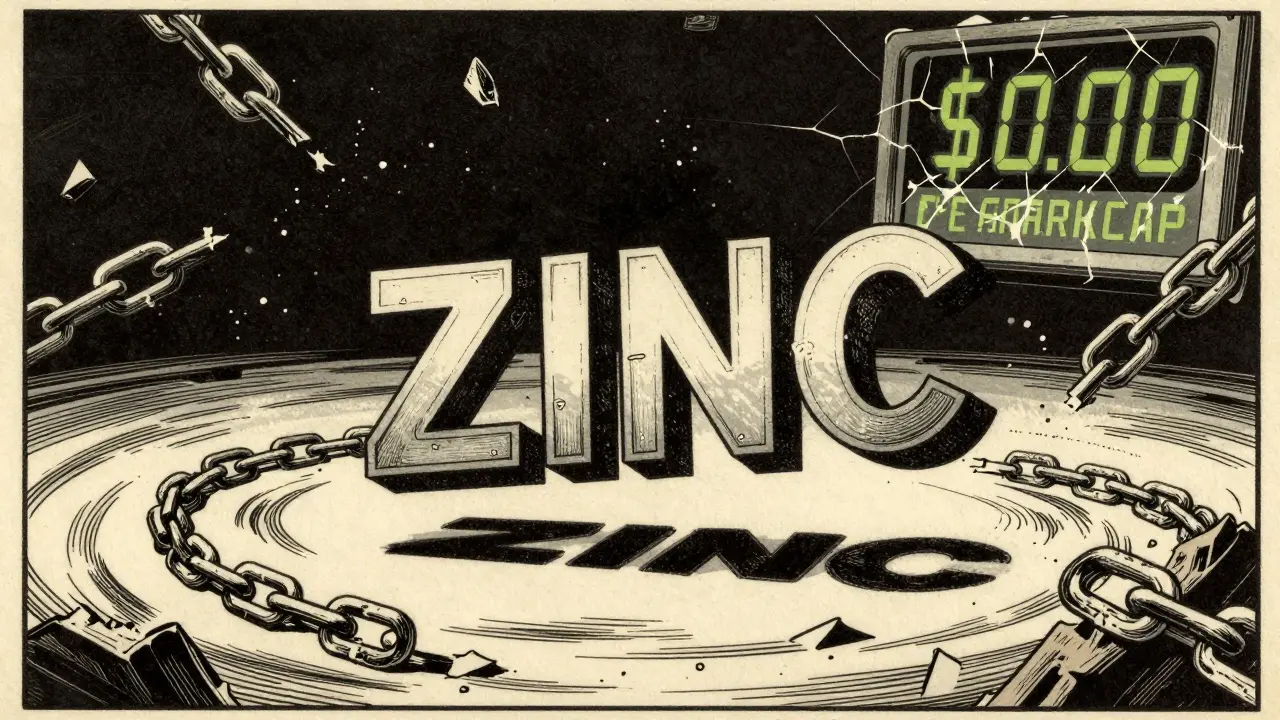
If you've heard about ZINC (ZINC) as a cryptocurrency and are wondering if it's worth looking into, here's the straight answer: ZINC doesn't have enough real trading activity to be considered a functioning crypto asset in 2026.
On March 12, 2026, ZINC is listed on BeInCrypto with a price of $0.00747 USD. That number might sound tempting, especially if you're scanning for cheap coins. But here's the catch: the platform openly admits it lacks accurate trading data for ZINC. The reported 24-hour trading volume is $0.00. The market cap? Also $0.00. That’s not a typo. It means no one is actively buying or selling this token on any major exchange that tracks volume.
When a cryptocurrency has zero trading volume, it’s not just inactive - it’s essentially frozen. There’s no liquidity. No buyers. No sellers. If you bought ZINC today, you wouldn’t be able to sell it tomorrow. No exchange would take it. No wallet would let you transfer it to someone else without a matching buyer on the other end. It’s like owning a ticket to a concert that was canceled - the ticket still exists, but it has no value.
There’s no public record of who created ZINC. No whitepaper. No GitHub repository. No official website. No development team listed anywhere. No community on Reddit, Telegram, or Discord. You won’t find any news articles from CoinDesk, Cointelegraph, or CryptoSlate covering ZINC. Even major blockchain analytics firms like Nansen or TokenTerminal don’t track it. That’s not normal for a coin that’s meant to be used - even obscure tokens usually leave some digital trail.
Compare ZINC to real projects in 2026. Take zkSync (ZK), a Layer-2 Ethereum scaling solution that processes over 10 million transactions daily and is integrated into dozens of DeFi apps. Or LayerZero (ZRO), a cross-chain messaging protocol used by over 50 blockchains to move assets between networks. These projects have teams, roadmaps, audits, and active GitHub commits. ZINC has none of that. It doesn’t even show up in lists of trending tokens on CoinMarketCap or CoinGecko - not because it’s ignored, but because it doesn’t meet their minimum data thresholds to be listed.
Some people might argue that ZINC could be a hidden gem, waiting to explode. But that’s not how crypto markets work. Coins with real potential don’t sit at $0.00 trading volume for months - they get picked up by exchanges, listed on DEXs like Uniswap or PancakeSwap, and start gaining traction through developer activity and user adoption. ZINC hasn’t moved in months. No updates. No announcements. No new wallets being created around it. If it were about to launch something big, you’d see at least a tweet, a blog post, or a GitHub commit. You see nothing.
There’s also no evidence ZINC runs on any known blockchain. Is it an ERC-20 token? A Solana SPL token? A BSC coin? No one knows. Without knowing the underlying chain, you can’t even check its contract address or verify its supply. You can’t use a blockchain explorer to see if tokens are being transferred. You can’t track who holds them. That’s not just incomplete data - it’s a complete absence of infrastructure.
Why does this matter? Because crypto isn’t just about price. It’s about trust, transparency, and usability. A coin with no volume, no team, no code, and no community is not an investment. It’s a ghost. And ghosts don’t pay dividends. They don’t appreciate in value. They don’t get listed on exchanges. They just sit there - a ticker symbol with no substance.
If you’re considering buying ZINC, ask yourself: Why would anyone sell it to you if there’s no market? Who’s the counterparty? What’s the incentive? The answer is: there isn’t one. This isn’t a case of early adoption. This is a case of no adoption at all.
There are hundreds of obscure tokens out there. Most fade away within months. ZINC is one of them. It’s not a scam in the traditional sense - there’s no evidence of a rug pull or a fake team. But it’s also not a project. It’s a placeholder. A name on a chart with no behind-the-scenes activity. In crypto, that’s the most dangerous kind of asset. Not because it’s malicious, but because it’s meaningless.
So what should you do? Skip ZINC. Don’t waste time researching it. Don’t buy it. Don’t even add it to your watchlist. Focus on projects with real data: active GitHub commits, verified contracts, exchange listings, and consistent trading volume. If you can’t find any of that, it’s not a coin - it’s noise.
There’s no future for ZINC because there’s no present. And in crypto, if you’re not moving forward, you’re already gone.
There are 15 Comments
Adam Ashworth
Lindsay Girvan
Douglas Anderson
Tina Keller
vasantharaj Rajagopal
ann neumann
William Montgomery
Mara Alves Mariano
Allison Davis
Tom Jewell
Sherry Kirkham
Jennifer Pilot
Sharon Tuck
karan narware
Michael Suttle
Write a comment
Your email address will not be published. Required fields are marked *