
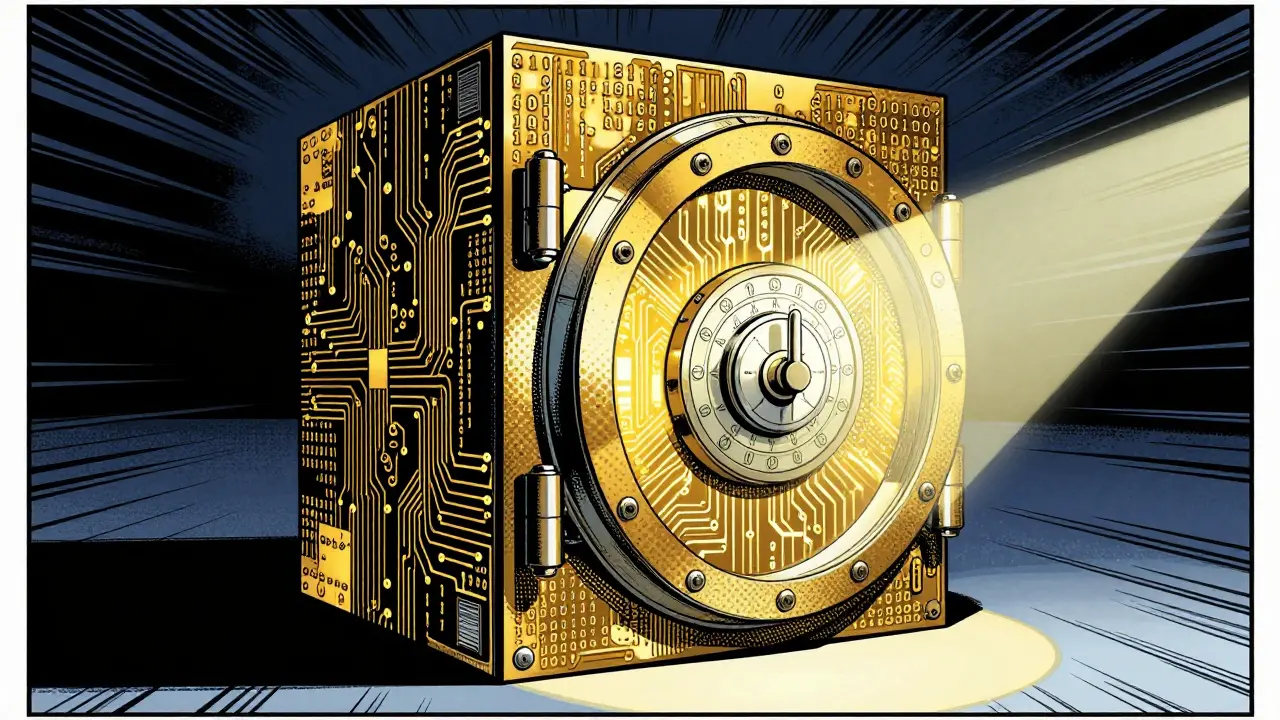
Imagine a digital vault that has never been broken into, despite billions of dollars sitting inside it. That is essentially what the Bitcoin network is. But how does it stay secure? It doesn't rely on a bank's firewall or a government's military protection. Instead, it relies on a piece of mathematics so robust that even supercomputers can't break it easily. That mathematics is the SHA-256 hashing algorithm.
You might wonder why Satoshi Nakamoto chose this specific tool back in 2008. Was it random? No. It was a deliberate choice for stability, security, and simplicity. Today, we are going to look under the hood of this technology to see exactly why SHA-256 remains the king of cryptocurrency hashing, how it works, and what the future holds for it.
The Origin Story: Why NSA Math Powers Crypto
To understand Bitcoin, you have to look at where its foundation came from. SHA-256, which stands for Secure Hash Algorithm 256-bit, was not invented by a crypto enthusiast in a basement. It was developed by the National Security Agency (NSA) in 2001.
Yes, the same agency known for surveillance created the math that protects decentralized money. This matters because algorithms from intelligence agencies undergo intense scrutiny. They are tested against every known attack vector before they are released to the public. By 2008, when Satoshi published the Bitcoin whitepaper, SHA-256 had already been out there for seven years. Cryptographers around the world had tried to break it and failed.
Satoshi needed a function that was:
- Deterministic: The same input always produces the same output.
- One-way: You can go from data to hash, but never from hash back to data.
- Avalanche Effect: Changing one tiny bit of input completely changes the output.
SHA-256 fit all these criteria perfectly. It provided a trusted, battle-tested standard that didn't require users to trust a new, unproven mathematical model.
How SHA-256 Actually Works
You don't need a PhD in cryptography to grasp the basics, but it helps to visualize the process. Think of SHA-256 as a blender. You throw ingredients (data) in, and you get a smoothie (hash) out. You cannot turn the smoothie back into strawberries and milk.
Here is the technical breakdown of what happens inside the algorithm:
- Padding: Your input data is padded so its length is a multiple of 512 bits. If your message is short, zeros are added until it fits the block size.
- Initialization: The algorithm starts with eight specific 32-bit values. These aren't random; they are derived from the fractional parts of the square roots of the first eight prime numbers (2, 3, 5, 7, 11, 13, 17, 19).
- Processing Rounds: The data goes through 64 rounds of complex logical operations. Each round mixes the data further, ensuring that no pattern remains.
- Output: The result is a fixed 256-bit string, usually displayed as a 64-character hexadecimal number (like
a1b2c3...).
No matter if you hash the word "hello" or an entire encyclopedia, the output is always exactly 256 bits long. This consistency is crucial for the blockchain structure.
The Double Hashing Trick
If you dig into Bitcoin's code, you will notice something odd. Bitcoin doesn't just use SHA-256 once. It uses it twice. This is called double SHA-256 (or SHA-256d).
Why double up? It’s a defensive measure against something called a length extension attack. In some cryptographic scenarios, if an attacker knows the hash of a message and the length of that message, they might be able to calculate the hash of a longer message without knowing the original content. By running the hash through SHA-256 again, Bitcoin eliminates this vulnerability. It adds a layer of safety that makes theoretical attacks practically impossible.
This double-hashing method secures both individual transactions and the blocks themselves. As of 2024, this mechanism protects over $1.2 trillion in digital assets. That is a pretty good return on investment for two lines of code.
Proof-of-Work: Turning Math into Money
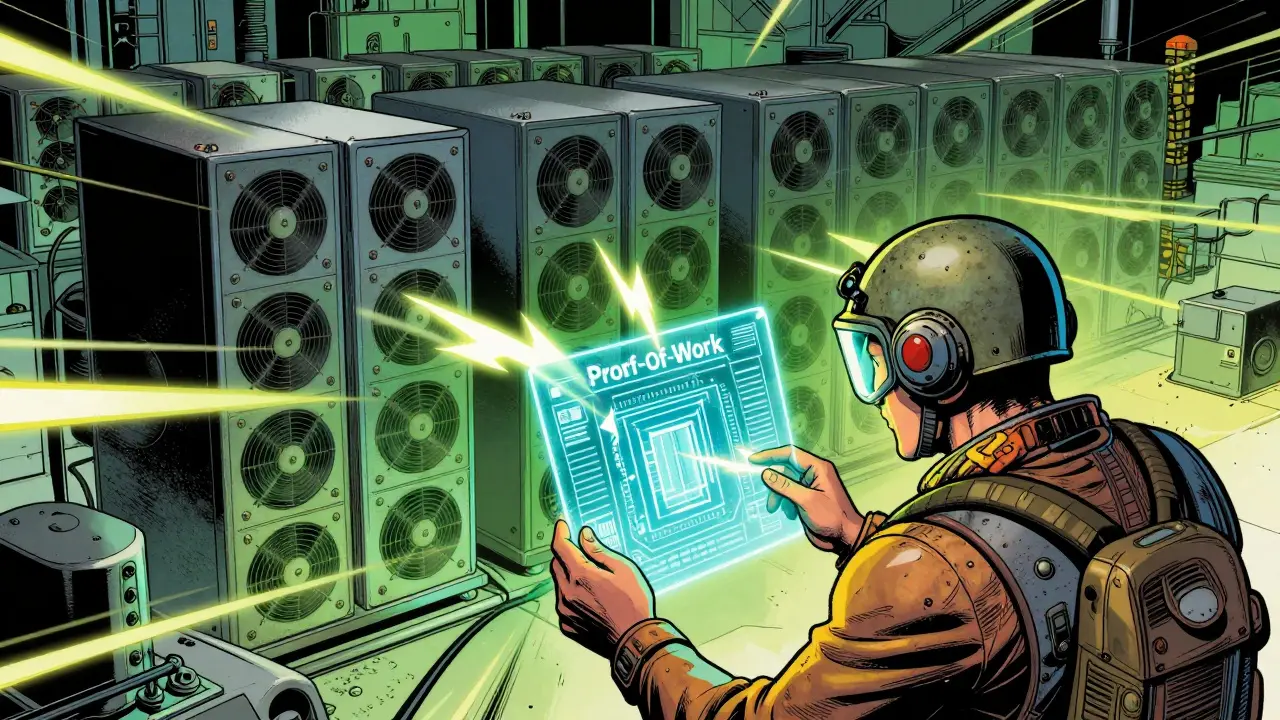
Hashing isn't just about storage; it's about consensus. Bitcoin uses a system called Proof-of-Work (PoW). Here is how SHA-256 drives this:
Miners compete to solve a puzzle. The puzzle involves finding a specific number (called a nonce) that, when hashed with the block's data, produces a SHA-256 hash starting with a certain number of zeros. For example, the target might require a hash starting with four zeros.
| Difficulty Level | Required Leading Zeros | Probability of Success |
|---|---|---|
| Low | 1 Zero | ~6% chance |
| Medium | 4 Zeros | ~0.0015% chance |
| High (Current Bitcoin) | 19+ Zeros | 1 in trillions |
Because SHA-256 is unpredictable, miners have to guess millions of nonces per second. The first one to find a valid hash broadcasts it to the network. Everyone else checks it instantly. If it’s correct, the block is added to the chain, and the miner gets rewarded.
This process prevents double-spending. To change a past transaction, an attacker would need to redo the Proof-of-Work for that block and every block after it, faster than the rest of the network combined. With Bitcoin's hashrate reaching approximately 650 exahashes per second (EH/s) in mid-2024, this is computationally impossible for any single entity.
The ASIC Problem: Centralization Concerns
Every coin has two sides. While SHA-256 is incredibly secure, it has led to a significant shift in who controls the network. Because the algorithm is simple and consistent, engineers built specialized hardware to solve it faster. These are called ASICs (Application-Specific Integrated Circuits).
In the early days of Bitcoin, you could mine with your laptop. Today, a consumer-grade GPU is useless for Bitcoin mining. You need machines like the Antminer S19 XP, which costs around $4,200 and consumes 3,000 watts of power. This has created a barrier to entry.
Critics argue this leads to centralization. According to data from Q3 2024, the top 10 mining pools control over 95% of the network's hashrate. While these pools are distributed across different countries (the US, Kazakhstan, Canada), the economic power is concentrated among those who can afford industrial-scale electricity and hardware.
This contrasts with other cryptocurrencies. For example, Litecoin uses Scrypt, which was designed to be memory-hard and resist ASICs initially. Ethereum used Ethash for similar reasons before switching to Proof-of-Stake entirely. Bitcoin stuck with SHA-256 because changing it now would split the network and destroy its value proposition.
Is SHA-256 Safe from Quantum Computers?
A common fear is that quantum computers will break SHA-256 overnight. Let's put that to rest.
Quantum computers excel at breaking encryption keys (like ECDSA, which Bitcoin uses for signatures) using Shor's algorithm. However, for hashing functions like SHA-256, they use Grover's algorithm. Grover's algorithm provides a quadratic speedup, not an exponential one.
This means a quantum computer would effectively halve the security strength of SHA-256, turning it into something equivalent to SHA-128. While that sounds scary, SHA-128 is still considered extremely secure against brute-force attacks. Furthermore, current quantum computers are nowhere near powerful enough. IBM demonstrated a processor with ~1,121 qubits in 2023, but breaking practical crypto requires millions of stable qubits.
Experts like Dr. Adam Back, CEO of Blockstream, have stated that SHA-256 has more than enough security margin for the next 15-20 years. NIST also continues to certify SHA-256 as secure, noting that while theoretical attacks exist, none are practical.
Why Not Switch to SHA-3?
NIST standardized SHA-3 in 2015 as a backup to SHA-2. Some argue it is more modern and resistant to certain side-channel attacks. So why hasn't Bitcoin switched?
Two main reasons:
- Consensus Risk: Changing the hashing algorithm requires a hard fork. Every node, wallet, and miner must upgrade simultaneously. If even 1% of the network disagrees, the chain splits. Bitcoin's greatest strength is its immutability and agreement. Introducing a new algorithm introduces uncertainty.
- Performance: SHA-256 is highly optimized in both software and hardware. Decades of engineering have made it lightning-fast on existing ASICs. Switching would render billions of dollars of mining equipment obsolete overnight, causing massive economic disruption.
As developer Pieter Wuille noted, changing the algorithm presents significant technical challenges and requires near-unanimous consensus. Given that SHA-256 is working perfectly well, there is little incentive to risk the network's stability.
Conclusion: Stability Over Novelty
Bitcoin’s choice of SHA-256 wasn't about being trendy. It was about being boringly reliable. In the world of finance, boring is good. It means predictable, auditable, and secure.
While newer blockchains experiment with novel consensus mechanisms, Bitcoin remains anchored by the NSA-developed math that has stood the test of time. The rise of ASICs has brought centralization concerns, but the security benefits outweigh the drawbacks for most users. As long as no practical attack on SHA-256 emerges-and current evidence suggests that won't happen for decades-Bitcoin will continue to use this algorithm as its bedrock.
What is the main purpose of SHA-256 in Bitcoin?
The main purpose is to provide a secure, deterministic way to validate transactions and link blocks together. It enables the Proof-of-Work consensus mechanism, which prevents double-spending and ensures the integrity of the blockchain.
Why does Bitcoin use double SHA-256 instead of single SHA-256?
Bitcoin uses double SHA-256 (SHA-256(SHA-256(data))) to protect against length extension attacks. This additional layer of hashing makes it cryptographically difficult for attackers to manipulate the hash output based on the length of the input message.
Can quantum computers break SHA-256?
Not anytime soon. While quantum computers can theoretically speed up hash cracking using Grover's algorithm, they would only reduce the effective security to that of SHA-128. Current quantum technology is far from having the millions of qubits required to pose a real threat, making SHA-256 safe for at least the next 15-20 years.
How do ASICs affect Bitcoin mining decentralization?
ASICs (Application-Specific Integrated Circuits) are specialized hardware that mines SHA-256 much faster than general-purpose computers. This has raised barriers to entry, leading to concerns about centralization as large mining pools with access to cheap electricity and expensive hardware dominate the network's hashrate.
Why hasn't Bitcoin switched to SHA-3?
Switching to SHA-3 would require a hard fork, risking network splits and requiring unanimous consensus. Additionally, SHA-256 is deeply optimized in existing hardware and software. Since SHA-256 remains secure, the risks and costs of switching outweigh the potential benefits.



There are 21 Comments
Steven Jacobowitz
Wait, so you're telling me the NSA made the math that protects my money from the government? That is some serious irony right there. I mean, they built a tool specifically to keep secrets safe and now we use it to make transactions public but unchangeable. It’s wild how technology loops back on itself like that. The avalanche effect part really clicked for me too. Changing one bit changes everything. That is basically the definition of chaos theory in action isn't it? I always thought hashing was just simple compression but this blender analogy makes way more sense. You can't un-blend a smoothie. Simple.
Sylvia Mossman
This article is completely missing the point about centralization. Calling ASICs a 'barrier to entry' is an understatement. It's a monopoly factory. You think anyone with a laptop can mine Bitcoin now? Please. It's all run by massive farms in places with cheap hydroelectric power or subsidized energy. The decentralization myth is dead. SHA-256 didn't secure democracy; it secured industrial mining conglomerates. Stop pretending this is a grassroots movement. It's not.
Brad Ranks
I tried mining back in 2013 with my old gaming rig and I was making like $2 a day. Now I look at the hashrate charts and I want to cry. My GPU is literally a paperweight for BTC. 😭
Caitlin Donahue
i mean its kinda true tho. the whole asic thing feels super exclusive now. i just want to support the network but i cant afford a machine that costs more than my car lol. maybe thats why ethereum switched to stake? felt more inclusive even if people hated it.
Karthikeyan S
The quantum fear-mongering here is absolutely pathetic 🙄. People screaming about Grover's algorithm like their grandma is going to hack their wallet next week. Let me educate you peasants. Grover's gives a quadratic speedup. Quadratic! Not exponential. You need millions of stable qubits to break SHA-256 effectively. We have thousands. Maybe tens of thousands. Do the math. Your savings are safer from quantum computers than they are from you losing your password. Wake up. 🧠💤
Dinesh Pattigilli
You clearly dont understand the implications of side-channel attacks either. Its not just about brute force. SHA-3 exists for a reason. Sticking with SHA-256 is lazy engineering. Satoshi picked it because it was available in 2008 not because it is the pinnacle of cryptographic design. If we were starting today we would use something else. But no lets cling to legacy tech because changing it is hard. Typical crypto bro mentality. Refuse to adapt and die.
Madhu Menon
Perhaps we should consider the philosophical weight of immutability. To change the hash function is to change the identity of the chain. It is not merely a technical upgrade; it is a metaphysical shift. The value of Bitcoin lies in its stubborn refusal to change. In a world of fluid identities, SHA-256 provides a fixed point. A constant in the equation of digital existence. Is it perfect? No. But is it consistent? Yes. And consistency is the foundation of trust. 🕊️
verna kennedy
Let's be real here. The double hashing trick is just a band-aid for a flawed design choice. Length extension attacks are theoretical for most applications but in a system handling trillions of dollars, theoretical risks become practical nightmares. Why did Satoshi not just pick a safer algorithm from the start? Probably because he wanted to move fast and break things. Now we are stuck with this legacy codebase that requires billions in hardware investment to maintain. It's unsustainable.
Kelly Tenney
I actually find the history fascinating though! It's cool to see how the NSA's work ended up empowering decentralized finance. It shows that good tools can be repurposed for different ideals. I'm trying to learn more about the initialization values derived from prime numbers. Isn't it beautiful that the security of our money is based on the fundamental building blocks of mathematics? Primes are everywhere. It connects us to the universe in a way. 💖
Caralee Robertson
i love the blender analogy tbh. finally something that makes sense to me without needing a degree in comp sci. the idea that you cant get the ingredients back out is so satisfying. makes me feel safer knowing my txns are mixed up beyond recognition. thanks for explaining it simply!
JEVON HALL
Hey folks just wanted to add that the nonce guessing process is pure probability. Its like buying lottery tickets but you buy millions per second. The difficulty adjustment every 2016 blocks is what keeps the network stable. If everyone bought ASICs tomorrow the difficulty would skyrocket and only the biggest pools would survive. Its a self-regulating ecosystem in a way. 🚀⛏️
Dr Lynea LaVoy
As someone who studies cryptography, I appreciate the nuance here. The distinction between Shor's algorithm breaking ECDSA and Grover's algorithm affecting SHA-256 is critical. Many conflate the two. Quantum resistance for signatures is urgent. Quantum resistance for hashing is a distant concern. We have time. We should focus on post-quantum signature schemes rather than panicking about the hash function. Stay informed, stay calm.
Matthew Malone
And let's not forget where these mining farms are popping up. Kazakhstan. China (underground). The US. It's global infrastructure. Some say it's centralized, I say it's distributed power generation. Bitcoin miners provide grid stability by absorbing excess renewable energy. They are the ultimate flexible load. Without them, wind farms would curtail power. With them, that power secures the blockchain. It's a win-win for American energy independence and global security. Don't listen to the haters.
aaliyah zahid
Oh wow, Matthew, you really went there with the energy angle. I guess I never thought of miners as grid stabilizers. That's... actually kind of impressive when you put it that way. Though I still worry about the carbon footprint in places that rely on coal. But hey, if they are using excess wind power, then I suppose we should give them some credit. It's complicated stuff. 😅
Erik Kirana
The article fails to mention the environmental cost adequately. Burning megawatts of electricity to solve a puzzle that produces a random number is absurd. It is a waste of resources on a planetary scale. While you debate the merits of SHA-256 vs SHA-3, the planet burns. This is not innovation; it is digital strip-mining. The consensus mechanism is fundamentally broken and needs to be replaced with something sustainable like Proof-of-Stake. 🌍🔥
dan kaffeman
Typical elitist take. You think PoS is better? PoS is plutocracy. Rich get richer. Bitcoin is meritocracy. Work gets rewarded. If you don't like the energy usage, go live off-grid. The security model of Bitcoin is unmatched because it ties digital value to physical reality via energy. That is what makes it sound money. Everything else is just IOUs. Wake up sheeple. The NSA math works because it forces real-world commitment. 💪
Meg Gran
Can we talk about the sheer audacity of trusting the NSA? Like, seriously? The same agency that spies on everyone? Now we are basing our financial freedom on their algorithms. It's ironic isn't it? Or maybe it's just pragmatic. Either way, I'm skeptical. I'd rather see open-source developed algorithms that haven't been through the black box of intelligence agencies. But hey, if it ain't broke... 🙄
Alexander DeVries
Meg, you raise a valid point about trust. However, the beauty of SHA-256 is that it is standardized. NIST published it. Anyone can audit it. There are no backdoors found in 20+ years. If the NSA wanted a backdoor, they would have used a custom algorithm. By using a public standard, they allowed the world to verify its integrity. That is transparency. That is trust. Keep pushing forward! 💼
Mark Corpuz
The technical explanation of the padding and initialization vectors was particularly clear. The use of square roots of primes for initial values is an elegant touch that ensures the constants are arbitrary yet verifiable. It prevents any suspicion of hidden biases in the starting state. This level of detail is often overlooked in popular explanations, so it is refreshing to see it highlighted. Well written.
Yogendra Dwivedi
I am curious about the future of ASIC resistance. Are there any new algorithms being developed that could potentially replace SHA-256 in the long run without causing a hard fork? Or is Bitcoin destined to remain locked into this specific mathematical framework forever? It seems like a rigid path but perhaps that rigidity is its strength. 🤔
Alexis Abster
OMG the fact that one tiny bit change flips the whole output is just MAGIC ✨. I ran a test online and changed 'hello' to 'hell0' and the hashes were completely different. It's like digital fingerprinting but way cooler. I feel so much smarter reading this. Thank you for sharing! 🙌❤️
Write a comment
Your email address will not be published. Required fields are marked *