

Imagine earning extra rewards on your staked Ethereum without moving a single token. That’s the promise of crypto restaking-a system that lets you use the same ETH to secure not just Ethereum, but also dozens of other protocols at once. It sounds too good to be true. And in many ways, it is. Restaking isn’t just a new feature-it’s a fundamental shift in how crypto security and rewards work. But with higher yields come hidden dangers most beginners don’t see until it’s too late.
What Is Crypto Restaking?
Restaking means taking your staked ETH and reusing it to help secure other blockchain services, called Actively Validated Services (AVSs). These aren’t full blockchains like Solana or Polygon. They’re smaller, specialized tools-like decentralized oracle networks, privacy layers, or cross-chain bridges-that need economic security to operate safely.
The system was built by EigenLayer a protocol on Ethereum that allows stakers to re-use their ETH to secure additional services. Since its mainnet launch in August 2023, EigenLayer has grown to over $10 billion in locked value, making it the largest restaking platform by far. It’s not magic-it’s smart contract math. When you restake, your ETH still earns base staking rewards from Ethereum, but now it also earns extra rewards from every AVS you help secure.
There are two ways to do it: native and liquid. Native restaking requires running your own validator node and installing extra software. It’s for advanced users. Most people use liquid restaking. That’s where you stake ETH through a platform like Lido or Rocket Pool, get stETH or rETH in return, then deposit those tokens into EigenLayer. In exchange, you get LRTs-Liquid Restaking Tokens-that represent your combined stake across Ethereum and the AVSs you’ve chosen.
Why Restaking Pays More
Traditional staking on Ethereum gives you around 3-4% APY. Restaking can push that to 5-8%-sometimes even higher. That’s not just a small bump. It’s a 50-100% increase in passive income, without selling or moving your assets.
Here’s how it works: Every AVS pays a fee to attract security. Think of it like renting out your home’s extra room. You still live there (your ETH stays staked on Ethereum), but now you’re also letting someone else use part of your security to protect their service. In return, you get paid. Platforms like Renzo, Ether.Fi, and Puffer Finance act as intermediaries, letting you pick which AVSs to support. Some focus on privacy, others on data availability. Each offers different yields.
According to DAIC Capital’s Q2 2024 analysis, restaking creates “multi-layered rewards.” You get paid by Ethereum, then again by each AVS you’re connected to. It’s like having multiple income streams from one asset. And unlike staking on a new chain-where you have to move your coins and risk bridge failures-you keep everything on Ethereum. No need to trust new networks. Your ETH stays where it’s safest.
The Hidden Risks: Slashing Multiplied
But here’s the catch: every time you restake, you’re agreeing to new rules. Ethereum’s slashing rules are strict but predictable. If your validator goes offline or signs conflicting blocks, you might lose 0.1% to 5% of your stake. Simple.
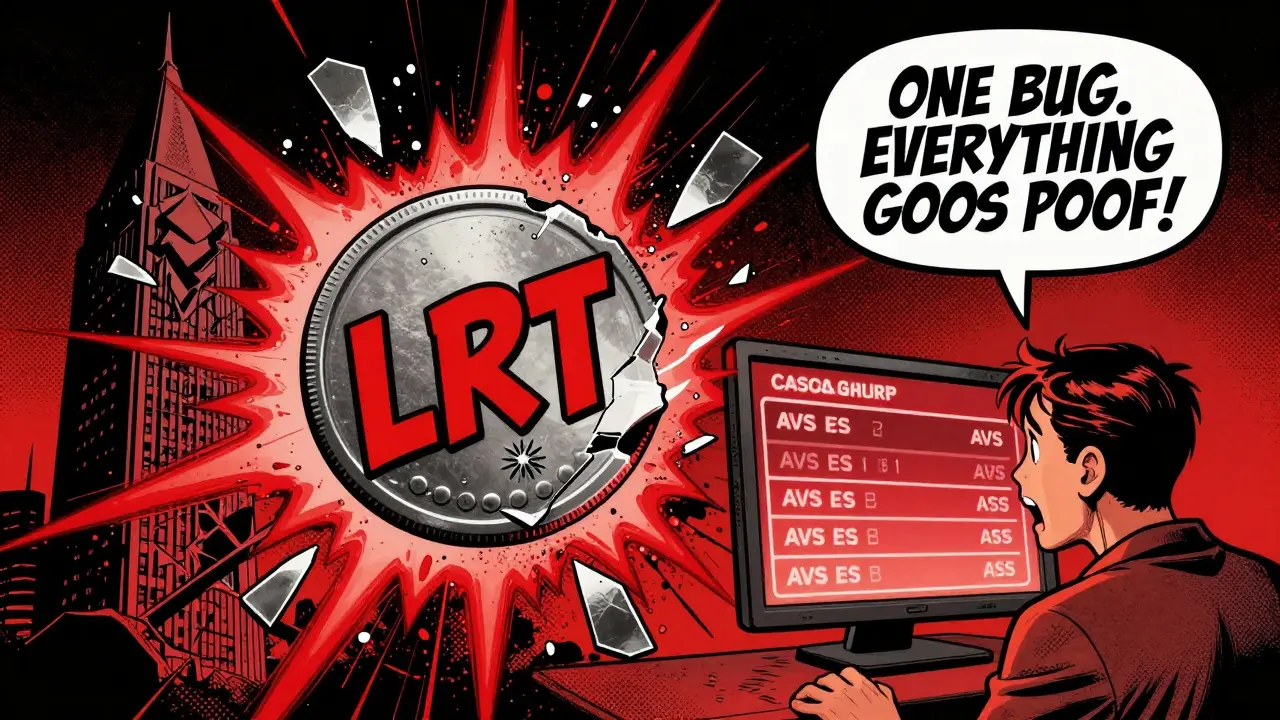
With restaking, you’re now bound by the slashing rules of every AVS you support. One AVS might slash you for a minor timing error. Another might slash you if the service gets hacked. A third might have a bug that triggers a penalty you didn’t even know existed.
Galaxy Research’s March 2024 report calls this “compounded slashing risk.” It’s not additive-it’s multiplicative. If you’re securing five AVSs and one of them has a failure, you could lose a chunk of your ETH-not just from that AVS, but from your entire restaked position. There’s no insurance. No safety net. And unlike traditional staking, where you can just stop and wait, restaking ties your funds to the uptime of dozens of external systems.
Users on Reddit’s r/ethstaker have reported losing 2-7% of their restaked ETH after unexpected slashing events. One user restaked through a new AVS that turned out to have a poorly tested consensus mechanism. Within two weeks, the protocol crashed. His LRTs were penalized. He lost $1,800 on a $10,000 stake. He didn’t know the AVS had a 10% slashing threshold for latency. No one told him.
Counterparty and Centralization Risks
Restaking isn’t just about smart contracts. It’s about people. The AVSs you support are run by teams-some well-known, some anonymous. Some are backed by top venture capital. Others are built by two developers in a garage.
When you restake through a liquid provider like Renzo or Ether.Fi, you’re trusting them to manage your LRTs, choose AVSs, and handle slashing. If their software has a bug-or if they get hacked-you lose everything. That’s counterparty risk. And it’s real. In late 2023, a liquid restaking platform had a misconfigured withdrawal queue. Hundreds of users couldn’t access their LRTs for 11 days. The team fixed it, but the panic caused a 15% drop in LRT prices.
Then there’s centralization. Over 80% of all restaked ETH flows through EigenLayer. That means Ethereum’s security is now heavily dependent on one protocol. If EigenLayer gets compromised, it could trigger cascading failures across every AVS. Vitalik Buterin warned in October 2023 that this could create a “single point of failure” for the entire Ethereum ecosystem. The more value locked in restaking, the bigger the target. And right now, it’s growing fast.
Who Should Restake-and Who Should Avoid It
Restaking isn’t for everyone. If you’re new to crypto, don’t start here. Even experienced stakers need to understand what they’re signing up for.
Here’s who should consider it:
- You already stake ETH and understand slashing risks.
- You’re comfortable with DeFi and have used liquid staking tokens before.
- You’re not relying on this income for living expenses.
- You’re willing to spend time learning about AVSs and monitoring your positions.
Here’s who should stay away:
- Anyone who doesn’t know what a validator is.
- People who think “higher APY” means “risk-free.”
- Those who can’t afford to lose even 10% of their staked ETH.
- Users who rely on third-party advice without checking the source.
Changelly’s April 2024 beginner’s guide says it best: “Start small. Pick trusted platforms. Never commit more than you’re ready to lose.” That’s not just advice-it’s survival.

How to Get Started (Safely)
If you’re ready to try restaking, here’s a simple, low-risk path:
- Stake your ETH on a trusted liquid staking provider like Lido or Rocket Pool. Get stETH or rETH.
- Go to EigenLayer’s official website (not a third-party link). Connect your wallet.
- Deposit your stETH. You’ll get LRTs in return.
- Start with just one AVS-preferably one with a proven track record, like a well-known oracle service.
- Set a limit: never restake more than 20% of your total ETH stake until you’ve seen how it performs over 6 months.
Use tools like EigenLayer’s dashboard or DeFi Llama to track your APY and slashing history. Join their Discord. Read their GitHub docs. The official EigenLayer documentation has a 4.2/5 rating from over 120 developers. That’s rare in crypto.
And never, ever trust a YouTube video or Telegram group promising “15% APY guaranteed.” If it sounds too good to be true, it is. Restaking isn’t a get-rich-quick scheme. It’s a high-stakes game of security economics.
The Future: Where Restaking Is Headed
Restaking isn’t going away. Ethereum’s security budget could grow 3-5x if restaking scales. That’s huge. By 2026, analysts predict $50-100 billion could be locked in restaking across multiple chains.
EigenLayer v2, launching in late 2024, will let users pick risk profiles-“conservative,” “balanced,” or “aggressive.” That’s a step toward making restaking safer. Cosmos is also testing restaking, which could break Ethereum’s monopoly. But until then, the entire ecosystem depends on one protocol.
Regulators are watching. The U.S. SEC has hinted that LRTs might be classified as securities. If that happens, platforms could be forced to shut down or comply with strict rules. That could freeze the market overnight.
For now, restaking is a powerful tool for those who understand it. It’s not just about earning more. It’s about making Ethereum more secure by turning idle capital into active protection. But that power comes with responsibility. The more you earn, the more you’re betting on the system holding together.
Restaking matters because it expands the power of your digital assets, which drives efficiency, security, and liquidity across the whole ecosystem. But if you don’t know what you’re securing-you’re not earning. You’re gambling.
Is restaking safe?
Restaking is not inherently safe-it’s high-risk, high-reward. Your ETH is still secure on Ethereum, but you’re now exposed to slashing from every AVS you support. If one AVS fails or gets hacked, you could lose part of your stake. Only restake what you can afford to lose, and avoid unknown or untested protocols.
How much extra can I earn with restaking?
Restaking typically adds 20-50% more APY compared to standard Ethereum staking. Most users earn between 5% and 8% total APY, depending on the AVSs they choose. Some platforms offer higher yields, but those often come with greater risk. Always check real-time data on DeFi Llama or EigenLayer’s dashboard.
Can I unstake my ETH anytime?
No. Restaking locks your ETH for the same withdrawal period as Ethereum’s staking-currently around 18-24 hours for liquid restaking, but up to 7 days for full withdrawals. You can’t access your funds instantly. And if you’re restaked on an AVS that’s under attack, withdrawals may be delayed or frozen.
What’s the difference between stETH and LRT?
stETH is your liquid staking token from Lido-it represents your ETH staked on Ethereum. LRT (Liquid Restaking Token) is what you get when you deposit stETH into EigenLayer. LRTs represent your staked ETH plus your additional security contributions to AVSs. You earn rewards from both Ethereum and the AVSs through your LRTs.
Is restaking only for Ethereum?
Right now, yes. EigenLayer is the only mature restaking protocol, and it runs on Ethereum. Cosmos is testing similar tech, but it’s still experimental. Other blockchains like Solana or Polygon don’t support restaking yet. Ethereum remains the only viable option for now.




There are 19 Comments
Linda Prehn
Brenda Platt
Paru Somashekar
george haris
steven sun
Melissa Contreras López
Adam Lewkovitz
Sara Delgado Rivero
Athena Mantle
Arnaud Landry
Arielle Hernandez
Jessica Boling
carol johnson
Adam Fularz
HARSHA NAVALKAR
Steve Fennell
Chidimma Catherine
Mathew Finch
Adam Fularz
Write a comment
Your email address will not be published. Required fields are marked *