

Crypto Compliance Cost Calculator
Business Type
Jurisdiction
Business Size
Estimated Annual Compliance Costs
By December 2025, if you're running a crypto business, trading digital assets, or even holding Bitcoin, you're not just dealing with technology-you're navigating a maze of laws that changed faster than the market itself. Five years ago, regulators were still figuring out if crypto was money, a commodity, or a security. Now, the rules are clear, strict, and in full force. And they’re different depending on where you are, what you’re doing, and who you’re working with.
The U.S. Split: Two Laws, Two Regulators
The U.S. didn’t just add new rules in 2025-it rewrote the rulebook. Two laws, the GENIUS Act and the CLARITY Act, now define how crypto works under federal law. They don’t just regulate-they divide responsibility. The GENIUS Act targets stablecoins. If you issue a digital coin pegged to the dollar, euro, or any fiat currency, you now need to hold 100% of your reserves in high-quality liquid assets like U.S. Treasuries or cash. You can’t just say you’re backed by reserves-you have to prove it. Quarterly audits by PCAOB-registered firms are mandatory. And you need approval from either the Federal Reserve or your state’s banking regulator. New York’s BitLicense already required this. Now, the whole country does. The CLARITY Act is the flip side. It handles everything else: Bitcoin, Ethereum, Solana, and other non-stablecoin assets. It draws a hard line between the SEC and the CFTC. If your asset is a digital commodity-meaning no single entity controls more than 20% of the network’s validation power-the CFTC owns it. That’s Bitcoin. That’s Ethereum after the Merge. The SEC still has authority to decide if something is a security, but now they have to prove it. And if you’re running a crypto exchange, broker, or custodian, you can register with either agency based on what you trade. But here’s the catch: the SEC still gets to define decentralization. That means projects stuck in legal gray areas-like tokens that started as securities but claim to be decentralized now-could still face enforcement. It’s not a clean break. It’s a conditional one.State Rules Are Still a Nightmare
Federal laws don’t erase state laws. In fact, they made things worse. New York’s BitLicense, created in 2015, is still the toughest. You need $500,000 to $2 million in capital, full AML systems, cybersecurity audits, and you’re subject to daily monitoring. In 2025, NYDFS cracked down harder-issuing warnings on memecoins, forcing banks to use blockchain analytics tools like TRM Labs, and shutting down firms that skipped compliance. The average time to get a BitLicense? Nine months. California’s Digital Financial Assets Law (DFAL), which took effect in 2025, added new layers. You need to disclose risks in plain language. If someone wants to invest more than $10,000, they get a 72-hour cooling-off period. Biometric verification is required for high-value transactions. It’s consumer protection on steroids. Then there’s Wyoming. They created special-purpose bank charters for crypto firms. You need $25 million in capital to qualify. Nebraska? A sandbox. You can start with $5 million if you’re testing something new. But if you want to operate across state lines, you’re not just dealing with one regulator-you’re dealing with 50. Compliance costs jumped from $1.2 million in 2023 to $2.8 million in 2025. That’s not a tax. That’s a barrier to entry.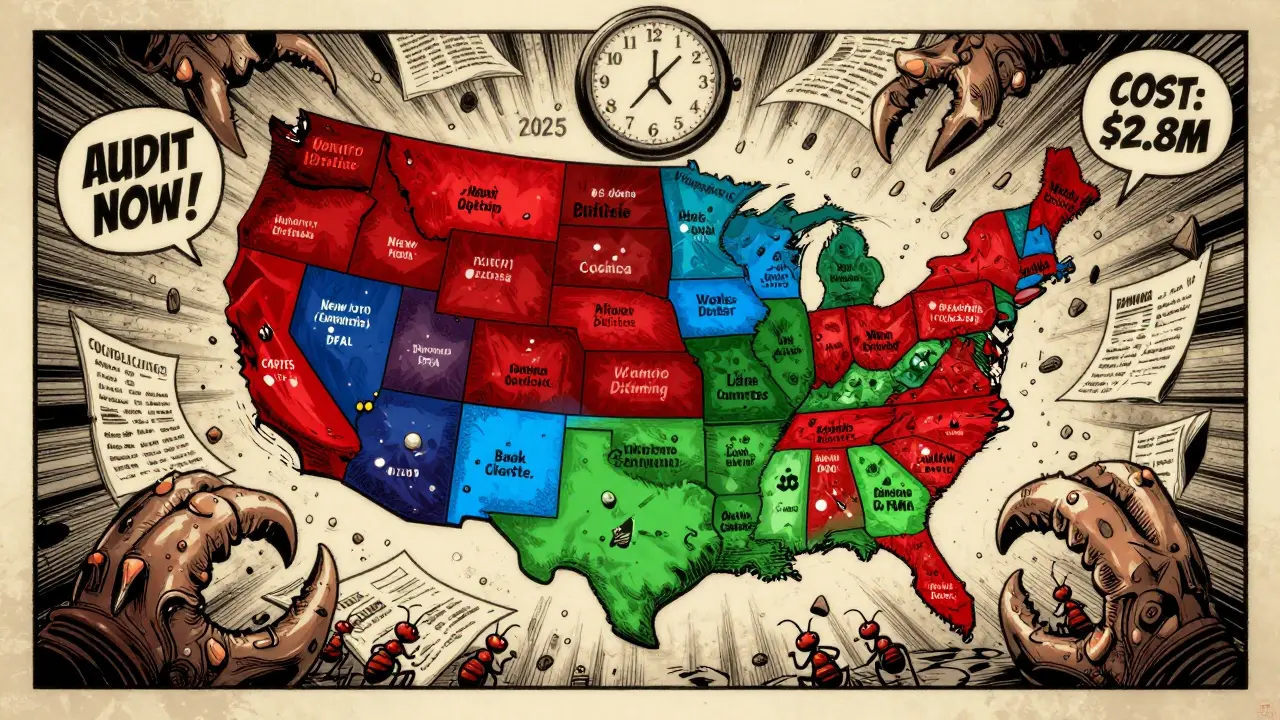
Global Rules Are Getting Closer
The U.S. isn’t alone. The Financial Stability Board (FSB), made up of central banks and regulators from 27 countries, pushed a global framework in 2023. By 2025, 18 countries fully adopted its stablecoin rules. 14 implemented rules for crypto service providers. The European Union’s MiCA regulation, fully active since January 2025, became the gold standard. Issuers must publish white papers. Stablecoins need a 2% loss buffer. Custody services must be insured. And you can’t just launch a token without explaining how it works. Countries like Canada, Australia, and Brazil followed suit. Canada now requires stablecoin issuers to hold 110% reserves. Brazil set minimum capital at $2 million to $6.9 million depending on business size. Australia made digital asset platforms subject to the same licensing rules as banks. The big wins? Almost every major country now requires VASPs to follow the FATF Travel Rule-sharing sender and receiver info on transactions over $1,000. 85% require regular audits. 78% demand clear risk warnings to users. But gaps remain. Emerging markets only hit 45% compliance. And while the EU and U.S. are aligned on core principles, enforcement is still local. A crypto firm in Singapore might be fine ignoring U.S. rules-but if it serves American customers, it’s still in danger.What’s Changing in the Market
The rules didn’t just affect compliance teams-they reshaped the entire industry. Stablecoin issuance exploded. After the GENIUS Act passed, 47 companies applied for federal authorization in just one quarter. The number of active U.S. crypto exchanges dropped from 128 to 97. Smaller players couldn’t afford the cost. The big ones? They bought them out. Institutional adoption surged. 78% of the top 50 U.S. banks now offer crypto custody or trading. The OCC confirmed national banks can legally hold digital assets-so long as they manage risk. Market cap hit $3.2 trillion by December 2025. Stablecoins now drive 68% of daily trading volume. Why? Because institutions won’t touch volatile crypto unless they can move in and out with stable, regulated assets. Enterprise blockchain spending hit $187 billion-up 44% in a year. Banks, insurers, and logistics firms are tokenizing assets: real estate, invoices, supply chain records. They’re not doing it for hype. They’re doing it because the rules now let them. But innovation? It’s fleeing. U.S.-based DeFi protocol development dropped 28% in 2025. Developers moved to Switzerland, Singapore, and Dubai, where rules are lighter. Crypto compliance software spending hit $9.3 billion-up 62%. That’s not a sign of growth. It’s a sign of survival.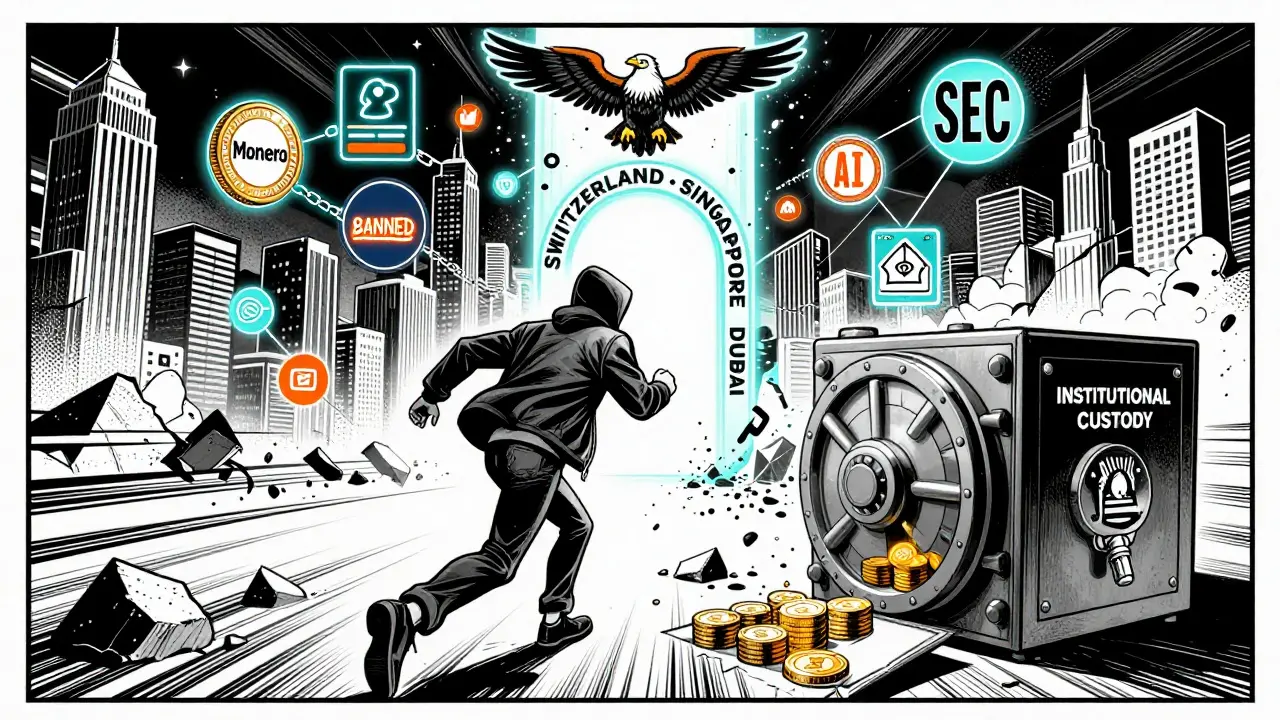
What’s Coming Next
The CLARITY Act is still in the Senate. If it passes by early 2026, the SEC-CFTC split becomes law. The SEC’s Crypto Task Force will release its token classification framework in Q1 2026-finally telling developers exactly when a token stops being a security and becomes a commodity. The Treasury Department is expected to issue guidance on DAOs in Q2 2026. Are they legal entities? Can they be sued? Do they need to file taxes? The answer will change how decentralized projects operate. Privacy coins like Monero and Zcash are under threat. The FATF is considering new rules that could ban or heavily restrict privacy-enhancing technologies. If you’re building a protocol that hides transaction details, you’re building something that may soon be illegal in most countries. And AI? The SEC added AI-driven crypto trading systems to its 2026 agenda. If your algorithm manages over $100 million in crypto assets, you’ll need to prove it’s not manipulating markets. That means logs, testing, audits-just like a hedge fund.What You Need to Do Now
If you’re a business:- Know whether you’re dealing with stablecoins or digital commodities. That determines your regulator.
- Get audited. Quarterly. By a PCAOB-registered firm.
- Map your state requirements. You can’t ignore New York or California.
- Document everything. Tokenomics, governance, supply mechanics. The SEC wants to see it.
- Use licensed custodians. Don’t hold private keys yourself unless you’re prepared for a full audit trail.
- Only use platforms registered with the CFTC or SEC. Look for their license number.
- Read the risk disclosures. They’re now legally required to be clear.
- Don’t assume decentralization means safety. The SEC still decides what’s decentralized.
- Watch for stablecoin issuers with transparent reserves. If they don’t publish audit reports, walk away.


There are 24 Comments
Shane Budge
Stablecoin reserves need to be 100% backed? That’s the bare minimum. If you’re not holding actual Treasuries, you’re just printing IOUs.
And yes, PCAOB audits are non-negotiable now. No more shady accounting.
Simple.
Done.
sonia sifflet
You think this is regulation? This is corporate capture dressed up as consumer protection. The SEC and CFTC are just splitting the loot. The real winners are the banks that bought up the small exchanges. You call this freedom? This is financial feudalism with a blockchain logo.
And don’t even get me started on MiCA-Europe’s answer to tyranny with better typography.
Chris Jenny
They’re watching everything. Every transaction. Every wallet. Every hash.
They say ‘commodity’ but they mean ‘control.’
The GENIUS Act? More like GENOCIDE of decentralization.
They’re not regulating crypto-they’re burying it alive under paperwork, audits, and compliance drones.
They’ll ban privacy coins next. Then they’ll track your browser history. Then your thoughts.
They’ve already got the algorithms. They just need the law to justify it.
Wake up. This isn’t finance. This is surveillance with a whitepaper.
Adam Bosworth
Oh wow, the SEC finally figured out how to be a bully without getting sued? Congrats, guys. You took a wild frontier and turned it into a DMV with crypto logos.
And don’t even get me started on how NYDFS is still the real boss. You think California’s DFAL is tough? Try getting a BitLicense without bribing a compliance intern.
Meanwhile, my uncle in Ohio is still holding $20k in Shiba Inu and thinks he’s a ‘crypto OG.’
Regulation? Nah. Just another way for the rich to lock out the rest of us.
Uzoma Jenfrancis
America thinks it owns crypto now? Look at the global picture. Nigeria, India, Brazil-they’re building their own systems. You think your laws apply to the whole world? You’re not the center of the universe. Your regulations are outdated before they’re printed. We don’t need your audits. We need our own rules. Your ‘stablecoins’ are just dollar proxies. We want real sovereignty.
Jonathan Sundqvist
They say compliance costs jumped to $2.8M? That’s not a cost-it’s a tax on innovation. The only people who can play now are the ones who already have billions. That’s not regulation. That’s asset consolidation under the guise of safety.
And don’t get me started on how ‘decentralization’ is now a legal term decided by the SEC. That’s like letting the FBI define what ‘free speech’ means.
They didn’t fix crypto. They killed its soul.
Thomas Downey
It is profoundly regrettable that the regulatory architecture has been so poorly conceptualized. The bifurcation between the SEC and CFTC is not merely inefficient-it is ontologically incoherent. One cannot regulate a decentralized network through two competing agencies whose definitions of ‘security’ and ‘commodity’ are mutually exclusive. This is not governance. This is bureaucratic schizophrenia. And the fact that compliance costs have tripled in two years suggests not progress, but systemic failure.
Moreover, the notion that ‘institutional adoption’ constitutes success is a fallacy of misplaced concreteness. More capital does not equate to more integrity.
Jerry Perisho
Big picture: the rules are messy but they’re finally real. No more ‘we’re not a security’ loopholes.
Stablecoins getting audited? Good. Exchanges choosing CFTC or SEC? Better.
State laws are still a nightmare, yeah-but at least now you know what you’re up against.
Developers leaving? Totally expected. But the ones who stay? They’re building for the long game.
And if you’re an investor? Stick to licensed platforms. No exceptions.
That’s it. No drama. Just facts.
Madison Agado
What’s the point of a decentralized system if its survival depends on the whims of regulators who can redefine ‘decentralization’ at will?
Are we building a new financial order-or just another layer of control, this time with smart contracts instead of bureaucrats?
Maybe the real innovation isn’t in the tech. Maybe it’s in the quiet rebellion of people still running nodes in basements, ignoring the audits, refusing to register, just keeping the network alive.
Regulation doesn’t make crypto safe.
It just makes it predictable.
And predictability is the opposite of freedom.
Nelson Issangya
Look, I know it’s scary. I get it. The rules changed fast. But this isn’t the end-it’s the beginning of something real.
People are finally taking crypto seriously. Banks are joining. Institutions are moving in. That’s not a bug, it’s a feature.
Yeah, the small guys got squeezed. But now the big ones have to play by the rules too.
Stay calm. Stay compliant. Keep learning.
This is how industries mature. We’re not losing-we’re leveling up.
Richard T
For anyone new here: if you’re holding BTC or ETH, you’re fine under CLARITY. Just don’t trade tokens that haven’t been audited or aren’t on a licensed exchange.
Don’t panic. Don’t overthink. Just check if your platform has a CFTC or SEC license.
And if you’re building something? Document your tokenomics. Even if you think it’s obvious, the SEC will ask.
It’s not hard. Just be clear. Be honest. And don’t assume decentralization is a magic shield.
jonathan dunlow
Let me tell you something-I’ve been in this game since 2017. I saw the first ICO boom. I watched the crash. I saw people lose everything. And now? Now we’re finally getting to the point where you don’t need to be a genius to survive.
You don’t need to know how Merkle trees work. You just need to know where to put your money.
Use a licensed exchange. Read the risk disclosures. Don’t trust influencers. Don’t chase memecoins. Don’t hold your own keys unless you’ve got a safe and a backup plan.
And if you’re a dev? Move to Singapore. Or Switzerland. But don’t give up. The future’s still here. We just had to grow up first.
It’s not the Wild West anymore. It’s the Renaissance. And we’re the ones painting it.
Mariam Almatrook
It is not merely ‘regulation’ that has emerged-it is the institutionalization of financial hegemony under the guise of consumer protection. The so-called ‘GENIUS Act’ is, in fact, a masterstroke of regulatory capture, wherein the very entities that once profited from chaos are now the architects of its ossification. The CFTC’s dominion over ‘digital commodities’ is a semantic sleight-of-hand; Bitcoin is not a commodity-it is a social contract, a protocol of trust, a rebellion against the monetary monoculture. To reduce it to a ‘commodity’ is to commit epistemic violence upon its essence. And let us not forget: the SEC retains the power to retroactively classify tokens as securities. This is not clarity. It is a legal guillotine with a compliance checklist.
Chris Mitchell
Most people think regulation means death for crypto.
It doesn’t. It means death for scams.
Stablecoins with real audits? Good.
Exchanges registered with real agencies? Better.
Developers leaving the US? They’ll come back when the rules stabilize.
Real builders don’t run from structure-they build inside it.
Stop crying. Start adapting.
rita linda
Let’s be clear: if you’re not using a BitLicense-compliant custodian, you’re not a serious investor. You’re a speculator with a wallet and a prayer. The DFAL in California isn’t ‘overreach’-it’s the bare minimum for protecting retail from predatory DeFi ponzi schemes. And the fact that you’re still arguing about ‘decentralization’ proves you haven’t read the CLARITY Act. If you can’t prove you’re decentralized, you’re a security. Period. No more semantics. No more ‘we’re a utility token.’ The SEC isn’t bluffing. They’ve got subpoenas and auditors. Get your house in order-or get out.
nicholas forbes
I get that some people are mad about the rules.
But if you’re holding crypto and not worrying about compliance, you’re not being brave-you’re being reckless.
It’s not about trust. It’s about liability.
If your exchange gets shut down, your funds vanish.
If your stablecoin issuer goes dark, you lose everything.
Regulation isn’t the enemy.
Ignorance is.
Regina Jestrow
I read this whole thing and I just kept thinking: how many people actually understand what’s happening here?
Most of us just want to buy Bitcoin and forget about it.
But now? Now we’re all forced to become lawyers, auditors, and compliance officers.
Is that progress?
Or did we just turn a revolution into a corporate HR training module?
It’s beautiful. And terrifying.
And honestly? I don’t know if I’m excited or exhausted.
Martin Hansen
Oh wow, the SEC finally got its act together? Took them long enough. Meanwhile, I’m over here holding ETH because I don’t trust any of these ‘regulated’ stablecoins. They’re all just dollar clones with fancy names. And don’t even get me started on MiCA-Europe’s answer to being a boring parent who says ‘no’ to everything.
Meanwhile, real crypto people are still running nodes in their garage. The system’s rigged. But the network? Still alive.
Scott Sơn
They took the Wild West and turned it into a corporate boardroom with a blockchain dashboard.
They took the dreamers and turned them into compliance officers.
They took Bitcoin-the rebellion-and turned it into a ticker symbol on Bloomberg.
And now they’re patting themselves on the back for ‘stability.’
What they don’t realize? The people who built this didn’t want stability.
We wanted freedom.
And now? We got a 500-page PDF with a footnote that says ‘you’re still not safe.’
Stanley Wong
I think there’s a lot of anger here but maybe we’re missing the bigger picture
Yes the rules are heavy yes compliance is expensive yes developers are leaving
But look at what happened to the stock market when it was unregulated
People lost everything
Now at least you know who’s on the other side of the trade
Maybe it’s not perfect
But it’s better than the chaos
And if you’re building something real
you’ll find a way to make it work
even if you have to move to Zurich
the tech didn’t disappear
it just grew up
and maybe that’s okay
Kenneth Ljungström
Hey everyone, I just wanted to say I’m really proud of how far we’ve come 🙌
Even though the rules are intense, the fact that banks are now offering custody and institutions are jumping in? That’s huge.
It’s not the crypto we dreamed of in 2017-but it’s crypto that can actually change the world.
Keep building. Keep learning. And don’t forget to breathe 😊
We’re not done yet.
And we’re not alone.
Tom Van bergen
Regulation? What regulation? The SEC still defines decentralization? That’s like letting the Pope decide what God means
And MiCA? A European fantasy. The rest of the world doesn’t care
Stablecoins with 110% reserves? That’s not safety, that’s a bank in disguise
And if you think this is the end of crypto
you’ve never seen a black market
They can regulate the exchanges
But they can’t regulate the code
And the code? It’s still running
in basements
in dorm rooms
in countries they’ve never heard of
So go ahead
audit everything
register your tokens
call it compliance
But the network doesn’t need you
It just needs the nodes
Shane Budge
They’re auditing stablecoins. Good. But what about the ones that already failed? Who’s paying back the users?
Regulation doesn’t fix the past.
It just prevents the next one.
sonia sifflet
And yet here we are, still waiting for the SEC to define ‘decentralization’ like it’s a math problem.
Meanwhile, the real decentralization is happening in Africa and Southeast Asia-where people are using crypto to bypass banks, not to comply with them.
You think your audits matter there?
They’re not waiting for your permission.
They’re building their own system.
Write a comment
Your email address will not be published. Required fields are marked *