
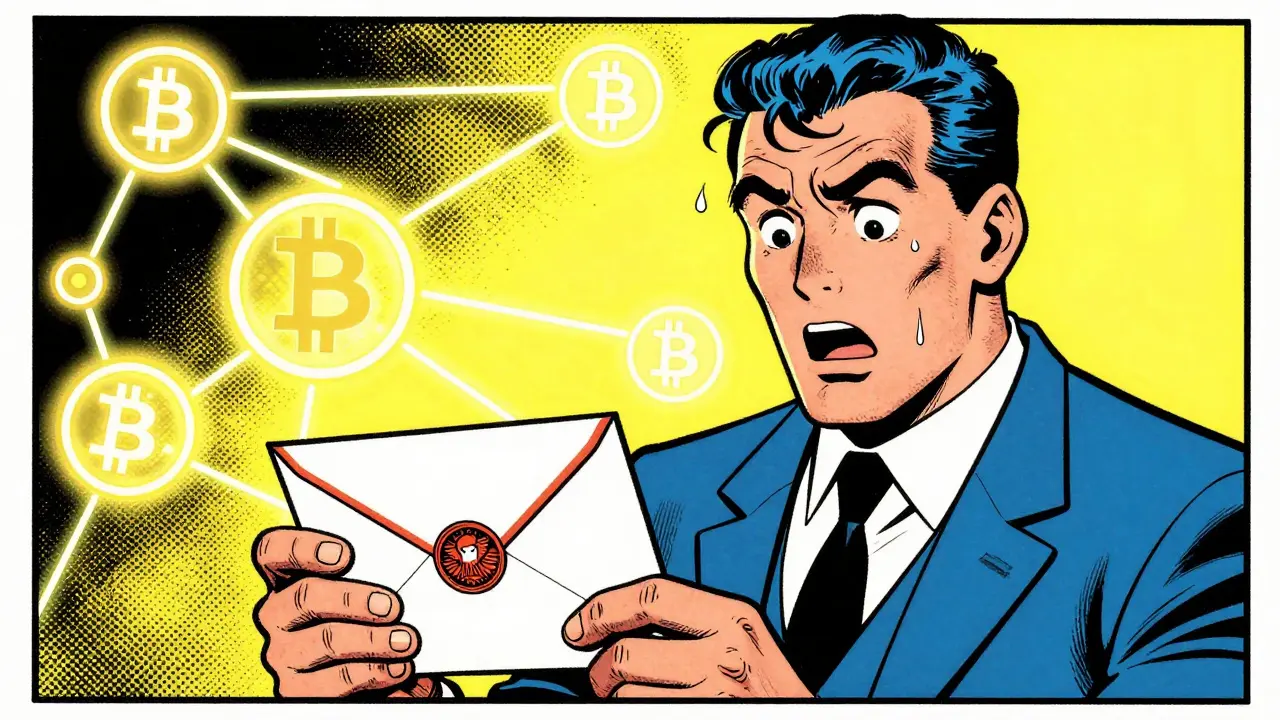
Imagine getting a letter from the IRS about a crypto trade you forgot to report. It might seem like a small mistake, but the consequences can be huge. In the US, crypto tax evasion isn't just a paperwork issue-it's a felony that can land you in jail for five years and cost you $250,000 in fines. And it's not just about big transactions. Even a $10 trade needs to be reported. Let's break down what this really means for you.
Key Takeaways
- IRS treats cryptocurrency as property, not currency, so every transaction-trading, mining, staking, or receiving as payment-must be reported.
- Intentional failure to report crypto income is criminal tax evasion, punishable by up to five years in prison and $250,000 in fines.
- Starting January 1, 2025, all U.S. exchanges must file Form 1099-DA, making it easier for the IRS to track transactions.
- Legal tax avoidance (like using tax-loss harvesting) is allowed, but intentional hiding of transactions is tax evasion and a felony.
- Amended returns for past years can reduce penalties, but waiting until the IRS finds you usually makes things worse.
Why the IRS treats crypto as property
The IRS made a clear decision back in 2014: cryptocurrency is property, not currency. This means every time you sell, trade, or use crypto, you could owe taxes. Unlike cash, where small transactions might fly under the radar, the IRS requires reporting for all crypto activity. There's no minimum threshold-whether it's $10 or $10 million, you must report it. This classification is why crypto tax evasion carries the same penalties as other tax fraud cases. It's not about the amount; it's about hiding the transaction.
What the real penalties look like
When the IRS says "up to five years in prison and $250,000 in fines," they mean exactly that. But here's the kicker: civil penalties can be even worse. If you underreport crypto gains, you could face penalties of up to 75% of the unpaid taxes. Add interest on top of that, and the total cost can spiral quickly. For example, if you owe $50,000 in taxes from unreported crypto trades, you might pay $37,500 in penalties plus interest-totaling over $87,500. Criminal charges usually happen when the IRS suspects intentional fraud, like hiding transactions or using fake identities. Civil audits are more common, but they can escalate to criminal investigations if the IRS believes you're deliberately avoiding taxes.

How the IRS tracks your crypto
Operation Hidden Treasure is the IRS's secret weapon. This program uses blockchain analytics to trace transactions across exchanges like Coinbase and Binance. Before 2025, many investors thought they could stay anonymous, but that changed. Starting January 1, 2025, all U.S. exchanges must file Form 1099-DA for every transaction. This form reports details like the date, amount, and type of trade directly to the IRS. Even transfers between your own wallets must be tracked-something many people don't realize. The IRS now has a complete picture of your crypto activity, making it nearly impossible to hide transactions without getting caught.
Tax avoidance vs. tax evasion: what's legal?
It's easy to confuse tax avoidance with evasion, but the difference is critical. Tax avoidance means using legal strategies to reduce your tax bill. For example, holding crypto for over a year before selling qualifies for lower long-term capital gains rates. Donating crypto to charity can also reduce taxable income. On the flip side, tax evasion is intentional. That includes not reporting a trade, falsifying records, or using unregistered exchanges to hide transactions. The IRS has stated clearly: if you know you should report it and choose not to, that's a felony. Even a single unreported $10 trade can lead to criminal charges if it's part of a pattern of evasion.

What to do if you made a mistake
Many crypto investors panic when they realize they missed reporting. The good news? You can fix it. The IRS has a voluntary disclosure program where you can file amended returns for past years. This often results in reduced penalties compared to being caught during an audit. For example, if you file an amended return before the IRS contacts you, you might only pay the original tax plus interest, avoiding the 75% civil penalty. Using tools like Koinly or CoinLedger can help track your transactions and generate accurate tax reports. Experts recommend reviewing your past filings-especially for 2023 and 2024-and correcting errors before the new Form 1099-DA data comes in. Waiting until the IRS finds you is almost always the worst move.
New rules for 2025: wallet-by-wallet accounting
Starting in 2025, you can't just average your crypto purchases anymore. The IRS requires wallet-by-wallet accounting for cost basis calculations. This means tracking every transfer between wallets and exchanges to determine which coins were sold. For example, if you bought 1 BTC on Coinbase and later transferred it to a hardware wallet, then sold part of it from the hardware wallet, you must track the original purchase price. This change makes accurate reporting more complex but also more transparent. Many crypto tax software platforms now support this method, but manual tracking is still necessary for cross-exchange transfers. Ignoring this rule could lead to underreporting gains and triggering IRS scrutiny.
Real-world consequences
In 2024, the U.S. collected $2.4 billion in crypto-related enforcement actions, with tax evasion accounting for 15% of global penalties. One high-profile case involved a crypto trader who failed to report $2 million in gains over three years. He was sentenced to 3.5 years in prison and ordered to pay $500,000 in fines and back taxes. Another investor received an IRS letter after the agency cross-referenced blockchain data with tax returns. After filing an amended return, he paid $80,000 in penalties but avoided criminal charges. These cases show the IRS is actively enforcing crypto tax rules-and the penalties are real.
Can I be charged with tax evasion for a small crypto trade?
Yes. The IRS has no minimum threshold for reporting crypto transactions. Even a $10 trade must be reported. While the IRS may not pursue criminal charges for very small amounts, intentional non-reporting of any size is still tax evasion. However, the likelihood of criminal prosecution increases with the amount involved and repeated failures to report. It's always better to correct mistakes early rather than risk escalation.
What happens if I don't report crypto mining income?
Mining crypto generates taxable income at the fair market value when you receive it. If you don't report mining rewards, the IRS can treat it as tax evasion. Penalties include up to five years in prison, $250,000 fines, and civil penalties of up to 75% of the unpaid tax. For example, earning $10,000 in mining rewards and not reporting it could lead to over $7,500 in penalties plus interest. Always report mining income on your tax return as ordinary income.
Do I need to report crypto received as payment for services?
Absolutely. If you receive crypto for work, it counts as income at the market value when you get it. This applies to freelancers, employees, and anyone earning crypto as payment. Failure to report it is tax evasion. For instance, getting paid in Bitcoin for a freelance job must be included in your taxable income-just like cash or checks.
Can the IRS track transactions on decentralized exchanges?
Yes. While decentralized exchanges (DEXs) don't require KYC, blockchain analytics tools can still trace transactions. The IRS uses these tools to follow crypto movements across all networks, including DEXs. If you trade on a DEX, you must report it. Ignoring DEX transactions is a common mistake that triggers IRS audits.
What's the difference between civil and criminal penalties for crypto tax evasion?
Civil penalties are financial (like fines and interest) and usually apply to unintentional mistakes. Criminal penalties involve jail time and are for intentional fraud. For example, accidentally forgetting to report a trade might result in civil penalties, but hiding transactions or using fake identities crosses into criminal territory. Criminal cases are rare for small amounts but common for large-scale evasion.
Is it too late to fix past crypto tax mistakes?
No. The IRS allows amended returns for up to three years of past tax filings. If you file before the IRS contacts you, you'll typically only pay the tax owed plus interest-avoiding steep civil penalties. Waiting until the IRS finds you often means higher fines and possible criminal charges. It's always better to correct errors proactively.


There are 23 Comments
Alex Garnett
The IRS treats cryptocurrency as property, not currency. This means every single transaction, regardless of amount, must be reported. Ignoring this is tax evasion-a felony punishable by up to five years in prison and $250,000 in fines. Americans must understand that compliance is non-negotiable. The notion that small trades don't need reporting is dangerously misguided. The IRS has tools to track every transaction, especially with Form 1099-DA coming in 2025. This isn't just about punishing individuals; it's about maintaining the integrity of the tax system. If you're not reporting your crypto activity, you're putting yourself at risk. There's no such thing as 'just a small mistake' when it comes to tax evasion. The law is clear: report everything. Period. Don't be naive about the consequences. The IRS isn't bluffing. They're actively enforcing these rules. If you're unsure, consult a tax professional immediately. Compliance is the only safe path forward.
Ryan Chandler
The IRS classifying crypto as property is a seismic shift in how we view digital assets. Every trade, every swap, every staking reward is a taxable event. This isn't just about compliance-it's about redefining value itself. Imagine the implications: from mining rewards to decentralized exchanges, every move is under scrutiny. The 2025 Form 1099-DA will be a game-changer, but it's also a wake-up call. The world is watching how the US handles this, and it sets the tone for global regulation. This isn't just about money; it's about the future of finance. We must embrace transparency while protecting individual rights. The balance between regulation and innovation is delicate. Let's not forget that this affects millions worldwide. The IRS's approach must be both firm and fair. This is a pivotal moment in the evolution of money itself. Let's rise to the challenge with wisdom and courage.
Ajay Singh
Report all crypto transactions. No exceptions. Small or big. Every trade counts. Use tax software. It's easy. File amended returns if needed. Better safe than sorry. Stay compliant. You'll thank yourself later. Simple as that.
Kyle Pearce-O'Brien
Let's dive into the nitty-gritty of crypto taxation. The IRS's classification as property isn't just semantics-it's a fundamental shift in how we conceptualize value. Every transaction, no matter how trivial, must be reported. This includes trades on decentralized exchanges, which are now under the IRS's microscope thanks to blockchain analytics. The upcoming Form 1099-DA will make tracking even more precise, leaving no room for error. Tax evasion isn't just about hiding income; it's about systemic fraud. The penalties are severe: up to five years in prison and $250k fines. But here's the kicker-civil penalties can be even worse. 75% of unpaid taxes plus interest? Ouch. The key is to distinguish between avoidance (legal) and evasion (illegal). For example, tax-loss harvesting is smart, but hiding transactions isn't. Ignoring this could lead to audits, penalties, or worse. The IRS isn't playing games. They're serious. So get your house in order before they come knocking. Trust me, you don't want to be on the wrong side of this. 🤔💰
Paul Jardetzky
Hey there! Don't panic about crypto taxes. Just report everything! You can file amended returns! It's easy! Use software like Koinly! It'll help you! No worries! Just do it! You'll be fine! 🚀💸
David Bain
The IRS's classification of cryptocurrency as property fundamentally alters the tax landscape for digital asset holders. Every transaction, regardless of size, necessitates accurate reporting due to the property designation. This is not merely a regulatory nuance but a legal imperative. Failure to comply constitutes tax evasion, which carries severe criminal penalties. The 2025 Form 1099-DA implementation will enhance IRS oversight, making non-reporting increasingly untenable. It is crucial to understand that tax avoidance through legitimate strategies differs markedly from evasion, which involves intentional concealment. For instance, utilizing tax-loss harvesting to offset gains is permissible, whereas deliberately omitting transaction data is not. The concept of cost basis accounting has evolved, requiring wallet-specific tracking for precise calculations. This complexity underscores the necessity for meticulous record-keeping. Ignoring these requirements invites scrutiny and potential prosecution. Historical enforcement data reveals substantial penalties for non-compliance. In 2024 alone, crypto-related enforcement actions totaled $2.4 billion, with tax evasion accounting for a significant portion. The IRS's Operation Hidden Treasure leverages blockchain analytics to trace transactions across all platforms. Consequently, the notion of anonymity in crypto transactions is a fallacy. Proactive compliance, such as filing amended returns before IRS contact, mitigates risks significantly. Therefore, the prudent course of action is to ensure all transactions are accurately reported to avoid severe consequences.
Mrs. Miller
Crypto tax evasion isn't just a US issue-it's a global conversation. The IRS's stance on property classification has ripple effects worldwide. But let's be real: this isn't about punishment; it's about fairness. Everyone should pay their fair share, but the rules need to be clear. The IRS isn't the enemy; they're just enforcing the law. However, the complexity of crypto taxation can be overwhelming. Many people don't know what to report. That's where education comes in. The government should provide better guidance, not just penalties. We need to balance regulation with understanding. After all, crypto is here to stay. Let's work together to make this system work for everyone. It's not about fear; it's about smart compliance. Don't let fear drive you to make mistakes. Stay informed, stay compliant, and move forward.
Nathaniel Okubule
It's important to approach crypto taxes with a calm and informed mindset. The IRS treats crypto as property, so every transaction must be reported. However, there are legal ways to minimize your tax burden, like tax-loss harvesting. If you've made mistakes in the past, filing amended returns can help. It's better to address issues proactively than wait for the IRS to find you. Many people are overwhelmed by the complexity, but help is available. Consult a tax professional who understands crypto. Don't let confusion lead to penalties. Stay proactive, stay compliant. It's manageable with the right guidance.
Alisha Arora
Wait, so even a $10 trade? Seriously? That's ridiculous. How are people supposed to keep track of that? The IRS is going way too far. They need to focus on bigger issues, not tiny transactions. This is just another way to squeeze money out of people. It's insane. I don't see how this helps anyone. Just makes life harder for regular folks.
Paul Gariepy
hey there! dont panic about crypto taxes! just report everything! you can file amended returns! its easy! use software like koinly! itll help you! no worries! just do it! youll be fine! but dont forget to double check everything! typos happen! but its better to be safe than sorry! seriously! just do it!
Shruti Sharma
ok so like crypto taxes are a thing? i didnt know that. but like, do they really care about small trades? like, $10? come on. this is so annoying. why do they make it so complicated? just let us pay taxes without all this fuss. its not like we're hiding anything. just report it and move on. but this is too much. why cant it be simple?
Robin Ødis
Let me tell you something about crypto taxes. It's not just about reporting. It's about integrity. The IRS has every right to track transactions. But the real issue is that people think they can get away with it. They're wrong. The IRS is using advanced tools to catch evaders. And when they do, the penalties are brutal. Five years in prison? $250k fines? That's not a joke. It's serious. People need to wake up. This isn't just about money; it's about ethics. If you're not reporting, you're cheating the system. And that's not acceptable. The IRS isn't here to scare you; they're here to enforce the law. So get your act together before it's too late. Trust me, you don't want to be on the wrong side of this. It's not worth it.
Jacque Istok
Let's cut through the noise. Crypto tax evasion isn't some technicality-it's a felony. The IRS isn't messing around. Every transaction, no matter how small, must be reported. But here's the thing: the rules are clear, and the consequences are severe. So why do people still ignore this? Ignorance isn't an excuse. The IRS has tools to track everything. Form 1099-DA in 2025 will make it even harder to hide. Civil penalties can be worse than criminal ones. 75% of unpaid taxes plus interest? Ouch. The difference between avoidance and evasion is critical. Legal strategies exist, but intentional hiding is a felony. Don't wait for the IRS to find you. File amended returns now. It's better to fix mistakes early than face worse consequences later.
Freddie Palmer
Hey! Don't worry about crypto taxes! Just report everything! It's easy! Use software like Koinly! It'll help you! File amended returns if needed! You'll be fine! Just make sure to double-check everything! It's important! Stay compliant! You'll thank yourself later!
Udit Pandey
The IRS's approach to cryptocurrency taxation is both necessary and appropriate. As a nation, we must uphold the integrity of our tax system. Every transaction, regardless of size, must be reported. This is not a suggestion but a legal requirement. Failure to comply constitutes tax evasion, punishable by up to five years in prison and $250,000 in fines. The upcoming Form 1099-DA will enhance oversight. Tax avoidance is legal; evasion is not. It is imperative to understand the distinction. The IRS's enforcement actions in 2024 totaled $2.4 billion. This underscores the seriousness of compliance. Proactive measures, such as amended returns, mitigate risks. Ignoring this is reckless. Compliance is non-negotiable.
Sharon Lois
Crypto taxes? Report it or go to jail. Simple.
Michael Sullivan
Crypto tax evasion? It's not just a mistake-it's a felony. Prison time and fines. 🚨💰🔥
Reda Adaou
Hey everyone! Don't stress about crypto taxes. Just report everything. Use tools like Koinly. It's easy. File amended returns if needed. You'll be fine. Stay compliant. It's simple. Let's all do our part. Together, we can make this work. No need to panic. Just take it step by step. You've got this!
perry jody
Hey there! Don't panic! Just report everything! Use Koinly! It's easy! File amended returns! You'll be fine! 🚀💸
Oliver James Scarth
Cryptocurrency taxation is a critical component of modern finance. The IRS's property classification ensures transparency and compliance. Every transaction, regardless of amount, must be reported. This is not a suggestion but a legal requirement. Failure to comply constitutes tax evasion, punishable by up to five years in prison and $250,000 in fines. The upcoming Form 1099-DA will enhance oversight. Tax avoidance is legal; evasion is not. It is imperative to understand the distinction. The IRS's enforcement actions in 2024 totaled $2.4 billion. This underscores the seriousness of compliance. Proactive measures, such as amended returns, mitigate risks. Ignoring this is reckless. Compliance is non-negotiable.
Kieren Hagan
It's essential to understand that crypto transactions must be reported. The IRS treats crypto as property, so every trade, mining reward, or payment must be included in your tax return. However, there are legal strategies to minimize your tax burden, such as tax-loss harvesting. If you've made mistakes in the past, filing amended returns is the best course of action. It's better to address issues proactively than wait for an audit. Many people are overwhelmed by the complexity, but professional help is available. Stay informed, stay compliant, and don't let confusion lead to penalties.
sachin bunny
wait a second! the IRS is tracking everything? like, even decentralized exchanges? that's crazy! they're watching us! this is a conspiracy! they want to control all our money! i think the government is using this to take away our freedom! what's next? they'll track every dollar we spend! this is so scary! i don't trust them at all! we need to fight back! 🤯🤯🤯
aryan danial
Let me break this down for you. The IRS treats cryptocurrency as property, which means every transaction-whether it's a trade, mining reward, or payment-must be reported. This classification is crucial because it affects how taxes are calculated. The upcoming Form 1099-DA will require exchanges to report all transactions, making it nearly impossible to hide activity. However, there is a distinction between tax avoidance and evasion. Avoidance is legal; evasion is not. For example, holding crypto for over a year before selling qualifies for lower capital gains rates, which is perfectly legal. But intentionally hiding transactions or using fake identities crosses the line into criminal territory. Civil penalties can be severe-up to 75% of unpaid taxes plus interest. Criminal charges, though rare for small amounts, can lead to prison time and fines. It's important to understand that even a $10 trade must be reported. Ignoring this could escalate into serious legal issues. The IRS has tools like Operation Hidden Treasure to trace transactions across all platforms, including decentralized exchanges. Therefore, proactive compliance is the only safe path forward. Consulting a tax professional who specializes in crypto can help navigate these complexities. Remember, the goal is not to evade taxes but to comply with the law while legally minimizing your liability. This is not just about money; it's about maintaining the integrity of the financial system. Let's all do our part to ensure transparency and fairness.
Write a comment
Your email address will not be published. Required fields are marked *