Remember when crypto rewards felt like finding a penny on the sidewalk? Random, small, and mostly forgettable. That era is over. If you’ve been hearing about the DAR airdrop but aren’t sure if it’s worth your time or just another hype cycle, you’re not alone. The landscape of Web3 gaming rewards has shifted dramatically since late 2025, and understanding how to actually earn these tokens requires more than just clicking a button.
The DAR Open Network is an AI-powered, chain-agnostic infrastructure provider that serves as the foundation for web3 applications with shared technology, assets, and $D token utility at its core. It launched a comprehensive Web3 Quest System on September 1, 2025. This wasn't a one-time giveaway; it was a structured "Play-2-Airdrop" competition mechanism designed to unite gamers across the Dalarnia ecosystem. For anyone looking to participate in 2026, knowing the rules of this system is the difference between earning meaningful rewards and wasting hours for zero return.
How the Web3 Quest System Actually Works
You don’t get free money here. You get paid for participation. The core engine driving the DAR rewards is the Quest System. Think of it less like a lottery and more like a seasonal league. Players earn what are called Quest Points by completing specific tasks. These tasks aren’t vague suggestions; they are daily, weekly, and seasonal quests spread across various Web3 games within the Dalarnia Open Network ecosystem.
The system operates on a four-week seasonal cycle. When Season 1 kicked off in September 2025, the reward pool was set at 100,000 $D tokens is the native utility token of the DAR Open Network used for governance, staking, marketplace transactions, and in-game utility. Your share of that pool depends entirely on your performance relative to other players. If you grind the quests and rank high, you get a larger slice. If you log in once a week, you get crumbs. This performance-based distribution ensures that active and skilled players receive proportionally higher rewards, keeping the competitive edge sharp.
There are three main types of rewards you’ll encounter:
- Quest Points: The primary currency for the Play-2-Airdrop competition. These determine your final ranking and your share of the $D token pool.
- Moon Coins: In-game currency that helps you progress faster within individual titles, indirectly helping you complete more quests.
- Exclusive Rewards: Special items or NFTs tied to specific achievements, which can hold value outside the immediate quest context.
The beauty of this setup is the cross-game asset sharing. Because DAR Open Network is chain-agnostic, your progress and assets can often move between different games in the ecosystem. This lowers the barrier to entry. You don’t need to master five different complex blockchains. You just need to play the games.
The Role of Dalarnia Legends and Competitive Gaming
If you’re a casual player, the daily quests might be enough. But if you want to maximize your earnings, you need to look at Dalarnia Legends is a flagship competitive game within the DAR ecosystem featuring the Legends Circuit tournament structure. The launch of the Quest System coincided with the introduction of the Legends Circuit. This is a layered tournament structure that starts with daily tournaments.
Why does this matter for an airdrop guide? Because high-level competition yields high-level Quest Points. The circuit provides a pathway for players to advance from daily matches to flagship tournaments. At the top, there’s the annual Grand Masters Final, where 64 players compete for massive prizes. Even if you don’t make the Grand Masters, participating in the lower tiers boosts your Quest Point total significantly. This multi-tiered approach ensures accessibility for casual players while maintaining high-reward opportunities for serious gamers. It’s a pyramid, but unlike most pyramids, the base layer still gets paid.

Understanding the Value of the $D Token
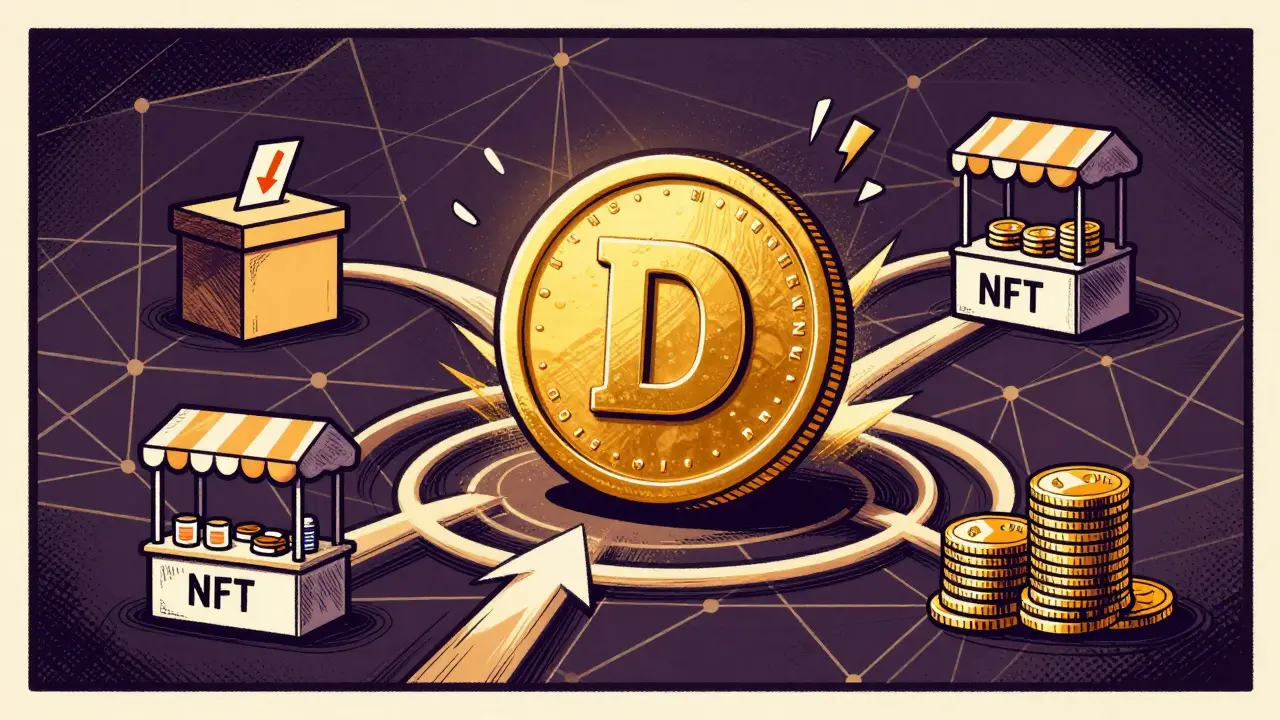
Earning tokens is great, but only if they have utility. The $D token isn’t just a speculative asset; it powers the entire ecosystem. As of early October 2025, data showed the token trading around $0.03131 with a circulating supply of 640 million D tokens. While prices fluctuate-showing volatility typical of the sector-the token has established itself as a functional medium of exchange.
Here is what you can actually do with your earned $D tokens:
- Governance: Vote on proposals that shape the future of the DAR Open Network.
- Staking and Lending: Use platforms like Bitget Earn to stake your tokens for passive income or lend them out.
- Marketplace Transactions: Buy and sell in-game assets and NFTs directly using $D.
- In-Game Utility: Spend them on upgrades, characters, or resources within supported games.
- Peer-to-Peer Payments: Send value directly to other users without traditional banking rails.
This utility creates a flywheel effect. More players mean more demand for $D, which supports the value of the rewards you earn. It’s not a closed loop where you earn tokens just to watch them depreciate. The ecosystem is designed to keep the token in circulation and useful.
| Feature | Quest System (Daily/Weekly) | Legends Circuit (Tournaments) | Assist2Earn (Referrals) |
|---|---|---|---|
| Effort Level | Low to Medium | High | Low |
| Reward Type | Quest Points, Moon Coins | High Quest Points, Exclusive Items | $D Tokens, Referral Bonuses |
| Consistency | Predictable Daily | Event-Based | Ongoing |
| Best For | Casual Players | Competitive Gamers | Community Builders |
Strategies to Maximize Your Airdrop Yield
So, how do you actually win? It comes down to strategy. You can’t just play randomly. Here are three proven approaches based on the system’s design.
1. The Consistency Grind
The Quest System rewards regularity. Daily quests reset every 24 hours. Missing a day means losing points that others will claim. Set a reminder. Treat it like a daily habit. Over a four-week season, those small daily gains compound into a significant Quest Point total. This is the safest route for steady returns.
2. The Tournament Climber
If you have skill in action games, focus on Dalarnia Legends. The Legends Circuit offers exponential point multipliers compared to standard quests. Winning a daily tournament can give you more points in an hour than grinding for a week. However, this requires time investment and practice. Analyze the meta, understand the mechanics, and climb the ranks.
3. The Assist2Earn Lever
Don’t underestimate referrals. The Assist2Earn program allows you to earn rewards by inviting friends. If you build a small community of players who also engage with the Quest System, you create a secondary income stream. This doesn’t replace gameplay, but it supplements it effectively. Combine this with Learn2Earn promotions to boost your initial capital.
Also, keep an eye on price fluctuations. The $D token has shown volatility, with 24-hour changes ranging from -1.20% to +4.60%. Some users arbitrage these swings. If you hold a large amount of $D, consider converting portions during peaks using Bitget Convert or spot trading. This turns your airdrop earnings into realized profit rather than just portfolio numbers.
Technical Accessibility and Chain Agnosticism
One of the biggest barriers in Web3 has always been technical friction. Which wallet? Which blockchain? Gas fees? DAR Open Network addresses this by being chain-agnostic. This means the infrastructure works across multiple blockchain networks. For you, the user, this translates to fewer headaches. You don’t need to manage five different wallets or bridge assets constantly.
The platform’s AI-powered infrastructure also optimizes user experience. It handles the backend complexity of asset sharing and progress tracking. This democratizes app development and enhances user agency. You focus on playing; the network focuses on making sure your rewards land correctly. This technical stability is crucial for long-term trust. If the system breaks, the airdrop stops. DAR’s commitment to robust infrastructure suggests this is built for longevity, not just a quick cash grab.
Future Outlook and Ecosystem Growth
As we move through 2026, the DAR ecosystem is expanding. Future developments include continued integration of new games, enhanced AI features, and potential increases in reward pool sizes. The success of the initial Quest System launch has likely influenced subsequent seasons. Performance metrics and community feedback drive iterative improvements.
What does this mean for you? It means the opportunity window is widening. More games mean more quests. More quests mean more ways to earn. However, it also means more competition. As the ecosystem grows, so does the number of players vying for the same reward pools. Early adopters had an advantage. Now, strategy and consistency are your best tools.
The 100,000 $D token pool for the inaugural season demonstrated significant financial commitment. Expect similar or larger commitments in future seasons as the market cap and user base grow. Keep an eye on official announcements for any changes to the reward structure or new game integrations. Adaptability is key in Web3.
When did the DAR Open Network airdrop start?
The comprehensive Web3 Quest System, which includes monthly airdrops, officially launched on September 1, 2025. The first four-week season began on this date with a reward pool of 100,000 $D tokens.
How do I earn Quest Points?
You earn Quest Points by completing daily, weekly, and seasonal quests across various Web3 games in the Dalarnia Open Network ecosystem. Points are awarded based on task completion and performance in activities like the Legends Circuit tournaments.
Is the DAR airdrop free to enter?
Yes, the Quest System is designed to provide accessible entry points for casual players. You do not need to purchase expensive NFTs to start earning. However, spending time and effort is required to maximize rewards.
What is the Legends Circuit?
The Legends Circuit is a layered tournament structure within Dalarnia Legends. It features daily tournaments that allow players to advance to flagship events, culminating in an annual Grand Masters Final for 64 top competitors.
Can I convert my $D tokens to other cryptocurrencies?
Yes, users can convert all crypto airdrops and rewards to other assets through mechanisms like Bitget Convert, Bitget Swap, or spot trading. The $D token is actively traded on major exchanges.
Does the DAR Open Network support multiple blockchains?
Yes, DAR Open Network is a chain-agnostic infrastructure provider. This allows the Quest System and associated games to operate across multiple blockchain networks, reducing technical barriers for users.