
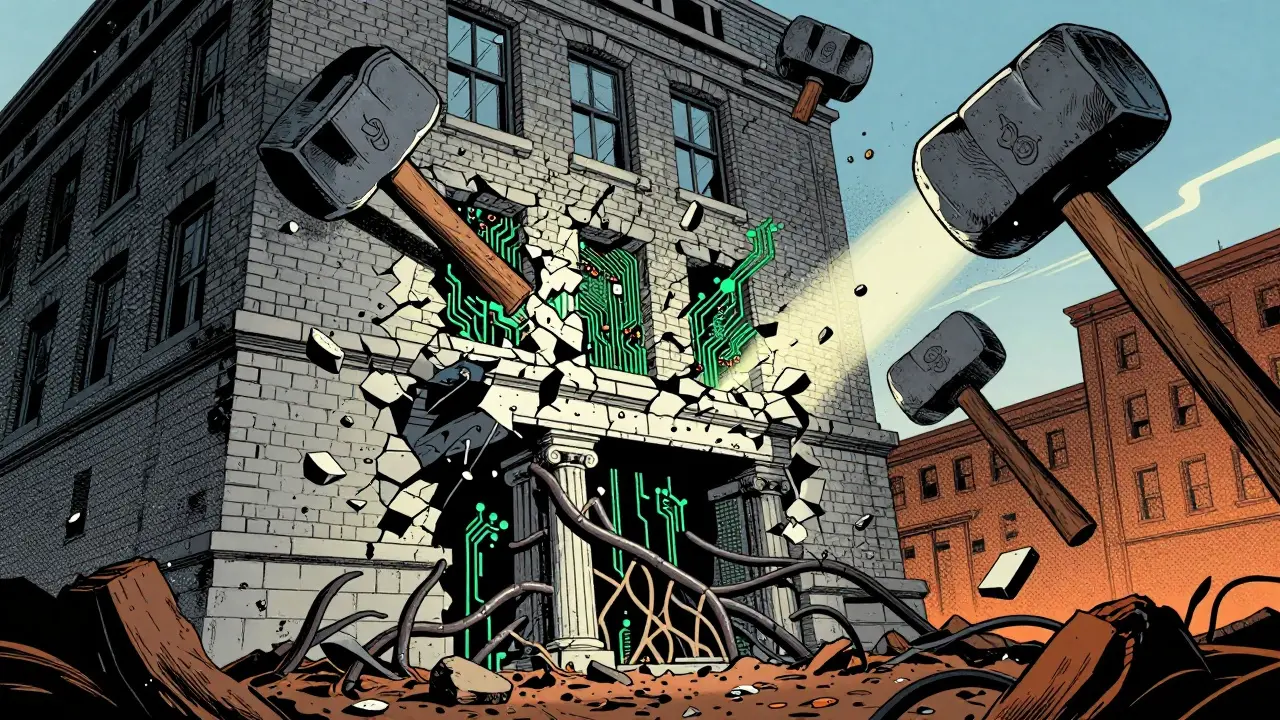
For anyone watching the intersection of geopolitics and digital finance, the story of Garantex is becoming harder to ignore. By March 2026, the platform has evolved from a standard crypto exchange into something far more complex-a decentralized ecosystem designed specifically to bypass Western controls. If you're a trader relying on these systems or analyzing market risks, understanding the full scope of the sanctions is critical. The United States Department of the Treasury didn't just slap a label on the site; they targeted the entire infrastructure keeping it alive.
You might ask why this matters now. Back in April 2022, Garantex was first sanctioned by OFACthe Office of Foreign Assets Control, part of the US Treasury responsible for enforcing economic sanctions. That move disrupted operations temporarily, but it wasn't the end of the road. In August 2025, the agency re-designated the entity under broader executive orders, citing its role in processing over $100 million linked to cybercrime and ransomware actors. The message was clear: the US sees this platform as a critical node in illicit financial networks.
The Garantex Ecosystem and Its Origins
To get a handle on the current mess, you have to look at where it started. Garantex Europe OU was originally registered in Estonia in late 2019, though most operations ran out of Moscow and Saint Petersburg. Founded by Sergey Mendelev and Aleksandr Mira Serda, the exchange quickly became one of the few remaining gateways for locals needing liquidity. When sanctions hit initially, many assumed the platform would fold. Instead, it went underground.
What began as a centralized web interface transformed into a distributed network. Researchers from Transparency International Russia identified that the brand name itself morphed. Even after domains were seized in March 2025 by authorities across Germany, Finland, and the US, the underlying business logic survived. The entity effectively split into successor platforms like Grinex and Exved, allowing users to access similar features without technically interacting with the 'sanctioned' URL. This cat-and-mouse dynamic is typical of evasion schemes, but the scale here is significant enough to draw global attention.
How Sanctions Changed the User Experience
If you are looking at this from the perspective of a trader, the practical effects are undeniable. Before the intensified crackdowns of mid-2025, getting your funds moved was relatively straightforward. Post-sanctions, the friction increased dramatically. Reports indicate transaction fees jumped from a low of 0.1% to nearly 1.5%. Why? Because the system relies on intermediaries to hide the trail.
Exved is a cross-border payment platform often associated with the Garantex ecosystem, facilitating payments in multiple jurisdictions to obscure transactions. Users now report needing 2-3 weeks just for verification through these intermediary agents. It used to take days. Community channels like BitBrothers highlight that novice users are struggling, with guidance periods extending to a month. The documentation has vanished in favor of Telegram bots offering minimal support, forcing everyone to rely on peer-to-peer knowledge sharing rather than official help desks.
| Metric | Before 2025 Sanctions | Current Reality (March 2026) |
|---|---|---|
| Transaction Fee | ~0.1% | ~1.5% |
| Verification Time | 1-2 Days | 2-3 Weeks |
| Support Channel | Website/Ticket System | Telegram Bots / P2P |
| Risk Profile | Standard Regulatory Risk | High Counterfeit/Ban Risk |
This isn't just about convenience. It's about visibility. The old model left some traces with regulated banks. The new setup tries to keep the 'crypto element invisible to regulators.' To do this, it moves through layers like Feilian Company Limited in Hong Kong, which holds accounts at Alfa-Bank in Russia. Funds go from rubles to foreign currency via these opaque bridges. For the average user, it feels seamless until a transaction gets flagged or stuck in limbo.
The Cybercrime Connection
There is a darker layer to this narrative that cannot be ignored. Why did the US Treasury double down in August 2025? Because the data showed deep ties to criminal enterprises. Assistant Director Michael Nordwall of the FBI noted during congressional hearings that platforms like Garantex provide 'critical infrastructure for criminal enterprises seeking to move value across borders while avoiding detection.'
FBI reports for 2024 showed crypto fraud surging 66%, totaling almost $10 billion in losses globally. Garantex was alleged to have processed transactions specifically for notorious ransomware-as-a-service groups and major darknet marketplaces. Secretary Janet Yellen stated publicly that the platform 'directly facilitated' these actors. While the exchange claims to be a victim of association, the forensic analysis places them at the center of a network processing illicit dollars, yuan, and USDT.
This connection brings immense risk to regular traders. You are likely using the same rails that bad actors are exploiting to hide their money. The result is a higher chance of being flagged, having assets frozen, or facing legal inquiries if your country enforces secondary sanctions.
Navigating the Multi-Jurisdictional Maze
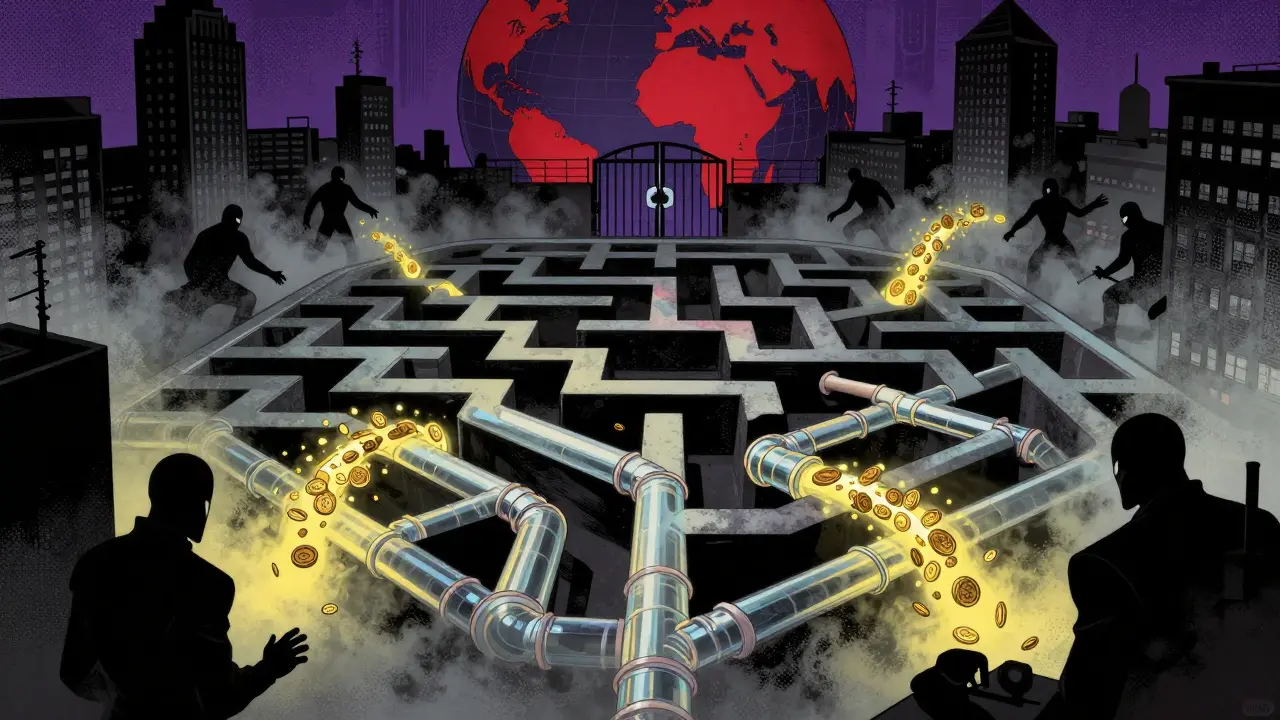
The architecture of the post-sanction Garantex ecosystem spans eight countries, including the UAE, Brazil, Georgia, and Thailand. Each jurisdiction adds a layer of complexity to how funds move. A typical journey involves transferring rubles to a Hong Kong entity, converting them to USD, and then moving USDT to a wallet. This multi-step process is designed to break the link between the original source and the final destination.
However, law enforcement knows this playbook. The OCCRP documented in September 2025 how investigators posed as exporters to map these routes. They found that transparency had vanished. New users now face steep learning curves. The 'support' provided is often community-based rather than corporate. This lack of professional oversight means if something goes wrong-like a lost transfer or a scam-you have no recourse.
Is Long-Term Viability Possible?
With the Department of State offering up to $5 million for information leading to arrests of leaders like Mira Serda, the pressure is mounting. One key figure, Aleksej Besciokov, was arrested in India in early 2025. Yet, despite arrests and domain seizures, the system persists. Chainalysis CEO Michael Gronager predicted in September 2025 that sanctions are actually creating 'more sophisticated, harder-to-track money laundering systems.'
Traders must weigh the convenience against the long-term stability. With 18.7 million cryptocurrency users in Russia as of mid-2025, demand remains high. However, reliance on a system that is actively being dismantled by international coalitions carries inherent uncertainty. Will a future ban cut off the bridge to foreign liquidity entirely? Or will the system just migrate again? The trend suggests migration, but every shift costs time and money.
Risks to Individual Wallet Holders
Using an entity that has been explicitly sanctioned by OFAC creates a potential chain reaction for personal wallets. Major exchanges in compliant jurisdictions (like those in Europe or North America) may flag incoming transfers from addresses known to interact with the Garantex network. Your funds could become 'blacklisted' even if your intent was innocent.
Furthermore, the integration of dual-use goods imports into this ecosystem adds another dimension. As the platform processes payments for sensitive technology exports, the scrutiny on any associated blockchain address intensifies. For a retail trader, this means enhanced due diligence and potentially losing access to banking services that refuse to touch high-risk counterparties.
Is it safe to use Garantex or its sister platforms in 2026?
It carries significant risk. Because the platform is sanctioned by the US Treasury and linked to illicit activities, holding funds there or moving them through associated entities can expose your other crypto assets to freezing or investigation by compliant exchanges and banks.
What happened to the Garantex website domains?
In March 2025, international law enforcement seized three primary domains, confiscated servers, and froze over $26 million in cryptocurrency holdings, forcing the ecosystem to operate through successors like Grinex and Exved instead.
How have transaction fees changed after the sanctions?
Fees have increased significantly, rising from roughly 0.1% before the crackdown to approximately 1.5% post-sanctions due to the added costs of multi-jurisdictional intermediaries and risk premiums.
Who founded Garantex Europe OU?
The exchange was co-founded by Sergey Mendelev and Aleksandr Mira Serda in late 2019, operating primarily out of Moscow and Saint Petersburg despite initial Estonian registration.
Are there legal consequences for individual traders using sanctioned platforms?
While enforcement focuses on leadership, traders risk asset freezes and banking exclusions if their transaction history intersects with sanctioned addresses, particularly if they trigger secondary sanctions checks in compliant jurisdictions.
There are 25 Comments
Justin Garcia
This whole setup is a trap waiting to bite people who think they know better.
Tiffany Selchow
Guess we cant just move money like normal folks anymore huh
Addy Stearns
The nature of financial sovereignty has shifted dramatically in recent years.
We observe that old structures crumble under geopolitical pressure.
It becomes difficult to trust traditional pathways anymore.
People seek alternatives when the main roads close up.
These alternatives often hide in plain sight within code.
However hiding does not mean safety from scrutiny.
The regulatory eye sees further than most users realize.
They trace flows through layers of complexity easily.
Users assume anonymity protects them from consequences.
That assumption leads to dangerous situations eventually.
The ecosystem adapts to survive against external force.
Adaptation costs the individual time and significant capital.
Fees rise as intermediaries insert themselves into chains.
Trust is eroded with every passing week of news.
Ultimately one must decide if the risk outweighs reward.
Raymond K
i tihnk you are rite abt the risk part but dont get too down
Jamie Riddell
its all pretty scary honestly
Chris R
different places see it differently here
Markus Church
The implications for cross-border transactions remain severe.
Leah Lara
Too much hassle just leave it alone.
Justin Smith
Exactly and compliance protocols dictate otherwise now.
Wade Berlin
Sanctions are fun until your wallet gets frozen forever.
Colin Finch
Yeah its like dancing with fire basically.
Shubham Maurya
Big tech lies always 💯💷🔥
Shaira Vargas
It is so messed up for regular people tho
Samson Abraham
just stay clear of the hot stuff
Cara Boyer
they are watching us all the tym now
athalia georgina
why u use thier system if bad
joshua kutcher
everyone makes mistakes sometimes just be careful going forward
Joy Crawford
feels like nobody cares about the little guy anymore
Beverly Menezes
we all just want safety and security
Lisa Miller
Hope things settle down soon for everyone here.
Zackary Hogeboom
yeah lets just hope for the best outcome for us
Alex Kuzmenko
thiis is reaal hard to deal with
Jay Starr
the drama never stops coming with these platforms
Matt Bridger
One observes the inevitable decay of regulated markets.
Michael Nadeau
True the cycle continues indefinitely without pause
Write a comment
Your email address will not be published. Required fields are marked *