

If you’re holding a large crypto portfolio and paying heavy capital gains taxes, you’re not alone. Many investors are asking: Can I legally reduce crypto taxes by moving abroad? The answer isn’t simple-but yes, it’s possible. And thousands have done it. But it’s not about buying a plane ticket and hoping for the best. This is a multi-year legal strategy that requires planning, documentation, and timing. Get it wrong, and you could face audits, penalties, or even double taxation. Get it right, and you could cut your crypto tax bill to zero.
Why Moving Abroad Works for Crypto Taxes
Most countries tax you based on where you live, not where your money is. The U.S., Canada, Australia, and the UK tax their citizens and residents on worldwide income-including crypto gains. But if you legally become a tax resident of a country that doesn’t tax crypto, you no longer owe tax on those gains. It’s not tax evasion. It’s tax residency optimization. The key is becoming a tax resident of a low- or zero-tax country. This isn’t the same as visiting or owning property. You need to prove you live there. That means spending enough days there, tying your life to the country, and cutting ties with your old tax home.Top Jurisdictions for Crypto Tax Reduction in 2025
Not all countries are equal when it comes to crypto. Here are the most effective options right now:- Dubai, UAE: No capital gains tax, no income tax, no wealth tax. Crypto transactions are completely tax-free for residents. To qualify, you need to live in the UAE for 183+ days per year or own property and register for a tax residency certificate. Many crypto founders and traders have relocated here because of the ease of banking, safety, and infrastructure.
- Portugal: Personal crypto gains are exempt from income tax and VAT. This applies only to individuals, not businesses. You need to become a tax resident by living there 183+ days a year or owning property. Portugal is popular among Europeans because it’s in the EU, has great weather, and low cost of living. But be warned: the government is under pressure to change this rule. Don’t assume it’ll last forever.
- Germany: If you hold crypto for more than one year, any profit is tax-free. You don’t need to move to avoid tax-you just need to wait. But if you want to become a tax resident, you only need to live there six months. This makes Germany ideal for long-term investors who want EU access without high taxes. The catch? You must prove you’re an individual investor, not a trader. Frequent trading could trigger business income rules.
- United Kingdom: Since April 2025, the UK replaced its old remittance basis with the Foreign Income and Gains (FIG) regime. New residents get a four-year tax holiday on foreign income and gains-including crypto. This is a rare window. If you move to the UK and haven’t been a resident in the last 10 years, you can shelter your crypto gains for four full years. After that, you’ll be taxed on worldwide income.
- Switzerland: Crypto gains are taxed as personal income, but rates vary by canton. Some, like Zug and Lucerne, have low rates and crypto-friendly policies. Switzerland doesn’t offer zero tax, but it offers stability, privacy, and strong banking. It’s a good middle ground for those who want EU access without the EU’s strict reporting rules.
What Doesn’t Work (And Why)
Many people think buying a second passport or setting up an offshore company will solve their crypto tax problem. It won’t. The U.S. taxes its citizens no matter where they live. If you’re a U.S. citizen, you must file taxes every year-even if you live in Dubai. To stop paying U.S. taxes, you must renounce your citizenship. That’s a big step. You’ll lose your passport, face an exit tax on your net worth over $2.6 million, and be barred from re-entering the U.S. as a tourist for 10 years if you’re considered a “covered expatriate.” Canada and Australia also tax citizens abroad. You can’t escape them by moving unless you give up your citizenship or permanent residency. Most people don’t do this unless their crypto portfolio is over $5 million. Also, don’t think you can just rent a place in Portugal for six months and claim residency. Tax authorities look at your life: where your family lives, where you bank, where you vote, where your car is registered. If you still have a U.S. address, a job, and a driver’s license, you’re still a U.S. tax resident-even if you’re in Lisbon.
The 12-Month Relocation Plan
Moving isn’t a weekend trip. It takes time. Here’s a realistic timeline:- Months 1-3: Audit Your Portfolio-List every crypto transaction you’ve ever made. Use tools like CoinTracker or Koinly to track purchase dates, amounts, and values. Know your cost basis. This is critical for proving holding periods and avoiding exit taxes.
- Months 4-6: Choose Your Target Country-Pick one based on your goals. Want zero tax? Go to Dubai. Want EU access? Go to Portugal or Germany. Want a four-year window? Go to the UK. Don’t pick based on hype-pick based on your lifestyle and long-term plans.
- Months 7-9: Establish Residency-Move your life. Rent or buy property. Open a local bank account. Get a local phone number. Cancel your old utilities. Start using your new address for mail. Spend at least 183 days in the country. Keep a travel log. Take photos. Save receipts.
- Months 10-12: Transfer Assets and Cut Ties-Move your crypto to wallets with your new country’s address as the recovery contact. Don’t sell anything yet. Wait until after you’re officially a tax resident. Then, sell. If you sell before becoming a resident, your old country may still claim the gain.
- Month 13+: File Correctly-Hire a cross-border tax advisor. File tax returns in both countries if required. Use foreign tax credits where applicable. Keep records for 10 years.
Exit Taxes and Traps to Avoid
Some countries charge you a tax just for leaving. The U.S. has an exit tax. Germany doesn’t, but it will tax you on unrealized gains if you leave before holding crypto for a year. The UK used to have a remittance basis-you could avoid tax on foreign income if you didn’t bring it home. Now, they’ve replaced it with the FIG regime, which is better for new arrivals but worse for long-term residents. The biggest trap? Selling crypto before you’re officially a tax resident. If you sell $500,000 in Bitcoin while still a U.S. resident, you owe U.S. capital gains tax-even if you move to Dubai the next day. The tax event happens when you sell, not when you move. Also, don’t forget about source rules. If you earn crypto from a U.S.-based exchange, that income might still be considered U.S.-sourced. That means even if you live in Portugal, the IRS might still want a piece. Work with a tax lawyer to structure your holdings correctly.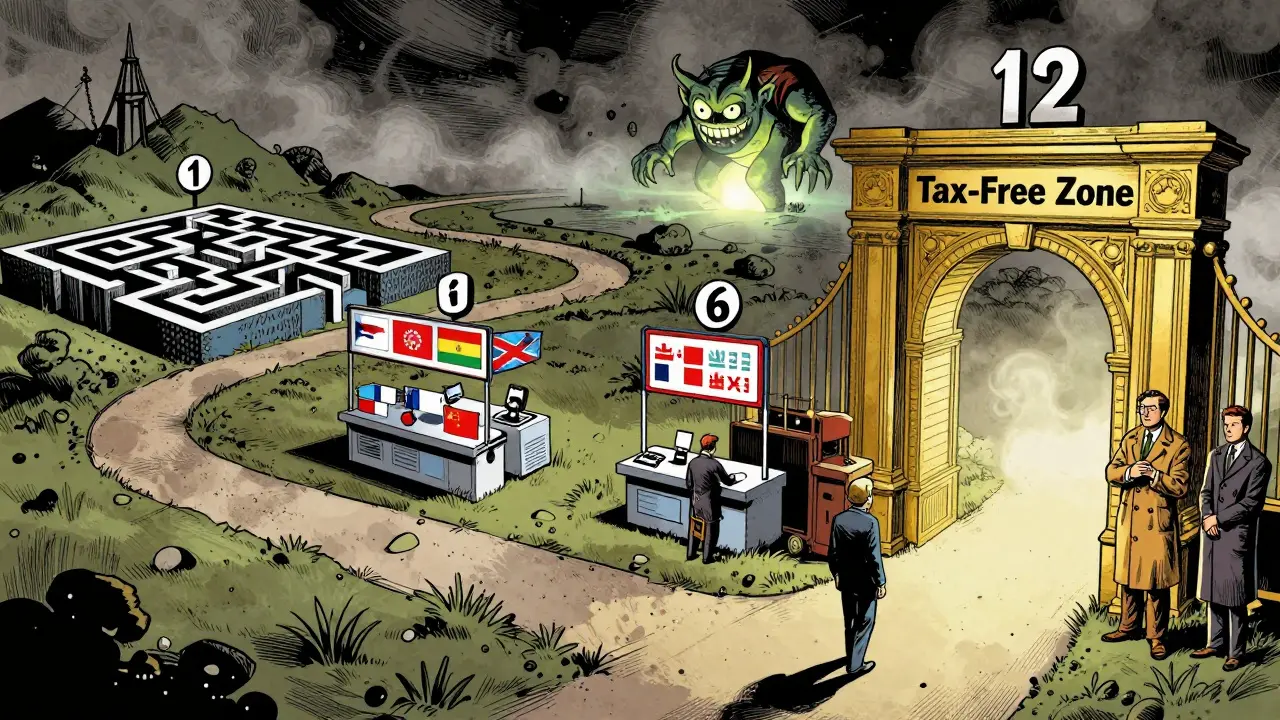
Tools and Professionals You Need
You can’t do this alone. You need:- CoinTracker or Koinly-to track every transaction across exchanges and wallets. These tools auto-calculate gains and losses in multiple currencies.
- A cross-border tax advisor-someone who understands both your home country’s rules and your new country’s crypto laws. Don’t use a local accountant who’s never handled crypto.
- A residency lawyer-to help you meet legal requirements for tax residency. In Dubai, this means getting a residence visa and tax certificate. In Portugal, it means proving your property ownership and intent to stay.
- A digital nomad accountant-for annual filings. Expect to pay $5,000-$20,000 a year depending on your portfolio size and complexity.
Real Stories, Real Results
One trader from New York moved to Dubai in early 2024. He held $1.2 million in Bitcoin and Ethereum. He didn’t sell anything until he got his UAE tax residency certificate. In 2025, he sold $800,000 in gains. He paid $0 in tax. He now lives in a villa in Palm Jumeirah. A couple from London moved to Portugal in 2023. They had $3 million in crypto. They became residents by buying a home in Lisbon. They sold $1.5 million in gains in 2025. No tax. They now run a crypto education business from a co-working space in Porto. But not everyone wins. A Canadian crypto investor tried to move to Portugal without cutting ties to Canada. He kept his Canadian bank account, his job, and his driver’s license. The CRA audited him and taxed him on $700,000 in gains. He lost $200,000 in penalties.The Future of Crypto Tax Relocation
The world is changing. The OECD is pushing for global crypto reporting. The EU’s MiCA regulation requires exchanges to report user data to tax authorities. Portugal might close its loophole. Dubai could introduce a wealth tax. The UK’s four-year window will expire for those who moved in 2025. This isn’t a permanent fix. It’s a strategic window. The window is open now-but it won’t stay open forever. The trend is clear: countries are getting smarter. They’re not just looking at where you live. They’re looking at where your money came from, how long you held it, and whether you have real economic substance in your new country. If you’re serious about reducing your crypto taxes, act now. But don’t rush. Do it right. Hire experts. Keep records. Be patient. The savings can be life-changing-but only if you play by the rules.Can I avoid crypto taxes by moving to a tax haven like the Cayman Islands?
No. The Cayman Islands don’t have a formal tax residency program for individuals. You can’t legally become a resident there to avoid crypto taxes. Most tax havens like this don’t offer residency to foreigners unless you’re investing millions in real estate or businesses. Even then, they don’t guarantee tax exemption on crypto. Stick to countries with clear residency rules like Dubai, Portugal, or Germany.
Do I need to sell my crypto before moving?
No. In fact, selling before you become a tax resident can trigger taxes in your old country. Wait until you’ve legally established residency in your new country. Then, sell. This ensures the tax event happens under the new country’s rules, not your old one. Use tools like CoinTracker to track the exact date you became a tax resident and match it to your sale date.
Can I keep my U.S. bank account after moving?
You can, but it’s risky. Keeping U.S. accounts, a U.S. address, or a U.S. driver’s license can make tax authorities think you haven’t truly left. For full tax optimization, open accounts in your new country, use a local address, and cancel U.S. services where possible. If you’re a U.S. citizen, you still have to report foreign accounts to the IRS-but that’s separate from paying tax on gains.
How long do I have to live in a new country to qualify for tax residency?
It varies. Portugal and Dubai require 183+ days per year. Germany requires six months. The UK’s new FIG regime only applies to people who haven’t been residents in the last 10 years. Always check the specific rules of your target country. Don’t assume 6 months is enough everywhere. Some countries require proof of intent-like signing a lease, enrolling kids in school, or joining a local gym.
What if I move and then return to my home country?
If you return and become a tax resident again, you’ll likely owe taxes on any gains you made while abroad-especially if you didn’t report them. Some countries, like the U.S., can tax you retroactively. Others, like Germany, may re-tax you on gains if you held crypto less than a year before leaving. Always plan for the long term. Don’t treat relocation as a short-term tax hack.




There are 16 Comments
SUMIT RAI
surendra meena
Bruce Morrison
Andrew Prince
Jordan Fowles
Steve Williams
prashant choudhari
Willis Shane
Jake West
Shawn Roberts
Abhisekh Chakraborty
dina amanda
Emily L
Gavin Hill
Andrea Stewart
Josh Seeto
Write a comment
Your email address will not be published. Required fields are marked *