
Crypto Compliance Cost Estimator
Calculate Your Compliance Budget
Estimate annual KYC/AML costs for your crypto business based on size and location
1,000
10,000
100,000
500,000+
10,000 users
Estimated Annual Compliance Costs
Includes: Software licenses, compliance officers, audits, and legal counsel
Based on 2025 regulations from FATF, MiCAR, and national guidelines
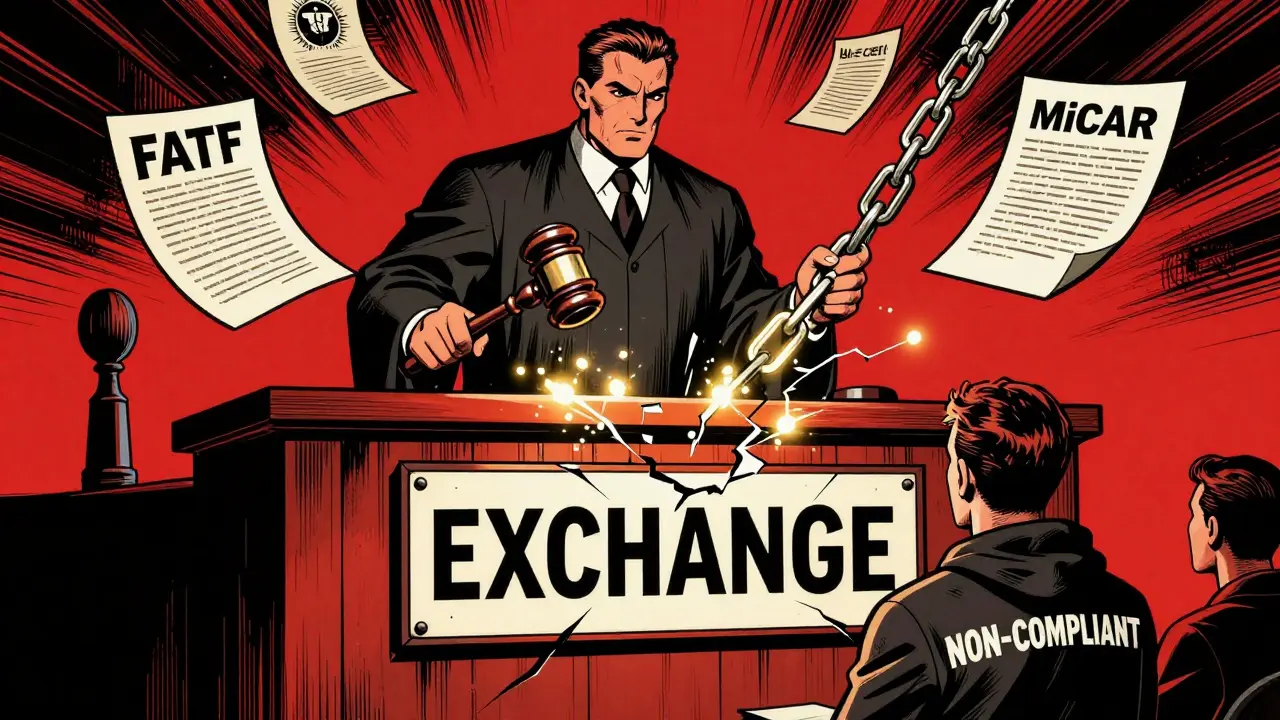
By 2025, there’s no such thing as a crypto business that can ignore KYC and AML rules. If you’re running an exchange, a wallet service, a DeFi gateway, or even a stablecoin issuer, you’re not just encouraged to comply-you’re legally required to. The days of operating in the gray zones are over. Regulators around the world have locked in strict, non-negotiable standards, and failing to meet them now means fines, bank account closures, or worse-shutting down entirely.
What KYC and AML Actually Mean for Crypto
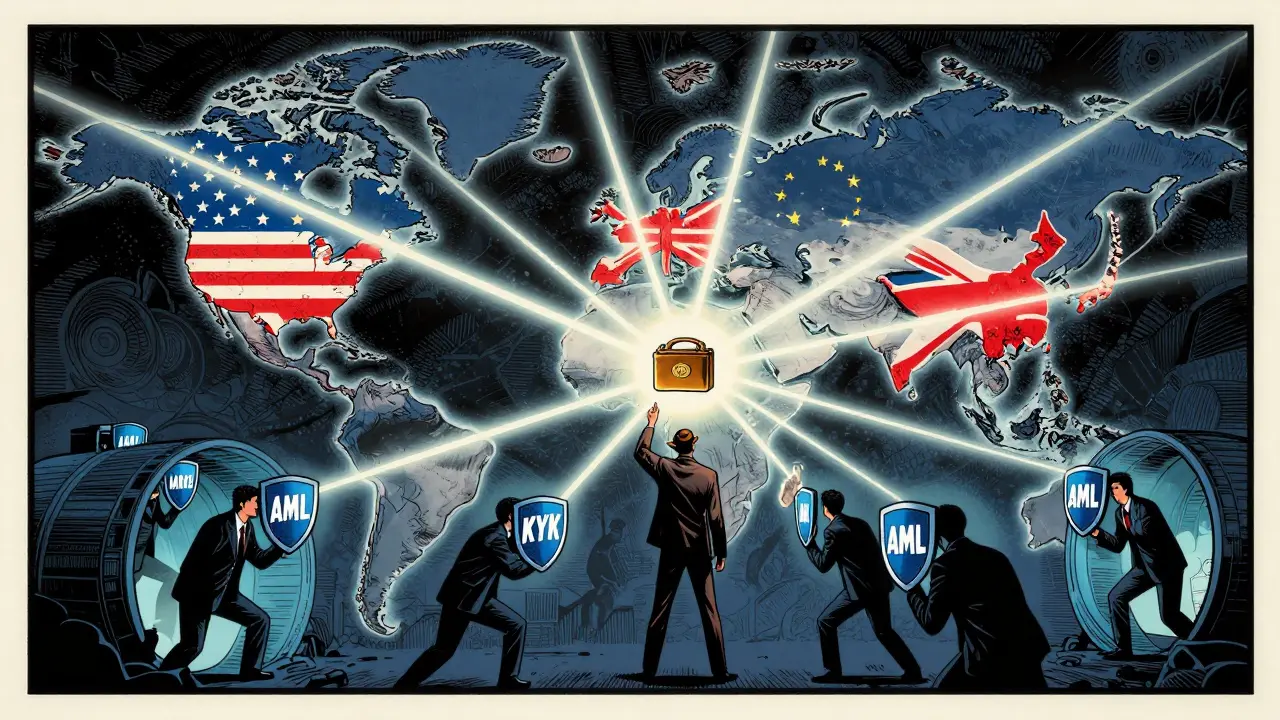
Know Your Customer (KYC) is about verifying who your users are. It’s not just asking for a name and email. It’s collecting government-issued ID, proof of address, facial recognition scans, and sometimes even source-of-funds documentation. Anti-Money Laundering (AML) goes further: it’s watching every transaction, flagging anything odd, and reporting suspicious activity before it becomes a problem.Before 2019, many crypto firms treated these as optional. Today, the Financial Action Task Force (FATF) makes it clear: every Virtual Asset Service Provider (VASP) must follow the same rules as banks. That includes crypto exchanges, OTC desks, custodial wallets, and even platforms that connect users to DeFi protocols. The FATF’s Travel Rule, updated in 2019 and fully enforced by 2025, forces VASPs to share sender and receiver details for transactions over $1,000. That means if you send $1,500 in Bitcoin from Binance to a wallet on Kraken, both platforms must exchange names, addresses, and account IDs-not just wallet addresses.
How Different Regions Handle Crypto Compliance
The rules aren’t the same everywhere, but they’re all tightening.
In the United States, the GENIUS Act (passed June 2025) and the STABLE Act now treat stablecoin issuers like banks. They must register with FinCEN, run full KYC on users, report suspicious activity, and hold reserves in audited, FDIC-insured banks. The SEC and CFTC are also cracking down on unregistered crypto platforms. In 2024, the U.S. imposed over $1.2 billion in crypto-related AML penalties-more than all previous years combined.
The European Union rolled out MiCAR in December 2024. It’s the most comprehensive crypto law ever written. Every issuer of Asset-Referenced Tokens (ARTs) or Electronic Money Tokens (EMTs) must get licensed by national authorities, submit detailed compliance reports, and use certified KYC/AML software. The new European Anti-Money Laundering Authority (AMLA), launched in 2025, now oversees enforcement across all 27 member states. No more playing one country’s rules against another’s.
In the United Kingdom, the FCA requires all crypto firms to register under the AML regime. You need to monitor transactions in real time, keep records for five years, and file Suspicious Activity Reports (SARs) within 72 hours. The UK also tightened rules on beneficial ownership: since August 2025, anyone holding crypto through a trust must disclose their identity publicly via the Register of Overseas Entities. Whistleblowers now have stronger legal protection too-under the Public Interest Disclosure (Amendment) Order 2025, insiders can report violations directly to HMRC or the FCA without fear of retaliation.
Japan and Singapore have long been strict, but in 2025, they’ve added real-time transaction monitoring mandates. In Japan, all exchanges must use AI-driven systems to detect layering and structuring patterns. Singapore’s MAS now requires all VASPs to submit quarterly compliance audits, with penalties for even minor documentation gaps.

Technology Is No Longer Optional
You can’t do this manually anymore. The volume, speed, and complexity of crypto transactions make human review impossible. That’s why top compliance teams now rely on:
- AI-powered KYC platforms that auto-verify IDs across 190+ countries using machine learning
- Real-time transaction monitoring that flags unusual patterns-like rapid transfers between high-risk wallets or sudden spikes in activity from dormant accounts
- Blockchain analytics tools like Chainalysis or Elliptic that trace funds across chains and identify mixers, tumblers, or sanctioned addresses
- Sanctions screening engines that update in real time against OFAC, UN, and EU lists
Companies using outdated KYC software-like basic document upload systems without liveness detection or geolocation checks-are getting flagged during audits. In 2025, the average crypto firm spent 28% of its operational budget on compliance tech. That’s not a cost-it’s insurance.
The Hidden Costs of Non-Compliance
It’s not just fines. It’s everything else that comes with being on a regulator’s radar.
In 2024, a U.S.-based crypto lender lost its banking relationships after failing to properly screen 12,000 transactions tied to a sanctioned Russian entity. The bank froze their accounts. They couldn’t pay employees. They couldn’t process withdrawals. They collapsed within six weeks.
Another firm in the UK was fined £4.7 million for not updating its sanctions list for eight months. The fine was bad. But the real damage? They lost access to SWIFT payments. Now they can’t move money internationally-even legitimate money.
And reputational damage? It’s permanent. Investors, partners, and even users avoid companies with compliance histories. In 2025, a survey of 1,200 institutional crypto investors found that 93% refused to work with any platform that had received a regulatory penalty in the last three years.
What You Need to Do Right Now
If you’re running a crypto business in 2025, here’s what you must have:
- A licensed compliance officer-someone who understands FATF, MiCAR, and local rules. Not a lawyer who dabbles in crypto. A full-time compliance pro.
- Integrated KYC/AML software that covers ID verification, transaction monitoring, sanctions screening, and reporting in one platform. Tools like KYC-Chain, ComplyAdvantage, or Trulioo are industry standards.
- Real-time monitoring for all on-chain and off-chain activity. No delays. No batch processing.
- Regular audits-at least quarterly. External auditors should review your logs, your reports, and your system configurations.
- Employee training-not a one-time webinar. Quarterly refreshers with real case studies from your own platform.
And if you’re a user? Don’t assume your wallet is safe just because it’s non-custodial. If you’re using a centralized exchange, your identity is already known. If you’re moving funds to a DeFi protocol, you’re still subject to the Travel Rule if the gateway you used is regulated.
The Future Is Clear: No More Gray Areas
The crypto industry isn’t being squeezed out-it’s being matured. The regulatory chaos of 2017-2021 is gone. What’s left is a system where transparency is the price of entry. The companies that survive aren’t the ones that dodged rules. They’re the ones that built compliance into their DNA.
By 2026, we’ll see even tighter global alignment. FATF is pushing for a unified Travel Rule standard. The IMF and World Bank are funding compliance tech in emerging markets. Even countries like Nigeria and Brazil, once seen as crypto havens, are rolling out mandatory KYC for all local exchanges.
If you’re still asking whether you need KYC and AML, the answer isn’t coming. It’s already here. The question now is: are you ready to meet it?
Do I need KYC if I only use non-custodial wallets?
If you’re just holding crypto in your own wallet and never using a regulated exchange or gateway, you’re not legally required to complete KYC. But if you ever buy crypto through a centralized platform-like Coinbase, Binance, or Kraken-you’ve already been verified. And if you send funds from that exchange to a DeFi protocol through a regulated on-ramp, your identity is linked to that transaction. The Travel Rule applies to the VASPs involved, not necessarily to you as an individual. But if you’re a business, even if you use non-custodial wallets, you still need KYC on your customers.
What happens if I ignore KYC/AML rules?
You risk losing access to banking services, facing heavy fines (often millions), and being blacklisted by regulators. In 2025, over 80 crypto firms globally had their licenses revoked or were forced to shut down due to compliance failures. Even small mistakes-like not updating a sanctions list or missing a SAR deadline-can trigger audits that lead to business closure. There’s no second chance in crypto compliance anymore.
Are DeFi platforms required to do KYC?
The protocol itself? No. But any gateway or intermediary that connects users to DeFi-like a centralized exchange that offers DeFi staking, or a wallet provider that routes transactions-must comply with KYC and the Travel Rule. In 2025, regulators are targeting the entry and exit points, not the open protocols. So if you’re using MetaMask to connect to Uniswap, you’re not being KYC’d. But if you bought your ETH through Binance first, Binance already verified you.
Is there a global standard for crypto KYC?
The FATF guidelines are the closest thing to a global standard. But countries implement them differently. The EU enforces MiCAR strictly. The U.S. uses a patchwork of federal and state rules. Japan has its own licensing system. So while the core principles-identity verification, transaction monitoring, reporting-are universal, the exact processes vary. That’s why compliance software must be configurable for multiple jurisdictions.
How much does crypto KYC/AML compliance cost?
For a small exchange with 10,000 users, expect to spend $150,000-$300,000 annually on software, staff, and audits. Larger platforms with over 500,000 users often spend $2 million or more. That includes licensing fees for compliance tools, hiring compliance officers, legal counsel, and internal audit teams. It’s expensive-but far cheaper than a $10 million fine or losing your bank account.
Can I use the same KYC system for crypto and traditional finance?
Technically, yes-but it’s risky. Traditional finance KYC tools aren’t built for blockchain data. They can’t trace on-chain behavior, detect mixer usage, or flag cross-chain swaps. Crypto-specific platforms integrate blockchain analytics and real-time wallet monitoring, which traditional tools don’t. Using a generic banking system for crypto compliance is like using a bicycle to race in the Tour de France. You might move, but you won’t win.
Compliance isn’t a hurdle anymore. It’s the foundation. The crypto industry that survives the next decade won’t be the one with the flashiest tech or the most hype. It’ll be the one that built trust through transparency.





There are 26 Comments
Madison Agado
It's funny how we call this 'maturity' when it's really just control dressed up in compliance suits. The same institutions that crashed the global economy in 2008 now get to decide who gets to participate in finance. Transparency? Sure. But whose transparency? Ours, or theirs?
And what happens when the algorithms flag a grandmother sending $500 to her grandkid in Nigeria as 'suspicious activity'? We're not building trust-we're building surveillance infrastructure with blockchain branding.
I'm not anti-regulation. I'm anti-authority masquerading as protection. The real innovation was decentralization. Now we're just re-centralizing it with more forms to fill out.
Tisha Berg
Hey, I just want to say-this is actually really helpful for people like me who are new to crypto and scared they'll mess up. I didn’t realize how much goes into compliance. Thanks for breaking it down so clearly. You’re right, it’s not optional anymore. Better to learn now than get shut down later. 🙏
Billye Nipper
YES!! This is exactly what we needed!! 💪🔥 Compliance isn’t boring-it’s the backbone of real adoption!!
Stop treating KYC like a chore-it’s your shield!! Your armor!! Your ticket to legitimacy!!
Investors are RUNNING from non-compliant platforms. I’ve seen it. I’ve lived it. Don’t be the next cautionary tale. Get the software. Hire the officer. Train your team. Do it NOW. I believe in you!!
Chris Jenny
They call this 'maturity'... but it's a trap. The same banks that froze your money during the 2008 crisis? Now they're writing the rules for crypto. You think they want you to be free? They want you controlled. They want your data. They want your transactions tracked. They want to know who you send money to-every single time.
And don't tell me 'it's for safety.' Safety for who? Not for us. Not for the Global South. Not for people who just want to move money without asking permission.
They're not regulating crypto-they're killing it softly. And you're all clapping while they tie the noose.
Uzoma Jenfrancis
Why are we letting Western regulators dictate how Africans use money? Nigeria has over 40 million crypto users. We don't need your FATF rules. We don't need your 'Travel Rule.' We built this with our own hands while you were still arguing about Bitcoin being a scam.
Now you come in with your audits and your sanctions lists and say 'this is how it must be.' No. This is our economy. Our future. You don't get to decide what freedom looks like for us.
Stop pretending this is about safety. It's about control. And we're not playing.
Renelle Wilson
While the regulatory landscape has undeniably evolved into a more structured and institutionalized framework, it is imperative to recognize that this evolution reflects a broader societal imperative toward financial integrity and systemic resilience. The integration of AI-driven compliance mechanisms, while technologically sophisticated, must be balanced with ethical considerations regarding privacy, equity, and algorithmic bias. Moreover, the disproportionate burden placed on small-to-medium-sized enterprises-particularly in emerging economies-raises legitimate concerns regarding equitable access to compliance infrastructure. It is not merely a matter of adherence to legal mandates; it is a philosophical reckoning with the nature of trust in digital finance. The question remains: Can transparency coexist with autonomy, or have we inadvertently constructed a panopticon under the banner of security?
Chloe Hayslett
Oh wow, a 28% budget on compliance? That’s adorable. You mean the same people who spent 2021 telling us 'code is law' are now begging for a license from the SEC? Congrats, you turned Bitcoin into a bank account with extra steps.
And don’t even get me started on MiCAR. The EU thinks they’re the IMF now. Wake up. Nobody cares about your paperwork if your exchange gets hacked tomorrow. Build better tech. Stop filling out forms.
Jonathan Sundqvist
Man, I used to think crypto was about freedom. Now I gotta submit my driver's license just to buy a few bucks of BTC? And they call this progress?
I get the money laundering thing. But this is overkill. I'm not a criminal. I just want to trade. Why does every platform feel like the DMV?
And don't even get me started on the Travel Rule. If I send 1.5k to my cousin in Canada, now Binance has to tell Kraken who I am? That's not compliance. That's surveillance.
Thomas Downey
One must pause to consider the philosophical implications of this regulatory convergence. The erosion of pseudonymity in financial transactions represents not merely a policy shift, but a metaphysical surrender to institutional authority. The very essence of decentralized finance-its ontological independence from state-sanctioned intermediaries-has been systematically dismantled under the guise of 'risk mitigation.'
One wonders: Is the blockchain still a ledger of value, or has it become merely a transactional logbook for compliance officers? The tragedy is not in the regulation, but in the collective acquiescence. We did not lose our freedom-we willingly handed it over, smiling, while signing the KYC form.
Annette LeRoux
This is actually kinda beautiful in a weird way 😊
Like, yeah, it’s a lot of paperwork… but imagine if we could finally stop scams. No more rug pulls. No more fake stablecoins. No more people losing their life savings because someone didn’t do their homework.
Compliance isn’t sexy, but it’s the quiet hero we didn’t know we needed. 🤝✨
Jerry Perisho
The Travel Rule applies only to VASPs, not end users. That’s the key point. If you’re using MetaMask and buying via a non-KYC P2P platform, you’re fine. The regulation targets intermediaries, not individuals. Most people misunderstand this.
Also, AI monitoring works best when trained on local transaction patterns. Generic tools fail in emerging markets. You need region-specific models.
Manish Yadav
They want to kill crypto with paperwork! This is a war against the poor! In India, we use crypto to send money home, to pay doctors, to survive. Now you want us to show bank statements? Who do you think you are?
They made Bitcoin to escape banks. Now they made banks the boss of Bitcoin. This is betrayal. This is theft. This is the end of freedom.
And you people are just nodding like good little sheep? Shame on you.
Krista Hewes
ok so i just read this whole thing and honestly i’m kinda overwhelmed?? like i get that compliance is important but… is there a simple guide for normal people? like, if i just hold btc in my ledger and never use an exchange do i need to do anything? or is it only if i use coinbase? also… what’s a SAR? sorry i’m new and this feels like a tax form from hell 😅
Noriko Robinson
I think this is a turning point. Not because regulation is bad, but because it forces us to grow up. We spent years saying 'we don’t need banks'-but now we’re building something better. Something that works with the real world, not against it.
Yes, it’s harder. Yes, it’s expensive. But if we want real adoption-by institutions, by governments, by grandma who wants to send crypto to her grandkids-we need trust. And trust needs rules.
Let’s build the future. Not the fantasy.
Mairead Stiùbhart
Oh honey, you really think this is about 'maturity'? Sweetie, it’s about banks reclaiming their monopoly. You think the SEC cares about your 'decentralized' protocol? They care that you’re not paying them a cut.
And don’t even get me started on the 'Travel Rule.' That’s not compliance-it’s a backdoor to financial censorship. You send $1,001? Now the government knows your cousin’s wallet address. Welcome to the surveillance state, darling. 💅
ronald dayrit
Let’s not pretend this is about financial integrity. Let’s be honest: this is about power. The state has always wanted to control money. Paper money was easy. Bitcoin was the first real threat to that control. Now, after years of resistance, they’ve weaponized bureaucracy. They didn’t outlaw crypto-they made it so expensive and complicated to run that only the well-funded survive.
Compliance tech is a tax on innovation. The real cost isn’t the software-it’s the silence. The creators who walked away because they couldn’t afford the lawyers. The small exchanges that closed because they couldn’t pass an audit. The users who gave up because they didn’t want to submit their ID to yet another platform.
This isn’t maturity. It’s assimilation. And we’re the ones being absorbed.
Doreen Ochodo
Compliance = trust. Trust = adoption. Adoption = real change. Done.
Stop overthinking it. Just do it.
Josh Rivera
Oh look, another whitepaper from someone who thinks 'regulation' means 'I get to charge you $200K for software you don't need.'
You say 'the companies that survive are the ones that built compliance into their DNA.' No. The companies that survive are the ones that bribed regulators, hired ex-FBI agents, and outsourced their KYC to a startup in Manila that uses 2012-era software.
And you wonder why crypto is dying? It’s not because of hackers. It’s because of consultants like you.
Neal Schechter
Real talk: most small devs don’t even know what FATF is. But they know if they can’t get a bank account, they’re dead.
The tools are expensive, yeah. But the real problem? The patchwork. One rule for the US, another for the EU, another for Japan. You need 10 different systems just to cover the basics.
What we need isn’t more compliance-it’s global alignment. Otherwise, we’re just building a regulatory maze for no reason.
Roseline Stephen
I appreciate the depth of this post. It’s clear a lot of thought went into it. I just wonder… are we losing something irreplaceable in the name of safety? Not just privacy, but the quiet rebellion of anonymity. The idea that you could move value without asking permission.
Maybe we needed this. Maybe we didn’t. But I think we should mourn what we gave up, even as we adapt.
Jon Visotzky
So… if I use a non-custodial wallet and never touch an exchange, I’m fine? Just curious. I’ve been holding in a ledger since 2017 and never submitted anything. Still good? Or am I just lucky?
Isha Kaur
This is so important for people in developing countries like India. We use crypto not for speculation but for survival-sending money to rural families, paying for medical bills, bypassing broken banking systems. But now, with these rules, even small remittances could get flagged. What happens to the poor then? Who protects them?
I’m not against regulation, but regulation without compassion is just another form of exclusion. We need solutions that protect without punishing. Can we build that? I hope so.
Glenn Jones
Let’s be brutally honest: this entire post is a PR stunt for compliance SaaS vendors. Chainalysis? Trulioo? ComplyAdvantage? They paid you to write this. They’re the ones making billions off this 'compliance industrial complex.'
You talk about 'insurance'-it’s a racket. You charge $200K/year for software that flags 98% false positives. You hire 'compliance officers' who don’t know blockchain from a spreadsheet. You create audits that take 6 months and cost more than the company’s entire revenue.
This isn’t about safety. It’s about profit. And you’re the cheerleader for the scam.
Renelle Wilson
Thank you for raising the ethical dimension. I’d add that algorithmic bias in KYC systems disproportionately impacts marginalized communities-those without formal IDs, those in regions with poor digital infrastructure, those who speak languages not recognized by AI verification models. Compliance cannot be blind to equity. The tools we build must reflect human diversity, not corporate convenience.
Jerry Perisho
Exactly. Most AI models are trained on Western data. A Nigerian user sending $50 to a family member weekly? That’s 'structuring' to the algorithm. A US user sending $5000 to a crypto exchange? That’s 'normal.'
We need localized training data. Otherwise, compliance becomes discrimination by proxy.
Doreen Ochodo
Compliance isn’t the enemy. Ignorance is. Do the work. Stay ahead. Win.
Write a comment
Your email address will not be published. Required fields are marked *