
Imagine sending $50 in Bitcoin to a friend for coffee. On the main blockchain, that transaction might take ten minutes and cost you nearly two dollars in fees. Now imagine doing it in less than a second for a fraction of a cent. That is the promise of the Lightning Network, which acts as the most prominent real-world example of a state channel implementation designed specifically for payments. But how does it actually work? And why do experts call it a specialized version of a broader concept known as state channels?
If you have ever wondered how Bitcoin scales without slowing down, understanding the relationship between Lightning and state channels is key. This guide breaks down the mechanics, compares it to other implementations, and tells you what you need to know if you want to use or run a node.
The Core Concept: What Is a State Channel?
To understand Lightning, you first need to grasp the idea of a state channel. Think of it like a tab at a bar. You don't pay cash for every single beer. Instead, you open a tab (open a channel), drink several beers over an hour (make multiple off-chain transactions), and then settle the final bill with the bartender when you leave (close the channel). The bartender trusts you because your credit card is on file (the blockchain security).
In blockchain terms, a state channel allows two parties to conduct multiple transactions off-chain while keeping the security of the main chain. They lock up a certain amount of crypto in a shared address. Then, they exchange signed messages updating their balances. Only when they are done do they broadcast the final balance to the blockchain. This saves time and money because the network only records the opening and closing transactions, not the hundreds of updates in between.
How Lightning Network Specializes in Payments
While general state channels can handle any kind of data update-like moves in a chess game or voting results-the Lightning Network is a specialized implementation focused exclusively on payment channels. Created by Joseph Poon and Thaddeus Dryja in 2016, it was built to solve Bitcoin's specific scalability bottleneck. Bitcoin can handle about seven transactions per second. Lightning, however, can theoretically process thousands.
Unlike Ethereum's general-purpose state channels, which support complex smart contract interactions, Lightning strips away the complexity. It focuses on moving value from Alice to Bob. This specialization makes it faster and cheaper but limits its use cases to payments. If you try to use Lightning for something other than sending Bitcoin, it won't work. It is a tool for one job, and it does that job incredibly well.

The Mechanics: HTLCs and Routing
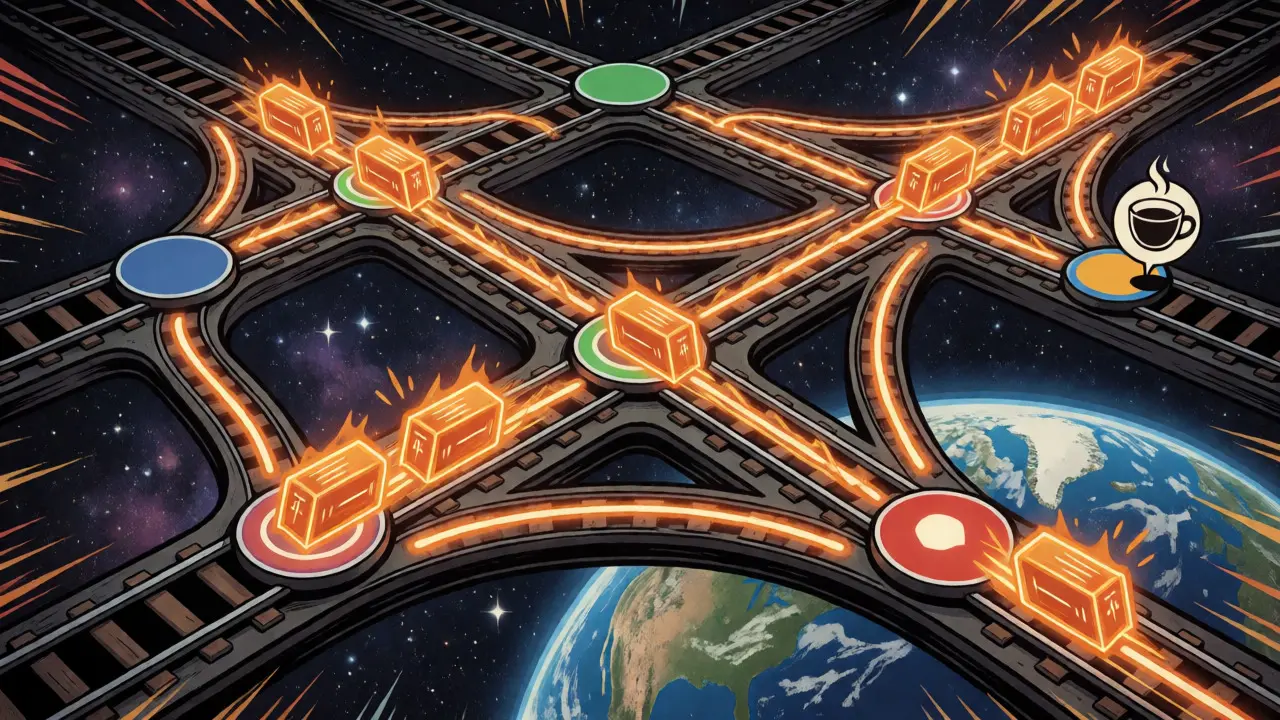
How do you send money to someone you don't have a direct channel with? This is where routing comes in. Lightning uses a technology called Hash Time-Locked Contracts (HTLCs). An HTLC is a safety mechanism that temporarily locks funds during a transfer. It ensures that if a payment fails halfway through, the money isn't lost; it simply returns to the sender.
When you send a payment, it doesn't go directly to the recipient. It hops through a series of intermediate nodes. Each node holds the funds briefly until the next node confirms receipt. If any hop fails, the entire chain reverses. This creates a trustless network where you don't need to trust the middlemen, only the cryptographic proofs that ensure the money arrives or returns.
| Feature | Lightning Network | General State Channels (e.g., Raiden) |
|---|---|---|
| Primary Use Case | Bitcoin payments | Arbitrary state updates (games, contracts) |
| Transaction Speed | Near-instant (<1 second) | Fast, but varies by protocol |
| Fees | Average 0.5 satoshis (~$0.0002) | Varies, often higher due to gas costs |
| Complexity | Low (payment-focused) | High (supports smart contracts) |
| Dispute Window | ~24 hours (144 blocks) | Often longer (e.g., 48+ hours) |
Liquidity: The Hidden Challenge
Here is the catch that many beginners miss: capacity. A Lightning channel has a limit. If you open a channel with 1 million satoshis (0.01 BTC) and spend all of it, your outbound capacity drops to zero. You cannot send more until you receive some back or rebalance the channel. This is different from the main Bitcoin blockchain, where you can always send as much as you have in your wallet.
This issue, known as liquidity imbalance, causes about 32.7% of payment failures on the network. To fix this, users employ tools to move funds between channels or close and reopen them. Experienced operators keep their inbound and outbound capacities balanced within 15% of parity to ensure smooth routing. If you plan to run a node, managing this liquidity is 90% of the work.
Real-World Adoption and Performance
As of late 2025, the network hosts over 18,000 public nodes and nearly 90,000 active channels. Major platforms like Strike and El Salvador's Chivo wallet rely on it for millions of weekly transactions. For users, the experience is seamless if the liquidity is there. You scan a QR code, the app finds a route, and the payment lands instantly.
However, running your own node requires technical effort. Setting up a basic node takes 3-5 hours for those comfortable with command lines. You need a Bitcoin full node (500GB+ storage) and stable internet. If your node goes offline for too long, you risk losing funds if a peer tries to cheat, though the dispute window gives you time to react. Most casual users stick to custodial wallets that manage these complexities for them.
Future Developments: Splicing and Symmetry
The network isn't static. Recent updates like channel splicing allow users to add or remove funds from existing channels without closing them entirely. This reduces the on-chain footprint significantly. Upcoming proposals like LN-Symmetry aim to improve privacy and reliability by changing how signatures are handled. These innovations show that while Lightning is already successful, developers are actively working to make it more robust and user-friendly.
Understanding Lightning as a state channel helps demystify Bitcoin scaling. It is not magic; it is clever cryptography applied to a specific problem. By focusing solely on payments, it achieves speed and low costs that general-purpose solutions struggle to match. Whether you are sending tips online or buying coffee, the underlying tech is a testament to how blockchain layers can evolve to meet real-world needs.
Is the Lightning Network the same as a state channel?
Not exactly. The Lightning Network is a specific type of state channel implementation. While all Lightning channels are state channels, not all state channels are part of the Lightning Network. General state channels can handle various types of data updates, whereas Lightning is specialized strictly for Bitcoin payments.
Why do my Lightning payments fail?
The most common reason is insufficient liquidity. If the channel between you and the next hop doesn't have enough outbound capacity, the payment cannot be routed. Other reasons include the recipient being offline or the path being too expensive in terms of routing fees.
Do I need to run a full Bitcoin node to use Lightning?
No, not for casual use. You can use custodial wallets like Cash App or Strike, which handle the node infrastructure for you. However, if you want full control and self-custody, you should run your own Lightning node connected to a Bitcoin full node.
What happens if my Lightning node goes offline?
If your node is offline, you cannot receive payments. More critically, if a peer broadcasts an old, unfavorable state of the channel, you have a dispute window (usually 24 hours) to submit a newer state to the blockchain. If you miss this window, you could lose funds.
Are Lightning fees really that cheap?
Yes. Average fees are around 0.5 satoshis per payment, which is roughly $0.0002 depending on Bitcoin's price. This is significantly lower than on-chain fees, which can range from $1 to $20+ during times of congestion.