

Remember when decentralized exchanges were just simple swap buttons? Those days are gone. Today’s top protocols are complex financial machines that reward loyalty, punish short-term thinking, and let communities vote on where the money flows. Ramses Exchange is one of those machines. It doesn’t just sit there waiting for trades; it actively manages liquidity through a sophisticated system called ve(3,3) tokenomics, originally designed by Andre Cronje but refined for modern markets.
If you’ve been trading on Arbitrum or exploring the newer HyperEVM ecosystem, you’ve probably seen Ramses pop up. But should you trust your capital to it? Is the yield worth the complexity? This review cuts through the hype to explain exactly how Ramses works, what risks you face, and whether it fits into your DeFi strategy in 2026.
What Is Ramses Exchange?
Ramses is not your typical automated market maker (AMM). While older platforms like Uniswap v2 relied on simple constant product formulas, Ramses combines two powerful concepts: concentrated liquidity from Uniswap v3 and the governance-driven incentive model known as ve(3,3). Think of it as a hybrid engine. The concentrated liquidity part means providers can place their funds in specific price ranges, making capital more efficient. The ve(3,3) part means that if you lock your tokens, you get a say in which pools earn fees and emissions.
The protocol was built primarily for the Arbitrum blockchain, aiming to be its central liquidity hub. However, recognizing that multi-chain presence is no longer optional, Ramses expanded to HyperEVM in June 2025. This move wasn’t just about brand visibility; it allowed Ramses to tap into Hyperliquid’s derivatives infrastructure, creating new opportunities for traders who want exposure to both spot and leveraged markets within a single ecosystem.
At its core, Ramses tries to fix what went wrong with earlier iterations of the Solidly model. Early versions suffered from high inflation and lack of decentralization. Ramses explicitly states its mission to restore three tenets: Community, Decentralization, and Functionality. By giving real power to voters rather than just distributors, it attempts to align the interests of traders, liquidity providers, and token holders.
Understanding the RAM Token and ve(3,3) Mechanics
To use Ramses effectively, you need to understand its native currency: the RAM token. According to data from CoinCarp, the maximum supply is capped at 200 million RAM, with 120 million currently in circulation. That’s a 60% distribution rate, which suggests a significant portion remains reserved for future incentives or treasury needs.
Here’s where it gets interesting. Holding RAM alone doesn’t give you special privileges. You have to lock them up. When you lock RAM, you receive a veNFT (vote-escrowed Non-Fungible Token). This NFT isn’t just a receipt; it’s your voting ticket. The longer you lock your tokens, the more voting power you gain. This mechanism discourages quick flips and encourages long-term commitment.
Why does this matter? Because veNFT holders decide where the protocol’s emissions go. Unlike traditional AMMs that spread rewards evenly across all pairs, Ramses lets the community vote to direct incentives toward specific pools. If you believe a particular pair will see high volume, you can vote to send emissions there. In return, you earn a share of the swap fees generated by that pool plus the directed emissions. This creates a feedback loop where smart capital allocation leads to higher returns for voters.
However, there’s a catch. Not all fees go to voters. Ramses allocates swap fees specifically based on the pools that users vote to receive token emissions. If you vote for a low-volume pair, you might get lots of emissions but very few fee revenues. This requires active management and research, unlike passive staking on simpler platforms.
Key Features: Concentrated Liquidity and Bribing
Ramses stands out because it borrows the best parts of different systems. First, it uses concentrated liquidity. In standard AMMs, your liquidity is spread across the entire price range of a token, from zero to infinity. Most of that liquidity sits idle, doing nothing. With concentrated liquidity, you choose a narrow range-say, between $40 and $60 for ETH-and put your money there. This increases your capital efficiency dramatically, meaning you can generate more fees with less capital. But it also increases risk. If the price moves outside your range, your position stops earning fees entirely.
Second, Ramses introduces a feature called "bribing." Projects wanting to launch on Ramses don’t just dump tokens into a pool and hope for the best. They can bribe voters directly. A project might offer extra tokens or other incentives to veNFT holders if they vote to direct emissions to that project’s pool. This ensures new projects get initial liquidity support without relying solely on organic growth. For voters, bribes represent an additional revenue stream beyond base emissions and swap fees.
This combination makes Ramses highly competitive against other ve(3,3) protocols like Velodrome and significantly more advanced than legacy AMMs like Uniswap v2. It turns liquidity provision into an active job rather than a passive investment.
| Feature | Ramses | Uniswap v3 | Velodrome |
|---|---|---|---|
| Liquidity Model | Concentrated + ve(3,3) | Concentrated Only | Full Range + ve(3,3) |
| Governance Power | Vote for Emissions & Fees | No Governance for LPs | Vote for Emissions |
| Bribing Mechanism | Yes | No | Yes |
| Primary Chains | Arbitrum, HyperEVM | Multichain (Ethereum, L2s) | Optimism, Base |
| Complexity Level | High | Medium-High | Medium |

Security and Partnerships
In DeFi, security isn’t just about code audits; it’s about resilience. Ramses emphasizes using "battle-tested technologies" by building on established architectures. Its partnership network is extensive, including collaborations with major protocols like Liquity, Frax Finance, Yearn, Olympus DAO, 1inch, Paraswap, LayerZero, and Axelar. These aren’t random logos; they indicate deep integration. For example, LayerZero and Axelar enable cross-chain messaging, allowing Ramses to interact seamlessly with assets on other networks.
The protocol also maintains a community-led emergency response capability. This means that in case of a critical vulnerability, trusted community members can act quickly to pause operations or mitigate damage. This approach aligns with Ramses’ goal of decentralization, avoiding reliance on a centralized team to pull the plug. However, this also places responsibility on the community to stay vigilant.
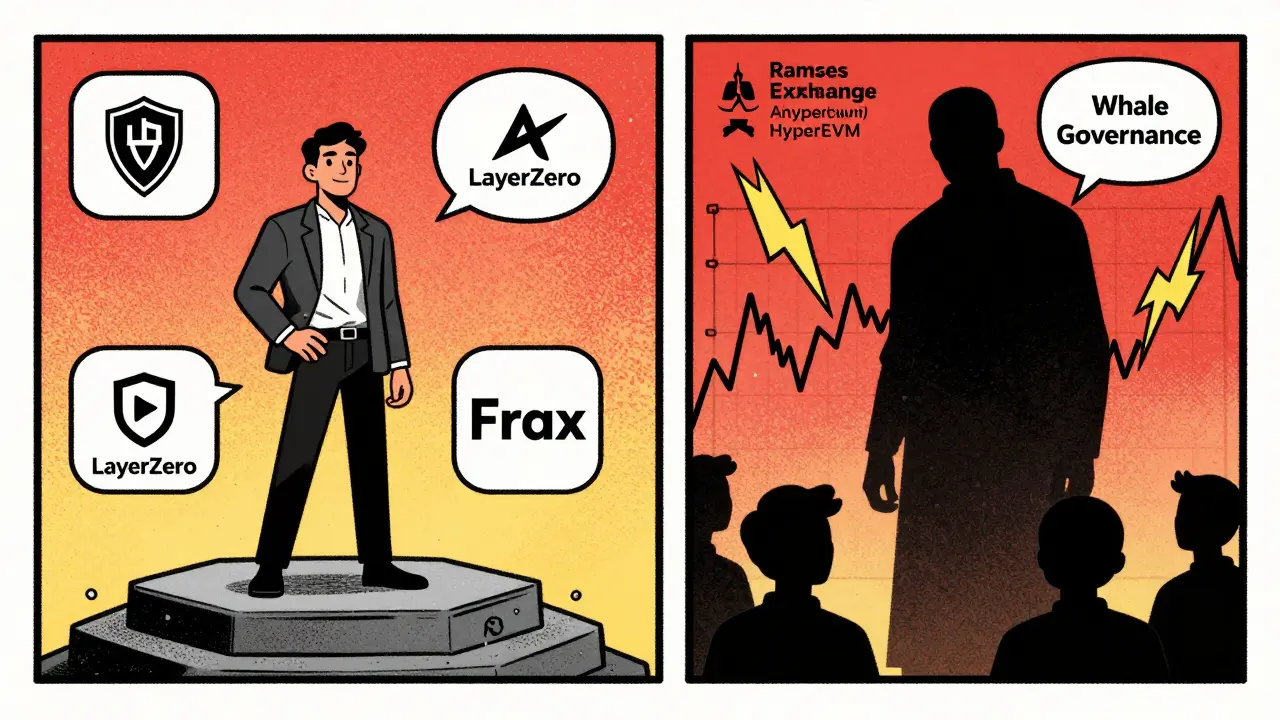
User sentiment reflects these strengths. Security-conscious users appreciate the emphasis on proven tech and community oversight. Yet, some express concern about the potential for governance manipulation. Large token holders, often referred to as "whales," could theoretically coordinate votes to funnel all rewards to pools they control, squeezing out smaller participants. This is a known risk in ve(3,3) models, and Ramses hasn’t completely eliminated it. Vigilance and diversification remain essential.
Who Should Use Ramses?
Ramses isn’t for everyone. If you’re looking for a simple, set-and-forget yield generator, this isn’t it. The learning curve is steep. You need to understand:
- Impermanent Loss: How price divergence affects your position.
- Concentrated Liquidity Ranges: How to set optimal bounds for your assets.
- VeNFT Management: How locking periods impact your voting power and rewards.
- Voting Strategy: Which pools offer the best balance of fees and emissions.
That said, if you’re comfortable with these concepts, Ramses offers superior yields compared to passive alternatives. Active liquidity providers who monitor their positions weekly can capitalize on shifting market conditions. Traders benefit from near-zero slippage due to the efficient liquidity structure. And investors interested in governance can shape the protocol’s direction while earning passive income.
For beginners, I’d recommend starting small. Allocate a modest amount to test the waters. Read the official docs thoroughly. Join community channels to ask questions. Don’t lock up years’ worth of tokens until you’ve experienced at least one full cycle of voting and rebasing.
Risks and Considerations
No DeFi protocol is risk-free. Here are the key challenges with Ramses:
- Smart Contract Risk: Despite battle-tested components, new integrations always carry unknown vulnerabilities.
- Governance Centralization: Large veRAM holders may dominate decision-making.
- Market Volatility: Concentrated liquidity positions can suffer significant losses during sharp price swings.
- Complexity Barrier: Misunderstanding mechanics can lead to suboptimal outcomes or accidental exits.
To mitigate these, consider using hardware wallets for signing transactions, diversifying your locked positions, and staying informed about governance proposals. Never invest more than you can afford to lose.
Final Thoughts
Ramses represents a mature evolution in decentralized exchange design. By merging concentrated liquidity with community-driven incentives, it creates a dynamic environment where every participant has a stake in the outcome. Its expansion to HyperEVM shows strategic foresight, positioning it for growth beyond Arbitrum.
But remember: sophistication comes with responsibility. Ramses rewards knowledge and activity. If you’re willing to learn and engage, it can be a powerful tool in your DeFi arsenal. If you prefer simplicity, stick to basic AMMs. Either way, make sure your choice matches your skills and goals.
Is Ramses Exchange safe to use?
Ramses uses battle-tested technology and has partnerships with major DeFi protocols like LayerZero and Frax Finance. However, all DeFi platforms carry smart contract risks. Always use hardware wallets, start with small amounts, and never invest more than you can afford to lose.
What is the difference between Ramses and Uniswap?
Uniswap v3 uses concentrated liquidity but lacks governance incentives for liquidity providers. Ramses combines concentrated liquidity with ve(3,3) tokenomics, allowing users to vote for emissions and earn a share of swap fees based on their votes. This makes Ramses more complex but potentially more rewarding for active participants.
How do I get started with Ramses?
First, acquire RAM tokens on Arbitrum or HyperEVM. Then, visit the Ramses interface to lock your tokens and create a veNFT. Choose a locking period-the longer you lock, the more voting power you get. Finally, vote for liquidity pools you believe will generate high fees and emissions. Regular monitoring is required to maximize returns.
What is the total supply of RAM tokens?
The maximum supply of RAM tokens is 200 million. As of recent data, 120 million tokens are in circulation, representing 60% of the total supply. The remaining tokens are likely reserved for future incentives, treasury functions, or ecosystem development.
Can I use Ramses on chains other than Arbitrum?
Yes. While Ramses launched on Arbitrum, it expanded to HyperEVM in June 2025. This allows users to access Ramses services on both networks. Future expansions to other blockchains are possible as part of its multi-chain strategy.




There are 25 Comments
Zara Zaman
Look, I don't care about your fancy tokenomics if the security isn't rock solid for American users. We are putting real money into these protocols and expecting them to hold up without blowing up our portfolios. The ve(3,3) model is just a way to lock liquidity so you can't exit when things get rough. It's a trap for the uninformed.
beti macedo
I have read this article with great interest and it seems very informative regarding the Ramses exchange platform. The explanation of concentrated liquidity is quite clear and helps me understand how capital efficiency works in modern DeFi ecosystems. I believe that learning more about these mechanisms will help me make better decisions in my own trading journey. Thank you for sharing such detailed insights on this topic.
Albert Lee
Oh wow, this is absolutely fascinating stuff! I mean, who knew that locking tokens could actually give you power over where the fees go? It’s like being part of a financial democracy but with much higher stakes and way more complex math. I’m trying to wrap my head around the bribing mechanism because it sounds like projects are literally paying voters to support their pools. That’s wild!
Yash Lodha
The whole concept of ve(3,3) is nothing short of a coordinated effort by elites to centralize control under the guise of decentralization. They want you to lock your assets so they can manipulate the governance votes from the shadows. Do not trust the narrative pushed by these tech oligarchs. The HyperEVM expansion is just another layer of surveillance infrastructure designed to track your movements across chains. Stay vigilant.
Sarah C
I think it is really important to take the time to understand the risks before jumping in. The article mentions impermanent loss which can be scary if you are not prepared. I always recommend starting small and reading the docs carefully so you know exactly what you are signing. It feels safer that way.
Kimberly Herbstritt
You know what? Everyone says ve(3,3) is the future but I bet most people lose money trying to figure out the optimal voting strategy. It’s just a game for whales while retail gets rekt by impermanent loss. The complexity is a feature for insiders and a bug for everyone else.
Sharada Vakkund
Hello everyone! I would love to hear more thoughts on the HyperEVM integration. It seems like a huge step for cross-chain interoperability. Does anyone here have experience using Ramses on both Arbitrum and HyperEVM? I am curious about the differences in user experience and liquidity depth between the two networks. Let us discuss!
Sudarshan Anbazhagan
It is imperative that one understands the fundamental mechanics of concentrated liquidity before attempting to provide funds. The notion that one can simply deposit assets and expect passive returns is fundamentally flawed within this specific protocol architecture. One must actively manage ranges and monitor price action constantly or risk significant capital erosion due to impermanent loss. This is not a set and forget investment vehicle.
John Gonzalez Bentham
lol the whole point of this review is to confuse you with jargon so you feel smart but actually dont know anything. ve(3,3) is just inflationary garbage designed to pump the token price temporarily. uniswap v3 is cleaner because it doesnt have this fake governance theater. stop falling for the hype train.
Ellie Riddell
Sure, call it sophisticated. I call it a lot of work for maybe slightly better yields than just holding spot. But hey, if you enjoy spending hours watching charts and voting on emissions every week, more power to you. Just don’t come crying when you miss out on life because you were rebasing your NFT.
Destiny Kilby
I appreciate the detailed breakdown of the risks involved. Many platforms fail to highlight the potential for governance manipulation by large holders. It is crucial for users to remain aware of these dynamics and diversify their strategies accordingly. Security should always be the primary concern.
Jerry CUNNINGHAM SR
This is a well-articulated overview of the Ramses Exchange ecosystem. The distinction between traditional AMMs and the ve(3,3) model is clearly explained. I believe that understanding the role of the veNFT is essential for any participant looking to engage meaningfully with the protocol. Please continue to share such informative content.
Shelby Cantu
Start small. Learn the ropes. Don’t rush in. It’s that simple.
Tobias Gjerlufsen
You are all idiots if you think this is safe. Smart contract risk is real and these new integrations are basically ticking time bombs. The fact that they rely on community-led emergency response is laughable. Who wants to bet their life savings on a Discord mod pressing pause? Wake up sheeple.
Ruben Michel
One must acknowledge the elegance of the concentrated liquidity model when implemented correctly. However, the average retail investor lacks the sophistication required to navigate these waters effectively. It is a tool for the discerning few who possess the requisite knowledge and discipline. Do not mistake accessibility for simplicity.
Gavin Wonnacott
I’ve been tracking Ramses since launch and frankly, the UI is atrocious. Why do I need five clicks to adjust my range? And don’t get me started on the gas fees on Arbitrum during peak times. It’s a mess. Fix your product before asking for more loyalty.
Samara McCallum
Isn’t it funny how we pretend to be decentralized when half the votes come from three wallets? But sure let us talk about community empowerment. I guess if you ignore the whales everything looks perfect. Anyway good luck with your yield farming adventures.
Sheldon Friesen
Alright folks, let’s break this down! First off, yes, it is complicated. But that’s where the edge comes from. If everyone was making easy money, there wouldn’t be any money left for you. So dive in, read the docs, and start experimenting. You got this! ;)
Tricia Alach
i think its cool how they expanded to hyperEVM but im still confused about the bribing part. does that mean i get paid extra just for voting? that sounds like free money right? maybe i should try locking some ram tokens soon. hope i dont mess up.
Jan Gilmore
Let me tell you something about Uniswap v3 vs Ramses. Uniswap is pure market efficiency. Ramses adds a layer of political maneuvering on top of it. Which one do you prefer? Pure economics or economic politics? I’ll take the clean code of Uniswap any day. No thank you to the governance drama.
Caique Muniz
another deFi protocol promising the moon while hiding the risks in tiny print. yawn. i’ve seen this movie before and it always ends with rug pulls or silent drains. save your money and buy index funds instead. at least those are regulated somewhat.
Bradley Geldenhuys
Listen up peeps. This is the future of finance whether you like it or not. Centralized exchanges are dinosaurs. If you want to be part of the revolution you gotta learn the tools. Ramses is tough but rewarding. Get out there and dominate the markets. Dont let fear stop you.
robert Whitehead
The moral hazard here is staggering. Encouraging users to lock liquidity for years based on speculative governance rewards is irresponsible. You are gambling with other people’s money essentially. The system is rigged against the small holder who cannot afford to lock up capital for long periods. It is unethical design.
Mike S
Oh look, another review praising the ‘sophistication’ of yet another clone. Give me a break. The only thing sophisticated is the marketing budget. Meanwhile, the actual UX is a nightmare and the yields are barely covering the stress headaches. Pathetic.
H F
Brilliant analysis! I particularly enjoyed the section on bribes. It really highlights the innovative nature of this ecosystem. I am excited to see how this evolves over the coming months. Great job highlighting the key features and risks for us all to consider.
Write a comment
Your email address will not be published. Required fields are marked *