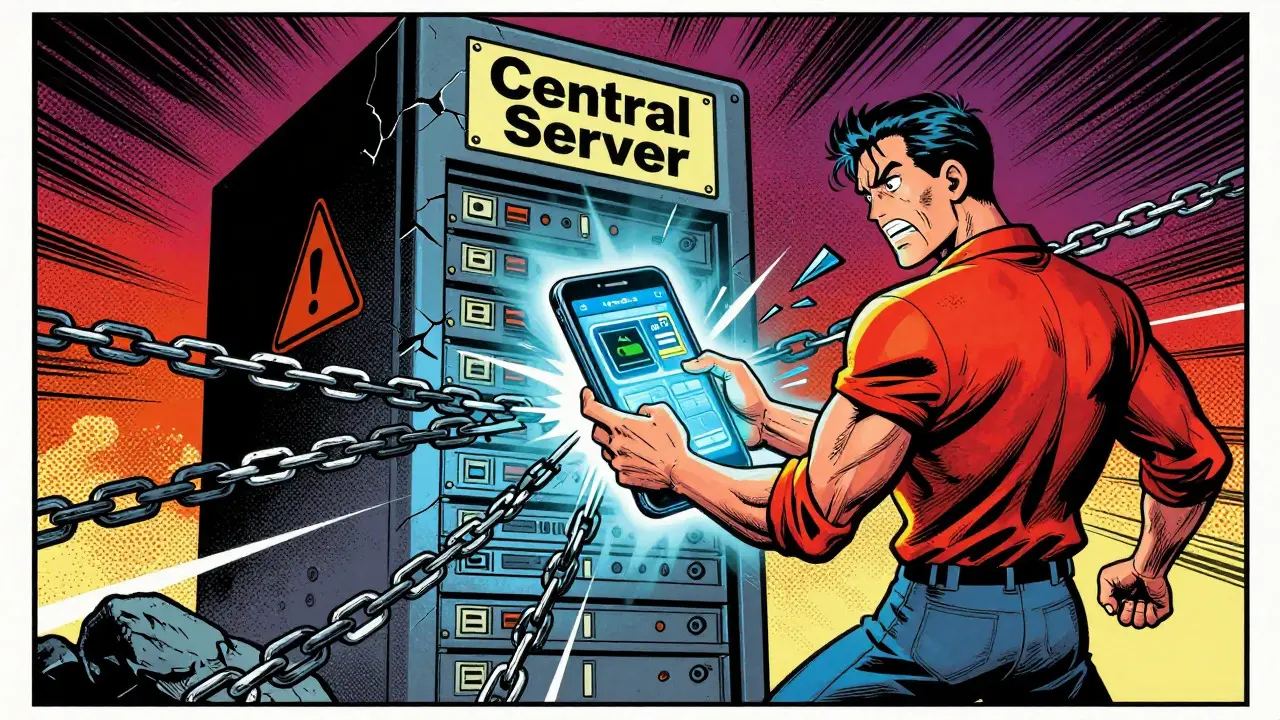
Imagine logging into your bank, your email, and your healthcare portal without typing a single password. Instead of hoping a central server hasn't been hacked, you hold the keys to your own existence in a digital wallet on your phone. This isn't science fiction anymore; it is the emerging reality of digital identity on blockchain. For decades, we have outsourced our identities to tech giants and government databases, accepting the risk that if those servers go down or get breached, we lose access to our lives. Now, technology is flipping the script, putting control back in your hands.
Why We Need a New Way to Handle Identity
The current system for managing who we are online is broken. It relies on centralized databases where companies store your name, address, and biometric data. This creates a massive target for hackers. According to Verizon's Data Breach Investigations Report, a staggering 81% of data breaches are linked to weak or compromised login credentials. When a company like Equifax or Marriott gets hacked, millions of people suffer because their data was stored in one vulnerable place.
Traditional systems also force you to share more information than necessary. To prove you are over 21, you often have to upload a driver’s license, revealing your address, birthdate, and photo to the merchant. You have no way to verify what they do with that data afterward. The frustration is real, and the security risks are higher every year. This is why the shift toward decentralized identity management is happening now. It promises a world where you own your data, not the platforms you use.
How Blockchain-Based Identity Actually Works
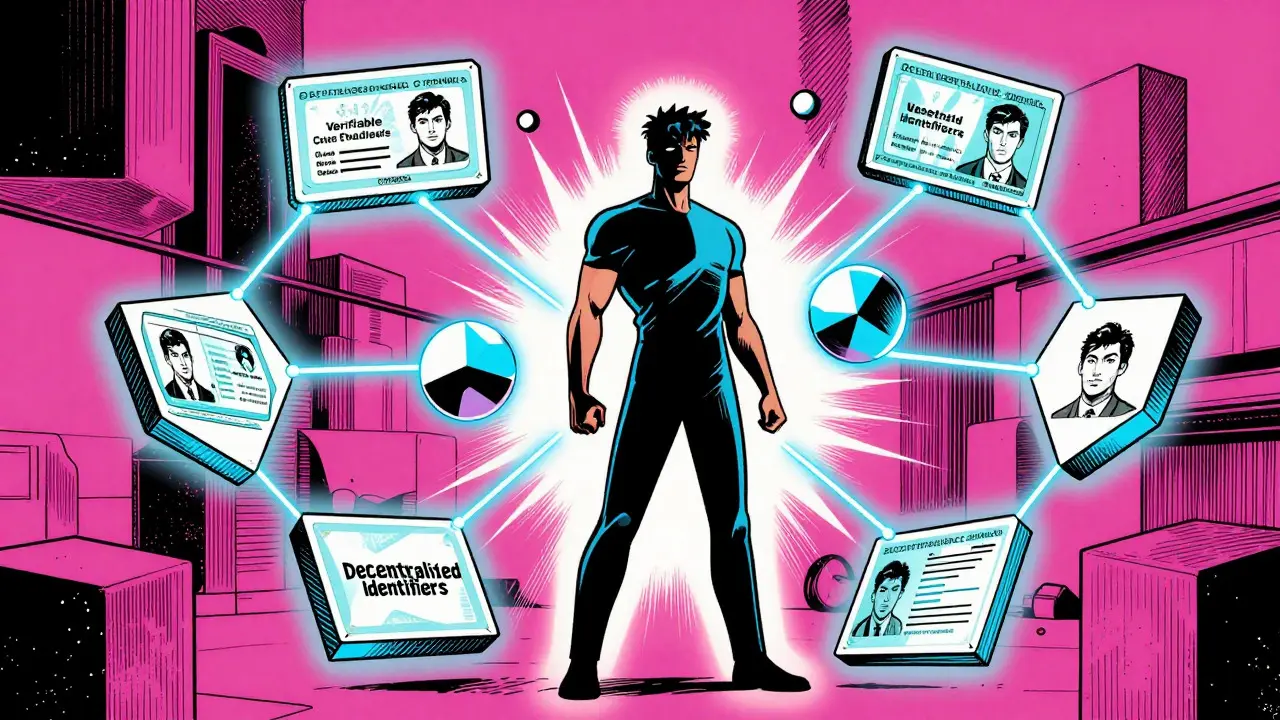
To understand the future, you need to know the building blocks. The core concept here is Self-Sovereign Identity (SSI), which means you control your identity without relying on a central authority. But how does that translate to code? It comes down to two main technical standards: Decentralized Identifiers (DIDs) and Verifiable Credentials (VCs).
Decentralized Identifiers (DIDs) are unique codes embedded in the blockchain. Unlike an email address or username, which is issued by a provider (like Gmail), a DID is created by you. It points to a public key that proves ownership of that identifier. Think of it as a digital fingerprint that only you can sign messages with. These DIDs are registered on distributed ledgers like Ethereum, Polygon, or Hyperledger Fabric, ensuring they cannot be deleted or altered by any single entity.
Verifiable Credentials (VCs) are the actual pieces of identity data. If a university issues you a diploma, they can issue a VC signed with their cryptographic key. You store this credential in your digital wallet. When a job application asks for proof of education, you present the VC. The employer verifies the signature against the university’s public key on the blockchain. The best part? The university doesn’t need to check its database, and you don’t need to send a scanned PDF that could be faked. The verification happens in seconds, securely and privately.
The Privacy Game-Changer: Zero-Knowledge Proofs
One of the biggest hurdles for privacy advocates has been the fear that blockchain is too transparent. After all, blockchains are public ledgers. How can your identity remain private? The answer lies in Zero-Knowledge Proofs (ZKPs).
ZKPs allow you to prove a statement is true without revealing the underlying data. For example, you can prove you are over 18 without revealing your exact birthdate. You can prove you have enough money in your account without revealing your balance. Projects like Polygon ID are leading this charge, using ZKPs to ensure that when you verify your identity, the verifier learns nothing more than what is strictly necessary. This solves the "over-sharing" problem of traditional identity checks. In 2024 pilots, Polygon ID reported 99.99% uptime and verification times between 2-5 seconds, making it practical for real-world use cases like age verification for streaming services or KYC for banking apps.
Who Is Leading the Charge?
This isn't just theoretical talk from crypto enthusiasts. Major players are already building infrastructure. The landscape is split between tech giants, specialized startups, and government initiatives.
| Organization/Project | Type | Key Focus & Status |
|---|---|---|
| Microsoft (Entra Verified ID) | Tech Giant | Enterprise integration; connected to over 1,200 enterprise applications by Q2 2024. |
| Polygon ID | Blockchain Protocol | Privacy-first ZKP solutions; focused on scalability and low-cost verification. |
| EU EBSI Program | Government Initiative | Cross-border identity for EU citizens; processed 1.2 million verified credentials by Dec 2024. |
| Worldcoin | Startup | Proof-of-personhood via iris scanning; 2.3 million users registered across 37 countries by mid-2024. |
| Estonia KSi | National System | Integrated blockchain components into national ID; reduced fraud by 92% since 2023. |
Microsoft’s approach is pragmatic, aiming to integrate blockchain identity into existing enterprise workflows through Entra Verified ID. Meanwhile, the European Union is pushing hard with eIDAS 2.0, a regulation set to establish legal frameworks for blockchain-based identities effective June 2026. This regulatory push is crucial because it gives these systems legal weight, forcing banks and governments to accept digital credentials as valid proof of identity.
Real-World Benefits and Early Results
What does this look like for you? The benefits are immediate and tangible. First, speed. Traditional Know Your Customer (KYC) processes in banking can take days. With blockchain VCs, verification drops to seconds. Healthcare administrators report patient onboarding times dropping from 45 minutes to just 8 minutes after implementing these systems. Second, cost reduction. Enterprise users report 40-60% reductions in identity verification costs because they no longer need to maintain massive, secure databases of user data.
Third, and perhaps most importantly, security. Since there is no central database to hack, the attack surface shrinks dramatically. Estonia’s digital identity system, which integrated blockchain components in 2023, has seen a 92% reduction in identity fraud. Users feel safer too; a 2024 survey found that 78% of people using decentralized identity wallets felt "more in control of their personal data."

The Hurdles Still Ahead
It’s not all smooth sailing. The biggest barrier remains usability. Managing private keys is hard for non-technical users. A 2024 study found that 62% of non-technical users struggled with key management, and 34% of early adopters experienced lockouts due to lost keys. If you lose your password, you can reset it. If you lose your private key in a pure SSI model, you might lose your identity forever. Solutions like social recovery mechanisms (where trusted friends help you recover access) are being developed, but they add complexity.
Regulatory fragmentation is another headache. While the EU is moving fast, the US remains fragmented, with only 17 states having specific digital identity legislation as of 2025. Global interoperability is still a work in progress. Can a credential issued in India be accepted seamlessly in Brazil? Not yet. Standards bodies like the W3C are working on universal DID specifications, but full global alignment will take time.
There are also privacy concerns. Dr. Jane Smith from MIT’s Digital Identity Lab warned in 2024 that unregulated biometric collection could create unprecedented tracking capabilities. As projects like Worldcoin use iris scans to prove uniqueness, critics argue we must ensure these biometric hashes aren’t linked back to individuals in ways that enable mass surveillance.
What Comes Next?
Looking ahead to 2026 and beyond, the trend is clear: convergence. AI and blockchain are starting to merge in identity management. AI will monitor and optimize how your digital identity interacts across platforms, detecting anomalies in real-time, while blockchain anchors the trust layer, verifying that the AI itself hasn’t been tampered with. By late 2025, we expect mobile-optimized ZK-proof implementations to reduce verification times to under one second, making the technology invisible to the end-user.
The market is growing rapidly, projected to reach $38.5 billion by 2025. Gartner predicts mainstream adoption by 2025, driven by the need for secure cross-border transactions and the UN’s Sustainable Development Goal 16.9, which mandates legal identity for all by 2030. Governments and corporations are realizing that the old way is too expensive and too risky. The question is no longer if blockchain identity will become standard, but how quickly you will be asked to migrate your digital life onto it.
Is my data safe on the blockchain?
Yes, generally safer than centralized databases. Your actual personal data (like your name or passport number) is usually stored locally on your device, not on the blockchain. The blockchain only stores cryptographic hashes or pointers (DIDs) that prove the data is authentic. Combined with Zero-Knowledge Proofs, you can verify facts about yourself without exposing the raw data.
What happens if I lose my private key?
In a pure decentralized system, losing your private key can mean losing access to your identity. However, new solutions are emerging. Social recovery schemes allow you to appoint trusted contacts who can help restore access. Biometric reconstruction is also being tested, though it introduces its own security debates. Always use reputable wallets with backup options.
Will governments accept blockchain IDs?
Increasingly yes. The EU’s eIDAS 2.0 regulation, effective June 2026, legally recognizes blockchain-based identities. Countries like Estonia and India are already integrating blockchain into national ID systems. While the US is slower, many federal agencies are piloting these technologies for internal employee verification and secure citizen services.
How is this different from just using Google or Apple Sign-In?
Google and Apple Sign-In are centralized federated identities. They still rely on a single company holding your data and controlling access. If Google bans you, you lose access to everything tied to that account. Blockchain identity is self-sovereign; you own the credentials. No single company can revoke your identity, and you choose exactly what data to share with each service.
When will this be available to regular consumers?
It’s already here in niche areas, but widespread consumer adoption is expected between 2025 and 2027. You’ll likely see it first in banking (faster KYC), travel (digital passports), and professional credentials (university degrees). As regulations like eIDAS 2.0 kick in, major apps will begin offering blockchain wallet logins alongside traditional passwords.