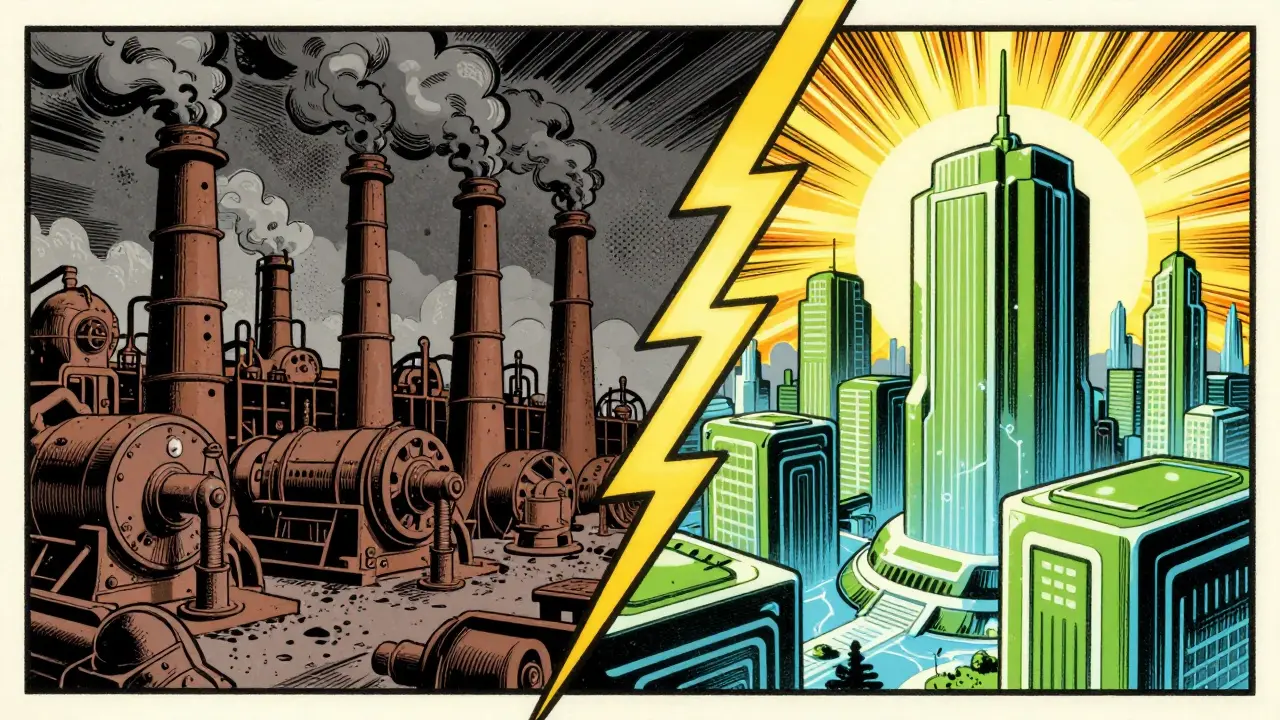
Remember when buying Bitcoin felt like a guilty pleasure? For years, the environmental cost of mining crypto was a heavy anchor dragging down the industry’s reputation. But if you look at the landscape today in June 2026, that narrative has flipped completely. The era of energy-hungry proof-of-work is fading into the background, replaced by a new wave of environmentally friendly crypto protocols that prioritize efficiency without sacrificing security. We aren't just talking about minor tweaks; we are looking at a fundamental shift where blockchains consume less energy than your coffee maker.
This isn't just a trend for eco-conscious hobbyists anymore. It is the standard for institutional adoption. With regulations tightening and ESG (Environmental, Social, and Governance) criteria becoming mandatory for many investors, green cryptocurrencies have moved from the fringe to the center of the digital asset economy. If you are holding onto the idea that crypto must be dirty to be secure, you are missing out on the most significant technological leap in blockchain history.
Why Energy Efficiency Matters Now More Than Ever
The shift toward green crypto wasn't driven by altruism alone; it was forced by necessity and market pressure. Back in 2022, Ethereum made its historic move to proof-of-stake (PoS), slashing its energy consumption by 99.95% overnight. That event changed everything. It proved that you didn't need to burn coal to secure a network. By 2025, this became the norm rather than the exception. According to data from Kraken Research in Q1 2025, 78% of new blockchain projects launched with energy-efficient protocols instead of traditional proof-of-work.
Institutional money follows compliance. The SEC filings show a 64% year-over-year increase in stablecoin mentions, largely because these assets align better with corporate sustainability goals. When 92% of U.S. crypto holders express optimism about blockchain modernizing the economy while addressing environmental concerns, as reported by Kraken in February 2025, the signal is clear. Investors want growth, but they don't want the ecological baggage. This demand has created a massive value proposition for projects that can prove their carbon footprint is negligible or even negative.
Leading Protocols: How They Work and What They Cost
To understand the future of green crypto, you have to look at the mechanics behind the leading networks. These aren't just marketing slogans; they rely on distinct consensus mechanisms that drastically reduce computational waste.
| Cryptocurrency | Consensus Mechanism | Energy per Transaction | Key Feature |
|---|---|---|---|
| Algorand | Pure Proof-of-Stake | 0.000008 kWh | Carbon-negative certified |
| Hedera Hashgraph | Hashgraph Consensus | 0.00014 kWh | 10,000 TPS speed |
| Chia Network | Proof of Space and Time | 0.023 kWh | Uses storage, not compute |
| Nano | Block-Lattice (DAG) | 0.000112 kWh | Feeless transactions |
Algorand is often cited as the gold standard here. Operating on pure proof-of-stake, it consumes an almost imperceptible 0.000008 kWh per transaction. To put that in perspective, Bitcoin uses roughly 1,375 kWh for a single transaction. Algorand’s entire network uses just 0.0006 GWh annually. That is a ratio of nearly 200 million to one in favor of Algorand. On top of being efficient, Algorand partnered with ClimateTrade to achieve carbon-negative certification, meaning it actively removes more carbon from the atmosphere than it emits.
Hedera Hashgraph takes a different approach. Instead of a traditional blockchain, it uses a directed acyclic graph structure managed by a council of 39 global organizations. This allows for incredible speed-up to 10,000 transactions per second-with minimal energy use. While some purists argue that a governing council reduces decentralization compared to fully permissionless networks, the trade-off is undeniable stability and enterprise-grade performance. Companies like Maersk have used Hedera to cut carbon verification costs by 37%, proving its utility beyond simple payments.
Then there is Chia Network, which introduced 'Proof of Space and Time.' Instead of burning electricity to solve math problems, Chia farmers use unused hard drive space to secure the network. A transaction requires only 0.023 kWh, which is still a 99.998% reduction compared to Bitcoin. This model leverages existing infrastructure, turning idle storage into a productive resource rather than demanding specialized ASIC miners that generate heat and e-waste.

The Reality Check: Security, Speed, and Trade-offs
No technology is perfect, and green crypto comes with its own set of challenges. You might wonder if cutting energy use means cutting corners on security. Dr. Alex de Vries, founder of Digiconomist, noted in early 2025 that while the shift to PoS is the biggest environmental improvement in blockchain history, we must remain vigilant against greenwashing. Not every project claiming to be 'green' passes a transparent energy audit.
Performance issues also exist. User feedback from platforms like Reddit and Trustpilot highlights that while people love the ethical angle, they hate technical glitches. Hedera users, for instance, reported a 12.7% transaction failure rate during peak congestion periods in mid-2025, compared to Ethereum's 2.3%. One user on r/CryptoCurrency bluntly stated, "The environmental marketing is great, but I've had three failed transactions on Chia during critical moments." This reminds us that efficiency cannot come at the cost of reliability.
There is also the issue of developer activity. Ethereum still dominates with over 4,200 active developers, whereas Algorand has around 1,842. Fewer developers can mean slower innovation or fewer decentralized applications (dApps) to choose from. However, this gap is closing as major tech firms realize that building on energy-efficient chains is now a regulatory requirement in many jurisdictions.
Regulation and Institutional Adoption in 2026
If you are wondering whether this is a fad, look at the regulators. In July 2025, the U.S. passed the GENIUS Act, establishing the first comprehensive framework for environmentally certified digital assets. This legislation effectively created a two-tier system: legacy proof-of-work coins face higher scrutiny and potential bans on mainstream exchanges, while green cryptos receive fast-tracked approval processes.
Gartner forecasted in June 2025 that by 2030, energy efficiency will be a mandatory requirement for all major cryptocurrency exchanges. We are already seeing this play out. Eighty-seven S&P 100 companies were holding or transacting in green cryptocurrencies by mid-2025, up from just 22 in 2023. Why? Because their shareholders demand it. The World Economic Forum reports that 67% of institutional investors now include blockchain energy efficiency as a mandatory criterion in their investment decisions.
This regulatory push has also brought clarity to the 'green inflation' problem. Previously, any project could slap a leaf logo on its website and claim to be eco-friendly. Now, audited standards matter. The Environmental Blockchain Audit Consortium found that in early 2025, 31% of self-described 'eco-friendly' projects failed to meet minimum energy efficiency standards. As regulations tighten, these weaker projects will likely fade away, leaving only the truly efficient networks standing.
How to Get Started with Green Crypto
Switching to environmentally friendly crypto is easier than you think, though it does require a slight change in habit. You no longer need to worry about mining rigs or complex hardware setups. Most green networks operate via wallets that interact directly with the blockchain through staking or delegation.
- Choose a Reputable Wallet: Look for wallets that display real-time carbon footprint metrics. Algorand-based wallets, for example, have high ratings (4.7/5 on Trustpilot) specifically because they highlight environmental impact data clearly.
- Understand Staking: Unlike mining, staking involves locking up your coins to help validate transactions. This secures the network without consuming extra electricity. Learn how much you need to stake for each network, as requirements vary.
- Check Integration Compatibility: If you are using these for business, ensure your payment processor supports cross-chain transfers. Circle’s Cross-Chain Transfer Protocol has helped reduce integration time for institutions from 147 hours to just 28 hours, making it smoother to connect green crypto to traditional banking systems.
- Verify Audits: Before investing heavily, check if the project has undergone third-party energy audits. Don't just trust the whitepaper; look for independent verification from groups like the Environmental Blockchain Audit Consortium.
New users typically spend about 8.2 hours learning to use eco-friendly wallets proficiently, compared to 6.4 hours for traditional Bitcoin wallets. The extra time goes into understanding staking interfaces and reading environmental dashboards. It’s a small price to pay for peace of mind regarding both your portfolio and the planet.
What the Future Holds
The trajectory is clear. The International Energy Agency projects that by 2026, 75% of all blockchain transactions will occur on energy-efficient networks. We are already past the halfway mark. The next frontier isn't just reducing energy use; it's leveraging blockchain for carbon accounting. The World Economic Forum predicts that blockchain-enabled carbon systems will save $14.3 billion annually in verification costs by 2027.
We are moving toward a hybrid ecosystem where green crypto handles high-frequency, low-value transactions (like micropayments and supply chain tracking), while legacy systems might retain niche roles. Projects like SolarCoin, which awards tokens for verified solar energy production, show how crypto can incentivize renewable energy generation directly. This creates a positive feedback loop: clean energy generates crypto, which funds more clean energy.
As we settle into 2026, the question is no longer whether environmentally friendly crypto is viable. It is the default. The technology has matured, the regulations are in place, and the institutions are buying in. If you are still focused solely on hash rate and mining difficulty, you are looking at the rearview mirror. The road ahead is paved with efficiency, transparency, and sustainability.
Is environmentally friendly crypto as secure as Bitcoin?
Yes, but the security model is different. Bitcoin relies on proof-of-work, which is secured by massive amounts of electricity and hardware. Green cryptos like Algorand and Cardano use proof-of-stake, where security is derived from economic incentives (validators risk losing their staked coins if they act maliciously). While proof-of-work has a long track record, proof-of-stake has proven robust since Ethereum's transition in 2022, handling billions of dollars in value securely with a fraction of the energy.
Which green cryptocurrency is the best for beginners?
Algorand is often recommended for beginners due to its user-friendly wallets, clear documentation, and strong community support. It offers a straightforward staking process and provides transparent data on its carbon-negative status. Nano is another good option for those interested in feeless, instant transactions, though its ecosystem of apps is smaller than Algorand's.
Will proof-of-work cryptocurrencies be banned?
Not necessarily banned globally, but they face increasing restrictions. The U.S. GENIUS Act and similar regulations in Europe are creating barriers for proof-of-work assets on mainstream exchanges and in institutional portfolios. Gartner predicts that by 2030, energy efficiency will be a mandatory requirement for major exchanges, effectively pushing proof-of-work coins to niche markets.
How do I verify if a crypto project is truly green?
Look for third-party energy audits and certifications. Avoid projects that only make vague claims about being 'eco-friendly.' Reputable projects like Algorand publish detailed energy consumption metrics (e.g., kWh per transaction) and partner with recognized entities like ClimateTrade. You can also check resources like the Cambridge Bitcoin Electricity Consumption Index (CBECI) for comparative data.
Can I mine green cryptocurrencies?
Most green cryptos do not use 'mining' in the traditional sense. Instead, they use staking or farming. For example, Chia Network uses 'Proof of Space and Time,' where you allocate hard drive space to farm XCH. Algorand and Cardano use staking, where you lock up your coins to earn rewards. These methods require minimal energy compared to the intensive computing needed for Bitcoin mining.