
Trying to send money or buy Bitcoin in Cambodia can feel like navigating a minefield. One minute you're looking at a convenient exchange app, and the next, your bank account is frozen because of a transaction that looked perfectly normal to you. This confusion stems from Cambodia's banking restrictions on crypto transactions, which have evolved from a total ban into a complex, tightly controlled system. If you live here, do business with local banks, or just want to understand why your remittance takes so long, this guide breaks down exactly how the National Bank of Cambodia (NBC) regulates digital assets in 2026.
The Current Regulatory Landscape
It’s not a simple "yes" or "no" anymore. Since early 2025, the NBC has operated under Prakas B7-024-735, a rulebook that splits digital assets into two distinct buckets. This classification determines what you can legally do with your money and which banks are allowed to touch it.
- Group 1 Assets: These include tokenized securities and fully backed stablecoins. Banks are allowed to hold these, but only up to 15% of their Tier 1 capital. Think of these as "safe" digital versions of traditional finance.
- Group 2 Assets: This covers unbacked cryptocurrencies like Bitcoin and Ethereum. Commercial banks are prohibited from holding these on their balance sheets. However, they can still provide services like custody or exchange for clients if they get specific approval.
This distinction matters because it explains why some services work smoothly while others trigger automatic flags. The government wants to encourage the use of regulated, low-volatility instruments while keeping speculative assets out of the core banking system.
How Banks Handle Your Crypto Transactions
If you've ever had a Wing Money or ABA account frozen after a P2P trade, you've hit the enforcement mechanism head-on. The NBC mandates strict Anti-Money Laundering (AML) protocols. For any transaction over $3,000, banks must comply with the FATF 'Travel Rule,' meaning they need detailed information about who sent the funds and where they're going.
Banks are required to report suspicious activities to the Anti-Money Laundering Committee (AMLC) within 24 hours. But the real friction comes from the auto-flagging systems. These algorithms don't always distinguish between a legitimate peer-to-peer sale and illicit activity. As a result, many users face 14-day freezes while their paperwork is reviewed. To avoid this, keep every invoice, chat log, and ID verification document handy. Speed in documentation often means the difference between a quick release and weeks of waiting.
Project Bakong vs. Open Crypto
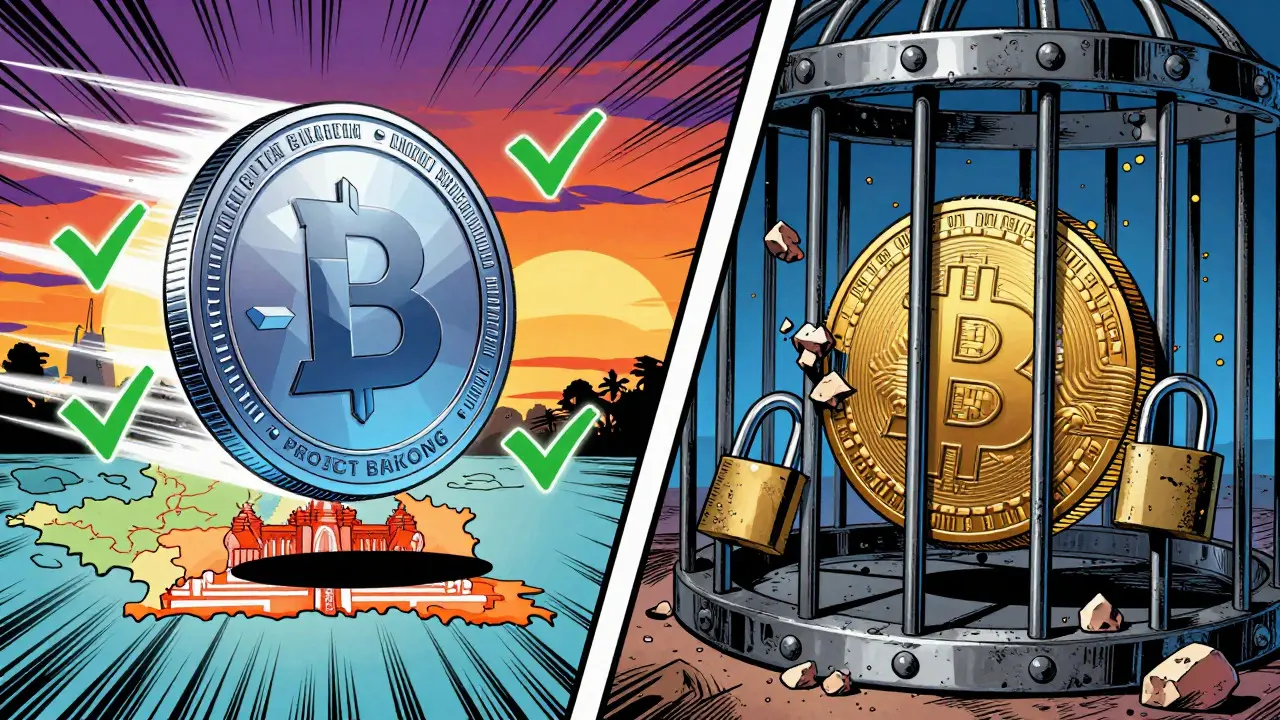
Cambodia isn't just restricting crypto; it's actively pushing its own alternative: a blockchain-based payment system launched in 2020 with Japanese support Project Bakong. By late 2024, Bakong had reached 65% population penetration, processing millions of daily transactions. It’s fast, cheap, and integrated directly into the national banking infrastructure.
Here’s the catch: Bakong is a closed ecosystem. It doesn't connect easily to open networks like Ethereum or Bitcoin Lightning. The NBC Governor has stated that private cryptocurrencies won't be legal tender until Bakong achieves full stability. For most people, this means Bakong is the practical choice for everyday payments, while crypto remains a niche asset class for investors and cross-border remittances.
| Feature | Project Bakong | Licensed Crypto Exchanges | Offshore Exchanges (e.g., Binance) |
|---|---|---|---|
| Legal Status | National Standard | Regulated (SERC/NBC) | Restricted/Blocked |
| Speed | Instant | 1-3 Days | Variable (often blocked) |
| Cost | Low | ~0.8% | High (due to workarounds) |
| Bank Compatibility | Direct Integration | Approved Channels Only | Risk of Account Freeze |
| Best For | Daily Spending | Stablecoin Holdings | Advanced Traders (at risk) |
Regional Context and Competitive Disadvantages
Cambodia’s stance is the strictest in Southeast Asia. While Thailand allows banks to hold up to 20% of capital in digital assets and Singapore embraces innovation, Cambodia caps exposure at 15% and bans direct holdings of unbacked coins. This caution has protected the riel from volatility, keeping inflation at a manageable 6.2%, but it has created a competitive gap.
Remittance costs in Cambodia sit at 6.8% of transaction value, compared to 4.2% in Laos, where crypto corridors are permitted. Cross-border payments can take 3-5 business days versus 24 hours in Vietnam. For businesses dealing with international partners, this delay adds up. Yet, the trade-off is regulatory certainty. Companies like RiceX have successfully raised funding through approved channels, proving that if you play by the rules, the system works.

Practical Tips for Navigating the System
If you need to move value using crypto in Cambodia, follow these steps to minimize headaches:
- Stick to Licensed Platforms: Use Royal Group Exchange or other SERC-authorized entities. They handle compliance for you.
- Use Stablecoins for Transfers: USDT is far less likely to trigger volatility alerts than BTC. Ensure it's a Group 1 compliant stablecoin.
- Document Everything: Keep proof of source of funds. If you're selling crypto for riel, have the buyer's details ready.
- Avoid Offshore Apps: Accessing blocked exchanges like Binance via VPN increases the risk of bank scrutiny. The TRC has already blocked 16 major offshore platforms.
- Monitor Transaction Limits: Daily conversion limits vary by platform (e.g., $5,000 on Royal Group). Plan large transfers in batches if necessary.
Future Outlook and What to Watch
The regulatory environment is tightening, not loosening. With recent sanctions on Cambodian-linked scam centers by the U.S. Treasury, the NBC is cracking down harder on illicit flows. Expect mandatory real-time monitoring for all crypto-fiat conversions in 2026. The goal is clear: protect the financial system from fraud while slowly integrating digital assets into the mainstream economy through safe, regulated channels.
Is Bitcoin illegal in Cambodia?
Not exactly. Bitcoin is classified as a Group 2 asset. Banks cannot hold it on their books, but individuals can own it. The main issue is accessing offshore exchanges without triggering bank freezes. Using licensed local platforms is the safest route.
Why was my bank account frozen after a crypto trade?
Likely due to the NBC's auto-flagging system detecting an unusual pattern or a missing KYC document. Contact your bank immediately with proof of the transaction's legitimacy. Most freezes are lifted within 14 days if documentation is complete.
Can I use Binance in Cambodia?
Technically, access is blocked by the Telecommunication Regulator of Cambodia. While some users access it via VPN, it carries high risk of bank account issues. It is better to use licensed local exchanges like Royal Group Exchange for compliance safety.
What is the limit for crypto holdings in Cambodian banks?
Banks can hold up to 15% of their Tier 1 capital in Group 1 assets (stablecoins/tokenized securities). They are prohibited from holding Group 2 assets (like Bitcoin) directly. This limit applies to the bank's balance sheet, not individual customer accounts.
Is Project Bakong better than using crypto for remittances?
For domestic payments, yes. Bakong is faster and cheaper. For cross-border remittances to countries without Bakong integration, licensed crypto stablecoins may still offer lower fees, provided you use NBC-approved channels to avoid delays.