Imagine waking up to find your bank account frozen because the institution holding your money failed. Now imagine that same scenario with your cryptocurrency holdings. In most countries, you’re on your own. But in Japan? The story is different. If you hold Bitcoin or other digital assets on a registered Japanese exchange, there’s a structured safety net designed to get your money back, often faster than traditional banking procedures allow.
This isn’t just theory. As of September 2026, Japan hosts over 12 million crypto exchange accounts with deposits exceeding 5 trillion yen (roughly $33.7 billion). That’s a massive pool of retail capital. To protect it, the Financial Services Agency (FSA) has built one of the world’s strictest regulatory frameworks. This article breaks down exactly how consumer protection for crypto in Japan works, what rights you have if an exchange fails, and why these rules matter whether you’re a local resident or an international investor looking at Tokyo-based platforms.
The Core Rulebook: PSA and FIEA
Japan’s approach to crypto regulation rests on two main pillars: the Payment Services Act (PSA) and the Financial Instruments and Exchange Act (FIEA). Think of the PSA as the rulebook for payment methods and custody, while the FIEA governs investment products. Since the major revisions in 2017, and especially after the significant 2025 amendments, these laws have tightened significantly.
Why does this distinction matter for you? Because it determines who watches over your assets. Under the PSA, any company offering crypto exchange services-known legally as a Crypto-Asset Exchange Service Provider (CAESP)-must register with the FSA. You can check their registration status publicly. If they aren’t registered, they are operating illegally, punishable by up to three years in prison or fines up to JPY 3 million. This immediate legal consequence filters out many fly-by-night operators before they even touch your money.
The 2025 amendment didn’t just tweak the rules; it revolutionized them. It introduced direct refund options for users when funds transfer businesses fail. Previously, recovering funds from a failed business secured by bank guarantees could take at least 170 days due to government-led processing. Now, banks and trust companies can return funds directly to users without waiting for lengthy bureaucratic approvals. For a retail investor, this cuts weeks off the recovery timeline, providing critical liquidity during market stress.
Custody Standards: Where Your Money Actually Sits
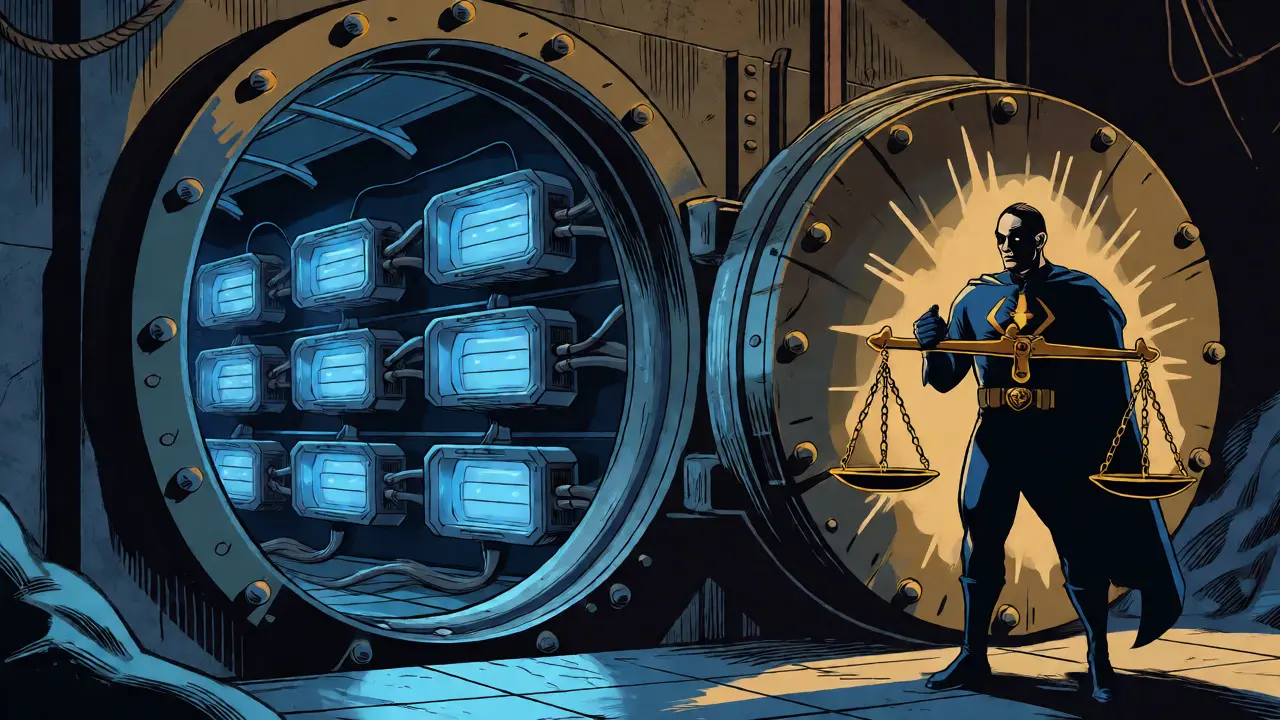
You might assume your crypto sits on a server in a data center. In Japan, the law dictates otherwise for the vast majority of it. Registered exchanges must keep at least 95% of user assets in offline cold wallets. These are hardware devices disconnected from the internet, making them nearly immune to remote hacking attempts.
The remaining 5% stays in hot wallets for daily trading liquidity. But here is the key consumer protection feature: segregation. Exchanges are required to keep customer funds strictly separate from their own corporate assets. If the exchange goes bankrupt, creditors cannot claim your Bitcoin to pay off the company’s debts. Your assets remain yours, held in trust. This separation is audited regularly, ensuring that the balance sheet matches the actual crypto holdings.
| Requirement | Japan (Registered CAESP) | Typical Unregulated/Offshore Exchange |
|---|---|---|
| Cold Storage Ratio | Minimum 95% | Varies widely, often less than 50% |
| Fund Segregation | Mandatory legal separation from company assets | Often commingled with operational funds |
| Audit Frequency | Regular external audits required | Self-reported or no audits |
| Physical Presence | Must have physical operations in Japan | Can be fully virtual/offshore |
Reclassification: When Tokens Become Securities
Not all tokens are treated equally. The FSA recently moved to reclassify certain digital assets under the FIEA, effective June 2025. If a token offers investment-like returns or governance rights similar to stocks, it’s now regulated as a security. This shift brings those tokens under stricter disclosure rules.
For consumers, this means better information. Issuers of these "security tokens" must provide mandatory disclosures comparable to stock market filings. They face insider trading regulations and market conduct rules. Before this change, many investors bought tokens based on whitepapers that lacked legal enforceability. Now, if a project misrepresents its financial health, investors have clearer legal pathways to seek redress. This also paves the way for regulated spot Bitcoin ETFs in Japan, offering another layer of institutional-grade protection for passive investors.
DeFi and Emerging Risks
What about Decentralized Finance (DeFi)? Traditional consumer protection relies on a central entity to blame if things go wrong. DeFi removes that entity. Recognizing this gap, the FSA established a formal DeFi Study Group that meets every two to three months. This group includes regulators, industry experts, and academics working to define how smart-contract-based services fit into existing laws.
Currently, DeFi protocols themselves aren’t always subject to the same CAESP rules, but the intermediaries connecting users to them often are. The study group is exploring how to apply AML (Anti-Money Laundering) and KYC (Know Your Customer) standards to decentralized interfaces. While not fully resolved, the proactive stance suggests that future regulations will likely require front-end providers to implement identity checks, reducing anonymity-related fraud risks for everyday users.
Practical Steps for Users
If you are using a Japanese exchange, you already benefit from these protections. But you should verify a few things to ensure you’re fully covered:
- Check Registration: Always confirm the exchange appears on the FSA’s official list of registered CAESPs. Unregistered platforms offer zero statutory protection.
- Understand Withdrawal Limits: Due to anti-fraud measures, some exchanges impose withdrawal delays or limits for new accounts. This is a security feature, not a bug.
- Read the Trust Agreement: Ensure your contract explicitly states that assets are held in trust. This is the legal document that protects you in bankruptcy.
- Watch for Credit Card Rules: If you buy crypto via credit card installment plans, additional consumer protections under the Installment Sales Act apply, including cooling-off periods.
Approximately 70% of crypto users in Japan are middle-income earners expecting long-term gains. The regulatory framework is tailored to this demographic, prioritizing stability and transparency over high-risk speculation. By enforcing strict capital reserves and operational standards, the FSA ensures that the system remains robust enough to handle mass adoption without collapsing under the weight of volatility.
FAQ
What happens if my Japanese crypto exchange goes bankrupt?
Your assets are protected because registered exchanges must segregate customer funds from company assets. Additionally, 95% of assets are kept in cold storage. In the event of failure, recent 2025 amendments allow for faster direct refunds from banks or trust companies, bypassing lengthy government processing times that previously took over 170 days.
Are all cryptocurrencies regulated the same way in Japan?
No. The Payment Services Act covers general crypto-assets used for payments. However, tokens with investment characteristics are being reclassified under the Financial Instruments and Exchange Act (FIEA) as securities. This subjects them to stricter disclosure requirements and insider trading laws similar to stocks.
How much of my crypto is stored online?
Japanese law requires registered exchanges to store at least 95% of user assets in offline cold wallets. Only up to 5% can be kept in hot wallets connected to the internet for daily trading needs. This minimizes the risk of large-scale cyber theft.
Do I need to do anything special to be protected?
Yes, primarily ensure you are using an exchange registered with the Financial Services Agency (FSA). Using unregistered offshore exchanges means you lose access to Japan’s specific consumer protection mechanisms, such as mandatory fund segregation and cold storage requirements.
What is the penalty for operating an unregistered crypto exchange in Japan?
Operating without registration can result in imprisonment for up to three years or fines up to JPY 3 million. Note that from June 2025, imprisonment penalties may be replaced by confinement punishment under updated Penal Code amendments, maintaining strict enforcement against non-compliant entities.