
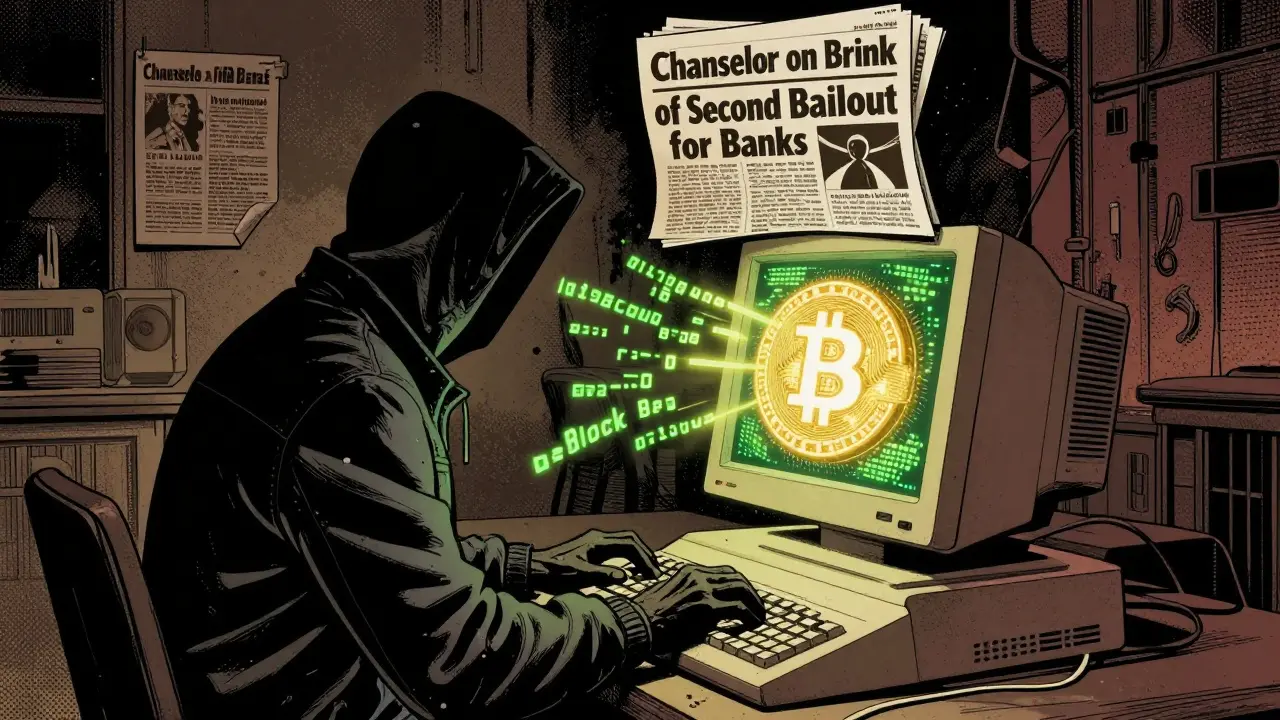
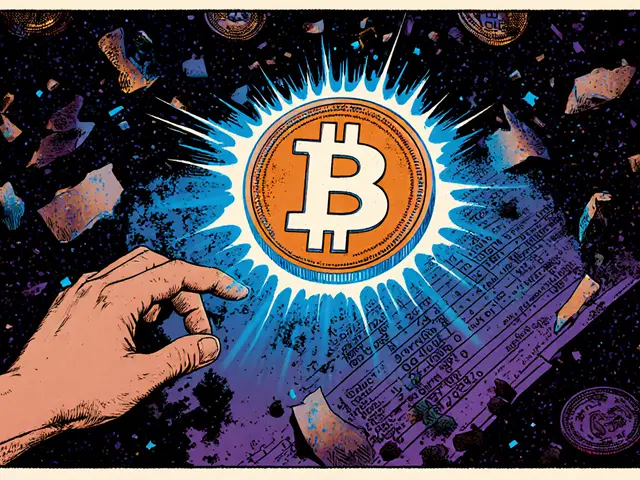
The first block ever mined in a blockchain isn’t just code-it’s a manifesto. On January 3, 2009, a single block was created that changed how money works. It didn’t come from a bank. It didn’t need approval from a government. It was born from a quiet, anonymous act that would later spark a global financial revolution. That block? The Genesis Block of Bitcoin.
What Makes the Bitcoin Genesis Block So Special?
The Bitcoin Genesis Block, known as Block 0, was mined by Satoshi Nakamoto at 18:15:05 GMT. Its hash is000000000019d6689c085ae165831e93. It’s not just a string of numbers-it’s the anchor of the entire Bitcoin network. Every single block that came after it traces its lineage back to this one. No other block has that kind of authority.
What sets it apart isn’t just its position. It contains a message: "The Times 03/Jan/2009 Chancellor on brink of second bailout for banks". That headline from The Times wasn’t randomly picked. It was a direct jab at the 2008 financial crisis. Banks were collapsing. Governments were bailing them out with taxpayer money. Satoshi was saying: "We don’t need this system."
The block also includes a 50 BTC reward. But here’s the twist: that reward can never be spent. It’s frozen in time. Why? Because the Genesis Block was never meant to be part of normal mining. It was hardcoded into the Bitcoin software as a starting point. No miner ever solved it. It was placed there by design.
Unlike every other block, it doesn’t point to a previous block. There’s no parent. It’s the root. And because of that, it’s the only block in Bitcoin’s history that can’t be altered-even by a 51% attack. It’s the one unshakable truth in the entire chain.
How the Genesis Block Changed Everything
Before Bitcoin, digital money had one fatal flaw: it needed a middleman. PayPal, banks, credit card companies-they all had to verify transactions. That meant control, fees, and censorship. Satoshi’s Genesis Block proved you could remove them all. The block used proof-of-work to establish trust without a central authority. Miners didn’t need to trust each other. They just needed to trust the math. The hash function, the Merkle root (4a5e1e4baab89f3a32518a88), the timestamp-all of it worked together to create an immutable ledger. That’s the real innovation.
This wasn’t just a new currency. It was a new way to record value. The Genesis Block showed that data could be stored across thousands of computers, secured by cryptography, and made tamper-proof. That idea didn’t stay in Bitcoin. It spread.
Within a few years, Ethereum, Litecoin, Ripple, and hundreds of other blockchains were built using the same blueprint. Each had their own Genesis Block. Ethereum’s was mined on July 30, 2015. Litecoin’s on October 7, 2011. They all copied Bitcoin’s structure: hardcoded, unspendable, timestamped. The Genesis Block became the standard.
Why the Times Headline Matters More Than You Think
Most people think the Genesis Block is just a technical milestone. But the real power is in the message. The 2008 crisis wasn’t an accident. It was the result of reckless lending, opaque derivatives, and central banks printing money to save failing institutions. The public lost trust. Satoshi didn’t just build a currency-they built a protest. That headline was chosen for a reason. It wasn’t random. It was a timestamp with meaning. It tied Bitcoin’s birth to a moment of systemic failure. It said: "This is why we need something better." Today, that message still resonates. When inflation hits 10%, when banks freeze accounts, when governments devalue currency-people look back at that block and remember why Bitcoin exists. It’s not just about money. It’s about autonomy. The cypherpunk movement-crypto-enthusiasts who believed in using math to protect freedom-saw the Genesis Block as their manifesto. And now, over 16 years later, it’s still the most powerful symbol in cryptocurrency.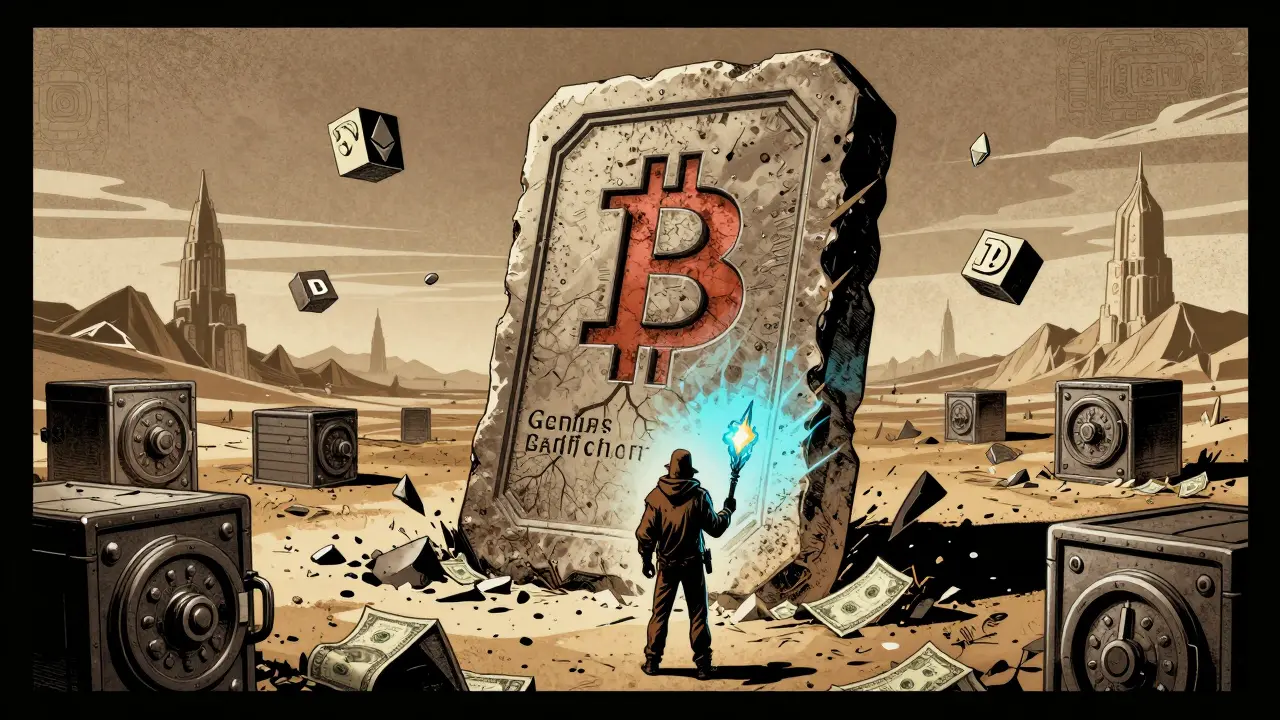
How Other Blockchains Use Genesis Blocks
Bitcoin’s Genesis Block didn’t just start a coin. It started a movement. Every blockchain that followed had to create its own genesis block. But not all of them are the same. Ethereum’s Genesis Block included a pre-distributed allocation of ETH to early supporters and developers. It wasn’t just a starting point-it was a funding mechanism. That’s different from Bitcoin, where no coins were pre-mined. Monero’s Genesis Block is hidden in a way that makes it impossible to trace. That aligns with its focus on privacy. Bitcoin’s block is public and transparent. Monero’s is deliberately obscure. Even central bank digital currencies (CBDCs) now use genesis blocks. China’s digital yuan, for example, has its own genesis block that controls how money is issued and tracked. It’s still a blockchain-but it’s centralized by design. That’s the key difference: Bitcoin’s genesis block was meant to remove control. Others use it to enforce it. The lesson? The Genesis Block isn’t just a technical detail. It’s a statement of purpose. What’s embedded in it tells you what the blockchain stands for.The Legacy of the Genesis Block in 2025
By 2025, Bitcoin has processed over 1.13 billion transactions. Its market cap peaked at $2 trillion in December 2024. Companies like MicroStrategy and Metaplanet hold Bitcoin as treasury reserves. El Salvador made it legal tender. Spot Bitcoin ETFs now trade on major U.S. exchanges. All of it traces back to that one block. The Genesis Block proved that a decentralized network could survive, grow, and thrive without permission. It didn’t need venture capital. It didn’t need a CEO. It just needed code and people who believed in it. Today, developers still study it. Students learn it in university courses. Blockchain bootcamps start with the Genesis Block because it’s the foundation of everything else. Even as new technologies like zero-knowledge proofs and layer-2 scaling emerge, the core idea remains unchanged: trustless systems can work. The Genesis Block was the first proof.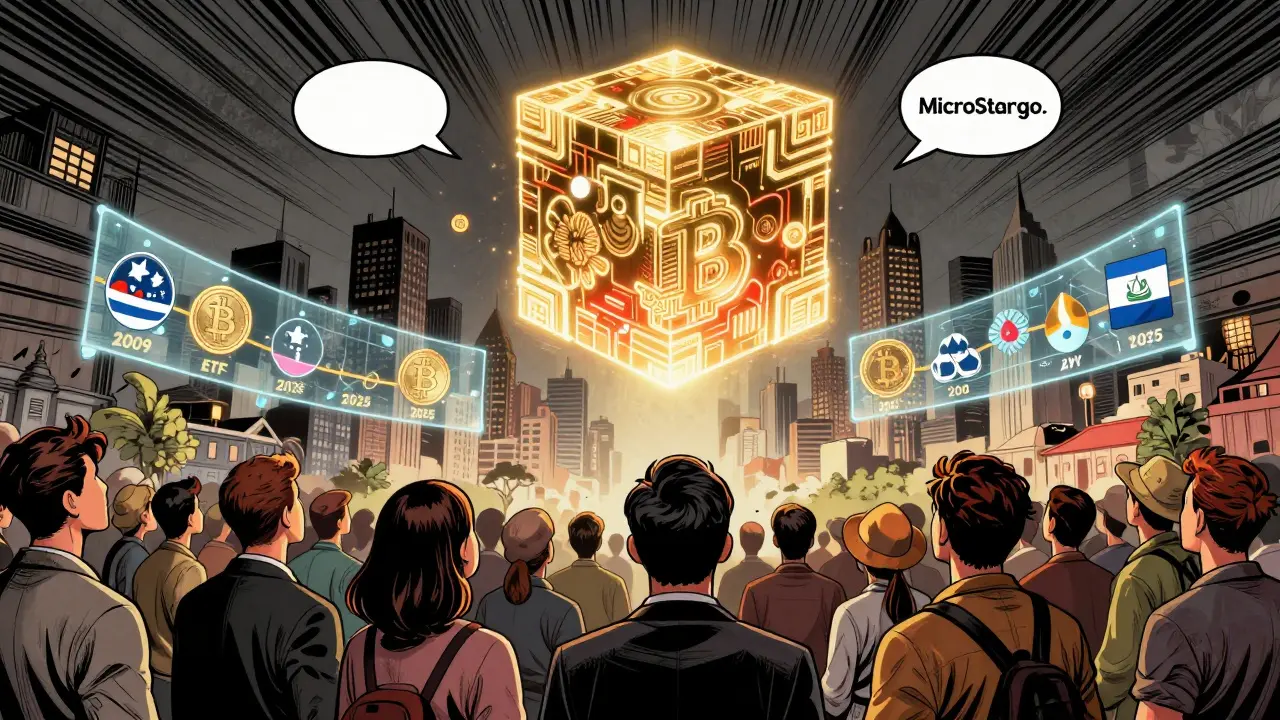
What You Can Learn From It
If you’re new to cryptocurrency, don’t skip the Genesis Block. It’s not just history-it’s a lesson. - Decentralization isn’t theoretical. It’s built into the code. The block can’t be changed. No one owns it. - Timing matters. Bitcoin launched when trust in banks was at its lowest. The message was clear. - Small actions can start big movements. One person, one block, one idea-changed the world. - Transparency is power. The entire chain is public. You can verify every transaction since day one. You don’t need to mine Bitcoin. You don’t need to buy it. But understanding the Genesis Block helps you understand why cryptocurrency exists at all.How to Explore the Genesis Block Yourself
You can view the Genesis Block right now. Go to any Bitcoin block explorer-like Blockchain.com or Blockstream.info-and search for block 0. You’ll see:- The exact timestamp: January 3, 2009, 18:15:05 GMT
- The embedded message in the coinbase transaction
- The 50 BTC reward, still unspent
- The hash and Merkle root
What is the Genesis Block in Bitcoin?
The Genesis Block is the very first block in the Bitcoin blockchain, mined by Satoshi Nakamoto on January 3, 2009. It’s Block 0 and serves as the foundation for all subsequent blocks. Unlike other blocks, it has no predecessor and contains a hardcoded message referencing the 2008 financial crisis. It also includes a 50 BTC reward that can never be spent.
Why is the Genesis Block unspendable?
The 50 BTC reward in the Genesis Block is unspendable because the Bitcoin software treats it as a special case. It was never meant to be part of normal mining or transaction history. The code doesn’t allow it to be referenced as an input in any future transaction. This ensures the block remains a permanent, unchangeable anchor point for the entire blockchain.
What does the message in the Genesis Block mean?
The message, "The Times 03/Jan/2009 Chancellor on brink of second bailout for banks," references a headline from The Times newspaper on the day the block was created. It’s a political statement criticizing central banks and the 2008 financial crisis. Satoshi used it to show Bitcoin was created as a response to failed traditional finance-not just as a new currency.
Do all cryptocurrencies have a Genesis Block?
Yes, every blockchain network, including Ethereum, Litecoin, and Monero, has its own Genesis Block. It’s the first block in their chain and is hardcoded into the software. While Bitcoin’s is purely symbolic, others sometimes include pre-mined coins or specific rules for how the network begins.
Can the Genesis Block be changed or deleted?
No. Because every block in Bitcoin references the one before it, changing the Genesis Block would require rewriting every single block that came after it. That’s impossible without controlling over 50% of the network’s computing power-and even then, the network would reject it. The Genesis Block is immutable by design.
There are 20 Comments
roxanne nott
Alison Fenske
Naman Modi
Rachel McDonald
vaibhav pushilkar
Radha Reddy
Amit Kumar
Dan Dellechiaie
Melissa Black
Jayakanth Kesan
Sarah Glaser
Dusty Rogers
Cathy Bounchareune
Janet Combs
Earlene Dollie
Sybille Wernheim
Vijay n
Megan O'Brien
Kevin Karpiak
Melissa Black
Write a comment
Your email address will not be published. Required fields are marked *