
Getting a FINMA crypto license in Switzerland isn't just about filling out forms. It is a rigorous process that demands specific capital, robust security architecture, and strict adherence to anti-money laundering laws. For exchanges aiming to operate in the "Crypto Valley," understanding these requirements is the difference between launching a compliant business and facing immediate shutdown.
Switzerland has long been a hub for blockchain innovation, but its regulator, the Swiss Financial Market Supervisory Authority (FINMA), does not tolerate ambiguity. If you are planning to launch an exchange, broker, or trading venue in Zurich or Zug, you need to know exactly which license applies to your model and what it costs to get there.
Choosing the Right License Type
FINA does not issue a single "crypto license." Instead, they use an activity-based approach. This means your license depends on what your platform actually does, not just what you call it. You must identify your primary function before you even start drafting your business plan.
| License Type | Primary Function | Key Requirement |
|---|---|---|
| VASP License | Exchange fiat for crypto or crypto for crypto; wallet services. | Compliance with Anti-Money Laundering Act (AMLA); registration with MROS. |
| DLT Trading Venue License | Operating a multilateral system for trading DLT-securities or cryptocurrencies. | Integration of trading, clearing, settlement, and custody under FMIA rules. |
| Crypto Broker License | Intermediating transactions between buyers and sellers. | Strict fit-and-proper tests for management; high capital reserves. |
| Crypto Custody License | Safeguarding assets for clients. | Advanced cold storage infrastructure; segregation of client assets. |
The most common entry point for new exchanges is the Virtual Asset Service Provider (VASP) status. This requires registration with the Money Laundering Reporting Office Switzerland (MROS) and adherence to the AMLA. However, if your platform matches orders or provides a marketplace, you likely need a DLT Trading Venue license under the Financial Market Infrastructure Act (FMIA). This latter license is significantly more complex, requiring integration of clearing and settlement capabilities.
Capital Requirements and Corporate Structure
You cannot operate as a sole proprietorship if you want a full FINMA license. You must incorporate as either an Aktiengesellschaft (AG) (joint-stock company) or a Gesellschaft mit beschränkter Haftung (GmbH) (limited liability company). The choice affects your minimum share capital.
- AG (Aktiengesellschaft): Requires a minimum share capital of CHF 100,000. This is the standard for larger exchanges seeking institutional credibility.
- GmbH (Limited Liability Company): Requires a minimum share capital of CHF 20,000. Suitable for smaller brokers or niche service providers, though some licenses may require higher operational capital regardless of this legal minimum.
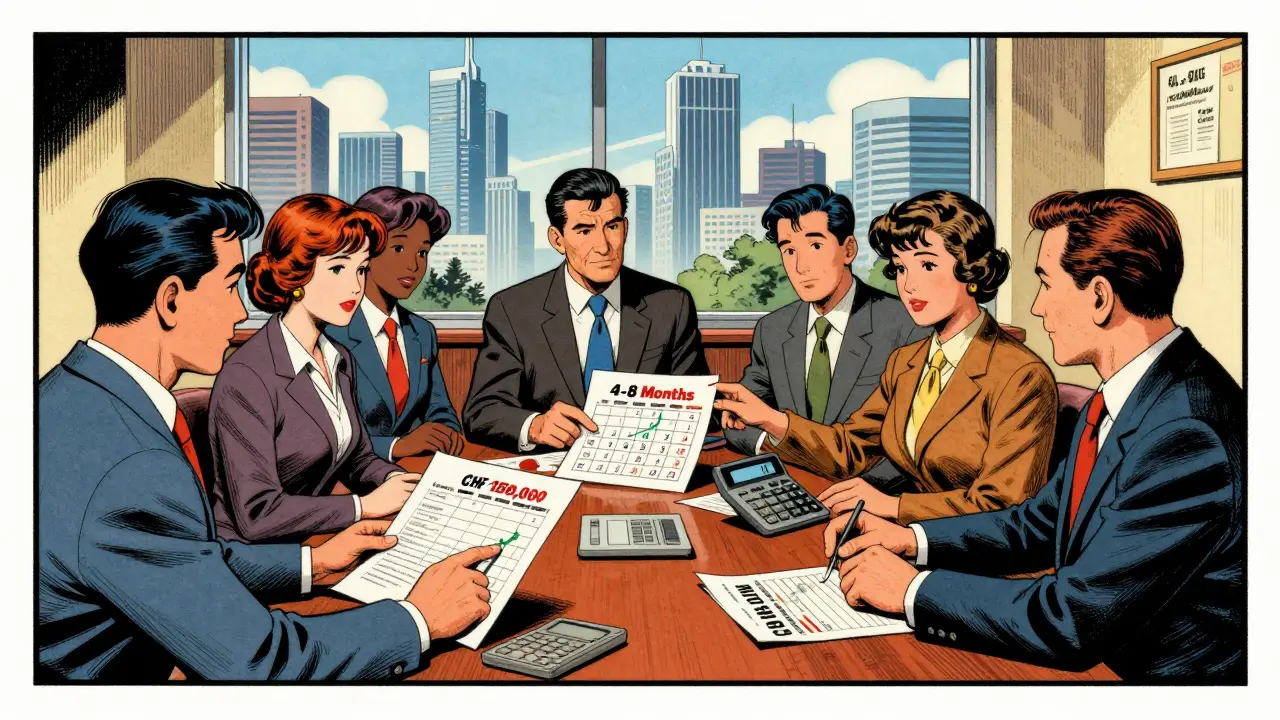
Beyond the statutory minimum, FINMA expects you to hold sufficient operating capital to cover initial losses. For a DLT Trading Venue, expect to demonstrate liquidity well above the CHF 100,000 mark. Total setup costs, including legal fees, compliance consultants, and government charges, typically range from CHF 50,000 to CHF 150,000 in the first year.
Technical Security and Operational Resilience
FNMA’s guidelines are explicit about technology. You cannot rely on basic hot wallets. Your security architecture must be documented in detail during the application phase. The regulator looks for evidence of "substance over form"-meaning even if your tech is decentralized, if you control keys or interfaces, you are responsible for security.
Your technical documentation must prove:
- Cold Storage Mandate: At least 95% of client assets must be stored in offline cold wallets.
- Multi-Signature Protocols: Use of multi-sig wallets with a minimum of 3-of-5 signing requirements for any movement of funds.
- Penetration Testing: Annual audits by FINMA-approved third-party security firms. You must submit these reports proactively.
- Recovery Objectives: Define clear Recovery Time Objectives (RTO) of no more than 4 hours and Recovery Point Objectives (RPO) of 15 minutes for critical systems.
If your system goes down for six hours, you are already in violation of best practices expected by the regulator. This level of resilience is non-negotiable for protecting retail investors.

The Application Process and Timeline
Do not expect speed. The entire process from incorporation to license approval takes between 4 and 8 months. Here is how that time breaks down:
- Months 1-3: Incorporation and Setup. Register your AG or GmbH. Open corporate bank accounts (this alone can take weeks due to banking reluctance toward crypto). Hire your Compliance Officer and MLRO (Money Laundering Reporting Officer).
- Months 4-6: Documentation Preparation. Draft your business plan, AML/KYC policies, and technical security architecture. Engage external auditors for preliminary reviews.
- Months 7-8: Submission and Review. Submit your application to FINMA. Expect back-and-forth communication. FINMA case officers are known for being responsive, often providing written feedback within 10 business days at each stage.
In September 2024, FINMA announced streamlined procedures for DLT Trading Venues that meet predefined technical standards, reducing approval timelines to 6-8 weeks for those specific cases. However, for most new entrants, the 4-8 month window remains the realistic expectation.
AML/KYC Compliance and the Travel Rule
Switzerland aligns closely with international standards set by the Financial Action Task Force (FATF). Your KYC (Know Your Customer) process must be stringent. You cannot onboard anonymous users. Every customer must be verified using government-issued ID, proof of address, and source of funds documentation.
As of January 1, 2025, the revised Anti-Money Laundering Act (AMLA) enforces stricter "Travel Rule" compliance. For any transaction above CHF 1,000, you must transmit sender and receiver information to the next service provider in the chain. Failure to implement this data transmission protocol will result in immediate regulatory action.
Costs and Ongoing Obligations
Licensing is not a one-time fee. You must budget for ongoing compliance costs. According to industry surveys, 62% of licensed exchanges report that their annual compliance expenses exceed initial projections by 25-40%. These costs include:
- Staffing: An average licensed exchange employs 3.2 full-time compliance staff.
- Consultants: Many firms hire external legal and compliance experts during the application phase, costing CHF 8,000-15,000 per month.
- Audits: Annual financial and security audits are mandatory.
- Government Fees: Registration and licensing fees account for approximately CHF 5,000-15,000 annually.
While expensive, this investment pays off. FINMA-licensed exchanges handle 78% of institutional crypto transactions in Europe. Institutional clients demand this level of regulatory certainty.
Challenges for DeFi Projects
If you are building a Decentralized Finance (DeFi) protocol, be warned: FINMA applies a "substance-over-form" test. Even if your code is open-source and runs on-chain, if you provide a user interface, manage governance tokens, or offer centralized support, you may be classified as a regulated entity.
In December 2023, FINMA clarified that genuine decentralization is rare. Most projects claiming to be DeFi still have identifiable controllers. Until Q2 2025, when FINMA plans to launch a sandbox for DeFi protocols with relaxed capital requirements, you should assume you need a full license if you interact with users directly.
Conclusion: Is It Worth It?
Switzerland offers unparalleled legal clarity and access to institutional capital. With 37 FINMA-licensed exchanges already operating and a market projected to grow at 14.3% CAGR through 2027, the opportunity is significant. However, the barrier to entry is high. If you lack the capital for robust security and the patience for a lengthy approval process, consider jurisdictions with faster setups like Singapore. But if you want long-term stability and trust, FINMA’s framework remains the gold standard.
How much does it cost to get a FINMA crypto license?
Total costs range from CHF 50,000 to CHF 150,000 in the first year. This includes minimum share capital (CHF 20,000 for GmbH, CHF 100,000 for AG), government fees (CHF 5,000-15,000), legal and compliance consultant fees, and initial security audit costs.
How long does the FINMA licensing process take?
The process typically takes 4 to 8 months from company incorporation to final approval. This includes 3-4 months for incorporation and document preparation, followed by 1-4 months for FINMA review. Streamlined processes for DLT Trading Venues can reduce this to 6-8 weeks if technical standards are met.
What is the difference between a VASP and a DLT Trading Venue license?
A VASP license covers basic exchange and wallet services under AML regulations. A DLT Trading Venue license, governed by the FMIA, allows for integrated trading, clearing, settlement, and custody of securities and cryptocurrencies, offering broader operational capabilities but requiring stricter oversight and higher capital.
Can decentralized exchanges (DEXs) avoid FINMA regulation?
Generally, no. FINMA uses a "substance-over-form" approach. If a DEX provides a user interface, manages governance tokens, or has identifiable controllers, it is likely subject to licensing requirements. True decentralization without any central entity is extremely rare and difficult to prove.
What are the technical security requirements for FINMA-licensed exchanges?
Exchanges must store at least 95% of client assets in cold storage, use multi-signature wallets (e.g., 3-of-5), undergo annual penetration testing by approved auditors, and maintain recovery time objectives of less than 4 hours for critical systems.