

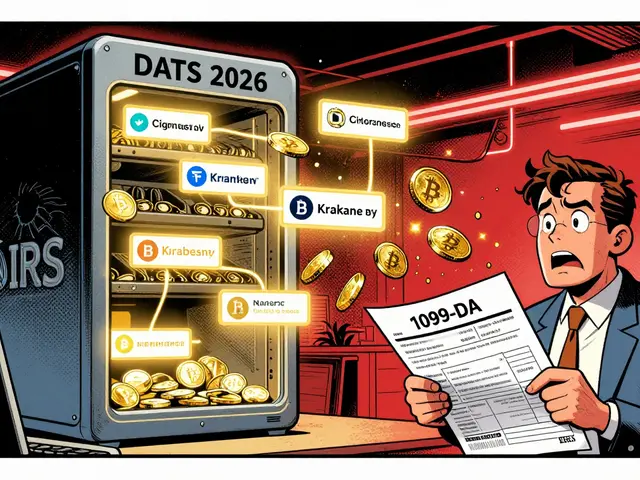
By 2026, if you hold crypto, you’re no longer just a trader or investor-you’re part of a global financial system that reports your transactions automatically. No more spreadsheets. No more guessing which trades are taxable. The era of manual crypto tax filing is over. The future of automated crypto tax reporting is here, and it’s already reshaping how millions of people handle their digital assets. This isn’t science fiction. It’s real. Every time you swap ETH for SOL, stake your ADA, or sell an NFT, that transaction is now being tracked, classified, and reported to tax authorities-not by you, but by the platforms you use. The system works because governments, tech firms, and exchanges have built something unprecedented: a global, real-time tax infrastructure for crypto. It started with the OECD’s Crypto-Asset Reporting Framework (CARF), launched in 2022. By January 2025, 112 countries had signed on. The European Union’s DAC8 directive and the U.S. IRS’s Form 1099-DA turned that framework into law. Now, exchanges like Coinbase, Binance, and Kraken are legally required to send your transaction data directly to tax agencies. No more relying on your memory or a tax app to piece it together. The numbers tell the story. The IRS’s Digital Asset Transaction System (DATS) now handles 1.8 billion crypto transactions every day. The OECD’s compliance program processes 1.2 million reports monthly. In 2024, the IMF estimated the global crypto tax gap at $10 billion. By 2026, that gap has shrunk by over 70% thanks to automated reporting. Eighty-three percent of crypto tax revenue now comes from third-party data, not self-reported forms. But how does it actually work? Behind the scenes, it’s a layered system. Blockchain analytics engines from Chainalysis and Elliptic scan public ledgers, matching wallet addresses to real identities. AI models predict transaction types-was that a swap? A staking reward? A liquidity pool deposit? These systems now achieve 98.7% accuracy in identifying what happened on-chain, according to MIT’s 2025 benchmark study. They don’t just see that you sent 0.5 BTC. They know you sent it to a DeFi protocol, and that it triggered a taxable event under MiCA standards. Data flows through standardized XML formats defined by CARF 2.1. There are 37 mandatory fields: exact timestamps down to the millisecond, wallet addresses, asset types, cost basis, and even the IP address used to access the exchange. For centralized exchanges, reporting happens in under 72 milliseconds. For DeFi? It’s slower-around 4.2 seconds-but still automatic. The big win? You no longer need to track every single trade yourself. If you only use Coinbase or Kraken, your 1099-DA form will include every buy, sell, swap, and earn. It’s accurate. It’s complete. And it’s sent to the IRS before you even file your return. But here’s the catch: it’s not perfect. DeFi is still a blind spot. Only 63% of Uniswap v3 transactions are properly attributed. Why? Because DeFi protocols don’t have user accounts. You interact with smart contracts directly. No KYC. No identity. That makes it harder to link a wallet to a real person. Even with advanced analytics, 18.7% of cross-chain bridge transactions-like moving ETH to Solana-remain untraceable, according to CertiK’s 2025 report. NFTs are worse. Forty-seven percent of royalty payments go unreported. If you sold an NFT and got 5% in royalties every time it changed hands, the tax system doesn’t know that. You still owe tax on every payout. Most users don’t even realize. Staking rewards? Only 31% of DeFi platforms correctly calculate when they’re taxable. Some treat them as income when received. Others say they’re taxable only when sold. There’s no global standard. That’s why tax software like CryptoTaxCalculator now has 1,247 protocol-specific rules in its engine, updated in real time. And cost basis? That’s where most people get tripped up. If you bought ETH on Coinbase, swapped it for UNI on Uniswap, then bridged UNI to Solana and staked it-your cost basis gets messy. A joint study by CoinGecko and TaxBit found 31% of multi-chain users had incorrect cost basis calculations in 2025. That means underpaying-or overpaying-taxes. The software market has exploded because of this. In 2024, crypto tax tools made $4.21 billion. In 2025, that jumped to $5.04 billion. CoinTracker leads with 38% of the market, mostly because it integrates cleanly with centralized exchanges. CryptoTaxCalculator owns 42% because it’s the only one that truly handles DeFi and NFTs. But even the best tools can’t fix broken data. If your wallet address isn’t linked correctly, or a DeFi protocol doesn’t report, the software can’t magically guess what happened. Users are split. On Reddit and Trustpilot, 68% say automated reporting saved them hours of work. But 74% worry about privacy. One user on r/CryptoTax wrote: "Form 1099-DA saved me 15 hours, but Coinbase reporting my wallet-to-wallet transfers to the IRS feels like overreach." That’s the tension: transparency vs. surveillance. Tax professionals have had to adapt fast. In 2023, learning crypto taxes took 80 hours. Now, it’s 22. CPA firms are hiring blockchain tax specialists at $142,500 a year. The skill set isn’t just about tax law anymore-it’s about understanding blockchain architecture, smart contracts, and how liquidity pools work. Looking ahead, the system will only get smarter. By 2027, Deloitte predicts crypto tax reporting will be embedded in standard financial statements. No more separate forms. Just one line item: "Digital Asset Gains." AI will start suggesting tax optimizations-not just reporting them. Imagine your software telling you, "If you wait until next month to sell this ETH, you’ll save $1,200 in taxes." The EU is already testing decentralized identity solutions. Think of it like a digital passport for crypto: you prove you own the wallet without revealing your real name to the tax authority. It’s a way to keep compliance without full surveillance. Quantum-resistant encryption is being mandated by the EU Cyber Resilience Act. That’s not about hacking-it’s about future-proofing tax data against computers that can break today’s encryption. The big question is: will this system hold up? The World Economic Forum estimates that by 2030, automated crypto tax systems will process 8.2 billion transactions daily. But only three blockchains can currently handle that volume. If Bitcoin or Ethereum hits a spike during a market crash, the system could lag-or crash. Governments are also still fighting over rules. The U.S. taxes staking rewards as income. The UK taxes them only when sold. Canada treats them as capital gains. The EU uses a hybrid model. Until there’s global alignment, users will keep getting conflicting advice. For now, here’s what you need to do:
- Connect all your exchanges and wallets to a single tax software. Don’t use five different tools.
- Use a platform that supports DeFi and NFTs-like CryptoTaxCalculator or Koinly. CoinTracker won’t cut it if you’re active in Uniswap or Blur.
- Verify every wallet address. If you moved crypto between wallets, make sure they’re all linked in your tax software.
- Don’t ignore NFT royalties. They’re taxable, even if the platform doesn’t report them.
- Keep records of gas fees. They can reduce your taxable gain on swaps.
What happens if I don’t use automated tax software?
If you ignore automated reporting and file manually, you’re gambling. The IRS and EU tax agencies now receive your transaction data directly from exchanges. If your self-reported numbers don’t match what the system has, you’ll get a notice. Penalties start at 20% of the underpaid tax. In serious cases, audits can lead to fines, interest, or even criminal charges for willful evasion.Do I need to report every single crypto transaction?
Yes. Under DAC8 and Form 1099-DA, every taxable event counts: trades, swaps, staking rewards, airdrops, and even NFT sales. The system doesn’t care if it’s $5 or $50,000. All of it is reported. Your tax software will aggregate everything and calculate your total gain or loss.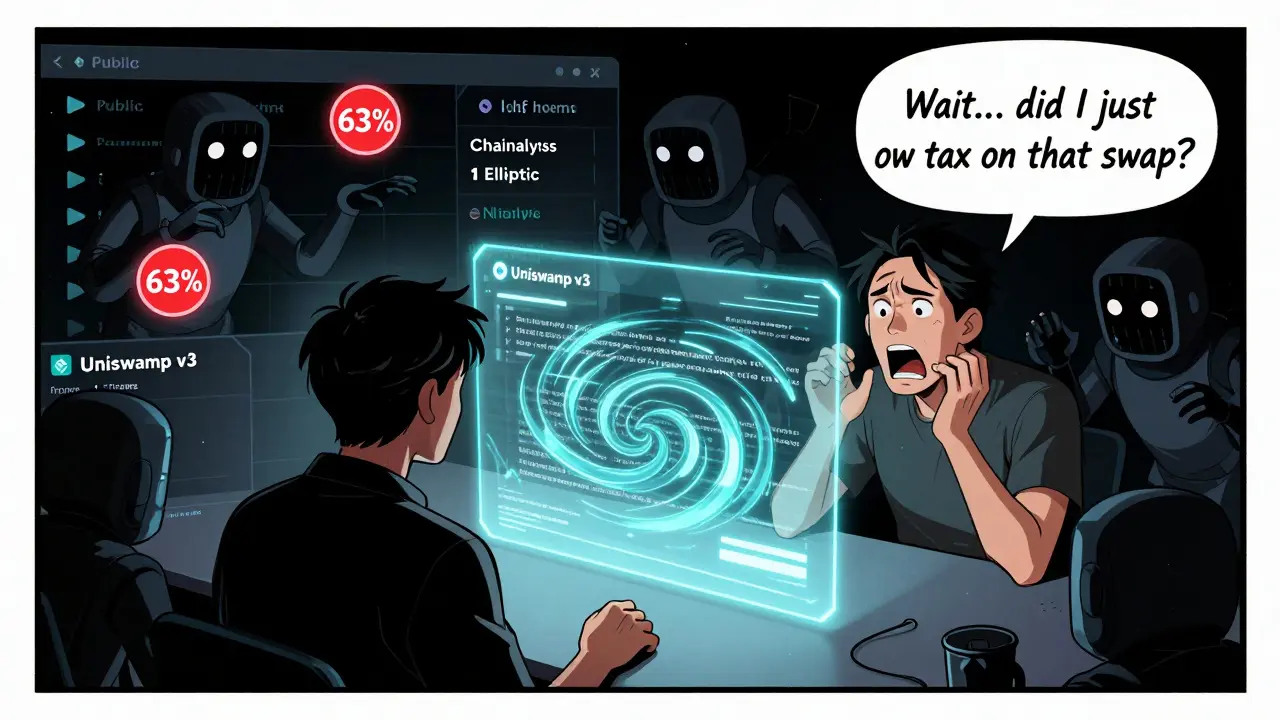
Can I use multiple tax software tools?
Technically yes, but it’s risky. If you use one tool for Coinbase and another for DeFi, you might miss cross-chain transactions or double-count trades. Most experts recommend one primary tool that connects to all your wallets and exchanges. It reduces errors and makes audits easier.

There are 16 Comments
Ann Liu
Automated reporting is a game-changer, but let’s not pretend it’s flawless. The system assumes every wallet is tied to an identity, which ignores the reality of privacy-focused wallets like Wasabi or Samourai. If you’re using CoinJoin or privacy layers, your transactions aren’t being reported - and that’s by design. The tax authorities aren’t catching everything, and they know it. This isn’t about compliance - it’s about deterrence.
Also, cost basis calculations are still a mess. Most software uses FIFO by default, but that’s not always optimal. LIFO or specific identification can save you thousands, but only if you manually track your lots. The 31% error rate? That’s because users don’t understand accounting methods, not because the tools are bad.
And don’t get me started on staking. The IRS says it’s income at receipt. The EU says it’s capital gain at sale. That’s not just inconsistency - it’s regulatory chaos. Until there’s a global standard, users are stuck playing whack-a-mole with tax laws.
Yes, automation saves time. But it also creates a false sense of security. I’ve seen clients get audited because their software misclassified a liquidity pool deposit as a swap. The system didn’t flag it. The user assumed it was handled. Big mistake.
If you’re serious about compliance, you need two things: a robust tax tool AND a human CPA who understands blockchain. No amount of AI can replace context. And if you’re using DeFi, keep detailed logs. Even if the protocol doesn’t report, you still owe taxes on rewards, swaps, and fee accruals.
Bottom line: automation is helping, but it’s not replacing due diligence. The IRS doesn’t care if you ‘didn’t know.’ They have the data. You’re responsible for matching it.
Dionne van Diepenbeek
So now the government knows every swap I make and which IP I used to log in to Binance
cool
next they’ll track my gas fees and tell me when to sell
Graham Smith
Let’s be clear - this isn’t ‘automation,’ it’s institutionalized surveillance under the guise of fiscal responsibility. The CARF framework is essentially a global tax compliance protocol masquerading as innovation. The 98.7% accuracy rate touted by MIT is statistically misleading - it conflates transaction classification accuracy with identity attribution fidelity.
DeFi remains a structural blind spot not because of technical limitations, but because of ontological incompatibility: smart contracts operate in a pseudonymous, permissionless lattice that fundamentally resists KYC-AML paradigms. The system’s inability to reconcile on-chain activity with off-chain identity is not a bug - it’s a feature of its inherent contradiction.
Furthermore, the $5.04B crypto tax software market is a classic rent-seeking ecosystem. Tools like CryptoTaxCalculator profit from complexity they helped create. They monetize the very ambiguity they claim to resolve.
And let’s not forget: the 1.8B daily transactions processed by DATS are largely synthetic - a significant portion are dust transactions, wash trades, and cross-chain arbitrage loops designed to obfuscate. The system is being gamed at scale.
What we’re witnessing isn’t progress - it’s the financialization of blockchain under state-capitalist control. The real innovation isn’t in reporting - it’s in the erosion of financial sovereignty.
Jerry Panson
While the technological infrastructure behind automated crypto tax reporting is undeniably sophisticated, it is imperative to acknowledge the legal and ethical implications of this paradigm shift. The integration of blockchain analytics engines with centralized tax authorities raises profound questions regarding the balance between regulatory compliance and individual privacy rights.
The fact that IP addresses, wallet addresses, and transaction timestamps are now being transmitted to government entities - even under the auspices of tax compliance - represents a significant expansion of data collection authority. This is not merely an administrative update; it is a redefinition of the relationship between the citizen and the state in the digital financial domain.
Moreover, the lack of global harmonization in tax treatment - particularly regarding staking rewards, NFT royalties, and DeFi interactions - creates a compliance burden that is both unnecessarily complex and potentially discriminatory across jurisdictions.
While the efficiency gains are measurable, the systemic risks - including data breaches, algorithmic misclassification, and jurisdictional overreach - warrant a cautious, transparent, and multi-stakeholder governance framework before full-scale implementation.
As a professional in financial regulation, I urge policymakers to prioritize auditability, user control, and international reciprocity over speed and scale.
Katrina Smith
so uhh yeah automated tax reporting lol
next theyll send me a bill for breathing
also why is my wallet address in a spreadsheet with my name???
cool cool
Anastasia Danavath
automated reporting?? more like automated stress 😭
my software says i owe $3k but i only made $2k in profit
also i forgot i staked 3 eth in 2023
sooo... i'm just gonna ignore this until the IRS texts me
💀
anshika garg
There is something deeply human in all of this - the way we cling to control over our digital lives, even as systems grow more powerful than we are.
For centuries, we’ve measured wealth in land, in gold, in paper. Now, it’s in code. And suddenly, the state wants to know every byte of it.
Is this progress? Or is it the quiet death of financial anonymity - not because we lost it, but because we let it slip away without a fight?
I wonder if, in 2030, people will look back at this moment and say: ‘They didn’t realize how much they were giving up… until it was gone.’
Maybe the real tax isn’t the money you pay.
It’s the peace you lose.
Bruce Doucette
Oh wow, so now even your gas fees are being tracked? How cute.
Did you know that 80% of people who use 'CryptoTaxCalculator' don't even know what a cost basis is? They just click 'export' and pray.
And the IRS? They're not even trying anymore. They just cross-reference the data and send out notices like it's a game of bingo.
You think you're being 'helped'? Nah. You're being harvested.
Also - DeFi? More like 'De-Fraud' if you're not tracking every single liquidity event.
Enjoy your 1099-DA, peasant.
Marie Vernon
I’ve been helping friends navigate crypto taxes for years, and honestly - this automation is a blessing for beginners. I used to spend hours helping someone trace a swap from Binance to Uniswap to Polygon - now, their tool does it in 30 seconds.
But I always tell them: don’t trust the tool blindly. Double-check the wallet links. Confirm that your staking rewards are tagged correctly. And if you’re doing NFTs? Keep screenshots of the sales - platforms lie.
Also - if you’re in the U.S., don’t panic about privacy. The IRS doesn’t care about your NFT profile pic. They care about whether you paid taxes on $10k in gains. That’s it.
Use one tool. Connect all wallets. Read the fine print. You’ve got this.
Elizabeth Kurtz
One thing no one talks about: the mental load of crypto taxes has shifted, not disappeared. Before, you had to track everything manually. Now, you have to track whether the tool tracked everything correctly.
I’ve had clients who trusted their software, got audited, and lost $20k because a DeFi transaction was misclassified as a gift instead of income.
The tools are better - but they’re not infallible. And the burden of verification? It’s still on you.
My advice? Use CryptoTaxCalculator or Koinly. Link every wallet. Export your CSVs. Save them. Print them. Put them in a folder labeled ‘Crypto Tax Backup.’
Because when the IRS calls, you don’t want to say ‘I thought the app did it.’
You want to say: ‘Here’s my proof.’
john peter
It is not merely a matter of taxation - it is a metaphysical confrontation between the individual and the algorithmic state. The blockchain, once a symbol of decentralization, has become the substrate for a panopticon of fiscal control.
When your wallet address is mapped to your legal identity, you are no longer a participant in a peer-to-peer network - you are a data point in a bureaucratic apparatus.
And yet, we are told to be grateful. Grateful for the 98.7% accuracy rate. Grateful for the 70% reduction in the tax gap. Grateful for the 1.8 billion daily transactions processed.
But at what cost to autonomy? At what cost to the very ethos of crypto?
One must ask: if the state can know every transaction you make - down to the millisecond - then what is left of freedom?
Marc Morgan
Look - I get the privacy fears. I do.
But let’s be real - if you’re holding crypto, you’re already in the financial system. You’re not some anarchist in a bunker. You’re using Coinbase. You’re trading on Kraken. You’re staking on Lido.
The cat’s out of the bag. The data’s already been sent.
So instead of crying about surveillance, use the tools. Connect your wallets. Let the software do the heavy lifting. Save yourself the headache.
And if you’re doing DeFi? Yeah, it’s messy. But that’s why you need Koinly, not CoinTracker.
Stop fighting the tide. Ride it.
Anastasia Thyroff
my crypto tax software just told me i owe $8,762
but i only made $1,200
so now i'm crying in my car
also my dog is judging me
why did i think this was a good idea
why
why
why
Kira Dreamland
Honestly? I was terrified of crypto taxes until I started using Koinly. It linked all my wallets - even the one I forgot I had from 2021.
It flagged a $300 staking reward I didn’t even realize was taxable. Saved me from an audit.
And yeah, the privacy stuff is weird - but honestly? I’d rather have the government know I made $5k than risk an audit because I forgot a trade.
Use one tool. Link everything. Save your CSVs. You’ll thank yourself later.
Also - gas fees are deductions. Don’t ignore them. They add up.
shreya gupta
It is imperative to note that the current framework of automated reporting is not a technological advancement, but a legal imposition cloaked in the language of efficiency.
By mandating data transmission from exchanges to tax authorities, governments have effectively transformed private financial actors into state agents.
Furthermore, the disparity in global regulations - such as the U.S. taxing staking rewards as ordinary income while the U.K. treats them as capital gains - demonstrates not innovation, but regulatory fragmentation.
It is not the user who is at fault. It is the system that lacks coherence.
One must question: if compliance requires such complexity, is the system truly serving justice - or merely enforcing control?
Derek Lynch
You guys are overcomplicating this. Automated reporting isn’t perfect - but it’s the best thing that’s happened to crypto taxpayers since the invention of spreadsheets.
Yes, DeFi is messy. Yes, NFT royalties get missed. But here’s the truth: if you’re using a good tool like Koinly or CryptoTaxCalculator, you’re covered 90% of the time.
And if you’re still worried? Just export your data, keep backups, and hire a crypto-savvy CPA for a one-time review. $300 saves you $10k in penalties.
This isn’t about surveillance. It’s about fairness. Everyone else is paying taxes on their gains. Why should you be the one getting away with it?
Stop panicking. Start organizing. You’ve got this.
Write a comment
Your email address will not be published. Required fields are marked *