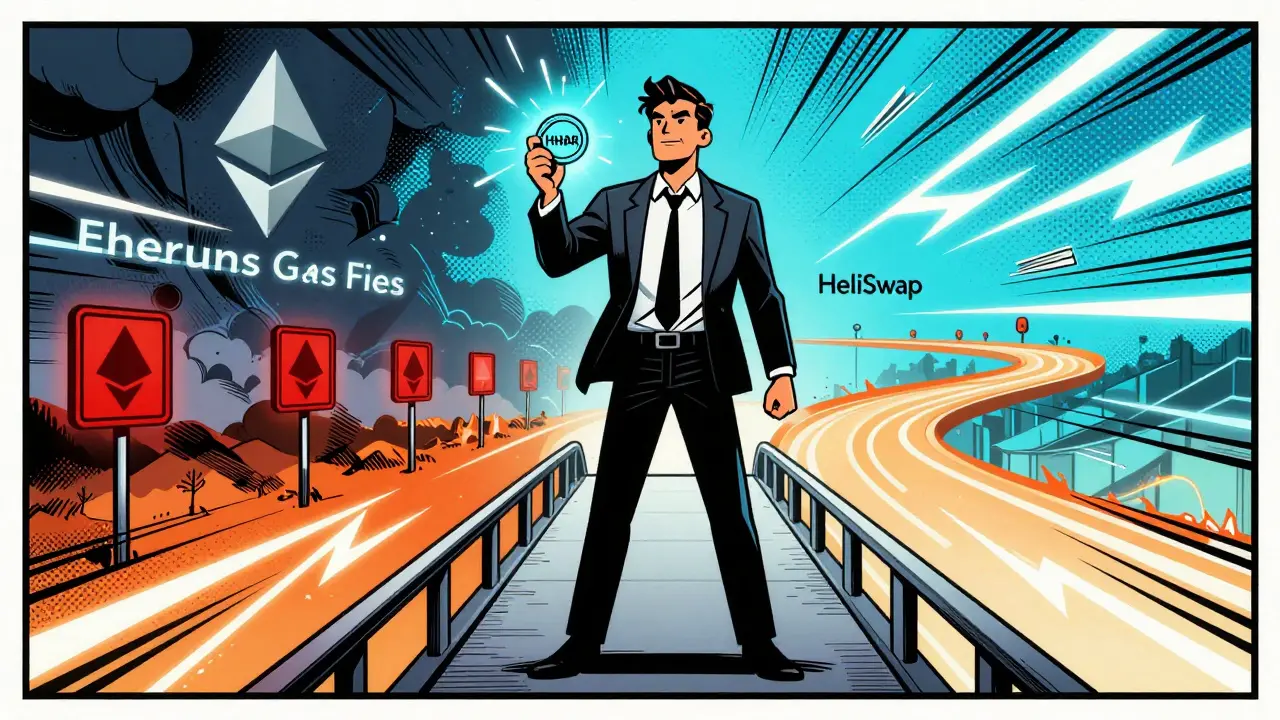
Imagine trying to trade crypto tokens without paying the massive gas fees that often eat up your profits on Ethereum. That is the promise of HeliSwap, a decentralized exchange built specifically for the Hedera Hashgraph network. But here is the catch: does it actually work well, or is it just another empty project in a crowded market? If you hold HBAR or are looking into the Hedera ecosystem, this platform is likely on your radar. I have dug into the technical specs, user experiences, and security records to see if HeliSwap lives up to the hype.
The Core Concept: Uniswap Logic on Hedera
To understand HeliSwap, you first need to know what it is not. It is not a centralized exchange like Binance or Coinbase where a company holds your funds. Instead, it is a non-custodial decentralized exchange (DEX). The developers took the proven architecture of Uniswap V2, a leading Ethereum-based protocol, and adapted it for Hedera’s unique hashgraph consensus mechanism. This means if you have used Uniswap before, the interface will feel familiar. You connect your wallet, select your tokens, and swap. However, under the hood, it runs on Hedera’s ledger, which offers faster transaction finality and significantly lower costs.
The platform was developed with support from LimeChain, a technology firm known for contributing to Hedera’s infrastructure. This partnership adds a layer of credibility, as LimeChain has a track record of building reliable blockchain tools. HeliSwap also operates as a Decentralized Autonomous Organization (DAO), meaning the community governs the platform through its native token, HELI. As of late 2023, there were 888.88 million HELI tokens in total supply, with about 32 million in circulation. These tokens are used for governance votes and potentially for fee discounts, aligning the interests of users and developers.
Performance and Fees: The Real Advantage
Let’s talk about the numbers, because that is usually why people move to Hedera. On Ethereum, a simple swap can cost anywhere from $5 to over $50 during peak congestion. On HeliSwap, transactions typically cost around $0.0001. Yes, that is fractions of a cent. Furthermore, Hedera claims to handle over 10,000 transactions per second. In practical terms, this means your swaps execute in under five seconds, according to user reports from early 2024. For high-frequency traders or those moving small amounts, this efficiency is a game-changer.
| Feature | HeliSwap | Uniswap (Ethereum) | PancakeSwap (BNB Chain) |
|---|---|---|---|
| Network | Hedera Hashgraph | Ethereum | Binance Smart Chain |
| Avg. Transaction Fee | ~$0.0001 | $5 - $50+ | ~$0.10 - $0.50 |
| Transaction Speed | < 5 seconds | Varies (often minutes) | ~3 seconds |
| Liquidity Depth | Moderate (Niche) | Very High | High |
| Custody | Non-Custodial | Non-Custodial | Non-Custodial |
However, speed and low fees come with a trade-off: liquidity. HeliSwap currently holds about 35% of the DEX volume on Hedera, trailing behind Hashflow. While this is impressive within the Hedera ecosystem, the overall Total Value Locked (TVL) on Hedera is only about $1.2 billion compared to Ethereum’s hundreds of billions. This means that while swapping major pairs like HBAR/USDC is smooth, trading smaller, obscure tokens might result in significant slippage. One user reported 3.2% slippage on a $500 swap, which is steep compared to major DEXes.
Safety and Security: What You Need to Know
When you use a decentralized exchange, you are interacting directly with smart contracts. There is no customer service line to call if something goes wrong. HeliSwap leverages the inherent security of the Hedera ledger, where every transaction is transparent and immutable. The platform uses standard ERC-20 compatible token structures, which reduces the risk of bugs associated with custom token standards. Additionally, because it is a fork of Uniswap V2, much of the core logic has been battle-tested by millions of users on Ethereum.
That said, "battle-tested" on Ethereum does not automatically mean "secure" on Hedera. The code had to be modified to fit the new environment. While Bitget’s research team noted that HeliSwap ensures transactions are safe and transparent, they did not cite specific third-party security audits in their initial reviews. This is a common gap in newer DeFi projects. Always check for recent audit reports from firms like CertiK or OpenZeppelin before depositing large sums. As of early 2024, independent security ratings placed HeliSwap’s ecosystem risk at a moderate level, largely due to the relative novelty of the Hedera DeFi space rather than any direct vulnerabilities in the code itself.
You also maintain control of your private keys. This is crucial. Unlike centralized exchanges, HeliSwap cannot freeze your account or lose your funds in a hack of their servers. However, this puts the burden of security on you. If you lose your seed phrase or connect your wallet to a malicious site, your funds are gone forever. Use reputable wallets like HashPack or Freewallet, which are optimized for Hedera interactions.
User Experience: Getting Started
Getting started with HeliSwap is straightforward if you already have a Hedera wallet. Here is how most users approach it:
- Set up a Wallet: Download HashPack or Freewallet. Create a new account and securely store your recovery phrase.
- Fund Your Wallet: Buy HBAR on a centralized exchange like KuCoin or Binance and transfer it to your wallet address. Ensure you are sending it via the Hedera network.
- Connect to HeliSwap: Visit the official HeliSwap website. Click "Connect Wallet" and approve the connection in your wallet app.
- Swap Tokens: Select the token pair you want to trade. Enter the amount. The interface will show you the estimated output and any potential slippage.
- Confirm Transaction: Review the details carefully. Confirm the swap in your wallet. You will pay a tiny fee in HBAR.
The learning curve is moderate. Users familiar with Ethereum DEXes usually get comfortable within 20-30 minutes. The main hurdle is understanding Hedera’s account ID system, which looks different from traditional Ethereum addresses. Also, note that there is no mobile app yet. All trading must be done through a web browser, which some users find inconvenient compared to the slick apps offered by centralized exchanges.
Community Governance and Future Roadmap
HeliSwap is more than just a trading tool; it is a community-driven project. The launch of its DAO in January 2024 allows HELI token holders to vote on key decisions, such as treasury allocations and protocol upgrades. This decentralization aims to prevent single points of failure and ensure the platform evolves according to user needs. Currently, the team is working on Version 2, which will introduce concentrated liquidity features similar to Uniswap V3. This upgrade could significantly improve capital efficiency for liquidity providers, potentially boosting yields.
Another critical development is the planned cross-chain bridge functionality. This would allow users to move assets between Hedera and Ethereum seamlessly. If successful, this could solve the liquidity issue by bringing deeper pools from Ethereum into the Hedera ecosystem. However, bridges are historically high-risk targets for hackers. Proceed with caution when these features go live.
Verdict: Who Should Use HeliSwap?
HeliSwap is not for everyone. If you are looking to trade mainstream tokens like Bitcoin or Ethereum with deep liquidity, stick to established platforms like Uniswap or PancakeSwap. However, if you are deeply invested in the Hedera ecosystem, HeliSwap is arguably the best option available. It offers a familiar interface, negligible fees, and fast execution. It is ideal for HBAR holders who want to diversify into other Hedera-native tokens without leaving the network.
The risks are primarily related to ecosystem maturity. Hedera still represents less than 2% of the total DeFi market. If the broader ecosystem struggles to attract developers and users, HeliSwap’s growth could stall. But for now, it stands out as a robust, efficient, and community-focused solution for Hedera users. Just remember to start small, verify contract addresses, and never invest more than you can afford to lose.
Is HeliSwap safe to use?
HeliSwap is generally considered safe due to its non-custodial nature and reliance on the secure Hedera ledger. However, as with all DeFi platforms, there are smart contract risks. Always verify the official website URL and consider using a dedicated wallet for DeFi interactions to minimize exposure.
What is the minimum fee for swapping on HeliSwap?
Transaction fees on HeliSwap are extremely low, typically averaging around $0.0001 per transaction. This is significantly cheaper than Ethereum-based exchanges, making it cost-effective for small trades.
Can I use HeliSwap on my mobile phone?
Currently, HeliSwap does not have a dedicated mobile app. You must access the platform through a web browser on your mobile device or desktop. Ensure you are using a secure, updated browser to avoid phishing risks.
How do I buy HELI tokens?
You can acquire HELI tokens through centralized exchanges like KuCoin, which lists HELI trading pairs against USDT and BTC. Alternatively, once you have HBAR, you can swap it for HELI directly on the HeliSwap platform.
Why is liquidity an issue on HeliSwap?
HeliSwap operates within the Hedera ecosystem, which is smaller than Ethereum or BNB Chain. While major pairs like HBAR/USDC have good liquidity, smaller tokens may suffer from thin order books, leading to higher slippage during trades.