
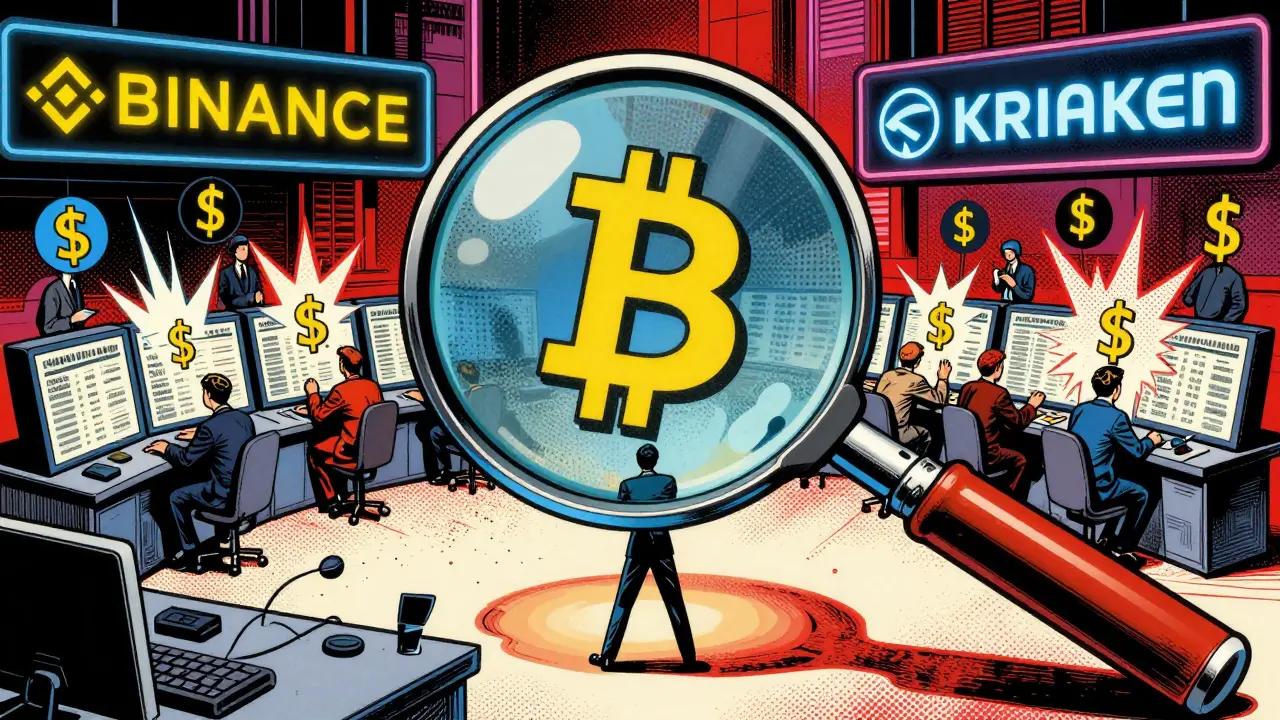
Most people think cryptocurrency exchanges are just digital marketplaces where you buy Bitcoin or sell Ethereum. But if that were all they did, none of them would be worth billions. The truth is, exchanges make money in ways most users never see - and some of those ways directly affect how much you pay, earn, or lose. Understanding how they profit isn’t just interesting; it’s essential if you want to trade smarter and avoid hidden costs.
Trading Fees Are the Foundation
The biggest source of income for every major exchange is trading fees. Every time you buy or sell crypto, the exchange takes a small cut. It’s simple, predictable, and scales with volume. On Binance, the standard fee is 0.10% for both maker and taker trades. That means if you trade $10,000 worth of Bitcoin, you pay $10 in fees. Sounds small? Multiply that by millions of trades a day, and you get billions.
But here’s the catch: fees aren’t fixed. High-volume traders get discounts. Binance offers rates as low as 0.02% for users who trade over $1 billion a month. Meanwhile, Coinbase charges 0.99% for spot trades - nearly ten times more. Why? Because Coinbase targets retail users who don’t negotiate fees. They also add a spread - the difference between the buy and sell price - which can add another 0.50% on top. So a $10,000 trade on Coinbase could cost you $15.99 total, not $99.
Exchanges also separate maker and taker fees. A maker adds liquidity by placing a limit order that waits to be filled. A taker removes liquidity by immediately matching an existing order. Makers usually pay less because they help the market stay liquid. That’s why experienced traders use limit orders, not market orders, to save money.
Withdrawal Fees Add Up Quietly
When you pull your crypto out of an exchange and into your own wallet, you pay a withdrawal fee. These aren’t always obvious. Kraken charges between 0.0005 and 0.001 BTC for Bitcoin withdrawals - around $30 to $60 depending on the price. Ethereum withdrawals cost $2-$10, but during network congestion, that can spike to $50 or more.
These fees are often framed as "network fees," but exchanges control the rates. They don’t pass on the exact blockchain cost - they set their own markup. For users who withdraw regularly, this becomes a hidden monthly cost. One Reddit user calculated they paid $15-$20 a month just in withdrawal fees across multiple exchanges. That’s $180-$240 a year - money you could’ve kept if you held longer or used an exchange with lower fees.
Listing New Tokens Is a Goldmine
Exchanges don’t just list coins because they’re popular. They list them because projects pay to be there. Listing fees range from $50,000 to $2 million, depending on the exchange and the token’s potential. Binance Launchpad, for example, charges $500,000-$2 million upfront, or takes 5-15% of the tokens being sold in an IEO (Initial Exchange Offering).
Why do projects pay so much? Because being listed on Binance or Coinbase means instant visibility and liquidity. A new token can go from zero to $100 million in market cap within hours of being listed. The exchange gets paid upfront, regardless of whether the token succeeds. That’s a low-risk, high-reward business model.
But there’s a dark side. Critics say exchanges prioritize projects that pay the most, not the ones with the best tech. Professor Hilary Allen testified before Congress in March 2026 that this creates a conflict of interest - exchanges become gatekeepers who profit from hype, not quality.
Staking and Lending: Turning Your Crypto Into Their Cash
Staking lets you earn interest by locking up your crypto to help secure a blockchain network. Exchanges like Coinbase and Binance offer staking services, paying you 3-10% annual interest. Sounds great, right? But here’s what they don’t tell you: they’re not just passing along the rewards. They’re taking a cut.
Coinbase reported $214.9 million in staking revenue in Q2 2025 alone. That doesn’t mean they paid out that much to users. They kept 15-25% of the total rewards as their fee. So if you earned $100 in staking rewards, the exchange likely kept $20-$25. And they’re not just staking your coins - they’re lending them out to institutional borrowers at higher rates, pocketing the spread.
Lending works the same way. You deposit your crypto, and the exchange lends it to hedge funds or traders who need leverage. They charge borrowers 8-12% interest, then pay you 3-6%. The difference? Their profit. Binance’s new financial services platform, launched in January 2026, offers crypto-backed loans with 50% loan-to-value ratios and 8% interest - a direct way to monetize user deposits without touching the underlying asset.
Derivatives: The High-Stakes Side Hustle
Derivatives like futures, options, and perpetual contracts let traders bet on price movements without owning the actual crypto. These products are complex, risky, and extremely profitable for exchanges.
Binance Futures charges 0.02% for makers and 0.04% for takers on perpetual contracts - double the rate of spot trading. Why? Because derivatives attract high-frequency traders and leverage seekers who trade constantly. Each trade generates a fee, and with leverage, the volume explodes. In 2025, derivatives accounted for 15% of Binance’s total revenue, even though only a fraction of users trade them.
But here’s the truth: most retail traders lose money on derivatives. Exchanges don’t care - they make money whether you win or lose. That’s why experts warn that derivatives are less about investing and more about extracting fees from speculative behavior.
Native Tokens: Binance Coin and the Ecosystem Trap
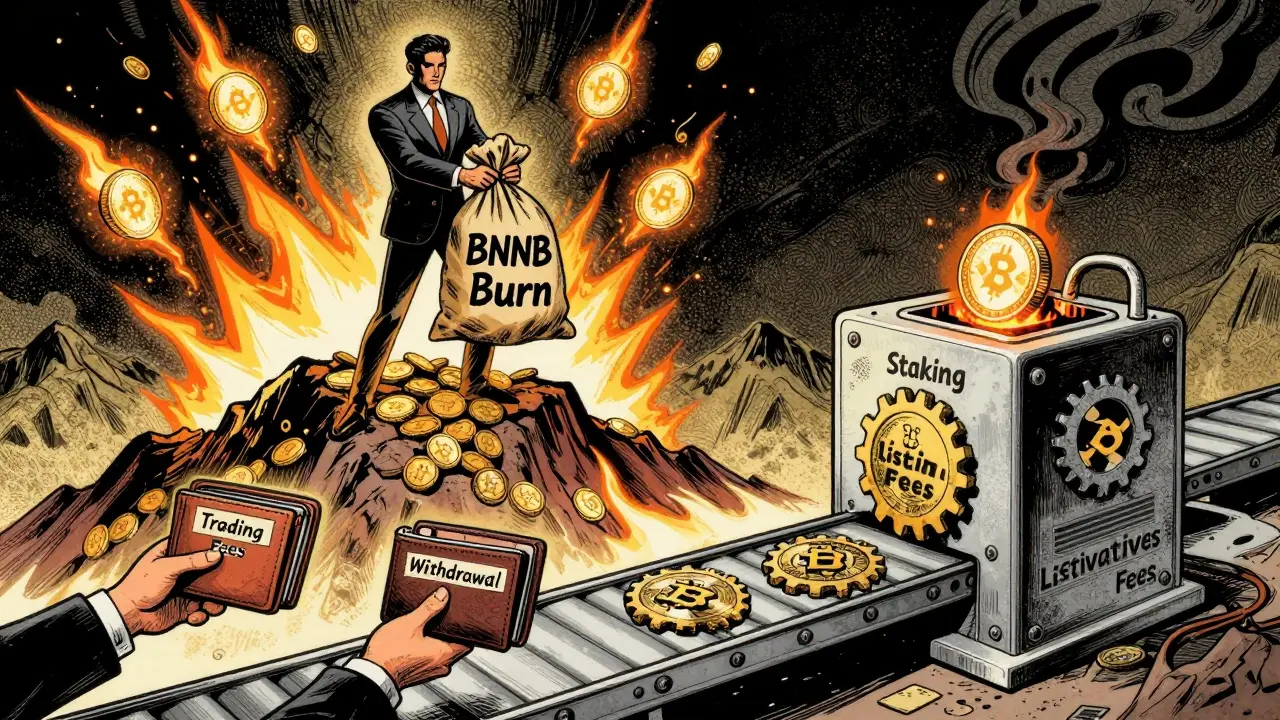
Binance Coin (BNB) isn’t just another cryptocurrency. It’s a revenue engine. Binance forces users to pay trading fees in BNB to get discounts - up to 25% off fees if you use it. That creates constant demand for BNB, pushing its price up. Then, Binance burns a portion of its profits every quarter to reduce supply. In Q4 2025, they burned $1.1 billion worth of BNB.
This creates a feedback loop: users buy BNB to save on fees → BNB price rises → Binance earns more from BNB sales → they burn more → scarcity increases → users buy more. It’s brilliant. And it’s why BNB is one of the top 5 cryptocurrencies by market cap - not because it’s a better blockchain, but because it’s tied to the exchange’s profit machine.
Other exchanges have tried this. Coinbase has USD Coin (USDC), but it’s not used for fee discounts. Kraken has KRAKEN token, but it’s still experimental. Binance’s model is the only one that’s truly scaled.
Regional Differences and Regulatory Pressures
Not all exchanges make money the same way. Coinbase operates under heavy U.S. regulation. They can’t do IEOs like Binance. They can’t offer high-leverage derivatives to Americans. So they make up for it with higher fiat conversion fees - 3.99% on credit/debit card purchases - and subscription services like Coinbase One, which costs $25/month for reduced fees and premium support.
Kraken focuses on institutional clients. They charge more for OTC (over-the-counter) trades, where big buyers move large amounts without affecting the market price. Their revenue split: 45% from professional services, 30% from spot trading, 15% from staking. They don’t chase retail users - they serve hedge funds and family offices.
Regional players like Huobi and Bitstamp adapt to local laws. Huobi makes 25% of its revenue from OTC services in Asia, where cash-to-crypto conversions are common. Bitstamp earns 20% from institutional custody - storing crypto for banks and asset managers.
Regulation is reshaping revenue. The EU’s MiCA rules forced exchanges to standardize fees, cutting average trading fees by 18%. The U.S. SEC’s crackdown on IEOs reduced that revenue stream by 35% for U.S.-focused platforms. Binance lost 15% of its revenue after being forced out of several markets following a $4.3 billion settlement in 2024.
The Future: From Exchange to Financial Platform
The most successful exchanges aren’t just trading platforms anymore. They’re becoming full-service financial institutions. Binance offers crypto-backed loans. Coinbase now lets you trade stocks and ETFs alongside Bitcoin. Gartner predicts that by 2028, 65% of exchange revenue will come from these integrated services - not trading fees.
Why? Because trading volume is volatile. During crypto winters, fees dry up. But lending, staking, and insurance products keep flowing. As Michael Novogratz said in January 2026, "The next frontier is embedded finance - retirement accounts, insurance, and traditional assets wrapped in crypto interfaces."
Exchanges that stick to trading alone - like smaller platforms without diversification - are already struggling. Those that built multiple revenue streams are surviving, even thriving. The winners aren’t the ones with the lowest fees. They’re the ones who turned users into customers across multiple financial products.
What This Means for You
If you’re a casual holder, stick with exchanges that have transparent, low withdrawal fees and no hidden spreads. Coinbase’s interface is cleaner, but you pay more. Kraken is cheaper for active traders. Binance offers the best fees and staking rewards - if you’re okay with regulatory risk.
If you’re trading frequently, use limit orders, pay fees in BNB if you’re on Binance, and avoid derivatives unless you know exactly what you’re doing. Withdrawals should be infrequent - every time you move crypto, you’re paying the exchange.
And always ask: who benefits here? If the exchange makes money whether you win or lose, that’s a red flag. The best exchanges make money when you succeed - through volume, not exploitation.
Do cryptocurrency exchanges make money from my losses?
Not directly. Exchanges don’t bet against you like a casino. But they do profit from your activity - whether you win or lose. Trading fees, withdrawal fees, and derivatives commissions are charged regardless of outcome. So while they don’t take your losses, they do take a cut every time you trade, even if you lose money.
Are staking rewards from exchanges safe?
They’re higher yield than bank interest, but riskier. When you stake through an exchange, you’re giving them control of your private keys. If the exchange gets hacked or freezes withdrawals, you lose access. Staking directly on a blockchain (like Ethereum via Lido or Rocket Pool) is safer but more technical. For beginners, exchanges are easier - but you’re trading convenience for control.
Why do some exchanges charge more than others?
It’s about their business model and user base. Coinbase targets retail users in the U.S. who value compliance and ease of use - so they charge more. Binance targets global, tech-savvy traders who want low fees and advanced tools - so they charge less. Kraken focuses on institutions that pay premium rates for security and OTC services. You’re not just paying for access - you’re paying for the type of service you need.
Is Binance really cheaper than Coinbase?
For spot trading, yes - if you use BNB for fee discounts. A $10,000 trade costs $10 on Binance (0.1%), $15.99 on Coinbase (0.99% + $6 spread). For withdrawals, Binance is usually cheaper too. But Coinbase is simpler, regulated, and safer for beginners. Binance offers lower fees but higher risk - especially for U.S. users who can’t access the full platform.
Can exchanges go bankrupt from too many withdrawals?
Yes - and they have. Mt. Gox collapsed in 2014 after losing 850,000 BTC, partly due to poor liquidity management. More recently, FTX failed in 2022 because it used customer funds to cover losses in its trading arm. Today, regulated exchanges must hold reserves, but not all do. Always check if an exchange publishes proof-of-reserves. If they don’t, you’re taking a risk - even if their fees are low.



There are 21 Comments
Ryan Depew
Andy Simms
Margaret Roberts
Harshal Parmar
Brenda Platt
Paru Somashekar
Steve Fennell
Heather Crane
Taylor Mills
HARSHA NAVALKAR
Shamari Harrison
MOHAN KUMAR
Abdulahi Oluwasegun Fagbayi
katie gibson
Ashok Sharma
Tselane Sebatane
Matthew Kelly
Linda Prehn
Clark Dilworth
Catherine Hays
Chidimma Catherine
Write a comment
Your email address will not be published. Required fields are marked *