
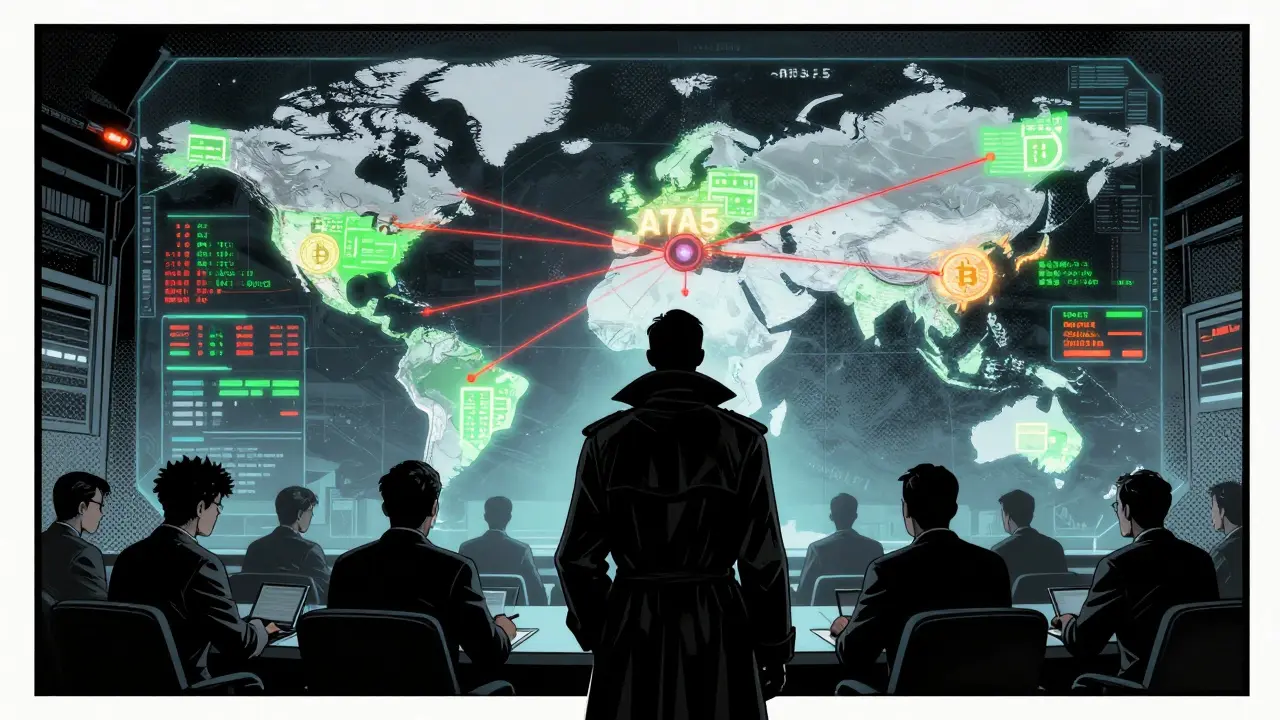
For years, the global financial system acted as a tight net around nations that violated international norms. Swift codes, correspondent banking relationships, and frozen assets were supposed to be impenetrable barriers. But since the invasion of Ukraine, Russia is actively using cryptocurrency networks to bypass these restrictions, turning digital assets into a lifeline for its war economy. It isn't just about buying Bitcoin on an app anymore. We are looking at sophisticated, multi-layered systems involving custom tokens, shell companies in Central Asia, and sanctioned exchanges that simply change their names to keep operating.
If you think crypto is just for tech enthusiasts or decentralized finance fans, look closer. In 2025 and early 2026, it became a critical tool for state-level sanctions evasion. The scale is staggering. We’re talking about billions of dollars moving through opaque channels, funded by oil revenues and military contracts, disguised as legitimate digital transactions. This article breaks down exactly how this machinery works, who is running it, and why it matters for the future of global finance.
The Core Mechanism: Custom Tokens and the A7A5 System
The heart of this operation isn’t Bitcoin or Ethereum alone. It’s a purpose-built digital asset designed specifically to bridge the gap between the Russian ruble and the global crypto market. That asset is the A7A5 token is a ruble-backed cryptocurrency issued by a Kyrgyzstani firm to facilitate sanctions evasion.
Here is how it works in practice. A Russian entity needs to pay for goods-let’s say microchips or drone parts-from a supplier in Turkey or China. Traditional banks will block the transfer because of sanctions. So, they convert rubles into A7A5 tokens. These tokens operate on both the TRON and Ethereum blockchains, providing redundancy. If one network faces scrutiny, the other remains open.
The numbers reveal the sheer volume of this activity. Since its creation, the A7A5 token has processed approximately $9.3 billion in transactions on a dedicated crypto exchange in just four months. That is not retail trading. That is institutional-grade money laundering on a massive scale. The token acts as a stablecoin proxy, allowing users to hold value denominated in rubles but trade it globally without triggering the same alarms as direct fiat transfers.
- Issuer: A Kyrgyzstani company linked to sanctioned entities.
- Backings: Pegged to the Russian Ruble (RUB).
- Blockchains: Deployed on TRON and Ethereum for accessibility.
- Purpose: To create a liquidity pool that bypasses SWIFT and traditional correspondent banking.
This system solves a specific problem: liquidity. By creating a closed-loop ecosystem where A7A5 can be easily swapped for USDT or USDC (stablecoins pegged to the US dollar), Russia ensures that its funds remain usable internationally. It’s a clever workaround, but it leaves a clear trail for blockchain analysts.
The Exchange Infrastructure: From Garantex to Grinex
You cannot move billions in tokens without an exchange to facilitate the trades. For a long time, Garantex was the primary darknet and sanctioned cryptocurrency exchange used by Russia to launder illicit funds. It was known for having minimal Know Your Customer (KYC) checks, making it perfect for moving dirty money.
But the U.S. Secret Service didn’t sit idle. On March 6, 2025, they led a major law enforcement action against Garantex. You would expect this to shut down the operation. Instead, it triggered a pivot. Immediately after the seizure, officers associated with Garantex launched a new platform: Grinex is a successor cryptocurrency exchange created to replace Garantex after sanctions.
Grinex didn’t start from scratch. It inherited Garantex’s infrastructure and, crucially, its customer base. Promotional materials for Grinex explicitly stated that the exchange was formed in response to sanctions and asset freezes affecting its predecessor. Within weeks, it began facilitating the transfer of billions of dollars in cryptocurrency transactions. The U.S. Treasury’s Office of Foreign Assets Control (OFAC) quickly designated Grinex for sanctions, noting it was owned or controlled by Garantex.
This pattern-shut down one entity, launch another with the same backend-is now a standard tactic. It shows deep technical capability and a willingness to operate outside legal boundaries. The UK government joined the fight in October 2025, targeting Grinex alongside another platform called Meer and the A7A5 token infrastructure itself.
| Exchange Name | Status | Key Role | Sanction Date/Action |
|---|---|---|---|
| Garantex | Seized/Sanctioned | Primary laundering hub before 2025 | U.S. Secret Service action (March 2025) |
| Grinex | Active/Sanctioned | Successor to Garantex; handles A7A5 flows | OFAC designation (2025); UK sanctions (Oct 2025) |
| Meer | Sanctioned | Associated platform in the evasion network | UK sanctions (Oct 2025) |
The Kyrgyzstan Connection: Capital Bank and Financial Gateways
Crypto doesn’t exist in a vacuum. Eventually, digital assets need to touch the real world-to buy fuel, ammunition, or pay soldiers. This is where Kyrgyzstan plays a critical role as a jurisdictional loophole for Russian financial operations.
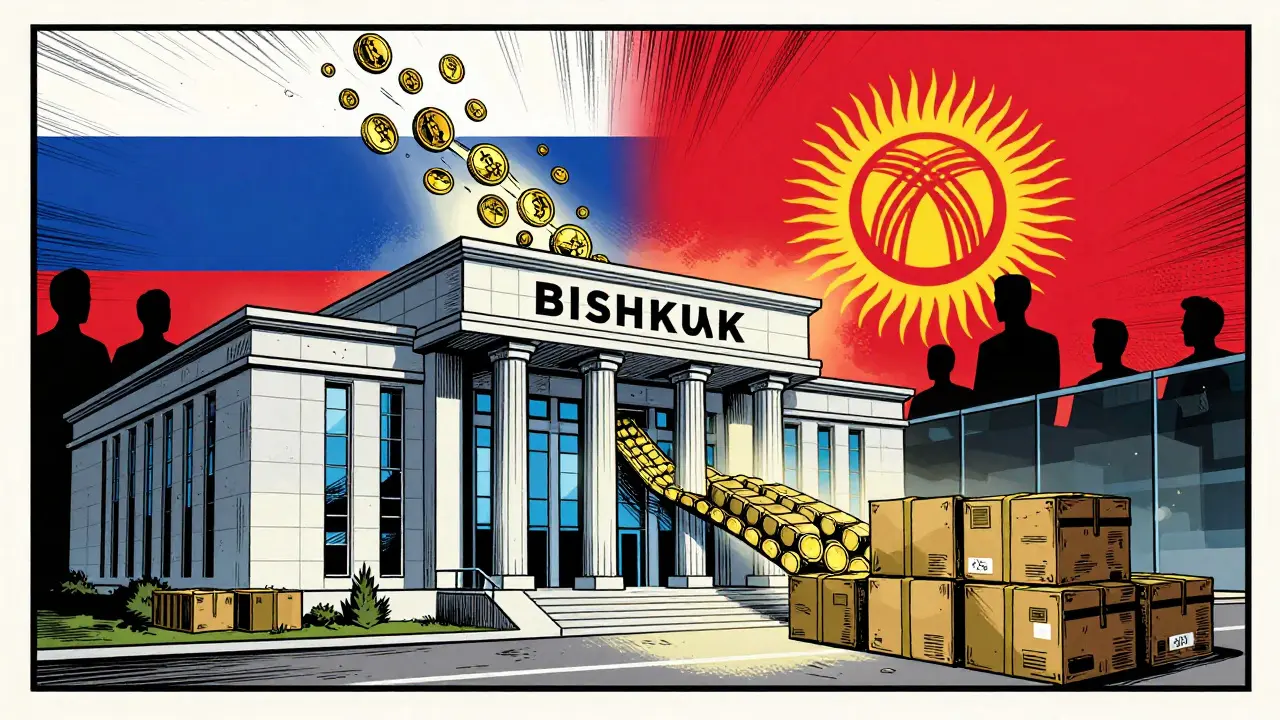
Central Asia has become a blind spot in the global sanctions regime. Kyrgyzstan, in particular, hosts financial institutions that serve as gateways between the Russian ruble and the crypto world. The key player here is Capital Bank is a Kyrgyzstani bank used by Russia to convert crypto assets into fiat for military procurement.
Capital Bank, under the direction of Kantemir Chalbayev, provides the essential link. Here is the flow: 1. Russian entities send crypto (like A7A5 or USDT) to wallets linked to Capital Bank. 2. The bank converts these digital assets into fiat currency (dollars, euros, or local kyats). 3. The funds are then transferred to suppliers of military goods via traditional banking channels that may not fully enforce secondary sanctions.
This integration of conventional banking with crypto infrastructure creates a comprehensive circumvention capability. It allows Russia to maintain supply chains even when cut off from SWIFT. Transparency International Russia has documented similar schemes, showing how shell individuals and companies sell their documents en masse to enable cash-outs and bypass KYC checks. These 'conveyor belt' operations often take place in Moscow City towers, converting illicit crypto gains into clean cash.

Data Leaks and the Ilan Shor Network
We know so much about these networks not just from intelligence agencies, but from data leaks. On September 3, 2025, significant data related to Ilan Shor was a sanctioned Moldovan fugitive politician whose leaked data revealed extensive crypto funding networks.
Shor is no stranger to controversy. Convicted in 2017 for his role in the theft of $1 billion from three Moldovan banks, he was later sanctioned by the U.S. for aiding Russia’s efforts to undermine democratic elections in Moldova. The leaked data provided a window into how his associates use crypto to fund political activism and infrastructure projects.
Analysis by blockchain analytics firm Elliptic showed that wallets controlled by 'A7' (linked to the A7A5 token issuer) and associated businesses received $8 billion in stablecoin transactions over an 18-month period. These payments weren’t just random. They were used to purchase infrastructure for apps that manage and pay networks of political activists in Moldova. This demonstrates that the crypto sanctions evasion machine isn’t just about buying weapons; it’s also about funding hybrid warfare and political influence operations abroad.
International Regulatory Responses
The response from Western governments has evolved from vague warnings to targeted strikes. The European Union adopted its 19th package of sanctions, marking a historic shift. For the first time, the EU directly targeted 'dirty Russian crypto schemes.' This included banning transactions on crypto platforms identified as tools for bypassing restrictions and funding the war in Ukraine.
In the UK, the October 2025 actions were part of a coordinated international effort. Officials described these moves as vital to reinforcing diplomatic pressure and keeping the cost of war high for Russia. The U.S. Treasury continued to designate entities like Grinex, ensuring that American financial institutions face severe penalties if they interact with these platforms.
However, the challenge remains immense. The Financial Action Task Force (FATF) highlighted in August 2025 that terrorist organizations and state actors alike are increasingly using virtual assets. President Elisa de Anda Madrazo noted that groups like ISIL-K have adapted to use crypto for organizational transfers. This broader context means that Russia’s efforts are part of a larger trend of malicious actors exploiting digital asset technologies.
Impact on the Crypto Industry and Compliance
For the legitimate cryptocurrency industry, this situation is a double-edged sword. On one hand, it brings intense regulatory scrutiny. On the other, it drives innovation in compliance technology. Firms like Elliptic have added support for A7A5 screening on both TRON and Ethereum blockchains. This allows exchanges and wallet providers to flag suspicious transactions automatically.
The development of these screening tools is crucial. It enables the industry to distinguish between legitimate users and those involved in sanctions evasion. Without such tools, reputable exchanges might face collateral damage, being forced to ban entire regions or risk losing their licenses.
Oxford Analytica predicted in September 2025 that Russia will likely continue expanding its crypto use for sanctions evasion. The short-term benefits are too significant to ignore. However, the assessment suggests that increasing regulatory pressure and better tracking capabilities will eventually constrain these activities. It’s a cat-and-mouse game, but the mouse is getting smarter.
What This Means for Investors and Users
If you are holding crypto, especially stablecoins or tokens on TRON and Ethereum, you should be aware of these dynamics. The risk isn’t necessarily that your coins will disappear, but that the networks you use could be sanctioned. Always check if your exchange is listed on OFAC or UK sanctions lists. Avoid platforms that lack robust KYC procedures, as these are often the ones facilitating illicit flows.
Furthermore, be skeptical of new 'ruble-backed' or emerging market tokens that promise high yields or seamless cross-border transfers. Many are designed specifically to exploit regulatory gaps. Stick to well-established assets and regulated exchanges to minimize your exposure to these geopolitical risks.
Is the A7A5 token legal to own?
The legality depends on your jurisdiction. In the UK and US, interacting with A7A5 infrastructure may violate sanctions laws because it is tied to sanctioned entities. While merely holding the token might not always be prosecuted, trading it on sanctioned exchanges like Grinex is illegal. Always consult local regulations.
Why does Russia use Kyrgyzstan for crypto operations?
Kyrgyzstan offers a weaker regulatory environment and less cooperation with Western sanctions regimes compared to European countries. It serves as a neutral ground where Russian rubles can be converted into crypto and vice versa without immediate freezing by SWIFT-connected banks.
What happened to Garantex?
Garantex was seized by the U.S. Secret Service in March 2025. Its operators immediately launched Grinex as a replacement, migrating customers and infrastructure to continue operations. Both are now heavily sanctioned.
How do blockchain analysts track these transactions?
Firms like Elliptic use advanced clustering algorithms to identify wallets linked to known sanctioned entities. They monitor large stablecoin flows and trace them back to exchanges like Grinex. Data leaks, such as those involving Ilan Shor, also provide crucial mapping data.
Will crypto sanctions evasion stop soon?
Unlikely in the short term. Oxford Analytica predicts Russia will expand its crypto usage despite risks. However, improved global coordination and better AI-driven compliance tools will make it harder and more expensive to evade sanctions effectively.
There are 12 Comments
Christina Pearce
It is genuinely fascinating to see how quickly these financial systems adapt when traditional routes are blocked. The resilience of the A7A5 network shows that sanctions often just create new, more complex problems rather than solving them immediately. We have to keep an eye on how this affects regular users who might accidentally get swept up in these sanctioned exchanges.
Barclay Chantel
Typical Western media narrative trying to paint crypto as some sort of evil mastermind tool for war crimes while ignoring the fact that fiat currency has been used for centuries to fund every single conflict in history. It is almost laughable how they act surprised that people find ways around bureaucratic red tape. The real issue here is not the technology but the hypocrisy of governments that claim moral superiority while manipulating their own currencies for geopolitical gain. One must question why the focus is always on the method of payment rather than the underlying aggression itself.
Miss Masquer
I have been following the developments in Central Asia for quite some time now and it is truly remarkable to observe how Kyrgyzstan has become such a pivotal player in this global financial chess game, especially considering its relatively small size and economic standing on the world stage which one would typically not associate with such high-stakes international banking maneuvers or sophisticated cryptocurrency laundering operations that involve billions of dollars moving through opaque channels that seem to defy conventional regulatory oversight mechanisms put in place by Western nations over the last several decades to maintain control over global trade flows and prevent illicit activities from flourishing in jurisdictions that lack robust legal frameworks for monitoring digital asset transactions.
Joshua Alcover
The ontological implications of state-sponsored cryptographic obfuscation necessitate a rigorous epistemological examination of sovereignty in the digital age. When a nation-state leverages decentralized ledger technologies to circumvent hegemonic financial structures, we witness a paradigm shift in the nature of international law enforcement. The utilization of the A7A5 token represents not merely a tactical evasion but a strategic redefinition of monetary autonomy against imperialist containment strategies. This phenomenon underscores the fragility of the petrodollar system and suggests that future geopolitical conflicts will be fought primarily in the domain of algorithmic liquidity and blockchain consensus mechanisms rather than traditional kinetic warfare alone.
Diana Morris
this is wild stuff honestly like who knew you could just swap tokens and bypass swft entirely its crazy how fast they moved from garantex to grinex after the raid total snake oil operation but hey at least we know where the money is going right
Dianne Wright
i mean everyone knows crypto is basically just for criminals anyway so why are we acting so shocked here it is literally designed to hide your identity and move money without anyone asking questions so of course russia is using it to buy weapons because thats what the whole industry was built for if you think otherwise you are living in a fantasy world where banks actually care about where your money comes from
stalin brian
its kinda funny how they try to shut down one exchange and then another pops up overnight like a hydra u cant kill the head without growing two more i guess decentralization works both ways huh maybe we should just embrace it instead of fighting it
kamal ifrani
This entire situation is a complete disaster for global stability and proves that our current financial regulators are utterly incompetent fools who cannot even track basic blockchain transactions. I am absolutely furious that my tax dollars are being wasted on ineffective sanctions while these criminals continue to operate with impunity. It is a tragedy of epic proportions that we are witnessing the collapse of international law right before our eyes and no one seems to care enough to do anything about it except write clickbait articles.
saradee dee
Oh my goodness, this is really scary! I never thought something like this could happen in our lifetime. It makes me feel so unsafe knowing that bad guys can use computers to hide their money. I hope someone stops them soon because it is just wrong and unfair to everyone else who follows the rules.
Craig Swanson
Listen up folks, this is exactly why you need to take control of your own finances and stop trusting institutions that clearly don't have your best interests at heart. If they can sanction exchanges, they can freeze your accounts too. Wake up and realize that the system is rigged against you unless you learn how to navigate these digital waters yourself. Don't let fear paralyze you into submission.
Bill Gunn
Hey there! 👋 Just wanted to drop some knowledge bombs 💣 on this topic. The way Grinex migrated users from Garantex is actually pretty slick tech-wise, even if the ethics are questionable 🤔. They basically cloned the frontend and kept the backend running. It’s like a phoenix rising from the ashes 🔥. But hey, that’s why tools like Elliptic exist to track those clusters. Stay safe out there in the crypto jungle! 🌿🦁
Dana Rapoport
The philosophical underpinning of this evasion strategy reveals a deep distrust in centralized authority structures. It forces us to consider whether the goal of sanctions is truly justice or merely dominance.
Write a comment
Your email address will not be published. Required fields are marked *