Imagine knowing exactly when a major investor is about to dump thousands of Bitcoin or scoop up Ethereum before the price spikes. That’s the power of crypto whale tracking. It’s not magic; it’s just reading the public ledger. Because blockchains are transparent, every transaction is visible. The trick is filtering out the noise to find the big players-the "whales"-who hold enough assets to move markets.
If you’ve ever wondered why the price suddenly dropped without bad news, a whale likely sold. If it pumped for no reason, a whale likely bought. By monitoring these large movements, you can spot trends early, avoid traps, and align your strategy with institutional money. This guide breaks down how to track these giants, which tools work best in 2026, and how to interpret their moves without losing your shirt.
Who Are Crypto Whales and Why Do They Matter?
In the crypto world, a "whale" isn’t just someone with a lot of money. It’s an entity holding enough cryptocurrency to influence market prices through their buying or selling power. According to CoinLedger’s 2025 guidelines, whales are defined as investors whose purchasing power can shift market dynamics. For context, we’re talking about wallets holding over 1,000 BTC (roughly $65 million) or 10,000 ETH (around $30 million).
Why should you care? Because whales set the tone. A University of California, Berkeley study from August 2025 found that whale transactions explain nearly 19% of Bitcoin’s short-term volatility and over 23% of Ethereum’s. When a whale moves, the market reacts. Retail traders often follow the herd, but if you watch the whales, you swim ahead of them.
What defines a crypto whale?
A crypto whale is an individual or entity holding a massive amount of cryptocurrency, typically enough to impact market prices. Common thresholds include 1,000+ BTC, 10,000+ ETH, or significant amounts of other major tokens.
The Best Tools for Tracking Whale Activity in 2026
You don’t need to be a coder to track whales anymore. Several platforms have made this data accessible to everyone. Here’s how the top contenders stack up:
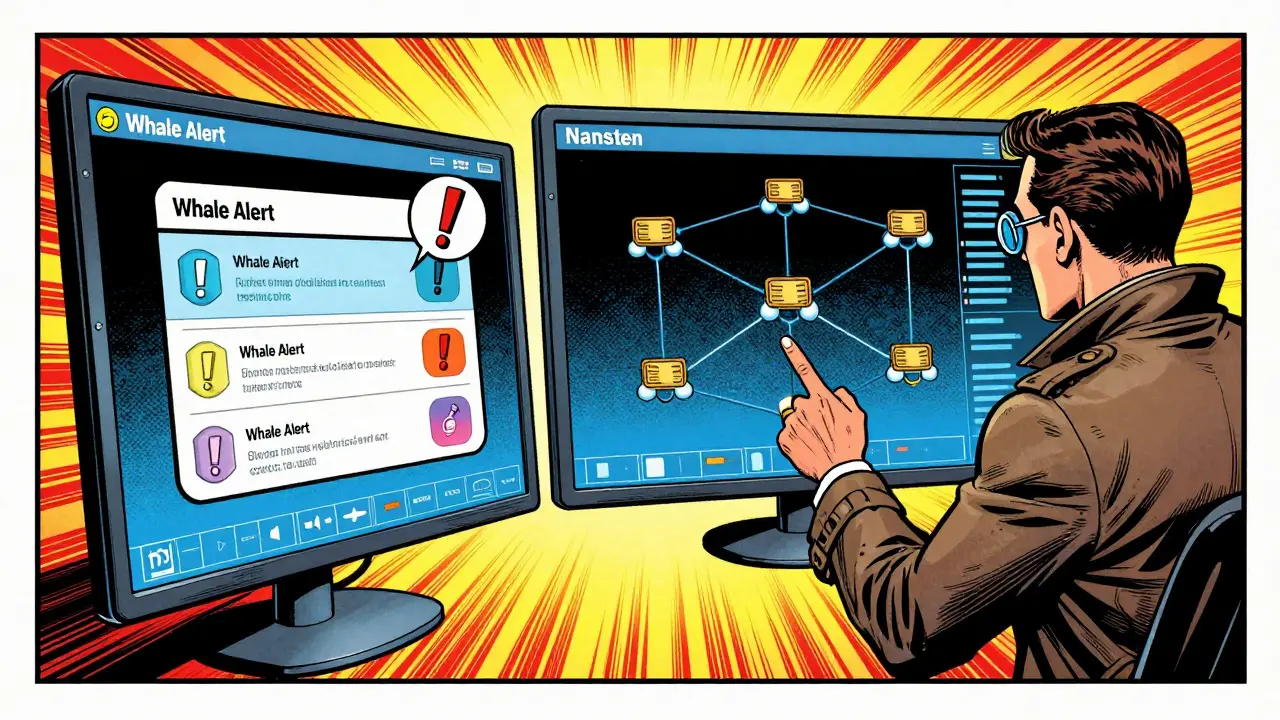
- Whale Alert is the most popular free service, broadcasting large transactions via Twitter and Telegram. Founded in 2018, it has over 1.2 million followers. It’s great for quick, real-time alerts but lacks deep historical analysis. Perfect for beginners who want simple notifications.
- Nansen.ai is a premium platform offering labeled wallet intelligence and advanced analytics. Launched in 2019, Nansen identifies whether a transaction comes from a known exchange like Coinbase or a specific fund. Pricing starts at $99/month. It’s ideal for serious traders who need context, not just numbers.
- Arkham Intelligence is an open-source intelligence platform that tracks wallet clusters across 15 blockchains. Founded in 2021, Arkham uses machine learning to group related addresses, revealing collective behavior. It costs around $149/month but provides institutional-grade insights previously reserved for hedge funds.
- CryptocurrencyAlerting.com is a mid-tier solution offering customizable alerts for specific tokens and values. At $29/month, it balances cost and features, allowing you to set custom thresholds for ETH, BSC, and other chains.
| Tool | Cost | Best For | Key Feature |
|---|---|---|---|
| Whale Alert | Free | Beginners | Real-time social media alerts |
| Nansen.ai | $99+/mo | Pro Traders | Labeled wallet intelligence |
| Arkham Intelligence | $149+/mo | Analysts | Wallet clustering & P/L analytics |
| CryptoAlerting | $29/mo | Custom Users | Tailored token/value alerts |
How to Interpret Whale Movements Like a Pro
Seeing a big number flash on your screen isn’t enough. You need to know what it means. Not all whale moves are created equal. Here are five strategies to decode their actions:
- Watch Exchange Flows: When whales move assets to an exchange, they’re likely preparing to sell. High inflows increase supply, which can drive prices down. Conversely, moving assets off exchanges to cold wallets suggests accumulation-a bullish sign. Nansen.ai research shows high outflows often precede price increases.
- Track Stablecoin Inflows: Before buying crypto, whales often deposit stablecoins (like USDT or USDC) onto exchanges. Large stablecoin transfers usually signal ready liquidity to buy dips. These moves often happen 12-24 hours before significant purchases.
- Identify OTC Trades: Massive transactions (1,000+ BTC) might be Over-The-Counter trades between institutions. These don’t always hit the order book immediately, so they may not impact price right away. Look for subsequent smaller trades to gauge sentiment.
- Cluster Wallets: Advanced tools like Arkham help you see if multiple large addresses belong to the same entity. A single whale might split funds across several wallets to hide their size. Clustering reveals the true scale of their position.
- Cross-Reference Sentiment: Don’t rely on on-chain data alone. Combine whale moves with technical indicators like RSI divergence. TradingView users report that combining whale alerts with RSI improves prediction accuracy from 52% to 68%.
Common Pitfalls and How to Avoid Them
Tracking whales sounds easy, but it’s full of traps. Many beginners lose money by misinterpreting signals. Here’s what to watch out for:
- False Positives: Not every large transfer is a whale acting on market strategy. Some are internal exchange movements or wallet migrations. CryptocurrencyAlerting.com notes that 30-40% of large transactions come from known exchanges, not individual traders.
- Whale Spoofing: Some whales place large orders to scare retail traders into selling, then cancel the order. This is called spoofing. Always wait for the transaction to confirm on the blockchain before reacting.
- Information Overload: Getting alerted for every large move can paralyze you. Set custom thresholds. If you only trade Ethereum, ignore Bitcoin alerts. Focus on the assets you actually hold.
- Privacy Coins and Hidden Wallets: Tools can’t track everything. Privacy coins like Monero and mixers like Tornado Cash obscure transactions. Chainalysis reports that 8-12% of crypto value remains untrackable due to privacy measures.
Setting Up Your Own Whale Tracking System
You don’t need to spend hundreds of dollars to start. Here’s a step-by-step setup for a beginner-friendly system:
- Choose Your Platform: Start with Whale Alert for free, real-time updates via Telegram or Twitter. It takes less than 3 hours to master.
- Set Custom Thresholds: If using a paid tool like CryptoAlerting, adjust the minimum transaction value. Instead of the default 1,000 ETH, try 500 ETH to catch slightly smaller but still significant moves.
- Select Specific Tokens: Filter alerts for only the cryptocurrencies you trade. Monitoring irrelevant coins creates noise and distracts from actionable signals.
- Integrate with Technical Analysis: Open your charting software (like TradingView). When you get a whale alert, check the current price action. Is there resistance? Is RSI overbought? Use the alert as one piece of the puzzle.
- Keep a Journal: Record each whale movement you act on and the outcome. Over time, you’ll learn which patterns are reliable and which are red herrings.
The Future of On-Chain Analytics
The industry is evolving fast. In 2025, the whale tracking sector generated $127 million in revenue, projected to hit $342 million by 2026. New features are emerging, like Nansen’s "Whale Pulse," which correlates on-chain data with social media sentiment to predict short-term price moves with 73% accuracy during beta testing.
AI-powered models are also entering the scene. Chainalysis acquired Skynet in July 2025 to develop predictive analytics slated for release in Q2 2026. However, regulators are watching. The SEC’s May 2025 guidance warns that linking wallet addresses to real-world identities must comply with privacy laws. Expect tighter rules on data usage in the coming years.
Despite these changes, the core advantage remains: blockchain transparency. As long as public ledgers exist, whales will leave footprints. Your job is just to learn how to read them.
Is whale tracking legal?
Yes, tracking public blockchain transactions is legal because the data is publicly available. However, using this data to manipulate markets or violate privacy regulations when linking wallets to identities is illegal.
Can whales hide their movements?
To some extent. Whales use privacy coins, mixers like Tornado Cash, and split transactions across multiple wallets to obscure their activity. However, advanced analytics tools can often cluster these addresses to reveal the underlying entity.
Do whale movements always predict price changes?
No. While whale transactions correlate with volatility, they don't guarantee direction. Factors like market sentiment, regulatory news, and macroeconomic trends also play huge roles. Always combine whale data with other analysis methods.
Which blockchain is best for whale tracking?
Ethereum (ETH) and Binance Smart Chain (BSC) are the most tracked due to high DeFi activity. Bitcoin (BTC) is also heavily monitored for large store-of-value movements. Multi-chain tools now cover 15+ networks.
How accurate are whale tracking tools?
Accuracy varies. Free tools like Whale Alert provide raw data with potential false positives. Premium tools like Nansen and Arkham use AI to label wallets, achieving over 90% accuracy in identifying strategic moves versus routine transfers.