Have you heard about Muda Crypto Exchange and are wondering if it’s a legitimate place to trade your Bitcoin or Ethereum? You aren’t alone. With new platforms popping up every day, it is easy to get excited by promises of high returns or unique features. But here is the hard truth: after digging through available data, privacy policies, and industry reports, there is almost no evidence that "Muda Crypto Exchange" exists as a consumer-facing trading platform.
Instead, what we find is a reference to something called MUDA Liquidity Rail. This sounds technical, doesn't it? And it is. A liquidity rail is not a place where you go to buy coins. It is a backend infrastructure service that helps other exchanges move money around. If you are looking for a dashboard to trade stocks or crypto, Muda likely isn’t it. In fact, treating it like one could be a dangerous mistake.
The Mystery Behind Muda Crypto Exchange
When you search for reviews, user testimonials, or fee structures for Muda, you hit a wall. There are no Reddit threads discussing its customer support. There are no Trustpilot ratings. There are no independent audits from firms like CertiK or Hacken. For a financial platform handling people's life savings, this silence is deafening.
The only concrete digital footprint we can find is a privacy policy dated November 27, 2025, for "MUDA Liquidity Rail." The document mentions that their security measures are "continuously reviewed." That is a nice sentence, but it tells us nothing about how they protect your funds if you were somehow able to deposit them. It doesn't list supported cryptocurrencies, trading pairs, or withdrawal limits. Without these basics, it is impossible to give it a star rating or recommend it.
So, why does this name exist? It appears MUDA operates in the shadows of the crypto world, providing liquidity solutions rather than retail services. If you have been invited to join "Muda Exchange" by a stranger on social media or via a direct message, pause. This pattern often matches common crypto scams where fake platforms use real-sounding names to trick users into depositing funds that never arrive.
What Is MUDA Liquidity Rail?
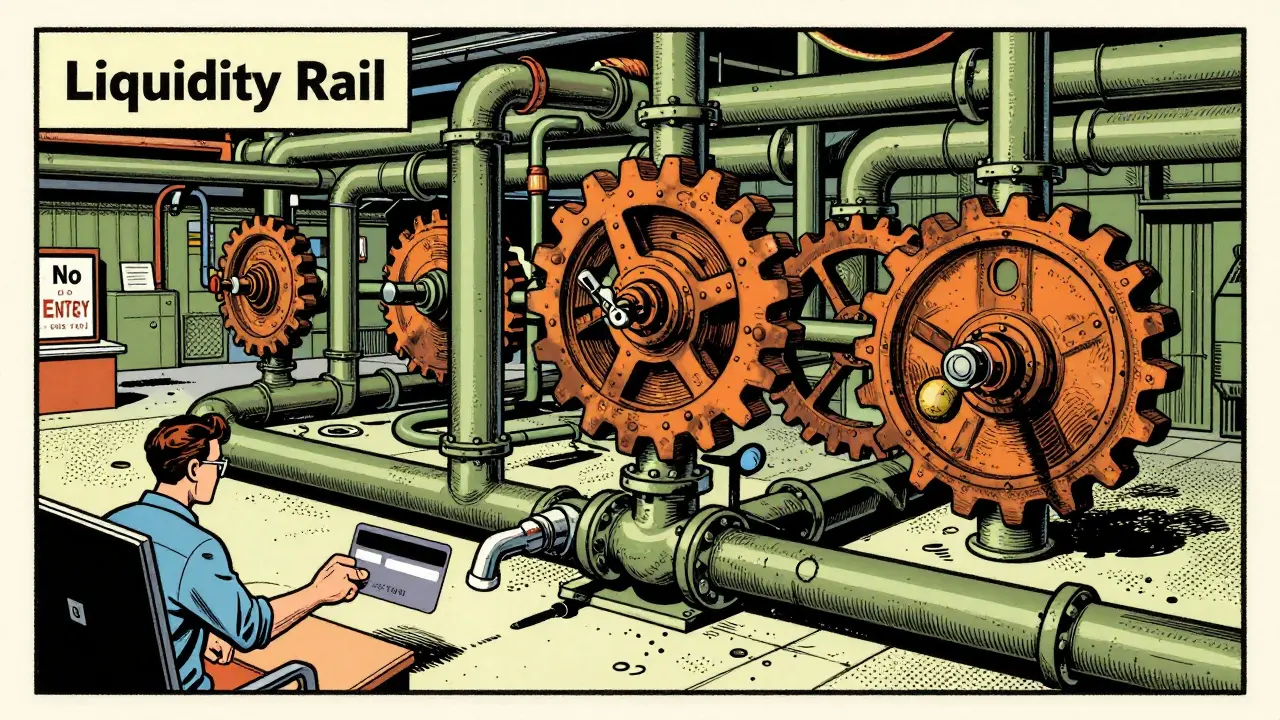
To understand why Muda isn't an exchange, we need to break down what a Liquidity Rail actually does. Think of the stock market. When you buy a share of Apple, you don't buy it directly from Tim Cook. You buy it from another trader, facilitated by a broker. That broker needs access to a deep pool of buyers and sellers so the trade happens instantly. That pool is liquidity.
In crypto, large exchanges like Binance or Coinbase connect to multiple liquidity providers to ensure prices stay stable and trades execute fast. A "liquidity rail" is a technology stack that connects these providers. It is the plumbing behind the sink, not the faucet you turn on. MUDA Liquidity Rail likely provides this infrastructure to other businesses. They do not have a retail app for you to download and start trading with your credit card.
If a website claims to be "Muda Exchange" and asks for your ID and bank details, it is either impersonating the infrastructure provider or using the name to sound authoritative. Legitimate liquidity providers do not solicit individual investors. They work with institutional partners who undergo rigorous due diligence.
Red Flags: Why You Should Stay Away
In the world of cryptocurrency, absence of evidence is often evidence of risk. Here are the specific red flags associated with the lack of information around Muda:
- No Public Track Record: Legitimate exchanges publish their volume, uptime, and security incidents. Muda has none of this.
- Vague Security Claims: Their privacy policy mentions updating security practices but gives zero specifics on cold storage ratios, encryption standards, or insurance funds.
- Lack of Regulatory Licenses: Major exchanges operate under licenses in jurisdictions like the US (FinCEN), EU (MiCA), or Singapore (MAS). We found no record of Muda holding such licenses.
- Confusion of Terms: Using the term "Liquidity Rail" suggests B2B services, yet any potential "exchange" interface would be B2C. This mismatch is a classic sign of a fraudulent setup.
Remember, in 2023 alone, hackers stole $2.38 billion worth of cryptocurrency according to Krayon Digital. Most of these losses happened on platforms with weak security or outright scams. Adding an unverified entity like Muda to your portfolio increases your risk exponentially.
How to Spot a Fake Crypto Exchange
You might be asking, "How do I know if another platform is safe?" Since Muda fails basic checks, let's look at what a *real* secure exchange looks like. This will help you avoid similar traps in the future.
A trustworthy exchange prioritizes transparency. They will clearly display their fee structure-maker and taker fees-on their homepage. They will provide proof of reserves, showing that they actually hold the assets they claim to manage. They will also have active community channels where developers answer questions publicly.
Security is non-negotiable. According to Beyond Identity's 2024 study, while 56% of crypto users use Multi-Factor Authentication (MFA), even protected accounts can be breached if the platform itself is weak. A good exchange implements MFA, but they also use cold storage. Industry best practice dictates that 95-98% of user funds should be kept in offline wallets, disconnected from the internet. If a platform says all your money is online for "fast withdrawals," run away.
Furthermore, look for regulatory compliance. Platforms like Coinbase and Kraken adhere to strict Know Your Customer (KYC) and Anti-Money Laundering (AML) laws. This isn't just bureaucracy; it ensures that the company exists legally and can be held accountable if things go wrong. Muda offers none of these safeguards.
Safer Alternatives for Trading Crypto
If you are looking to enter the crypto market, stick to established players. These platforms have survived multiple market cycles, undergone security audits, and built reputations over years.
| Feature | Established Exchanges (e.g., Coinbase, Kraken) | Unknown Platforms (e.g., Muda) |
|---|---|---|
| Regulatory Status | Licensed in major jurisdictions | No public records |
| Cold Storage | 95-98% of funds offline | Unverified |
| User Reviews | Thousands of independent reviews | None found |
| Security Audits | Regular third-party audits | No audit reports |
| Transparency | Proof of reserves published | Vague privacy policy only |
Platforms like Coinbase are great for beginners because of their user-friendly interface and strong US regulatory oversight. Kraken is known for its robust security history and wide range of altcoins. Binance remains the largest by volume, offering advanced tools for traders, though it faces more complex global regulations. All three have clear fee schedules and customer support teams you can reach when problems arise.
Protecting Yourself From Crypto Scams
Even on safe platforms, you are responsible for your own security. Here is a quick checklist to keep your assets safe:
- Enable 2FA Immediately: Use an authenticator app like Google Authenticator or Authy, not SMS, which can be intercepted.
- Use Withdrawal Whitelists: Pre-approve specific wallet addresses for withdrawals. This prevents hackers from draining your account to a random address.
- Beware of Phishing: Never click links in emails claiming to be from your exchange. Always type the URL manually.
- Check Domain Names: Scammers often register domains like "coinbase-support.com" instead of "coinbase.com." Look closely.
- Verify Liquidity Providers: If a platform claims to use "advanced liquidity rails," check if those providers are reputable firms like Fireblocks or BitGo, not obscure entities.
Encryption is the bedrock of security. As noted by Nadcab Labs, data must be converted into unreadable formats without decryption keys. Ensure any platform you use employs HTTPS and SSL/TLS protocols to protect data during transfer. If the browser shows a padlock icon, it's a good start, but not a guarantee of legitimacy.
Conclusion: Don't Gamble With Muda
The bottom line is simple: Muda Crypto Exchange does not appear to be a legitimate venue for retail trading. The references to "MUDA Liquidity Rail" point to a backend service, not a consumer product. Engaging with any platform using this name carries extreme risk. There is no track record, no regulation, and no community trust.
Your capital deserves better than guesswork. Stick to exchanges that have proven their resilience over time. Do your research, check for licenses, and never invest based on hype or anonymous recommendations. In crypto, safety isn't just a feature-it's the foundation.
Is Muda Crypto Exchange a scam?
While we cannot definitively label it a "scam" without legal judgment, Muda Crypto Exchange lacks all the hallmarks of a legitimate platform. There are no user reviews, no regulatory licenses, and no transparent fee structure. The only entity found is "MUDA Liquidity Rail," which appears to be a backend service, not a retail exchange. This discrepancy makes it highly risky and potentially fraudulent for individual investors.
What is MUDA Liquidity Rail?
MUDA Liquidity Rail is a technology solution that likely provides liquidity infrastructure for other financial platforms. It is not a consumer-facing exchange where you can buy or sell cryptocurrency directly. It functions as backend plumbing for the crypto ecosystem, similar to how payment processors handle transactions behind the scenes.
Are there any reviews for Muda Crypto Exchange?
No, there are no credible user reviews for Muda Crypto Exchange on platforms like Trustpilot, Reddit, or specialized crypto review sites. The absence of user feedback is a major red flag, as legitimate exchanges always have a visible community presence.
Is it safe to deposit money on Muda?
It is strongly advised against depositing money on Muda. Without verified security audits, cold storage confirmation, or regulatory oversight, your funds are at significant risk of theft or loss. Stick to regulated exchanges with proven security records.
What are safer alternatives to Muda?
Safer alternatives include well-established exchanges like Coinbase, Kraken, and Binance. These platforms are regulated, offer transparent fee structures, implement robust security measures like cold storage and 2FA, and have millions of verified users worldwide.