Imagine losing $1.46 billion in a single afternoon. That wasn’t a market crash or a smart contract bug gone wrong-it was North Korea stealing funds from the Bybit exchange in February 2025. This wasn't an isolated incident; it was part of a massive, state-sponsored campaign that saw the Democratic People's Republic of Korea (DPRK) steal over $2.03 billion in cryptocurrency by October 2025 alone.
If you are running a crypto business, working in compliance, or simply holding assets on-chain, this isn't just geopolitical news. It is an operational reality. The international community has responded with aggressive sanctions, but tracking these illicit flows requires more than just glancing at a wallet address. You need to understand how the regime moves money, who is sanctioning whom, and what tools you actually need to stay compliant in 2026.
The Scale of the Threat: Why North Korea Targets Crypto
To understand the sanctions, you first have to understand the motive. North Korea operates under some of the strictest economic sanctions in history. Traditional banking channels are effectively closed to them. Cryptocurrency offers a way around these restrictions because it is borderless, pseudonymous, and difficult for traditional financial institutions to monitor without specialized tools.
According to analysis from Elliptic published in late 2025, the cumulative value of cryptoassets stolen by the regime has surpassed $6 billion since tracking began. These funds don't disappear into a black hole. The United Nations and multiple government agencies confirm that this money directly finances North Korea’s prohibited nuclear weapons and missile development programs.
The shift in strategy has been stark. In 2022, the record year for theft prior to 2025, North Korean actors stole $1.35 billion through attacks on platforms like Ronin Network and Harmony Bridge. But 2025 shattered those records. The $2.03 billion figure for 2025 is nearly triple the total from 2024 ($712 million). This acceleration suggests that the regime views cyber theft not as a side hustle, but as a primary revenue stream essential for its survival.
Who Is Behind the Theft? Key Actors and Groups
When we talk about "North Korean hackers," we aren't talking about lone wolves in basements. We are talking about state-directed organizations. The most prominent group involved in these large-scale exchanges breaches is often linked to Lazarus Group, a unit within the Reconnaissance General Bureau (RGB).
However, the operation is broader than just hacking. It involves a complex ecosystem of IT workers, front companies, and money launderers. The U.S. Department of the Treasury’s Office of Foreign Assets Control (OFAC) has moved aggressively to dismantle this network. On July 24, 2025, OFAC sanctioned several key entities and individuals, including:
- Vitaliy Sergeyevich Andreyev: An individual identified for his role in fraudulent IT worker schemes.
- Kim Ung Sun: Another key figure in the orchestration of these frauds.
- Shenyang Geumpungri Network Technology Co., Ltd: A company used as a front for these operations.
- Korea Sinjin Trading Corporation: Designated for facilitating the movement of illicit funds.
Under Secretary of the Treasury John K. Hurley made the stakes clear during the announcement: "The North Korean regime continues to target American businesses through fraud schemes involving its overseas IT workers, who steal data and demand ransom." These designations mean that any interaction with these entities-whether direct or indirect-is illegal for U.S. persons and subject to severe penalties.
How Sanctions Are Enforced: The Role of Blockchain Analytics
You cannot sanction a Bitcoin address in the same way you freeze a bank account. The blockchain is immutable and decentralized. So, how do sanctions work? They work by cutting off the bridge between the illicit crypto and the legitimate financial system.
This is where Blockchain Analytics firms like Elliptic, Chainalysis, and TRM Labs become critical. These companies use transaction pattern recognition, cluster analysis, and intelligence sources to attribute specific wallet addresses to North Korean actors.
Here is the process in practice:
- Attribution: When a hack occurs, analysts look for known signatures. For example, if funds are moved to a mixer service immediately after a breach, and then withdrawn to a wallet previously linked to a Lazarus Group attack, the attribution confidence increases.
- Labeling: These wallets are labeled as "DPRK-associated" in compliance databases.
- Screening: Exchanges and fiat on-ramps screen every incoming transaction against these lists. If a deposit comes from a sanctioned wallet, the funds are frozen, and the exchange reports it to authorities.
The Multilateral Sanctions Monitoring Team (MSMT), established to ensure the effectiveness of UN Security Council Resolutions, released its second report in October 2025. This coalition of 11 nations-including the U.S., Japan, South Korea, and others-asserts that North Korea’s cyber program now rivals the sophistication of China and Russia. Their report highlights that the regime uses a "full-spectrum" approach, combining theft with illicit IT work and information trafficking.
The Laundering Challenge: Mixing, Swaps, and Privacy Coins
Tracking North Korean funds is a cat-and-mouse game. The regime knows that major exchanges will block obvious transfers. So, they employ sophisticated laundering techniques to obfuscate the trail before trying to cash out.
Common tactics observed in 2025 include:
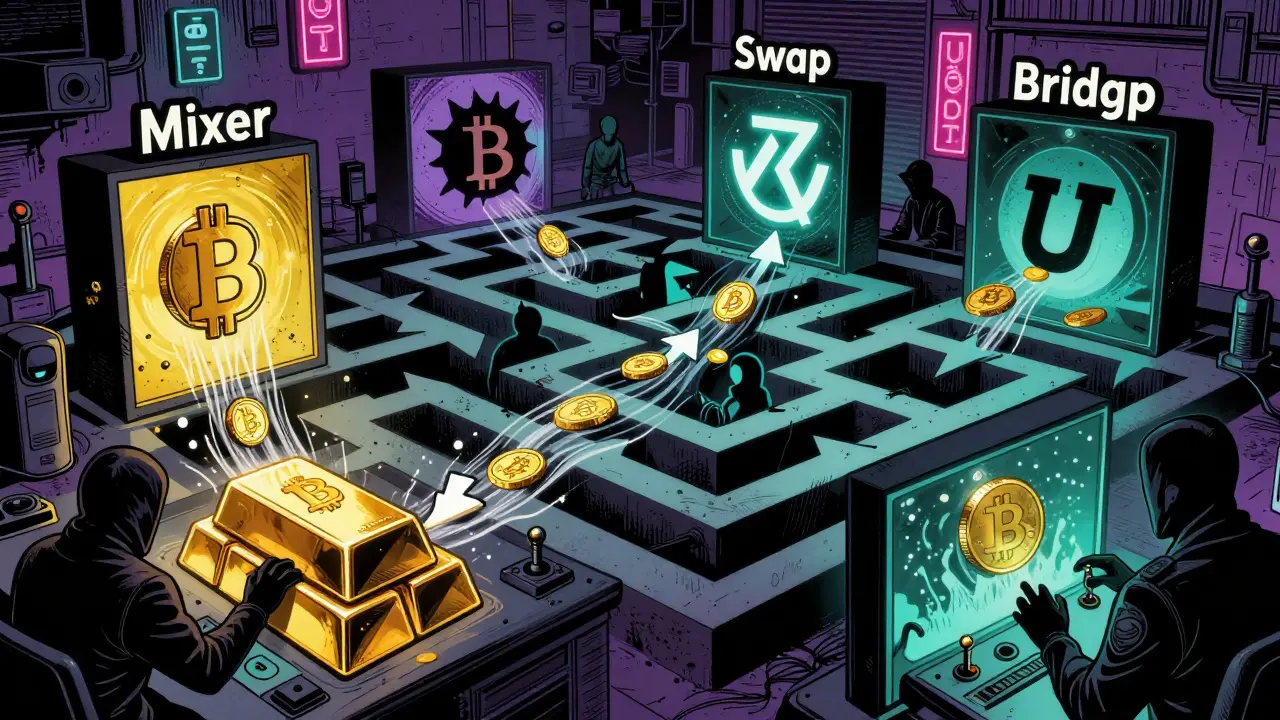
- Cross-Chain Swaps: Moving funds from Ethereum to Tron, then to Solana, using decentralized bridges. Each hop makes the chain of custody harder to follow.
- Mixing Services: Using tumblers to blend stolen coins with clean ones, breaking the link between the source and destination.
- Privacy Coins: Converting transparent cryptocurrencies like Bitcoin or USDT into privacy-focused coins like Monero (XMR), which hide transaction details entirely.
- P2P Trading: Selling small amounts of crypto to unsuspecting individuals via peer-to-peer platforms to slowly convert back to fiat currency.
Elliptic noted in their October 2025 analysis that while they attributed over thirty hacks to North Korean actors in 2025, the actual figure may be higher. Many thefts share hallmarks of DPRK activity but lack sufficient evidence for definitive attribution. This ambiguity creates a gray area for compliance officers. Do you block a transaction that looks suspicious but isn't proven? In 2026, the trend is toward "guilty until proven innocent" for high-risk patterns.
Practical Steps for Compliance in 2026
If you are operating in the crypto space, ignoring these sanctions is not an option. The U.S. State Department has offered rewards of up to $15 million for information leading to the disruption of these operations. This signals that enforcement will be relentless. Here is what you need to do:
1. Implement Real-Time Screening
Relying on static lists of banned addresses is no longer enough. North Korean actors generate new wallets constantly. You need dynamic screening tools that analyze transaction behavior in real-time. Integrate APIs from providers like Elliptic or Chainalysis into your exchange or wallet infrastructure.
2. Monitor DeFi Interactions
North Korea is increasingly targeting Decentralized Finance (DeFi) protocols and cross-chain bridges. If your project interacts with liquidity pools or bridges, ensure you have mechanisms to detect and flag interactions with known malicious contracts. The $1.46 billion Bybit breach showed that even centralized exchanges with robust security can fall victim to social engineering and technical exploits.
3. Train Your Staff on Social Engineering
Not all thefts are code breaks. Many involve IT worker schemes where employees are tricked into revealing credentials or installing malware. Under Secretary Hurley emphasized that IT workers "steal data and demand ransom." Regular security training is as important as your firewall.
4. Understand Secondary Sanctions
Even if you are not based in the U.S., interacting with sanctioned North Korean entities can expose you to secondary sanctions. This means you could lose access to the U.S. financial system, which is catastrophic for most global businesses. Due diligence is mandatory.
The Future Outlook: Will the Theft Stop?
Despite the increased pressure, experts predict that North Korean crypto theft will remain a persistent threat through 2026 and beyond. The regime’s adaptability is its greatest asset. As blockchain analytics improve, the hackers evolve their laundering methods.
The MSMT report indicates that the international community is coordinating more closely than ever. Japan’s Ministry of Foreign Affairs stated that the goal is to "promote the full implementation of relevant UNSCRs and call for the complete dismantlement of North Korea's nuclear and ballistic missile programs." This political will translates into stricter regulations for crypto businesses worldwide.
For the average user, the risk of direct interaction with North Korean funds is low if you stick to reputable, regulated exchanges. However, for developers, investors, and institutional players, the landscape is fraught with hidden dangers. The key is vigilance. Assume that any large, unexplained movement of funds could be linked to state-sponsored actors until proven otherwise.
What happens if I accidentally send crypto to a North Korean sanctioned wallet?
If you send funds to a wallet identified as North Korean-linked, you should immediately cease further transactions and contact your local financial crime reporting authority. In the U.S., this means filing a Suspicious Activity Report (SAR) with FinCEN. Do not attempt to recover the funds yourself, as this may complicate legal proceedings. While you may not face criminal charges if it was an honest mistake, the funds will likely be frozen or confiscated by authorities.
Which companies are responsible for tracking North Korean crypto wallets?
Leading blockchain analytics firms such as Elliptic, Chainalysis, and TRM Labs specialize in tracking illicit flows. They maintain databases of known North Korean wallet addresses and provide screening tools for exchanges and financial institutions. Additionally, the Multilateral Sanctions Monitoring Team (MSMT) coordinates international efforts to identify and report violations.
Is it illegal for non-US citizens to interact with North Korean crypto?
Yes, potentially. While primary sanctions apply to U.S. persons and entities, many countries have their own sanctions regimes aligned with UN resolutions. Furthermore, engaging with sanctioned entities can trigger secondary sanctions, which restrict access to the U.S. financial system. Most major global banks and exchanges enforce these rules universally to protect their own licenses.
How much has North Korea stolen in cryptocurrency recently?
As of October 2025, North Korean-linked groups had stolen over $2.03 billion in cryptocurrency during that year alone, bringing the cumulative total to more than $6 billion since tracking began. This includes the massive $1.46 billion breach of the Bybit exchange in February 2025.
What is the Lazarus Group?
The Lazarus Group is a cybercrime unit widely attributed to North Korea's Reconnaissance General Bureau. They are responsible for some of the largest cryptocurrency heists in history, including attacks on Bitfinex, Ronin Network, and Bybit. They are known for using sophisticated malware and social engineering tactics.