Celestia and Modular Blockchain Projects: A Practical Guide
Learn how Celestia's modular design, data availability sampling, and recent Ginger upgrade empower rollup projects and reshape blockchain scalability.
Read More
When working with Rollup, a Layer‑2 technique that aggregates many transactions into a single proof and posts it back to the main chain. Also known as roll‑up, it delivers higher throughput while keeping the security guarantees of the underlying blockchain.
Rollups sit on top of Modular blockchain, an architecture that separates consensus, execution, and data layers so each can be optimized independently. This separation makes it easier for a rollup to rely on a dedicated data layer, improving both speed and cost. One key piece of that data layer is Data availability, the guarantee that transaction data can be retrieved by anyone who needs to verify a rollup's state. Without strong data availability, a rollup could become unsafe because participants couldn't challenge invalid state transitions. Projects like Celestia, a modular blockchain that provides data‑availability sampling and a proof‑of‑stake consensus tailored for rollups illustrate how these concepts combine: Celestia handles the data, while rollups focus on execution and smart‑contract logic.
Rollups address the two biggest pain points for blockchain users: high fees and slow confirmation times. By moving the heavy lifting off‑chain, they let developers build complex DeFi apps without hitting the congestion that plagues base layers like Ethereum. At the same time, rollups inherit the base chain’s security model, so users don’t have to trust a new validator set. This security‑through‑inheritance is why many DeFi protocols are launching on Optimistic and ZK rollups rather than building stand‑alone chains.
Beyond cost savings, rollups open the door to richer user experiences. Since a rollup can publish a single proof for thousands of transactions, wallets can show near‑instant balances, and traders can execute arbitrage strategies across multiple layers without waiting for minutes. The ecosystem is also seeing cross‑rollup bridges that let assets flow between Optimistic, ZK, and even side‑chain rollups, creating a network of interoperable layers. As the rollup space matures, you’ll notice more tooling that automates proof generation, better monitoring of data‑availability health, and game‑changing upgrades like Celestia’s Ginger that boost throughput without compromising safety.
Below you’ll find a curated set of articles that dig deeper into these ideas. From Celestia’s modular design and data‑availability sampling to real‑world case studies of how rollups reshape markets, the collection gives you practical insights and actionable takeaways. Keep reading to see how rollups are reshaping blockchain performance, what challenges remain, and which projects are leading the charge.
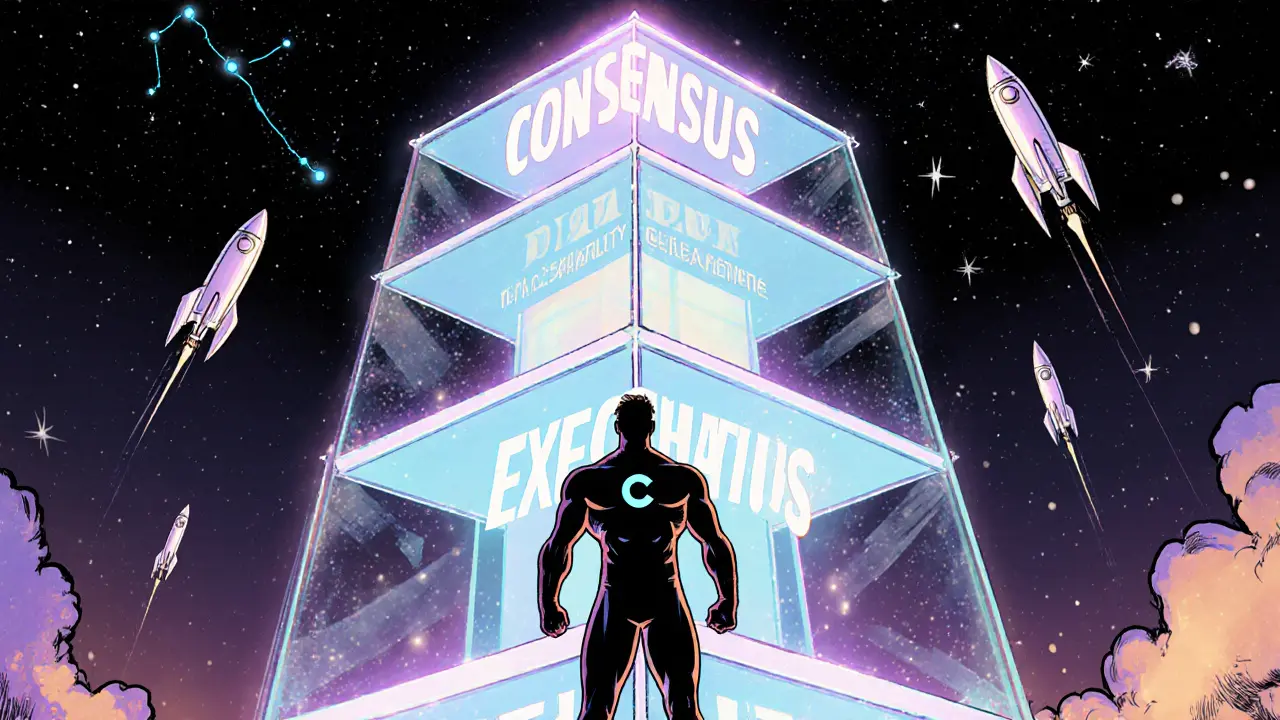
Learn how Celestia's modular design, data availability sampling, and recent Ginger upgrade empower rollup projects and reshape blockchain scalability.
Read More