
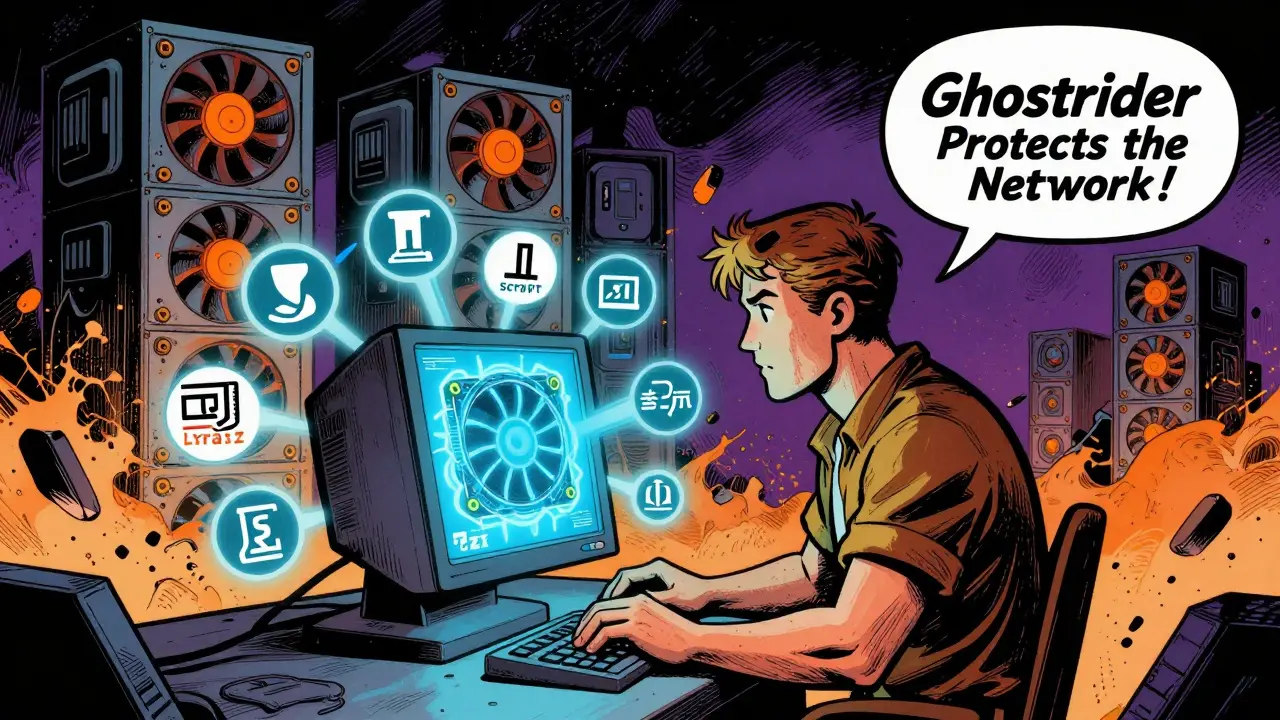
Raptoreum (RTM) isn't another meme coin. It’s a cryptocurrency built to solve real problems - specifically, the centralization of mining power. Launched in February 2021 after three years of development, Raptoreum mixes two mining methods: Proof of Work and Proof of Stake. This hybrid system lets everyday users participate without needing expensive mining rigs. The goal? A decentralized, secure network that’s hard to attack - even if someone tries to control more than half the network.
How Raptoreum Works: Ghostrider Algorithm
Most cryptocurrencies use one hashing algorithm, like Bitcoin’s SHA-256. That’s great for efficiency, but it also makes it easy for big mining companies to build custom hardware (ASICs) and take over the network. Raptoreum flips that script with something called Ghostrider. This isn’t just one algorithm - it’s a rotating set of algorithms that change every few blocks. Sometimes it uses Scrypt, sometimes X11, sometimes others. The idea? Make ASICs useless. If your mining chip is built for Scrypt, it’ll sit idle when the network switches to Lyra2Z. This keeps mining in the hands of regular users with standard CPUs and GPUs.
This isn’t theoretical. Since launch, Raptoreum’s network has stayed decentralized because no single mining farm or corporation has been able to dominate. The result? A more democratic system where anyone with a decent computer can contribute.
Smart Contracts and DApps Built In
Raptoreum doesn’t stop at mining. It’s also a full blockchain platform. You can create tokens, launch smart contracts, and even build decentralized apps (DApps) directly on it. Unlike Ethereum, where you need to learn Solidity, Raptoreum lets developers use familiar languages like Java and Python. That’s a big deal. It lowers the barrier for developers who already know those languages to jump in without relearning everything.
Smart contracts on Raptoreum aren’t just for trading. They’re used for asset tokenization - turning real-world assets like land, art, or even solar energy credits into digital tokens. That opens up new ways to trade value without middlemen. Futures trading is also supported, letting users bet on future price movements without needing a centralized exchange.
Real-World Adoption and Exchange Listings
Raptoreum got its first exchange listing on April 9, 2021, on SouthX. A few days later, it appeared on Qtrade. Today, it’s available on multiple platforms including CoinGecko, Crypto.com, Coinbase, and LBank. That’s not a huge list compared to Bitcoin or Ethereum, but for a project launched in 2021 with no big marketing budget, it’s solid.
Its social media presence has grown steadily too. The community is small but active - mostly developers, miners, and crypto enthusiasts who care about decentralization. There’s no hype, no influencer campaigns. Just people building and using the network.
Price and Market Data (March 2026)
As of March 2026, Raptoreum’s price is around $0.000097 on CoinGecko and $0.000096 on Crypto.com. Coinbase shows a slightly higher price at $0.000226, which could be due to lower trading volume on that platform. The 24-hour trading volume is around $35,888 on CoinGecko, which is low compared to top coins but normal for a smaller project.
The total supply is capped at 21 billion RTM. Right now, about 5.6 billion are in circulation. That means there’s still a lot of coins left to be mined or staked. The market cap sits at roughly $1.3 million, ranking it #3669 out of over 25,000 cryptocurrencies.
Don’t let the low price fool you. Raptoreum’s all-time high was $9,513.27 on December 30, 2023. That’s not a typo. It was a speculative spike fueled by a single pump-and-dump event. Since then, the price has corrected sharply - down over 99%. That’s common for many altcoins. The current price reflects its real utility, not hype.
Over the last 24 hours, RTM dropped 9.6%, and over seven days it’s down 1.1%. That’s underperforming compared to the broader crypto market, which was up 0.1% in the same period. But here’s the thing: Raptoreum isn’t trying to go viral. It’s focused on steady, long-term adoption.
Security: 51% Attack Immunity
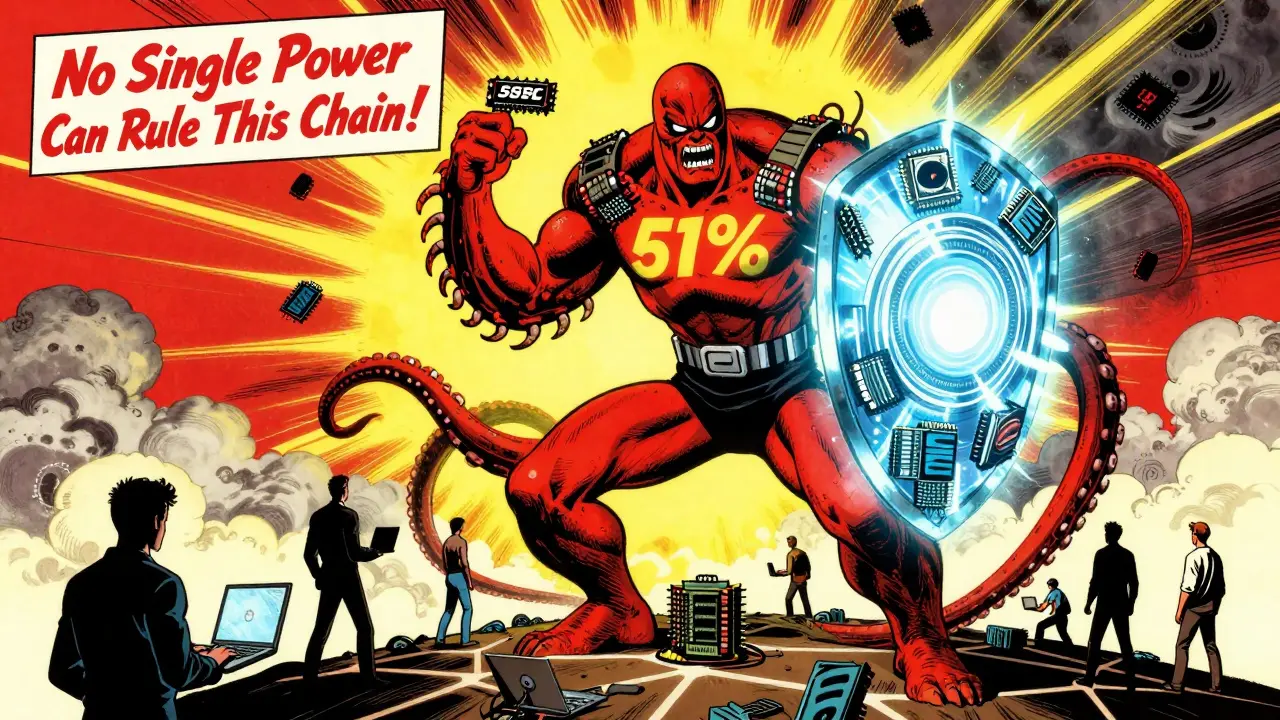
One of Raptoreum’s biggest claims is immunity to 51% attacks. Most blockchains are vulnerable if someone controls more than half the mining power. That’s why Bitcoin’s network is so secure - it’s too expensive to attack. Raptoreum takes this further. Because Ghostrider switches algorithms constantly, even if someone hoards one type of miner, they can’t dominate the network. The system forces attackers to own multiple types of hardware, which is practically impossible.
This isn’t marketing fluff. The code is open-source, and the network has run for over five years without a single successful attack. That’s a strong track record.
Who’s Behind Raptoreum?
The project was co-founded by David Morris - a name you won’t find on TikTok ads. He was one of the early contributors to BTCChina and helped translate key documents for Bitcoin’s first wave of global adoption. He’s not chasing fame. He’s focused on building something that lasts. The team is small, mostly developers and cryptographers who work quietly on GitHub. There are no flashy whitepapers or celebrity endorsements. Just code, commits, and community.
Is Raptoreum Worth It?
If you’re looking for a coin to flip in a week - no, Raptoreum isn’t for you. It’s slow, quiet, and doesn’t move fast. But if you care about:
- Decentralized mining that doesn’t favor big corporations
- Smart contracts that don’t require learning a new programming language
- A blockchain built for real utility, not speculation
- Security that’s tested over years, not just claimed
Then Raptoreum is one of the most interesting projects in crypto right now. It’s not glamorous. But it’s honest. And in a space full of noise, that’s rare.
What is Raptoreum (RTM) used for?
Raptoreum (RTM) is used for secure peer-to-peer transactions, smart contracts, tokenizing real-world assets, and running decentralized applications (DApps). Its hybrid Proof of Work and Proof of Stake system allows users to mine or stake RTM to earn rewards. The network also supports futures trading and non-fungible tokens (NFTs), all built on an ASIC-resistant blockchain.
Can I mine Raptoreum with a regular computer?
Yes. Raptoreum’s Ghostrider algorithm is designed to resist ASIC and FPGA mining. It rotates between multiple hashing algorithms, making specialized hardware ineffective. This means you can mine RTM using standard CPUs and GPUs - the same hardware most people already own. No need to invest in expensive mining rigs.
Is Raptoreum a good investment?
Raptoreum is not a high-growth speculative asset. Its price has dropped over 99% from its all-time high of $9,513 in 2023, and it currently trades under $0.0001. It’s not designed to make quick profits. Instead, it’s a long-term project focused on decentralization, security, and real-world use. If you believe in a mining-resistant blockchain with smart contract capabilities, it may be worth holding. But don’t expect returns like Bitcoin or Ethereum.
Where can I buy Raptoreum (RTM)?
You can buy Raptoreum on exchanges like SouthX, Qtrade, CoinGecko, Crypto.com, Coinbase, and LBank. It trades against Bitcoin, Ethereum, and stablecoins like USDT and USDC. Always check the trading pair before buying - some exchanges may have low liquidity, which can cause price slippage.
How many Raptoreum coins are there?
Raptoreum has a maximum supply of 21 billion RTM tokens. As of March 2026, about 5.6 billion are in circulation. The rest will be released gradually through mining and staking rewards over the next several years. This slow release helps prevent inflation and supports long-term network growth.
Does Raptoreum have a future?
Its future depends on adoption. Raptoreum has a working blockchain, active developers, and real use cases like asset tokenization and smart contracts. It’s not chasing trends - it’s focused on building a secure, decentralized platform. If more developers start building DApps on it, and more miners join the network, its value could grow. But it won’t explode overnight. It’s a slow-burn project built for sustainability, not hype.
If you’re looking for a cryptocurrency that actually tries to fix the problems of mining centralization - Raptoreum is one of the few doing it right. It’s quiet. It’s technical. And it doesn’t need to shout to be heard.

There are 13 Comments
anshika garg
It’s not a coin. It’s a statement.
Bruce Doucette
Meanwhile, Bitcoin’s still the only thing that doesn’t need a 10-page whitepaper to explain why it’s not trash.
Marie Vernon
I’m a dev who uses Python. The fact that I can write smart contracts in a language I already know? That’s huge. No more wrestling with Solidity at 2 a.m. while my cat judges me. Thank you, Raptoreum.
Ross McLeod
That’s why the trading volume is low. That’s why the price is stable. That’s why it’s survived five years without a 51% attack. It doesn’t want your money. It wants your participation. And that’s a radical concept in 2026.
rajan gupta
WE’VE BEEN LIVING IN A SIMULATION WHERE EVERY COIN IS A SCAM EXCEPT RTM 😭😭😭
DAVID MORRIS IS A MODERN DAY SAVIOR 🙏🙏🙏
I JUST MINED 12 RTM ON MY LAPTOP WHILE WATCHING CAT VIDEOS AND I FEEL LIKE A GOD 🤯🤯🤯
Billy Karna
Compare that to Monero, which had ASICs emerge after 3 years. Or Litecoin, which got crushed by Scrypt farms. Raptoreum didn’t just react - it anticipated. The rotating algorithms aren’t a gimmick. They’re a defense-in-depth strategy. And yes, the fact that it’s built on familiar languages like Python and Java? That’s the quiet killer feature. It’s not about being ‘better than Ethereum.’ It’s about being accessible to the 90% of devs who already know those languages. That’s how adoption happens - not through hype, but through frictionless onboarding.
Cheri Farnsworth
Gene Inoue
Don’t fool yourself. This isn’t the future. It’s the graveyard.
Ricky Fairlamb
Arlene Miles
Yes, it’s slow. Yes, it’s quiet. But quiet doesn’t mean weak. It means intentional. And if you’re still stuck on ‘when will it pump?’ - maybe you’re not the audience this project was meant for. That’s okay. There’s room for you elsewhere. But don’t knock what you don’t understand.
Jessica Beadle
Tony Weaver
It’s not bad tech. It’s just performative humility. And in crypto? That’s just another kind of scam.
Patty Atima
Write a comment
Your email address will not be published. Required fields are marked *