Think about the last time you logged into your favorite social media platform or ordered food through a delivery app. You typed in a password, maybe verified your identity with a code sent to your phone, and boom-you were in. It’s fast, it’s familiar, and it works because one company controls the entire backend. Now, imagine an application where no single company owns your data, where the code runs on thousands of computers worldwide, and where you hold the keys to your own digital life. That is the promise of dApps, or decentralized applications.
In 2026, we are at a crossroads. The tech world is split between the comfort of centralized systems and the radical freedom of blockchain-based solutions. But which one is actually right for you? Is the hype around decentralization worth the learning curve? Or should you stick with the apps that have served us well for decades? Let’s break down the real differences between dApps and traditional apps, looking past the buzzwords to see how they work under the hood.
The Core Difference: Who Holds the Keys?
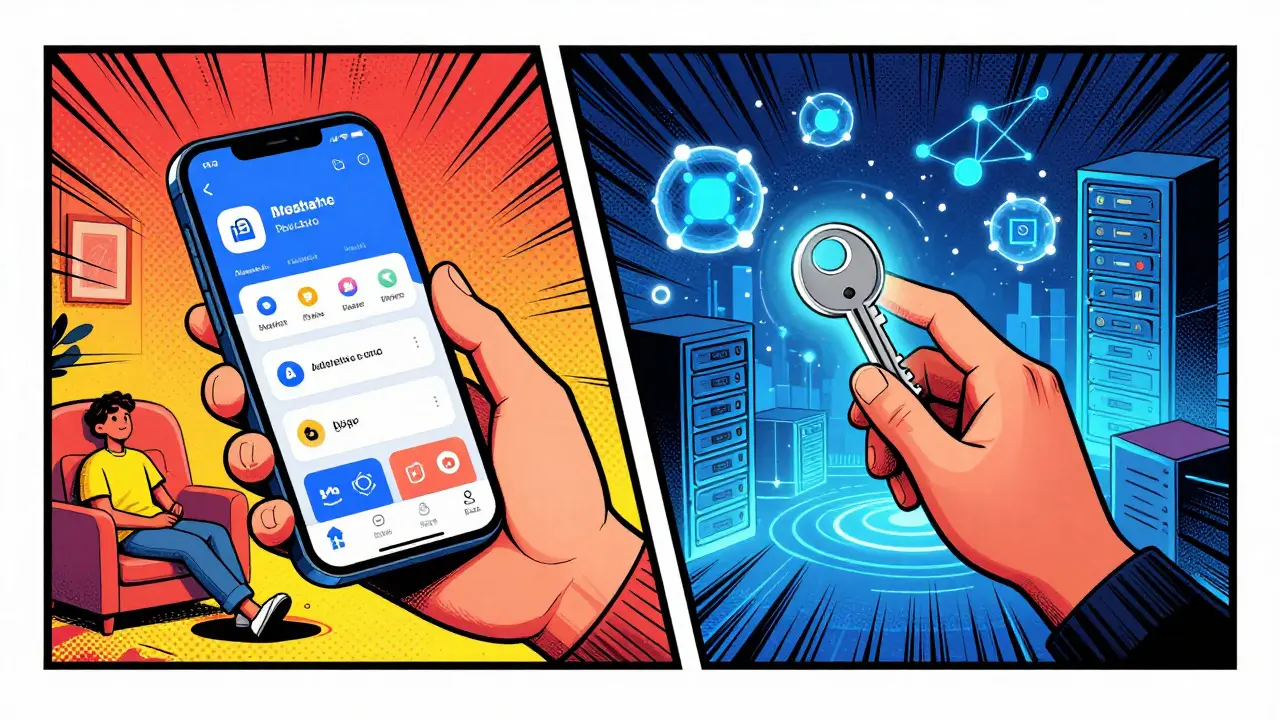
The biggest distinction isn’t just technical; it’s philosophical. A traditional application operates on a client-server model where a central authority manages the database and logic. When you use Facebook or Uber, Meta and Uber respectively own the servers, control the rules, and manage your data. If they decide to change the terms of service, shut down your account, or sell your information, they can do it with a click.
A decentralized application (dApp) removes this middleman by running on a peer-to-peer network of nodes using blockchain technology. Instead of one server, the app’s logic lives in smart contracts deployed on networks like Ethereum, Solana, or Polygon. No single entity can shut it down or alter its core rules without consensus from the network participants. This shift means user sovereignty. You don’t ask permission to join; you simply connect your wallet and interact with the protocol.
How They Work: Architecture Under the Hood
To understand why dApps feel different, you have to look at their structure. Traditional apps follow a straightforward path:
- Frontend: What you see on your screen (HTML/CSS/JavaScript).
- Backend: Servers hosted by companies like AWS or Google Cloud that process requests.
- Database: Centralized storage (like MySQL or MongoDB) where your profile, posts, and transactions live.
If the backend goes down, the app stops working. If the database is hacked, all users’ data is compromised at once. This is why we saw massive outages when major platforms like Facebook went dark for hours in 2021.
dApps use a three-layer architecture that changes the game:
- Interface Layer: Looks just like a normal website or mobile app.
- Middle Layer: Connects the interface to the blockchain using libraries like Web3.js or Ethers.js.
- Smart Contract Layer: Self-executing code stored on the blockchain that handles the logic and data storage.
This setup makes dApps incredibly resilient. Since the code is replicated across thousands of nodes globally, there is no single point of failure. Ethereum has maintained near-perfect uptime since its launch in 2015, whereas even the most robust traditional cloud services suffer occasional disruptions.
Speed, Cost, and Performance Trade-offs
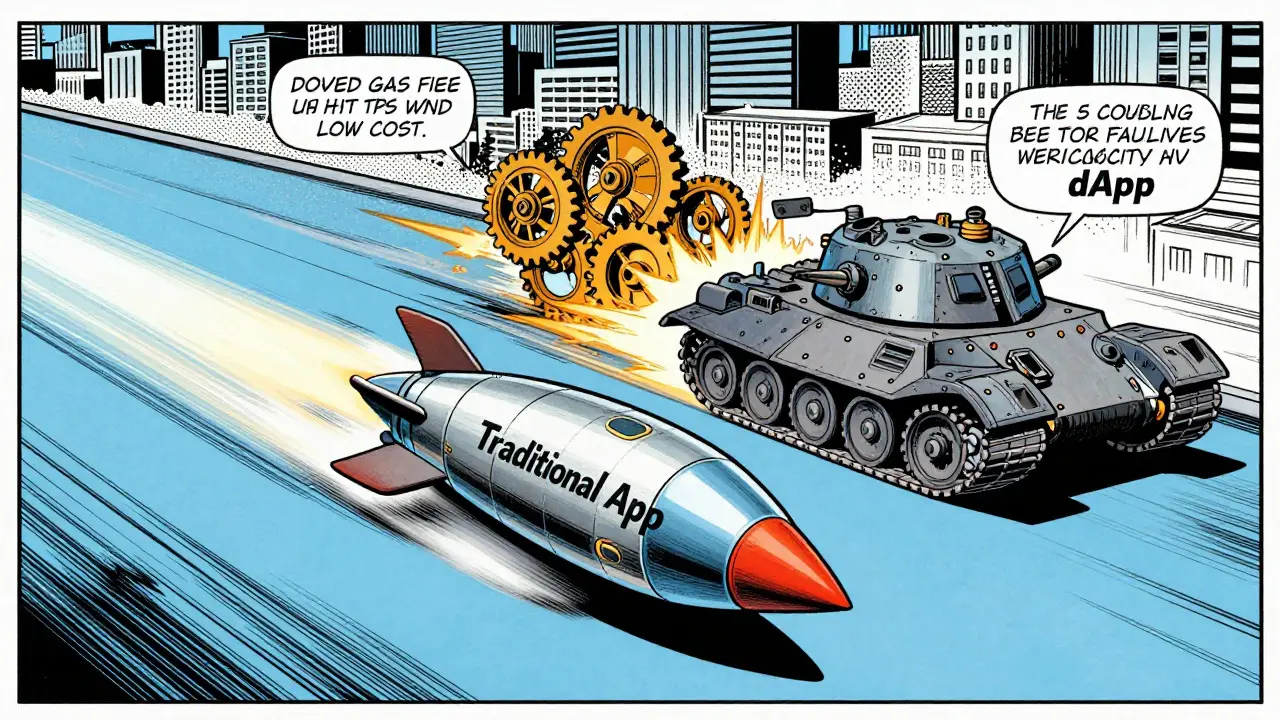
Here is where the romance of decentralization meets reality. Traditional apps are fast. Netflix processes millions of requests per second. Twitter handles billions of tweets daily. They achieve this speed by optimizing centralized servers and databases. In contrast, blockchains prioritize security and consensus over raw speed.
| Feature | Traditional App | dApp (Layer 1 Blockchain) |
|---|---|---|
| Transaction Speed | 10,000-100,000 TPS | 15-30 TPS (Ethereum Mainnet) |
| Cost Per Transaction | Negligible ($0.001 or less) | $0.01 - $50+ (Gas Fees) |
| Data Storage | Centralized Cloud (AWS/Azure) | Distributed Nodes / IPFS |
| Uptime Reliability | 99.9% (Subject to Outages) | 99.99%+ (Network Consensus) |
Why the difference? Every transaction on a blockchain must be verified by multiple nodes to prevent fraud. This verification takes time and computational power, leading to "gas fees." During peak times, these fees can spike dramatically. However, this gap is closing. Layer 2 solutions like Arbitrum and Optimism now handle thousands of transactions per second at a fraction of the cost, bringing dApp performance closer to traditional standards.
Security: Hacking Servers vs. Auditing Code
Security looks very different in both worlds. With traditional apps, the risk is usually external. Hackers target the central database, hoping to steal millions of usernames and passwords at once. In 2022 alone, there were nearly 4,000 reported data breaches affecting billions of records. Companies rely on firewalls, encryption, and customer support teams to mitigate damage.
With dApps, the security model is cryptographic. Your identity is your public key, and your access is controlled by your private key. There is no password to reset because there is no central admin to reset it. This eliminates phishing attacks targeting email accounts but introduces new risks. If you lose your private key or seed phrase, your assets are gone forever. There is no "Forgot Password" button.
Furthermore, dApps face smart contract vulnerabilities. Bugs in the code can lead to exploits where hackers drain funds directly from the protocol. In 2022, smart contract bugs resulted in over $1.3 billion in losses. While traditional apps have IT departments to patch holes, dApps often require community governance to vote on upgrades, making response times slower but more democratic.
User Experience: Convenience vs. Control
Let’s be honest: traditional apps are easier to use. Signing up takes seconds. You log in with Apple ID or Google, and you’re good to go. For the average person, this frictionless experience is invaluable.
dApps currently demand more effort. To use a dApp, you need a crypto wallet like MetaMask or Phantom. You must manage a seed phrase-a list of 12 or 24 words that acts as your master key. You also need to buy cryptocurrency to pay for gas fees. This barrier to entry has historically kept mass adoption low. A 2023 study found that users required 8-12 hours of onboarding to feel comfortable with dApps, compared to 15 minutes for traditional apps.
However, the tide is turning. New technologies like Account Abstraction (ERC-4337) are simplifying this process. Soon, you might be able to log in with a biometric scan or a social login, while the app handles the blockchain complexity in the background. The goal is to make the blockchain invisible to the user, preserving the benefits of decentralization without the headache.
When to Choose Which?
So, which should you build or use? It depends on what matters most for your specific needs.
Choose a Traditional App if:
- You need high-speed processing for millions of users simultaneously (e.g., video streaming, social feeds).
- You want a simple, familiar user experience with minimal setup.
- Your business model relies on selling data or personalized ads.
- You need easy regulatory compliance and customer support structures.
Choose a dApp if:
- Trustlessness is critical-users shouldn’t have to trust a company with their money or data.
- You are building in finance (DeFi), gaming (NFTs), or digital ownership spaces.
- Censorship resistance is important (e.g., free speech platforms).
- You want to offer users true ownership of their digital assets.
The Future: Hybrid Models
We are moving toward a hybrid future. By 2026, many traditional apps are integrating blockchain features. Twitter allows Bitcoin tips. Nike uses NFTs for sneaker authentication. These aren’t full dApps, but they borrow the transparency and ownership models of Web3.
Conversely, dApps are becoming more user-friendly. As Layer 2 scaling matures and wallets become simpler, the line between a traditional app and a dApp will blur. The best applications of tomorrow will likely combine the speed and ease of centralized infrastructure with the security and fairness of decentralized protocols.
What is the main difference between a dApp and a traditional app?
The main difference is control. Traditional apps are controlled by a central company that owns the servers and data. dApps run on decentralized blockchain networks, meaning no single entity controls them, and users retain ownership of their data and assets.
Are dApps safer than traditional apps?
They offer different types of safety. dApps are resistant to censorship and large-scale data breaches because data is distributed. However, they carry risks of smart contract bugs and user error (losing private keys). Traditional apps are vulnerable to centralized hacking but offer easier recovery options.
Why are dApps slower than traditional apps?
dApps require consensus among multiple nodes on a blockchain to validate every transaction. This process ensures security and prevents double-spending but takes more time than a single centralized server processing a request. Layer 2 solutions are helping to speed this up significantly.
Do I need to know coding to use a dApp?
No. Using a dApp is similar to using a website, but instead of logging in with a password, you connect a crypto wallet. You do not need to write code, though understanding basic concepts like gas fees and seed phrases is helpful.
What are gas fees in dApps?
Gas fees are transaction costs paid to the network validators who process and secure your transaction on the blockchain. Unlike traditional apps where transactions are free or handled via credit card processors, dApp users pay these fees directly in cryptocurrency.