
Ethereum Staking Reward Calculator
Estimate Your Ethereum Staking Rewards
Starting with as little as 0.01 ETH through staking pools
Note: Actual rewards may vary based on network conditions. Staking requires locking ETH for withdrawal periods.
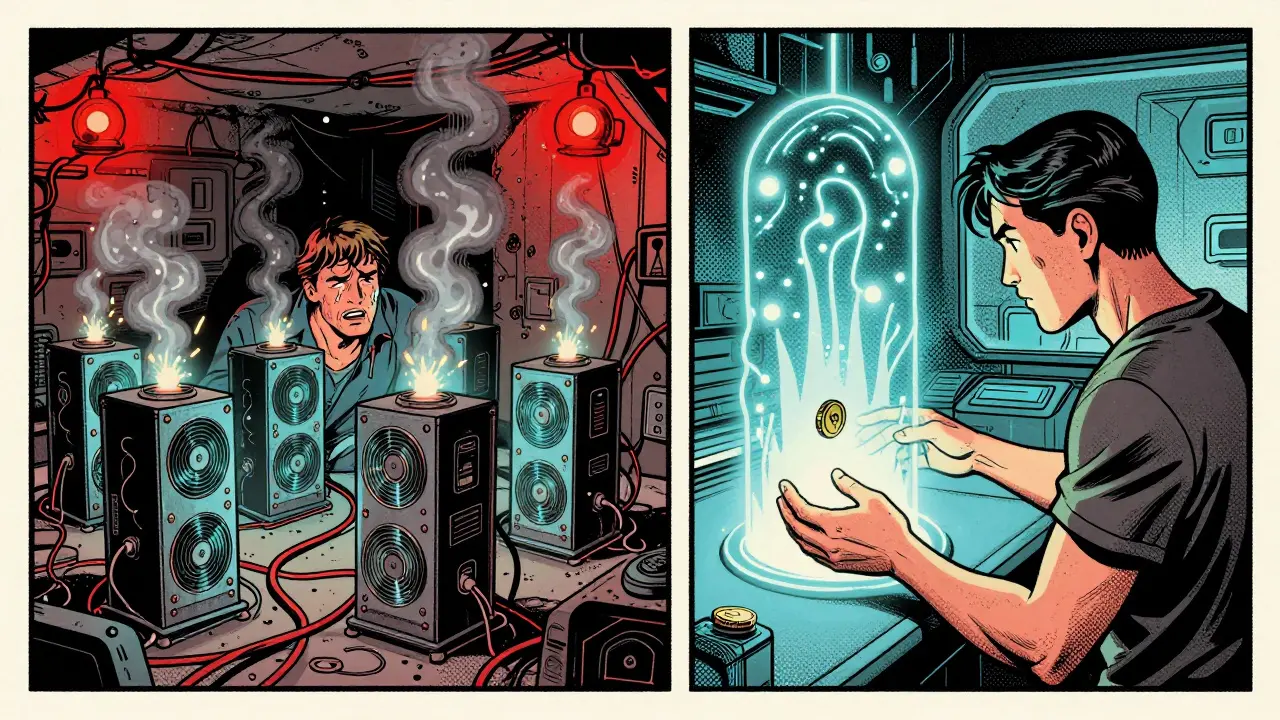
On September 15, 2022, something huge happened in cryptocurrency. Ethereum, the second-largest blockchain in the world, turned off its mining machines - forever. No more GPUs spinning 24/7, no more electricity bills climbing into the hundreds, no more noisy rigs heating up basements. Instead, it switched to staking. This wasn’t just an upgrade. It was a complete rewrite of how the network stays secure. And it changed everything.
What Was Ethereum Mining?
Before The Merge, Ethereum worked like Bitcoin. Miners used powerful graphics cards (GPUs) to solve complex math problems. The first one to solve it got to add a new block of transactions and earned rewards in ETH. It was competitive, expensive, and energy-hungry. A typical mining rig could cost between $2,000 and $10,000. Monthly electricity bills? Often $200-$500, depending on where you lived. And even then, profits were unpredictable. As more people joined, the difficulty went up. Rewards went down. Many miners were barely breaking even. The environmental cost was huge. Ethereum’s annual electricity use before The Merge was roughly the same as the entire country of the Netherlands. Critics called it unsustainable. Environmental groups pressured exchanges. Regulators started looking at crypto with suspicion. Ethereum’s team knew they had to fix it - and they had a plan.The Merge: Turning Off Mining for Good
The Merge wasn’t a small tweak. It was the moment Ethereum’s old blockchain (the execution layer) merged with its new Proof of Stake chain (the consensus layer). After years of testing, the network switched over in one seamless update. No hard fork. No chain split. Just a clean transition. The result? Ethereum’s energy use dropped by more than 99%. Overnight, it went from using as much power as a small country to using less than a single household. That’s not just efficient - it’s revolutionary. For the first time, a major blockchain proved you could be secure without burning through fossil fuels. The old mining rewards? Gone. In their place came staking rewards. Instead of solving puzzles, validators now lock up ETH as collateral. The more ETH you stake, the higher your chance of being chosen to propose or verify the next block. You’re not competing with hardware - you’re competing with capital.How Staking Works Now
To become a solo validator on Ethereum, you need 32 ETH. At current prices, that’s around $80,000-$120,000. That sounds like a lot - and it is. But here’s the catch: you don’t need to run your own server. Most people use staking pools or centralized platforms like Coinbase, Binance, Kraken, or Gemini. These services let you stake as little as 0.01 ETH. You deposit your ETH, they handle the technical side, and you earn a share of the rewards. It’s like putting money in a savings account - except it’s blockchain-based. Rewards? Typically 4-7% APY. That’s steady, predictable income. No more chasing volatile mining profits. No more worrying about GPU prices crashing. Just deposit, wait, and earn. The rewards come from two places: new ETH issued to validators (inflation) and transaction fees from users sending ETH or using DeFi apps. Validators are chosen randomly based on how much ETH they’ve staked and how long they’ve been online. The system is designed to be fair, secure, and decentralized - even if you’re not running a full node yourself.
Staking vs. Mining: The Real Differences
Here’s a quick breakdown of what changed:| Factor | Mining (Pre-Merge) | Staking (Post-Merge) |
|---|---|---|
| Hardware Required | High-end GPUs, cooling, power supply | None - just a computer or phone |
| Upfront Cost | $2,000-$10,000+ | 32 ETH ($80K-$120K) for solo, or less via pools |
| Running Costs | $200-$500/month in electricity | Nearly $0 |
| Energy Use | Massive - equivalent to a small country | 99%+ lower - less than a home router |
| Profit Stability | Highly volatile - depends on difficulty, price, power costs | Steady 4-7% APY - predictable and passive |
| Technical Skill Needed | Advanced - building rigs, tuning software, monitoring temps | Beginner-friendly via exchanges; advanced only for solo nodes |
Staking isn’t perfect. There are risks. If your validator goes offline too often, you can lose a small portion of your stake - a penalty called “slashing.” If you try to cheat the system, you lose more. And your ETH is locked until withdrawals are fully enabled - which happened in early 2023, but still has a queue. You can’t just pull your ETH out instantly if the market crashes.
Still, for most people, staking is simpler, safer, and more profitable than mining ever was.
What Happened to Miners?
When Ethereum shut down mining, hundreds of thousands of GPU rigs went offline. What did those miners do? Some sold their hardware. eBay and local classifieds flooded with used RTX 3080s and 3090s. Prices dropped by 60-80% in months. Others switched to other PoW coins. Ethereum Classic (ETC), Ravencoin, and Bitcoin are still mined using GPUs or ASICs. But those networks are smaller. Rewards are lower. And the same problems - high electricity, hardware wear, volatility - still exist. A few kept running their rigs as hobbyists. They liked the tech. The hands-on control. The noise. But they were the minority. Most saw the writing on the wall and moved on.Who Benefits From Staking?
Everyone - but differently.- Regular users get faster, cheaper transactions and a greener network.
- Investors earn passive income without buying mining gear or paying bills.
- Developers can now build on a scalable, energy-efficient base. Layer-2 solutions like Arbitrum and Optimism thrive because Ethereum’s foundation is stable.
- Regulators no longer see Ethereum as an environmental threat. Countries that banned mining now quietly accept staking.
- Institutions can now participate safely. Hedge funds and family offices now stake ETH through regulated platforms.
Even the Ethereum network itself benefits. With staking, security is tied to economic incentives. To attack the network, you’d need to own 33% of all ETH - over $100 billion. That’s far harder - and far more expensive - than buying enough GPUs to overpower a mining network.

How to Start Staking Today
If you want to start staking ETH, here’s how:- Buy ETH on a trusted exchange like Coinbase, Kraken, or Gemini.
- Choose your method:
- Centralized staking (easiest): Go to your exchange’s staking page, click “Stake ETH,” and confirm. Done in 5 minutes.
- Pooled staking (mid-level): Use services like Lido or Rocket Pool. Deposit ETH, get stETH or rETH tokens in return. Trade them like regular ETH.
- Solo validator (advanced): Run your own node with 32 ETH. Requires Linux skills, a dedicated computer, and constant monitoring. Only for tech-savvy users.
- Wait for rewards. They’re distributed every few days. You’ll see them in your wallet automatically.
There’s no need to buy hardware. No need to worry about cooling. No need to monitor your rig’s temperature at 2 a.m. It’s just deposit, stake, earn.
The Bigger Picture
Ethereum’s shift from mining to staking didn’t just change how ETH works. It changed the entire crypto industry’s trajectory. Other blockchains are following. Cardano, Solana, Polkadot - they all use staking. Even Bitcoin skeptics now admit: Proof of Stake is the future. It’s cleaner. It’s cheaper. It’s more democratic. The number of ETH staked? Over $40 billion as of 2025. That’s more than half of all ETH in circulation. And it’s growing. More than 500,000 individual validators now secure the network - from individuals in New Zealand to institutions in Singapore. The next big update? Sharding. It’ll split the network into smaller pieces to handle even more transactions. And it’ll make staking even easier - possibly lowering the 32 ETH requirement in the future.Final Thoughts
Ethereum didn’t just upgrade its technology. It upgraded its values. It chose sustainability over spectacle. Accessibility over exclusivity. Long-term health over short-term profits. Mining was a product of its time. Staking is the future. And for anyone who thought crypto was just about flashy hardware and loud fans - this proves otherwise. You don’t need a garage full of GPUs to be part of Ethereum. You just need ETH. And a little patience.Can I still mine Ethereum after The Merge?
No. Ethereum mining ended completely on September 15, 2022. Any website or service claiming to offer Ethereum mining is either outdated or a scam. The network only accepts staking now. If you’re seeing mining rigs advertised for ETH, avoid them.
How much ETH do I need to start staking?
To run your own validator, you need 32 ETH. But most people stake through exchanges or pools, where you can start with as little as 0.01 ETH. Platforms like Coinbase, Kraken, and Lido let you deposit any amount and earn proportional rewards.
Is staking ETH safe?
Staking is generally safe if you use a reputable platform. Centralized exchanges hold your ETH and manage the technical side - but you’re trusting them with your funds. Pooled staking services like Lido issue stETH tokens, which you can trade if needed. Solo staking is the most secure but carries risks like slashing penalties if your node goes offline. Always research before choosing a method.
What happens if ETH’s price drops while I’m staking?
Staking rewards are paid in ETH, so if ETH’s price falls, your rewards are worth less in USD terms. But you still earn the same percentage (4-7% APY). The value of your staked ETH will fluctuate with the market - just like holding any crypto asset. You’re not losing ETH unless you get slashed (rare), but your USD value can go down.
Can I unstake my ETH anytime?
Yes, since the Shanghai upgrade in April 2023, you can withdraw staked ETH and rewards. But there’s a queue. If thousands of people try to unstake at once, it can take hours or days to process. It’s not instant, but it’s no longer locked forever.
Is staking ETH better than mining Bitcoin?
For most people, yes. Bitcoin mining requires expensive ASIC hardware, constant electricity, and technical upkeep. Staking ETH requires no hardware, no electricity costs, and no maintenance. You earn 4-7% APY with just a wallet. Bitcoin mining might pay more in some cases - but only if you have cheap power and a large setup. For the average person, staking is simpler, cheaper, and more accessible.

There are 19 Comments
Abhishek Bansal
Albert Chau
Ike McMahon
Kathy Wood
Kathryn Flanagan
Joey Cacace
Taylor Farano
Anselmo Buffet
Sarah Luttrell
Scot Sorenson
Steven Ellis
Bridget Suhr
Taylor Fallon
Toni Marucco
JoAnne Geigner
Heath OBrien
Claire Zapanta
Patricia Whitaker
Toni Marucco
Write a comment
Your email address will not be published. Required fields are marked *