
HSM Deployment Selector
Which HSM Deployment Model Is Right For You?
Select your requirements to get recommendations based on blockchain security best practices.
Note: This tool assumes you need institutional-grade HSMs meeting FIPS 140-2 Level 3 or higher.
Recommended Deployment Model
Why this model?
Implementation tips:
When you're managing digital assets on a blockchain, the weakest link isn't the code-it's the keys. If someone steals your private keys, all the math, consensus, and decentralization in the world won't save your funds. That's why institutional-grade Hardware Security Modules (HSMs) aren't optional for serious blockchain operations-they're the foundation.
What Makes an HSM 'Institutional Grade'?
An institutional-grade HSM is a physical device built to keep cryptographic keys safe from every kind of attack: software exploits, insider threats, physical tampering, and even electromagnetic side-channel analysis. Unlike software wallets or cloud-based key storage, these devices generate, store, and use keys entirely inside a hardened chip. Keys never leave the HSM. Not in memory. Not over the network. Not even in encrypted form. These modules meet strict security certifications like FIPS 140-2 Level 3, Common Criteria EAL4+, and PCI HSM. That means they've been tested by independent labs to survive physical intrusion attempts-like drilling, probing, or freezing-and will wipe all keys if tampered with. Some even have self-destruct mechanisms that trigger if the casing is opened or temperature sensors detect anomalies. They also use True Random Number Generators (TRNGs) based on physical noise-thermal fluctuations or electronic jitter-not pseudorandom algorithms. This ensures keys aren't predictable, even if an attacker knows the HSM model or firmware version.Why Blockchain Needs HSMs
Blockchain systems rely on digital signatures to authorize transactions. Every time a wallet sends ETH, BTC, or a token, it signs the transaction with a private key. If that key is stored on a server, even a well-protected one, it's vulnerable to breaches. Hackers don't need to break the blockchain-they just need to compromise the server holding the keys. Institutional HSMs solve this by keeping keys isolated. When a transaction is signed, the HSM receives the data, signs it internally using the key, and returns only the signature. The key itself never touches the application server, the network, or the cloud. Even if the server is hacked, the attacker gets nothing. This is critical for:- Crypto exchanges holding customer deposits
- DeFi protocols managing multi-sig treasury wallets
- Enterprise blockchain networks like Hyperledger Fabric
- Government-backed CBDC pilots
- Tokenized asset platforms dealing with real-world assets
Three Deployment Models: On-Prem, PCIe, and Cloud
Not all HSMs are the same. How you deploy them changes everything. Network-attached HSMs are standalone appliances connected via Ethernet. They're ideal for large enterprises with multiple applications needing access to keys. Think of them as a secure key vault on your network. They offer high availability, centralized management, and support for protocols like PKCS#11 and KMIP. You can cluster them for redundancy and load balancing. PCIe HSMs plug directly into a server’s expansion slot. They’re the fastest option-latency is under 1 millisecond-because there’s no network hop. This matters for high-frequency trading bots, real-time settlement systems, or blockchain nodes processing thousands of transactions per second. They’re common in financial institutions and exchanges where speed is as important as security. Cloud HSMs are the newest evolution. Providers like AWS CloudHSM, Azure Dedicated HSM, and Google Cloud HSM offer FIPS 140-2 Level 3 certified hardware running in their data centers. You don’t buy or maintain hardware-you pay for access. This is perfect for teams already on the cloud who want enterprise-grade security without the overhead. Cloud HSMs integrate natively with Kubernetes, Terraform, and CI/CD pipelines, making them ideal for DevOps-driven blockchain projects. Most institutions use a mix. A cloud HSM for development and testing, a PCIe HSM for high-speed transaction signing, and a network HSM for cold storage backups. Hybrid setups are becoming the standard.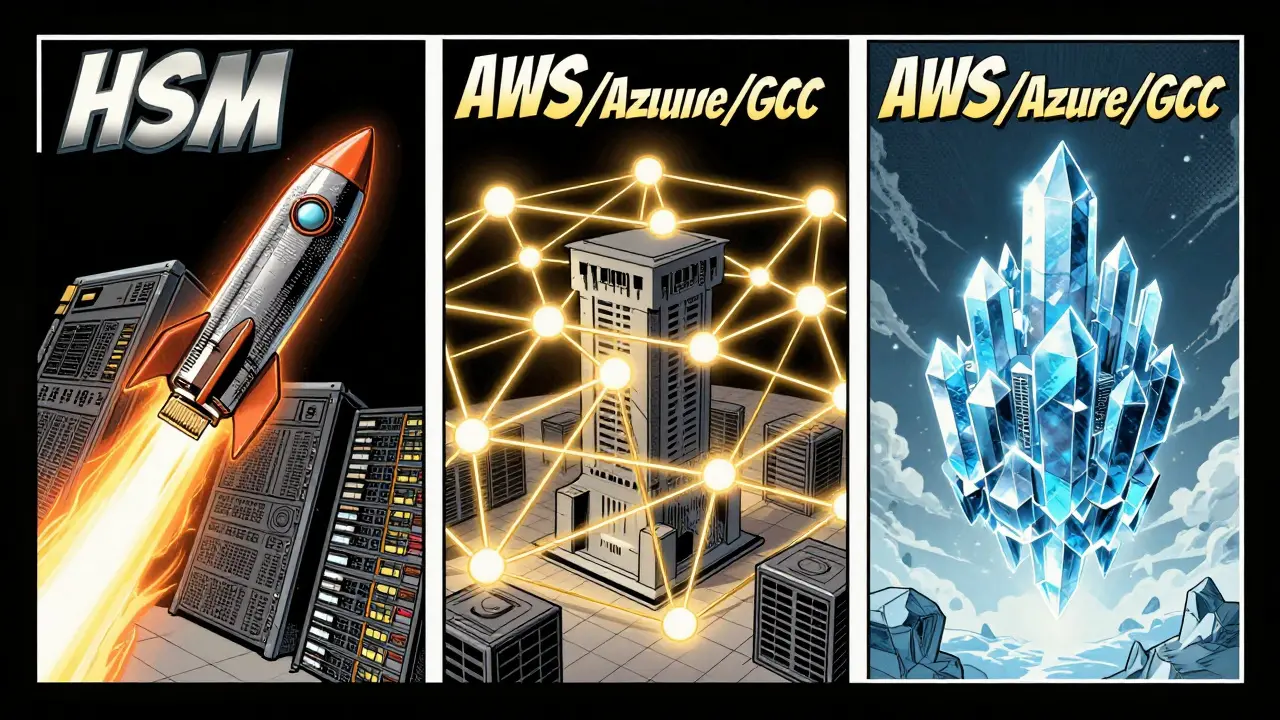
Key Management Is Everything
An HSM isn’t just a box you plug in and forget. You need a key lifecycle strategy. Keys must be generated inside the HSM using its TRNG. Never import keys from outside-that defeats the purpose. Once created, they’re encrypted and backed up using split-key techniques. For example, a 3-of-5 threshold scheme means five people each hold a part of the key, and you need any three to restore it. This prevents single points of failure or insider theft. Access controls are layered. You need:- Physical access controls (biometrics, secure rooms)
- Role-based API access (who can sign, who can rotate keys)
- Multi-factor authentication for admin actions
- Logging and audit trails for every key operation
Compliance Isn’t Optional
If you’re handling financial data, health records, or regulated assets, you’re already under pressure to comply. HSMs are the only way to meet:- PCI DSS: Requires HSMs for payment processing and cardholder data
- GDPR: Mandates secure key storage for personal data
- HIPAA: Requires cryptographic protection of PHI
- SOX: Demands audit trails for financial controls

What to Look for When Choosing an HSM
Not all HSMs are created equal. Here’s what to prioritize:- Certifications: FIPS 140-2 Level 3 or higher. Avoid anything without it.
- Performance: Look at signatures per second. For high-volume blockchains, aim for 10,000+ ops/sec.
- API Support: Must support PKCS#11, KMIP, and REST. Avoid vendors with proprietary APIs.
- Scalability: Can you add more units without re-architecting?
- Vendor Support: Enterprise HSMs cost tens of thousands. You need 24/7 support and clear documentation.
- Cloud Integration: If you’re cloud-native, choose a provider with native integration (AWS, Azure, GCP).
The Future: Quantum Resistance and Automation
HSMs are evolving. The next wave includes:- Post-quantum cryptography: HSMs are starting to support NIST-standardized algorithms like CRYSTALS-Kyber and Dilithium to prepare for quantum threats.
- Automated key rotation: Integrations with HashiCorp Vault and Kubernetes secrets enable auto-renewal without manual intervention.
- Zero-trust architectures: HSMs are now part of identity verification chains, replacing passwords and tokens in blockchain access systems.
Final Thought: Security Is a Process, Not a Product
Buying an HSM doesn’t make you secure. Using it correctly does. That means training your team, auditing key usage monthly, testing failover procedures, and never assuming your keys are safe just because they’re in a box. For blockchain institutions, HSMs are the difference between being a target and being untouchable. The technology exists. The standards are clear. The cost of not using one? Far higher than the price of the device.What is the main purpose of an institutional-grade HSM in blockchain?
The main purpose is to securely generate, store, and use cryptographic keys inside a tamper-resistant hardware device, ensuring private keys never leave the module. This prevents breaches even if servers or networks are compromised, making it essential for securing digital assets on blockchain networks.
Can I use a software wallet instead of an HSM for institutional blockchain use?
No. Software wallets store keys on general-purpose operating systems, which are vulnerable to malware, exploits, and insider threats. Institutional-grade operations require hardware-level isolation-something only certified HSMs provide. Regulators and auditors will not accept software-only key storage for compliance.
Are cloud HSMs as secure as on-premises hardware?
Yes, if they’re certified. Cloud HSMs from AWS, Azure, and Google Cloud use the same FIPS 140-2 Level 3 certified hardware as on-premises devices. The difference is where the physical device is located-not its security level. Many institutions now prefer cloud HSMs for scalability and reduced maintenance.
What happens if someone physically tampers with an HSM?
Modern institutional HSMs are designed to detect tampering and automatically wipe all cryptographic keys. This includes responses to drilling, temperature changes, voltage fluctuations, or unauthorized casing access. Once keys are erased, they cannot be recovered-this is intentional and required by security certifications.
Do I need an HSM if I’m using a multi-signature wallet?
Yes. Multi-sig splits the signing responsibility but doesn’t protect the keys themselves. If one of the signers uses a software wallet or unsecured key storage, that’s the weak link. HSMs secure each key in the multi-sig scheme, making the entire system resistant to compromise.
How do I know if an HSM is truly institutional-grade?
Look for official certifications: FIPS 140-2 Level 3 or higher, Common Criteria EAL4+, or PCI HSM compliance. Check the vendor’s certification documents on the NIST or Common Criteria websites. Avoid products that claim to be “enterprise-ready” without third-party validation.


There are 14 Comments
Sharmishtha Sohoni
Love how this breaks down HSMs without the fluff. Seriously, if your keys are anywhere but inside a certified HSM, you're just gambling with other people's money.
Been there. Lost that.
Durgesh Mehta
Agreed the hardware isolation is non negotiable
Been using Thales HSMs for our DeFi treasury and no complaints so far
Just make sure your team knows how to rotate keys properly
Nora Colombie
Ugh I can't believe Americans still think cloud HSMs are safe
Why would you trust AWS with your crypto keys when the NSA could just subpoena them
Real security is on prem period
Anyone who says otherwise is either clueless or paid by Amazon
Bhoomika Agarwal
Cloud HSMs? More like cloud *hope*
Meanwhile in India we're still trying to get banks to stop storing keys in Excel sheets
At least your 'cloud' HSM has a chip inside it
Meanwhile my cousin's crypto startup uses a USB drive labeled 'Btc keys DO NOT DELETE'
That's the real horror story
Katherine Alva
It's wild how we treat keys like they're just data... but they're literally the soul of your digital identity 🤯
Once they're gone, you're not just broke-you're erased.
That's why HSMs aren't tech-they're sacred tech.
And yeah, cloud HSMs? Totally fine if you trust the infrastructure.
But if you're holding billions? I'd want mine in a vault under a mountain.
Just saying.
Nelia Mcquiston
The real insight here isn't about hardware-it's about mindset.
Security isn't a product you buy, it's a culture you build.
Having an HSM doesn't prevent human error.
It just raises the bar.
And the bar is still too low for most organizations.
We treat keys like passwords instead of like nuclear launch codes.
That's the gap.
Not the technology.
The thinking.
alex bolduin
Cloud HSMs are legit if you're not a bank
My startup uses AWS CloudHSM and it's way cheaper than buying a Thales box
Plus the API integration with our CI/CD is smooth as butter
And yeah the keys never leave the hardware
So stop the fearmongering
It's not magic it's math and certification
And it works
Marsha Enright
Great breakdown! One thing I'd add-don't forget backup procedures.
HSMs wipe on tamper, so you better have your split-key backups stored securely in geographically separate locations.
Test your restore process quarterly.
Not yearly.
Quarterly.
And make sure more than one person knows how to do it.
Trust me, you'll thank yourself when the power grid goes down.
💙
Andrew Brady
Of course they're pushing cloud HSMs
It's a backdoor for federal surveillance
Every cloud provider is under NDAA contracts
They're giving you a fake sense of security while the government holds the master key
Real patriots use on-prem HSMs with Faraday cages and armed guards
And they never connect to the internet
Anything else is just digital surrender
Murray Dejarnette
Okay but what if your HSM gets hacked anyway
Like what if someone finds a zero-day in the firmware
And what if your vendor gets acquired by a Chinese company
And what if your internal admin gets bribed
And what if the power goes out and the battery dies
And what if your backup key holder dies in a car crash
Like... is ANY of this actually safe
Or are we just pretending we're secure because it makes us feel better
Because I'm starting to think blockchain security is just a really expensive placebo
Maggie Harrison
You're not just securing keys-you're securing trust.
Every time an exchange uses an HSM, it tells users: 'We take this seriously.'
That's worth more than the cost of the device.
And yes, quantum resistance is coming-start planning now.
You don't wait until the storm hits to build the roof.
Be the one who prepared.
🚀
Akash Kumar Yadav
Cloud HSMs? Ha! India has better security than your AWS account
Our banks use biometric locks on HSMs and manual approval chains
Meanwhile you guys are auto-deploying keys via Terraform like it's a TikTok trend
And you wonder why you get hacked
Security isn't about speed
It's about discipline
And your entire tech culture is addicted to convenience
Wake up
Jay Weldy
There's a middle ground between paranoia and negligence.
Cloud HSMs are safe for 90% of use cases.
On-prem is for sovereign wealth funds and nuclear codes.
But the real win is automation-auto-rotation, audit logs, key lifecycle tracking.
That’s where most teams fail.
Not the hardware.
The process.
Fix that and you're already ahead of 80% of 'enterprise' teams.
Melinda Kiss
One critical detail everyone overlooks: HSMs don't protect against social engineering.
Even the most hardened device is useless if someone tricks an admin into approving a fraudulent transaction.
Combine HSMs with strict approval workflows, time-delayed transactions, and mandatory multi-person verification.
Technology + process = real security.
Just tech? That's theater.
Write a comment
Your email address will not be published. Required fields are marked *