Remember when you could stake a few tokens and watch your portfolio explode with yields over 1,400%? For a brief moment in late 2021, JSwap.Finance was exactly that kind of opportunity. The platform promised high returns, fast transactions on OKExChain, and generous airdrops for early adopters. But if you are reading this in August 2026, you likely have one burning question: What happened to the JF token airdrop program, and is there still any value left to claim?
The short answer might hurt. The long answer is necessary for your wallet’s safety. While the initial hype around JSwap’s governance token, JF, drew in nearly 100,000 users and locked up over $60 million in assets, the current reality looks drastically different. Today, we will break down what the JF airdrop actually was, how it worked, why the market has shifted, and whether you should trust any current claims about free JF tokens.
The Peak Era: How the JF Airdrop Started
To understand where things stand now, we need to look back at when JSwap was actually active. Launched as a decentralized exchange (DEX) on OKExChain, JSwap positioned itself as an all-in-one DeFi hub. They offered swap mining, liquidity pools, and single-token vaults they called “machine gun pools” because of their rapid yield generation.
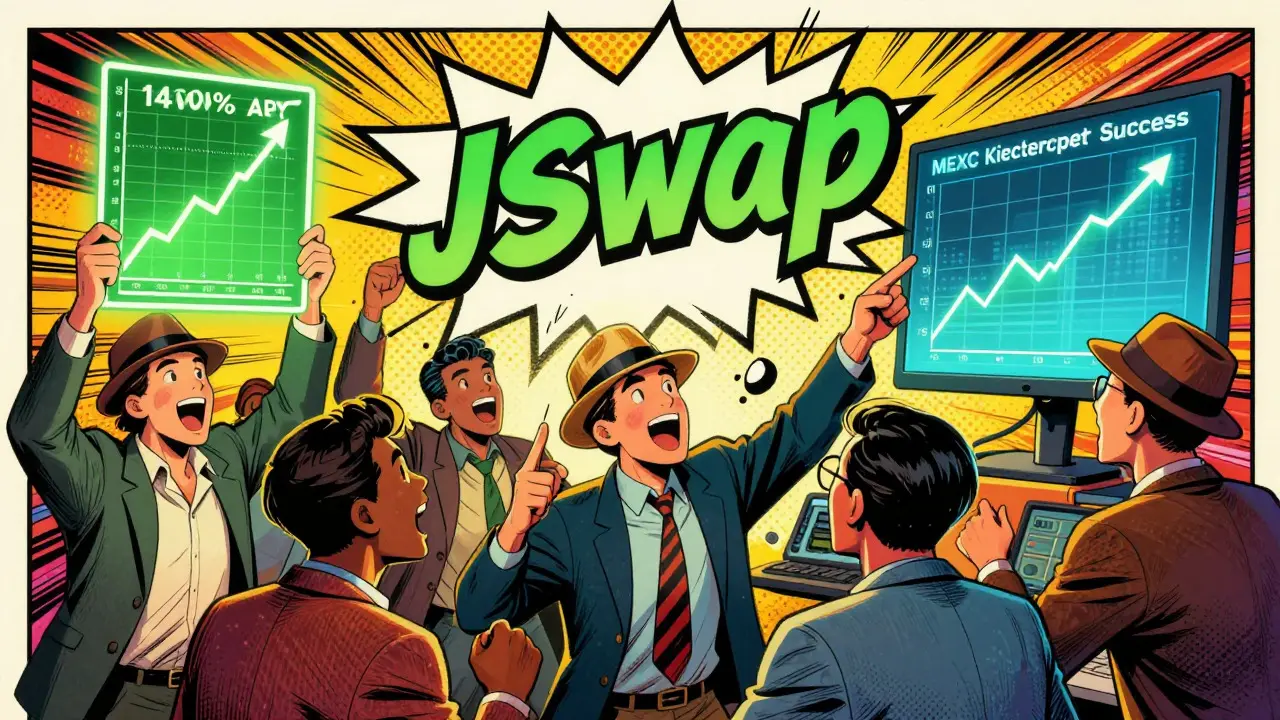
The most significant distribution event for the JF token wasn’t a random scatter; it was a strategic partnership. In November 2021, the MEXC Global exchange hosted a Kickstarter campaign for JSwap. This was a major milestone. Users didn’t just get tokens for signing up; they had to vote. Participants contributed a massive total of 23,648,779 MX tokens to support the listing. In return, successful voters received free JF tokens as rewards, totaling 35,200 tokens distributed among the community.
This mechanism served two purposes. First, it created immediate liquidity and interest. Second, it bound the community’s reputation to the project’s success. At its height, JSwap reported Annual Percentage Yields (APY) reaching absurd heights-up to 1,476.13% for JF/USDT pairs within a single day. If you were part of that ecosystem then, you saw real gains. But those numbers came with a warning label that many ignored: high risk.
Current Market Status: The Reality Check
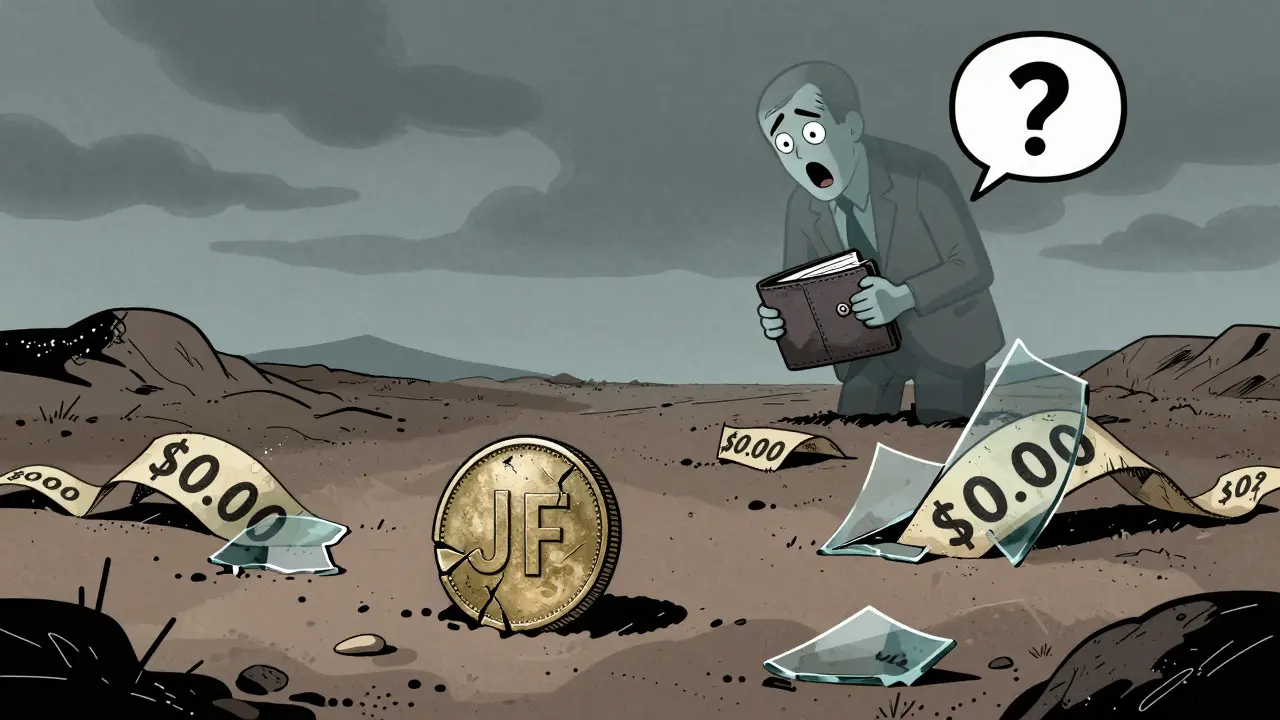
Fast forward to today. If you check major tracking platforms like CoinMarketCap or Binance data feeds, the picture is stark. The live price of the JF token is listed at $0 USD. Trading volume is effectively zero. Circulating supply data shows inconsistencies, with some sources indicating zero circulation despite a maximum supply cap of 100 million tokens.
Let’s look at the specific metrics that matter:
- Current Price: $0.00 USD across multiple exchanges.
- 24-Hour Volume: Approximately $40.24 (indicating near-zero activity).
- Market Cap: Listed as $0, though fully diluted valuation remains theoretically around $431,735.
- Price Change: Significant declines over 60-day (-23.41%) and 90-day (-30.75%) periods prior to hitting zero volume.
Why does the price show as $0? It usually means one of two things. Either the trading pairs have been delisted due to lack of liquidity, or the order books are so thin that no meaningful trade has occurred recently to update the price feed. For a token that once boasted millions in Total Value Locked (TVL), this drop suggests a complete collapse in user confidence or technical abandonment.
How to Participate in Current JF Opportunities (If Any)
You might see headlines claiming you can still “receive free Jswap.Finance airdrops by joining ongoing challenges.” Platforms like Bitget have historically listed such opportunities. However, you need to be extremely careful here. Here is how these modern airdrop claims typically work versus what they promise.
In the past, participation required tangible actions: voting with MX tokens on MEXC or providing liquidity on the JSwap protocol itself. Today, if you see a call to action for JF airdrops, it often involves “converting” other rewards into JF tokens. Bitget, for instance, mentions that various crypto rewards can be converted to Jswap.Finance tokens. But ask yourself: Why would you convert a valuable asset into a token trading at $0 with zero volume?
If you decide to investigate further, follow these steps to verify legitimacy:
- Check the Contract Address: The official JF smart contract is associated with the address starting with
0x5fAc...C85b0A. Verify this on blockchain explorers like OKLink. If a new address is presented, it is likely a scam. - Verify Liquidity: Look at the actual pool depth on the DEX. If there is no USDT or ETH paired with JF, you cannot sell what you earn.
- Read the Fine Print: Many “airdrops” require you to pay gas fees first. If the reward is worth less than the gas fee, it’s not an airdrop; it’s a loss.
Tokenomics and Deflationary Mechanics
One of JSwap’s original selling points was its deflationary model. The protocol stated that all profits generated from swaps and services would be used to repurchase and destroy JF tokens. In theory, this reduces supply and increases value. In practice, this mechanism only works if there are profits to begin with.
With daily trading volumes dropping to roughly $40, the amount of revenue available for buybacks is negligible. The “burn” function becomes irrelevant when the engine generating the cash flow has stalled. Furthermore, the DAO dividend pools, which were meant to distribute governance benefits to holders, likely stopped paying out meaningful dividends once the TVL evaporated.
The cross-chain bridge functionality, another key feature, also faces questions. Without active liquidity on the destination chains, bridging assets to JSwap offers little utility. The ecosystem relied on a network effect that appears to have broken down.
| Metric | Peak Performance (Late 2021) | Current Status (2026) |
|---|---|---|
| Total Value Locked (TVL) | >$60 Million | Negligible / Data Unavailable |
| Daily Trading Volume | High (Supporting >1,400% APY) | ~$40.24 |
| User Base | Approaching 100,000 | Unknown / Likely Minimal |
| Token Price | Active Trading | $0.00 USD |
| Airdrop Activity | MEXC Kickstarter (Major Event) | Unclear / Low Confidence |

Risks You Must Consider Before Engaging
Crypto projects come and go. Some fail due to bad code; others fail due to bad economics. JSwap seems to suffer from the latter. When you consider engaging with any remaining JF tokens or airdrop claims, keep these risks front and center.
Liquidity Risk: Even if you manage to acquire JF tokens through a promotion, getting them out is the hard part. With zero volume, you might hold tokens that are mathematically yours but practically worthless because no one is buying.
Smart Contract Risk: While the contract address 0x5fAc...C85b0A is known, older contracts on OKExChain may not have undergone recent security audits. Interacting with dormant protocols can sometimes trigger unexpected bugs or dust attacks.
Opportunity Cost: Time spent chasing a dead token is time lost finding active opportunities. The DeFi space moves fast. Newer protocols on Ethereum Layer 2s or Solana offer transparent, audited airdrops with clear roadmaps. Chasing ghosts from 2021 distracts from viable investments in 2026.
Final Thoughts on the JF Ecosystem
The JF token airdrop was a legitimate historical event that rewarded early participants during the OKExChain boom. The MEXC Kickstarter campaign proved that the community had energy and capital. However, markets are ruthless. Without sustained utility, development updates, and marketing, even promising DeFi hubs can fade into silence.
If you held JF tokens from the 2021 era, you are likely looking at a total loss unless a sudden revival occurs-which current data does not support. If you are seeing new ads for JF airdrops, treat them with extreme skepticism. Verify every link, check every contract, and assume the worst-case scenario until proven otherwise. In DeFi, survival isn't just about being first; it's about staying relevant.
Is the JSwap.Finance website still active?
While the domain may still load, the on-chain activity suggests minimal operational status. There is no significant trading volume or new liquidity provision happening on the protocol as of 2026.
Where can I find the official JF token contract address?
The primary contract address associated with JF on OKExChain starts with 0x5fAc...C85b0A. Always verify this on a trusted block explorer before interacting with any wallet transaction.
Did the MEXC Kickstarter airdrop end?
Yes, the major MEXC Kickstarter campaign concluded in November 2021. Any current references to this specific event are historical. New promotions may exist but carry higher risk due to the token's current market status.
Why is the JF token price showing as $0?
A price of $0 typically indicates a lack of recent trades. Without buyers and sellers actively exchanging the token, price aggregators like CoinMarketCap default to zero or stale data. It reflects a collapse in liquidity rather than a technical error.
Are there any safe alternatives to JSwap for DeFi yields?
Yes. Instead of chasing dormant projects, consider established decentralized exchanges like Uniswap, PancakeSwap, or Curve Finance. These platforms have verified audits, consistent volume, and transparent governance models.