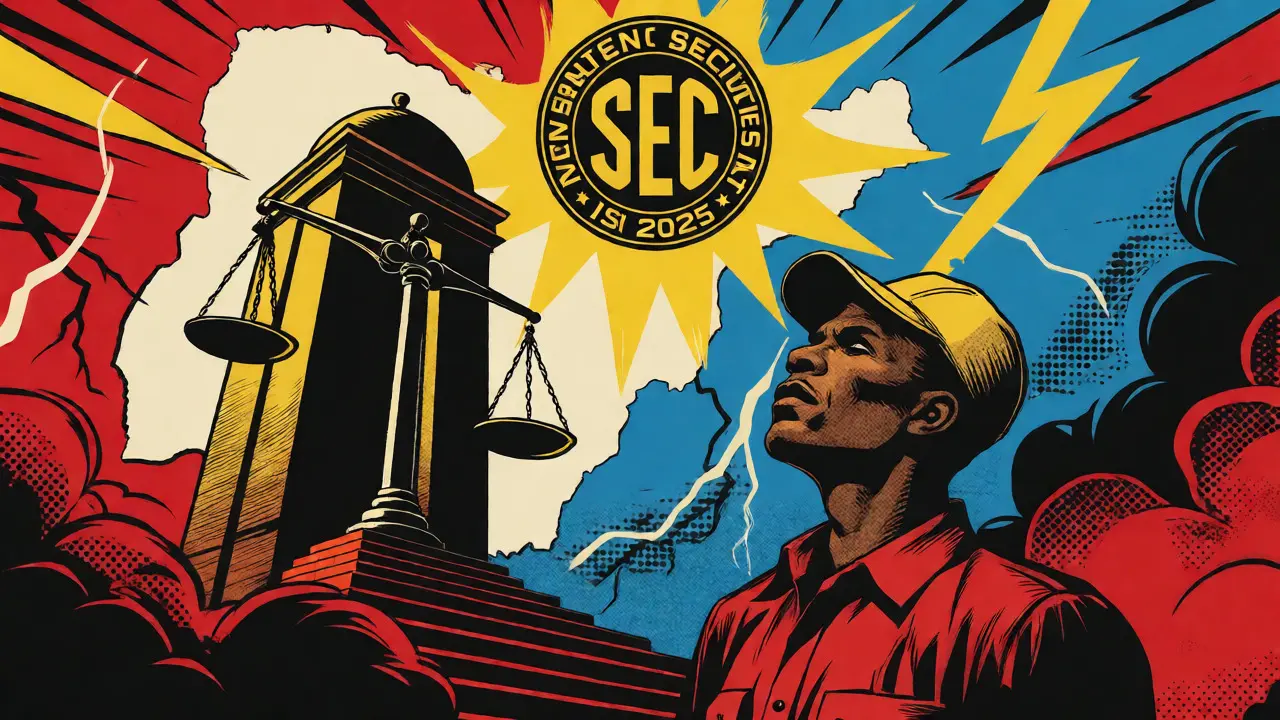
You might think you can just plug a rig into the wall and start earning Bitcoin in Lagos. But here is the twist: while mining itself isn't explicitly banned, the legal ground beneath it shifted dramatically in 2025. If you are planning to mine crypto in Nigeria, you aren't just fighting power outages; you are navigating a new web of Investments and Securities Act (ISA 2025). This law redefined digital assets as securities, pulling mining operations under strict regulatory scrutiny. You need to know exactly where the lines are drawn before you buy your next GPU or ASIC.
The Legal Status: Is Mining Actually Illegal?
Let's clear up the confusion first. As of late 2026, there is no specific law that says "you cannot mine cryptocurrency." The Central Bank of Nigeria (CBN) didn't ban the act of solving mathematical problems to validate transactions. However, the environment for doing so has tightened significantly. The Central Bank of Nigeria issued directives back in 2021 that stopped banks from facilitating crypto transactions. While these restrictions were partially lifted in late 2023 for licensed entities, the shadow of those early bans still affects how miners cash out their rewards.
Think of it this way: mining is technically permitted, but the plumbing-banking, licensing, and taxation-is heavily regulated. If you operate without understanding these indirect restrictions, you risk having your funds frozen or facing heavy fines. The ambiguity is gone. Now, it’s about compliance.
How ISA 2025 Changes the Game for Miners
The biggest shift came with the passage of the Investments and Securities Act (ISA 2025). This legislation brought virtual assets under the direct oversight of the Securities and Exchange Commission (SEC). Under Section 357, virtual assets are now legally defined as securities. Why does this matter to a miner? Because if you offer any service related to mining-like mining-as-a-service or pooling-you likely fall under the definition of a Virtual Asset Service Provider (VASP).
If you are a solo miner selling coins directly on peer-to-peer platforms, you might escape immediate VASP classification. But if you run a farm or sell hash power, you need an SEC license. The SEC requires paid-up capital, fidelity bonds, and local office registration. It’s not just a formality; it’s a barrier to entry designed to weed out fly-by-night operators.
Banking Restrictions and Cash-Out Challenges
Here is the practical headache. Even if you mine successfully, getting that value into your Nigerian bank account is tricky. The Central Bank of Nigeria maintains strict guidelines on how financial institutions interact with crypto businesses. Banks are wary. They don't want to get flagged by regulators for processing transactions linked to unlicensed entities.
Most miners bypass traditional banking rails using Peer-to-Peer (P2P) exchanges. Platforms like Quidax and Busha have gained provisional licenses, making them safer bets for converting BTC or ETH to Naira. But remember, every transaction leaves a trail. The Economic and Financial Crimes Commission (EFCC) works closely with the SEC to monitor suspicious flows. If you suddenly move large sums from unknown sources, expect questions.
Taxation: The New Reality Under NTAA 2025
You might have avoided taxes on crypto gains in the past. That era is over. The Nigeria Tax Administration Act (NTAA) 2025, effective in 2026, puts Virtual Asset Service Providers squarely in the taxman’s crosshairs. Non-compliance isn't cheap. Fines start at ₦10 million ($6,693) for the first month of default, plus ₦1 million monthly thereafter.
For miners, this means you must keep meticulous records. When did you mine? What was the fair market value at the time of receipt? Did you sell immediately or hold? The Federal Inland Revenue Service (FIRS) is building capacity to audit these claims. Don't assume crypto is tax-free because it's decentralized. In Nigeria, if you make money, they want their share.
| Regulatory Body | Primary Responsibility | Impact on Miners |
|---|---|---|
| SEC | Licensing VASPs and defining securities | Mandatory licensing for mining pools and services; strict KYC/AML checks. |
| CBN | Banking sector oversight | Limits on bank accounts for crypto firms; encourages P2P solutions. |
| FIRS | Tax collection under NTAA 2025 | Heavy fines for non-reporting; audits on mining revenue. |
| EFCC | Financial crime enforcement | Monitoring for fraud and Ponzi schemes disguised as mining. |
Infrastructure: The Silent Killer of Profitability
Law is one thing; physics is another. Nigeria’s power grid remains unreliable. Mining rigs consume massive amounts of electricity. If you rely solely on the national grid, downtime will eat your profits. Most serious miners in Lagos or Abuja use hybrid systems: solar panels paired with diesel generators. But fuel costs fluctuate wildly.
Consider the math. If electricity costs ₦80 per kWh and your rig uses 2kW continuously, that’s ₦3,840 daily just for power. If the price of Bitcoin drops, your margin vanishes instantly. Many miners have relocated operations to countries with cheaper energy, like Ethiopia or Kazakhstan, while managing the business remotely from Nigeria. This "energy arbitrage" is becoming common among sophisticated players.
Compliance Checklist for Nigerian Miners
Before you expand your setup, run through this checklist:
- Business Registration: Are you registered as a corporate entity? Sole proprietorships struggle with SEC licensing.
- VASP License: Do you offer services to others? If yes, apply for SEC provisional status.
- KYC Procedures: Can you identify every user or partner you transact with? AML laws now cover virtual assets.
- Tax Records: Do you have logs of all mined blocks and sales transactions? FIRS audits are increasing.
- Power Audit: Have you calculated break-even points based on current fuel/grid rates?
The Future Outlook: Clarity or Crackdown?
Nigeria is moving from chaos to order. The government sees blockchain as a tool for economic growth, evidenced by the National Blockchain Policy 2023. They aren't trying to kill crypto; they are trying to control it. For legitimate miners who comply with SEC rules and pay taxes, the future looks stable. For those operating in the shadows, the risk of sudden shutdowns or asset seizures grows higher.
Stay informed. Regulations evolve fast. What applies today might change tomorrow. Engage with licensed exchanges and consult legal experts specializing in fintech. Don't let regulatory ignorance wipe out your hard-earned rewards.
Is Bitcoin mining illegal in Nigeria?
No, mining itself is not explicitly illegal. However, it operates in a regulated grey area. While the act of mining is permitted, associated activities like exchanging mined coins for fiat currency or offering mining services are subject to strict SEC and CBN regulations.
Do I need a license to mine crypto in Nigeria?
Solo miners selling directly may not need a full VASP license immediately. However, if you run a mining pool or offer mining-as-a-service, you are considered a Virtual Asset Service Provider (VASP) and must obtain a license from the Securities and Exchange Commission (SEC) under the ISA 2025.
Can I use my Nigerian bank account for crypto mining proceeds?
It is difficult. Since the 2021 CBN directive, banks have been cautious about crypto-related inflows. While restrictions eased slightly in 2023 for licensed entities, many miners still prefer Peer-to-Peer (P2P) platforms to convert crypto to Naira to avoid account freezes.
What are the penalties for non-compliance with crypto tax laws?
Under the Nigeria Tax Administration Act (NTAA) 2025, Virtual Asset Service Providers face fines starting at ₦10 million for the first month of non-compliance, plus ₦1 million for each subsequent month. Regulators can also suspend or revoke business licenses.
Which exchanges are licensed in Nigeria for mining payouts?
As of 2026, platforms like Quidax and Busha have received provisional licenses from the SEC. These platforms allow users to trade and withdraw fiat currencies more securely than unlicensed offshore alternatives.