You’ve probably heard the horror stories. Someone loses their phone, drops a metal backup plate in the ocean, or forgets where they wrote down twelve random words, and suddenly thousands of dollars vanish into the digital ether. It’s not just bad luck; it’s often a misunderstanding of how cryptocurrency actually works. Unlike your bank account, which you can reset with an email and a password, crypto lives on a blockchain. If you lose the key, there is no support line to call. This is where BIP39 comes in. It is the industry standard that turns complex cryptographic keys into human-readable sentences, making your assets recoverable across almost every wallet app you might ever use.
| The Core Concept | BIP39 converts random binary data into a list of 12 or 24 words from a fixed dictionary of 2048 English words. |
| Security Level | A 12-word phrase offers 128 bits of security, which is currently considered unbreakable by modern computers. |
| Interoperability | Your seed phrase works on Bitcoin, Ethereum, Solana, and hundreds of other chains if the wallet supports BIP39. |
| The Passphrase Risk | Adding an optional passphrase creates a "hidden" wallet. Lose the passphrase, and you lose access, even with the correct 12 words. |
| Error Correction | The first four letters of each word are unique, helping software fix minor typos when you type them in. |
What Exactly Is BIP39?
Let’s strip away the jargon for a second. BIP39, or Bitcoin Improvement Proposal 39, is a technical specification that defines how wallets generate mnemonic codes-those lists of words you write down during setup. Before this standard existed, every wallet provider did things differently. One used numbers, another used weird symbols, and none of them talked to each other. If you switched apps, you had to move coins manually, paying fees every time. BIP39 solved this by creating a universal language for backups.
Think of it like this: your private key is a massive string of hexadecimal characters (letters and numbers) that looks like gibberish. It’s secure, but impossible for humans to memorize or write down without error. BIP39 takes that raw entropy-randomness-and slices it into chunks. Each chunk maps to a specific word in a predefined list of 2048 words. Why 2048? Because it’s a power of two ($2^{11}$), which fits perfectly with computer logic. So, instead of asking you to remember `7f3a9b...`, the wallet asks you to remember `zoo`.
This standard isn’t just about convenience; it’s about survival. When you set up a new hardware wallet like a Ledger or Trezor, or a software app like MetaMask, the device generates these words using a cryptographically secure random number generator. It doesn’t pick words based on what sounds nice. It picks them based on pure randomness. This ensures that no one else on Earth has the same sequence as you.
The Anatomy of Your Seed Phrase
You’ve seen the list. Usually, it’s either 12 or 24 words. But why those numbers? And what do they actually mean for your security?
A 12-word phrase provides 128 bits of entropy. In plain English, that means there are $2^{128}$ possible combinations. To put that in perspective, if you tried to guess a 12-word phrase by checking a billion combinations every second, it would take longer than the age of the universe to find yours. For most people holding less than a few million dollars in crypto, 12 words are plenty safe. A 24-word phrase bumps this up to 256 bits. Unless you’re managing institutional funds or worry about quantum computing breaking current encryption within your lifetime, the extra length is often overkill and just adds more chances for you to make a transcription error.
Here’s a neat trick built into the system: error correction. The BIP39 wordlist was carefully curated so that the first four letters of every word are unique. If you misread your handwritten note and type `abandon` instead of `ability`, the wallet software can often detect the mismatch because the checksum (the last word in the sequence) won’t match the others. This feature saves users from frustration when dealing with faded ink or smudged paper. However, don’t rely on it too heavily. If you misspell a word badly enough, the wallet will simply reject the entire phrase, telling you it’s invalid.
Why Interoperability Matters
The biggest win of BIP39 is portability. Imagine you start with Coinbase Wallet on your phone. Two years later, you buy a hardware wallet for better security. With BIP39, you don’t need to sell your Bitcoin and rebuy it. You just enter your 12 words into the hardware wallet, and boom-your balance appears. The coins didn’t move; your access point changed.
This works across different blockchains too. While BIP39 originated in the Bitcoin community, its adoption spread to Ethereum, Binance Smart Chain, Solana, and countless others. As long as the wallet implements the standard derivation paths correctly, your single seed phrase controls all your assets. This "one master key" approach simplifies management immensely. Instead of juggling fifty different passwords and keys, you manage one secret.
But here is the catch: interoperability assumes the wallet follows the standard strictly. Some older or niche wallets might use non-standard derivation paths. If you restore a seed phrase in a wallet that expects a different path, you might see a zero balance even though your coins are safe on the chain. This isn’t a loss of funds; it’s just a viewing issue. You’d need to switch to a wallet that uses the standard path (usually m/44'/...) to see your assets again.
The Optional Passphrase: Double-Edged Sword
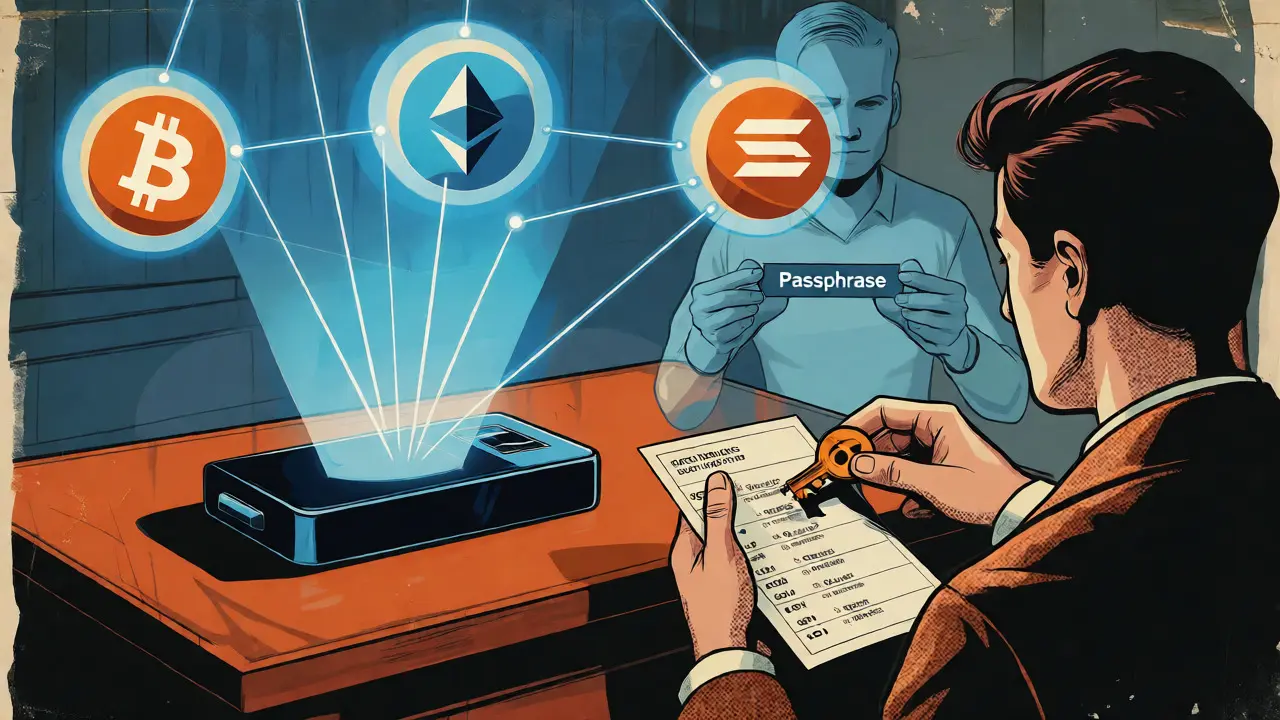
Somewhere in the fine print, you’ll see an option for a "passphrase." This is where things get tricky. Many beginners ignore it, thinking it’s just another password. It’s not. It’s a 25th word.
When you add a passphrase, you create a completely new wallet hidden inside your existing seed phrase. Let’s say your 12 words are `apple banana cherry...`. Without a passphrase, you access Wallet A. Add the passphrase `zebra`, and you access Wallet B. Both wallets exist simultaneously on the blockchain. They have different addresses and different balances. If you forget the passphrase `zebra`, you cannot access Wallet B, even if you have the correct 12 words. It’s effectively lost forever.
Why bother with this complexity? Plausible deniability. If someone forces you to reveal your seed phrase, you can give them the 12 words for Wallet A (which holds a small amount of crypto). They check it, see the funds, and leave. Meanwhile, your main fortune sits in Wallet B, protected by the passphrase you never mentioned. But remember: if you use a passphrase, you must back up both the 12 words AND the passphrase. Storing them together defeats the purpose. Store them separately.
Common Pitfalls and How to Avoid Them
Most losses aren’t due to hackers breaking into the blockchain. They’re due to user error. Here are the mistakes I see most often in my own circle and online forums:
- Digital Backups: Taking a photo of your seed phrase with your phone is dangerous. That photo syncs to iCloud or Google Drive. If your cloud account gets hacked, your crypto is gone. Never store your seed phrase digitally unless it’s encrypted in a password manager you trust implicitly.
- Human Randomness: Don’t try to make up your own 12 words. Humans are terrible at being random. We tend to repeat patterns or choose meaningful phrases. Let the wallet generate the words for you. If you insist on creating your own, use dice rolls, not intuition.
- Language Mismatch: BIP39 supports multiple languages. If you generated your phrase in Spanish, you must select "Spanish" when restoring it in a new wallet. Selecting "English" will result in a completely different set of private keys, and you’ll think your money is missing.
- Writing Errors: Use clear, block capitals. Avoid ambiguous characters like 0/O or 1/l/I. Write on paper or stamp into metal. Paper rots; fire burns it. Metal plates survive house fires and floods.
Is BIP39 Still Relevant in 2026?
You might wonder if newer standards have replaced BIP39. The short answer is no. While technologies like MPC (Multi-Party Computation) and Account Abstraction are gaining traction for smart contract wallets, BIP39 remains the bedrock for self-custody. It is simple, proven, and universally supported. Newer methods often still use BIP39 under the hood to generate the initial entropy.
The standard continues to evolve slightly, mainly through educational improvements and better tooling. Developers have created excellent open-source tools that let you verify your seed phrase offline. These tools allow you to simulate a restoration process without ever connecting to the internet, ensuring your words are valid before you send any real money. This step is crucial for peace of mind.
As we look toward the future, the focus is shifting from the technology itself to user education. The math behind BIP39 is solid. The weak link is us. Wallet interfaces are getting better at warning users about passphrases and encouraging physical backups. But ultimately, understanding that your 12 words are not just a password-they are the mathematical root of your ownership-is the most important skill in crypto.
Can I change my BIP39 seed phrase?
You cannot directly "change" the seed phrase of an existing wallet. The seed phrase is derived from the initial entropy generated when the wallet was created. To get a new seed phrase, you typically need to create a new wallet, transfer your funds to the new address, and then securely destroy the old backup. Some advanced setups allow rotating keys, but for most users, creating a fresh wallet is the safest method.
What happens if I lose one word from my 12-word phrase?
If you know the position of the missing word, you can brute-force it. Since there are only 2048 possible words, a computer can test all of them against the checksum very quickly. If you don't know which word is missing, you'll need to test each position with all 2048 words, which is still computationally feasible for modern devices. Specialized recovery tools can help automate this process.
Is a 12-word seed phrase secure enough for large amounts?
Yes, for practical purposes. 128-bit security is currently considered unbreakable by classical computers. Even with the advent of quantum computing, estimates suggest that 128-bit symmetric encryption remains robust for decades. Most experts recommend moving to multi-signature setups or hardware isolation for very large sums rather than relying solely on longer seed phrases.
Do I need to back up my passphrase separately?
Absolutely. If you use a passphrase, treat it as a separate critical piece of information. Store it in a different location than your seed phrase. If you store them together and lose that location, you lose everything. If you store them separately, losing one location only compromises half the security, allowing you to potentially recover access if you retrieve the other part.
Can I use my BIP39 phrase on any cryptocurrency?
Generally, yes, provided the wallet supports BIP39 and the specific blockchain's derivation path. However, some cryptocurrencies use different key derivation standards (like Monero or certain altcoins with custom algorithms). Always check if the target wallet explicitly supports importing BIP39 seeds for that specific coin before assuming compatibility.