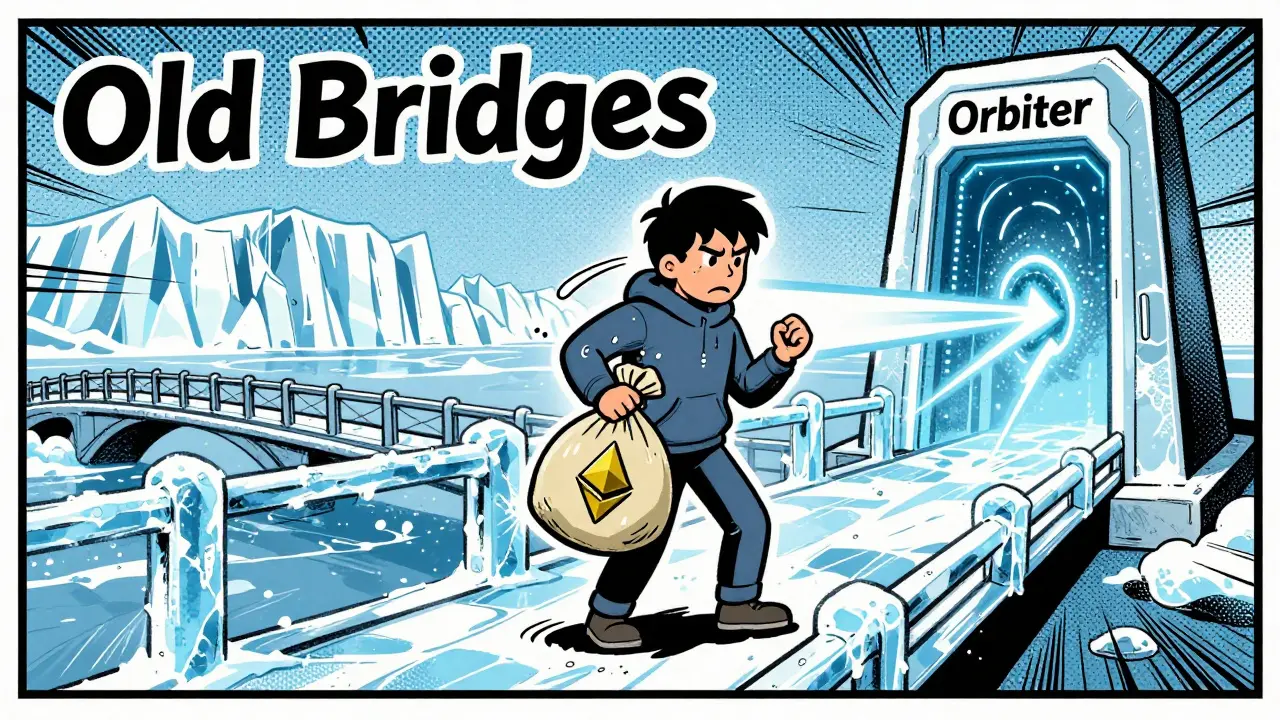
Have you ever tried moving money between different blockchain networks and felt like you were waiting for a glacier to melt? You send your Ethereum to an Arbitrum wallet, pay a fee that feels too high, and then wait ten minutes-or sometimes longer-for the transaction to clear. That friction is exactly what Orbiter Finance was built to fix.
Orbiter Finance isn't just another bridge; it’s a decentralized protocol designed to make cross-chain asset transfers faster, cheaper, and more secure. It uses Zero-Knowledge (ZK) proofs to verify transactions without exposing all the underlying data, which speeds things up significantly. If you are looking into the OBT token, you need to understand how this technology works, why the project raised so much money from top investors, and whether holding the token makes sense in today's market.
How Orbiter Finance Works: The Maker-Sender Model
Most traditional bridges rely on heavy cryptographic proofs or trusted intermediaries that slow down the process. Orbiter takes a different approach by using a Maker-Sender model. Think of it like a ride-sharing service for crypto assets.
Here is how the flow works:
- The Sender: This is you. You want to move ETH from Ethereum Mainnet to Arbitrum. You initiate the transfer on the Orbiter interface.
- The Maker: These are liquidity providers. They hold funds on both chains. When you request a transfer, a Maker instantly sends the equivalent amount to your destination wallet.
- The Security Layer: To prevent Makers from stealing funds or failing to deliver, they must post a margin deposit. If a Maker acts maliciously, you can trigger an arbitration mechanism to recover your funds plus compensation from their margin.
This setup removes the bottleneck of waiting for block confirmations on multiple chains before the swap happens. Instead, you get near-instant settlement because the Maker has already pre-funded the destination side. The ZK-proof technology ensures that the system remains trustless and secure, verifying that the Maker actually fulfilled their obligation without needing a centralized server to keep watch.
Network Support: Where Can You Move Assets?
One of the biggest selling points for Orbiter is its extensive support for Layer 2 (L2) rollups. As Ethereum scales, users live across various L2s like Arbitrum, Polygon, zkSync, Starknet, Base, Scroll, and Linea.
Orbiter connects these ecosystems seamlessly. But it doesn’t stop there. The platform also supports major Layer 1 networks including Solana, Sui, and even the Bitcoin ecosystem. This means you aren't just stuck in the Ethereum universe. You can bridge popular assets like USDT, BTC, SOL, and ETH across these diverse environments with fees that are often a fraction of what legacy bridges charge.
| Feature | Detail |
|---|---|
| Technology | Zero-Knowledge (ZK) Proofs |
| Model | Maker-Sender Liquidity Protocol |
| Speed Claim | Up to 6x faster than traditional bridges |
| Supported Chains | Ethereum L2s (Arbitrum, Base, etc.), Solana, Sui, Bitcoin |
| Token Utility | Governance and Staking |
OBT Tokenomics: Supply, Distribution, and Utility
The native currency of this ecosystem is the OBT token. Launched in January 2025, OBT serves two primary functions: governance voting and staking. Holding the token allows you to have a say in the future development of the protocol and earn rewards by securing the network.
Let’s look at the numbers, as they tell a specific story about scarcity and distribution:
- Total Supply: 10 billion OBT tokens.
- Circulating Supply: Approximately 4.4 billion OBT (as of mid-2026).
- Public Sale Allocation: Only 0.03% of the total supply (2.5 million tokens) was sold publicly during the Initial Exchange Offering (IEO).
The vast majority of tokens were distributed through community incentives. Before the token launch, Orbiter ran a points system. Users earned "Orbiter points" by using the bridge. When the token launched, these points converted into actual OBT tokens. This strategy was designed to reward early adopters who helped provide liquidity and volume to the network, rather than just rewarding speculators who bought the token at launch.
There were also Launchpool events on major exchanges that distributed millions of tokens to stakers of other exchange-native coins. This wide distribution aims to decentralize ownership quickly, though it also means there is significant sell pressure potential as early earners cash out.

Market Performance and Investor Backing
When evaluating any crypto project, you have to look at who believes in it enough to write a check. Orbiter Finance has secured substantial institutional backing. In November 2022, they raised $3.2 million in a seed round at a $40 million valuation. Investors included heavy hitters like Tiger Global, Matrixport Ventures, and StarkWare.
By March 2023, the valuation had skyrocketed to $200 million during their Series A round, which saw participation from OKX Ventures and Redpoint China Ventures. This rapid increase in valuation signals strong confidence in the team's ability to capture the cross-chain infrastructure market.
However, investor confidence doesn't always translate to immediate price stability for retail holders. The OBT token experienced significant volatility after its launch. It hit an all-time high of $0.03 in March 2025, shortly after the IEO price of $0.02. By August 2025, it had corrected sharply to an all-time low of $0.01. As of May 2026, the token trades around $0.0067, representing a steep decline from its peak.
This price action is typical for new DeFi tokens. The initial hype drives the price up, followed by a period of profit-taking and market discovery. For long-term holders, the question isn't just about the current price, but whether the utility-governance and staking yields-provides enough value to justify holding through the volatility.
Competitive Landscape: Why Choose Orbiter?
You might be wondering, "Why not just use LayerZero, Multichain, or Hop Protocol?" These are established players in the cross-chain space. So, what gives Orbiter an edge?
The main differentiator is speed and cost efficiency specifically for Layer 2 rollups. Traditional bridges often require waiting for finality on the source chain, which can take minutes. Orbiter’s Maker-Sender model bypasses this wait time. Because Makers are incentivized to act fast to maintain their reputation and avoid margin penalties, transfers happen almost instantly.
Furthermore, the integration of ZK-proofs adds a layer of security that purely optimistic bridges lack. While optimistic bridges assume transactions are valid unless challenged (which can take weeks), ZK-proofs mathematically prove validity upfront. This reduces the window of vulnerability for hackers targeting bridge protocols-a sector notoriously prone to massive exploits.
Risks and Considerations for Users
No crypto investment is without risk. Here are three critical factors to consider before interacting with Orbiter Finance or buying OBT:
- Smart Contract Risk: Like all DeFi protocols, Orbiter relies on code. If there is a bug in the smart contracts governing the Maker-Sender interactions, funds could be lost. While ZK-proofs enhance security, they do not eliminate the risk of implementation errors.
- Centralization of Liquidity: Although the protocol is decentralized, the liquidity is provided by Makers. If a few large entities control most of the Maker liquidity, they could theoretically manipulate prices or censor transactions. Monitoring the distribution of Maker capital is essential.
- Token Volatility: The OBT token has shown high volatility. If you are buying OBT for speculation, be prepared for sharp drawdowns. If you are buying it for utility (staking/governance), ensure that the yield generated outweighs the opportunity cost of holding a volatile asset.
Final Thoughts on Orbiter Finance
Orbiter Finance addresses a real pain point in the cryptocurrency ecosystem: the hassle of moving assets between chains. By combining ZK-proof technology with a practical liquidity model, it offers a faster and cheaper alternative to older bridge solutions. The strong institutional backing suggests the team has the resources to continue developing and expanding to new chains like Sui and Solana.
However, the OBT token’s performance reminds us that great technology doesn't guarantee immediate financial gains. The token has cooled off significantly from its launch highs. For users, the bridge itself is a valuable tool regardless of the token price. For investors, the thesis hinges on whether Orbiter can maintain its dominance in the L2 bridging space and if the token utility will drive sustainable demand over the next few years.
What is the main purpose of the OBT token?
The OBT token is primarily used for governance voting within the Orbiter Finance ecosystem and for staking. Staking allows holders to earn rewards and help secure the network, while governance gives them a voice in protocol decisions.
Is Orbiter Finance safe to use?
Orbiter Finance uses Zero-Knowledge proofs and a Maker-Sender model with margin requirements to enhance security. However, like all DeFi protocols, it carries smart contract risks. Users should always start with small amounts and verify the official website to avoid phishing sites.
Which blockchains does Orbiter support?
Orbiter supports major Ethereum Layer 2 networks such as Arbitrum, Polygon, zkSync, Starknet, Base, Scroll, and Linea. It also extends support to Layer 1 networks including Solana, Sui, and the Bitcoin ecosystem.
How did users receive OBT tokens initially?
Initial distribution was largely through airdrops based on a points system. Users earned points by using the bridge prior to the token launch. Additionally, there were Launchpool events on exchanges and a small Initial Exchange Offering (IEO).
Who are the key investors in Orbiter Finance?
Notable investors include Tiger Global, Matrixport Ventures, StarkWare, OKX Ventures, Redpoint China Ventures, and Mask Network. These firms invested in both the seed and Series A funding rounds.