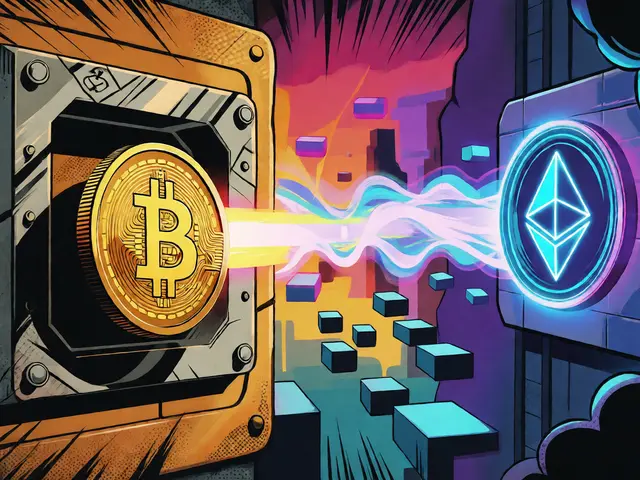
Imagine holding Bitcoin but wanting to use it in a lending protocol on Ethereum. Normally, you’d have to sell your BTC for ETH or rely on a centralized exchange to move the value. That process is slow, expensive, and puts your assets in someone else’s hands. Ren (REN token) was built to solve this exact problem. It allows you to move value between different blockchains privately and without trusting a central intermediary. But how does it actually work, and is it still relevant in today’s fragmented crypto landscape?
The Core Problem: Blockchain Silos
Most blockchains operate in isolation. Bitcoin doesn’t know what’s happening on Ethereum, and vice versa. This creates "silos" of liquidity. If you want to use your Bitcoin as collateral for a loan on an Ethereum-based DeFi platform, you can’t just send the raw Bitcoin over. The networks speak different languages and have different security models.
In the early days of DeFi, the solution was "wrapped tokens." You would lock your Bitcoin with a custodian (like a company or a multi-signature wallet), and they would mint an equivalent ERC-20 token representing that Bitcoin on Ethereum. While this worked, it introduced a massive risk: counterparty risk. If the custodian gets hacked, goes bankrupt, or acts maliciously, your funds are gone. We saw this fear play out repeatedly during market downturns when trust in centralized entities eroded.
Ren Protocol, originally launched as Republic Protocol, pivoted its focus from pure privacy to interoperability to address this gap. The goal wasn’t just to hide transactions; it was to connect blockchains in a way that didn’t require you to trust a single party with your keys.
How RenVM Works: The Engine Behind the Token
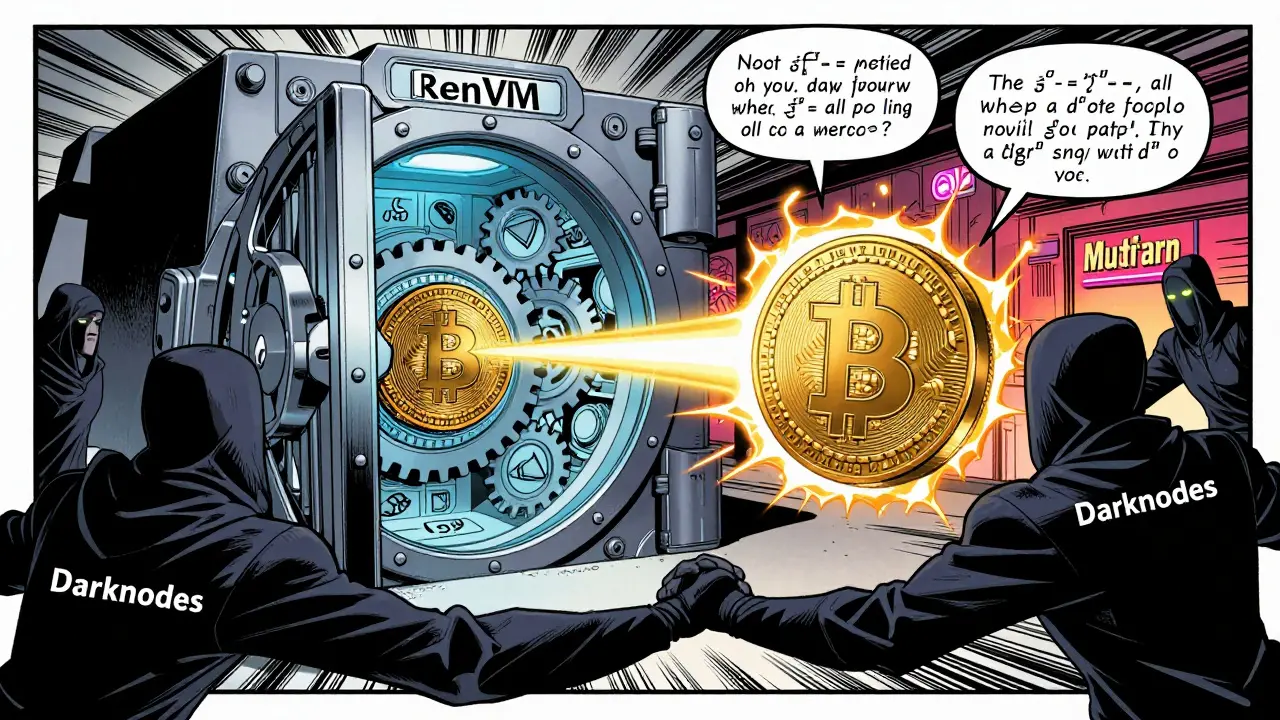
The heart of the system is not the token itself, but the infrastructure known as RenVM (Ren Virtual Machine). Think of RenVM as a specialized computer network designed specifically for moving assets across chains securely.
Here is the step-by-step process of how a transfer typically works:
- Locking Assets: You deposit your native asset (e.g., Bitcoin) into a smart contract or a specific address monitored by the Ren network.
- Minting Wrapped Tokens: Once the deposit is confirmed, RenVM mints a corresponding wrapped version of that asset (e.g., renBTC) on the target blockchain (like Ethereum). This renBTC behaves exactly like any other ERC-20 token.
- Using DeFi: You can now use renBTC in any Ethereum DeFi application-lending, borrowing, or trading.
- Burning and Releasing: When you’re done, you send the renBTC back to the Ren contract. The token is burned (destroyed), and the original Bitcoin is released from escrow back to your wallet.
The magic lies in *who* controls the escrow. In traditional bridges, a company holds the keys. In Ren, no single entity holds the keys. Instead, the network uses a combination of advanced cryptography to ensure security.
The Technology: zkSNARKs and MPC
To achieve trustless interoperability, Ren relies on two complex cryptographic concepts. You don’t need to be a mathematician to understand them, but knowing what they do helps explain why Ren is unique.
First, there is Secure Multi-Party Computation (MPC). Imagine splitting a safe key into three pieces and giving one piece to three different people. To open the safe, all three must agree and combine their pieces. No single person can open it alone. RenVM splits the private keys needed to sign transactions among many nodes. If a majority of these nodes act honestly, the funds remain secure. Even if some nodes are compromised, the attacker cannot steal the funds because they lack the complete set of key shards.
Second, Ren uses Zero-Knowledge Succinct Non-Interactive Arguments of Knowledge (zkSNARKs). This technology allows the network to prove that a transaction is valid without revealing the underlying data. For example, you can prove you have enough funds to make a payment without revealing your total balance or identity. This adds a layer of privacy that most other bridges lack.
| Feature | Centralized Custody Bridges | Ren Protocol (RenVM) |
|---|---|---|
| Trust Model | Must trust a company or multisig group | Trustless; relies on cryptographic consensus |
| Privacy | Low; transactions are often public and linked to KYC accounts | High; utilizes zero-knowledge proofs for obfuscation |
| Security Risk | Single point of failure (hackable server/key) | Distributed risk; requires majority of nodes to collude to fail |
| Asset Support | Varies by provider | Bitcoin, Zcash, Litecoin, Dogecoin, and more via RenVM |
The Role of the REN Token
If RenVM is the engine, the REN token is the fuel and the insurance policy. It is an ERC-20 utility token, meaning it lives on the Ethereum blockchain but powers the Ren ecosystem.
You might wonder: "Can I stake my REN to earn passive income?" The answer is generally no, at least not in the traditional sense. Ren operates on a proof-of-stake mechanism, but it doesn’t pay out inflationary rewards to node operators. Instead, the token serves three critical economic functions:
- Collateral for Darknodes: To run a node (called a Darknode) on the Ren network, you must stake exactly 100,000 REN tokens. This high barrier to entry ensures that only serious participants join the network. These tokens act as a bond. If a node operator misbehaves-for example, by trying to double-spend or censor transactions-they lose their staked REN.
- Transaction Fees: Users pay fees in REN to execute swaps and transfers. These fees go to the node operators, providing an incentive to keep the network running smoothly.
- Governance and Security: The bonding curve adjusts dynamically. If the price of REN drops, the required stake amount might increase to maintain the same level of economic security. This aligns the interests of token holders with the health of the network.
This model is distinct from many other Proof-of-Stake networks where users stake tokens simply to earn more tokens. In Ren, the value accrues through the utility of the network and the fees generated by cross-chain activity.
Darknodes: The Network Guardians
The security of Ren depends entirely on its Darknodes. These are specialized servers operated by individuals or organizations who have met the 100,000 REN stake requirement.
Why is the number of Darknodes important? Because Ren’s security model assumes that less than 50% of the nodes will ever act maliciously. As long as the honest majority remains intact, the cryptographic protocols hold up. The 100,000 REN stake acts as a deterrent against Sybil attacks, where one bad actor tries to create thousands of fake nodes to gain control of the network. Since each node requires a significant financial commitment, it becomes economically unfeasible for an attacker to buy up enough influence.
However, this high entry cost has been a point of debate. Critics argue that limiting the number of nodes reduces decentralization. Proponents counter that a smaller, highly incentivized group of professional operators is safer than a large, chaotic network of poorly secured home routers. As of recent updates, the project has focused on improving the user experience for node operators and expanding the range of supported assets to justify the operational costs.
Historical Context and Market Position
Understanding Ren’s current state requires looking at its history. Founded by Taiyang Zhang and Loong Wang, the project started as Republic Protocol, focusing heavily on privacy features similar to Monero. They rebranded to Ren in 2019 to emphasize interoperability.
A pivotal moment occurred in February 2022 when Alameda Research, the trading firm associated with Sam Bankman-Fried, acquired a majority stake in Ren. At the time, this was seen as a boost, promising resources to accelerate development. However, following the collapse of FTX and Alameda in November 2022, the association cast a shadow over the project. Many in the crypto community became wary of projects tied to the FTX ecosystem.
Despite this, Ren continued to operate. The protocol is decentralized, meaning that even if the founding company faces legal or financial issues, the code and the network continue to function as long as the Darknodes remain online. Today, Ren positions itself as a neutral infrastructure layer, essential for the growing demand for cross-chain DeFi applications. With the rise of Layer-2 solutions and alternative Layer-1 blockchains, the need to move assets seamlessly without losing privacy or security has never been greater.
Risks and Considerations for Users
While Ren offers a sophisticated solution, it is not without risks. Here is what you should consider before using the protocol:
- Smart Contract Risk: Like all DeFi protocols, Ren relies on code. If there is a bug in the RenVM or the bridging contracts, funds could be lost. Regular audits are conducted, but no code is perfectly immune to exploits.
- Complexity: Using Ren is more complex than swapping tokens on a centralized exchange. You need to manage gas fees on both the source and destination chains, understand slippage, and monitor transaction statuses carefully.
- Liquidity Depth: For major pairs like BTC/ETH, liquidity is usually sufficient. However, for smaller or newer assets, you might encounter higher fees or slower processing times due to lower liquidity pools.
- Regulatory Uncertainty: Privacy-focused technologies are under scrutiny globally. While Ren emphasizes that it provides privacy tools rather than anonymity services for illegal activities, regulatory changes could impact its adoption or accessibility in certain jurisdictions.
Is Ren Still Relevant in 2026?
The crypto landscape has evolved significantly since Ren’s launch. Newer interoperability standards like IBC (Inter-Blockchain Communication) used by the Cosmos ecosystem and various Layer-2 rollups have changed how we think about connectivity. However, Ren remains one of the few solutions that supports non-Ethereum blockchains like Bitcoin and Zcash natively while maintaining a strong privacy focus.
As the industry moves toward a multi-chain future, the ability to move value between Bitcoin’s security and Ethereum’s programmability is crucial. Ren fills a niche that purely Ethereum-centric bridges cannot. Whether you are a DeFi power user looking to leverage Bitcoin holdings or a developer building cross-chain applications, understanding Ren provides insight into the deeper layers of blockchain infrastructure.
What is the difference between Ren and a standard crypto bridge?
Standard bridges often rely on centralized custodians or simple multi-signature wallets, creating a single point of failure. Ren uses a decentralized network of Darknodes and cryptographic techniques like MPC and zkSNARKs to ensure that no single party controls the assets, offering higher security and privacy.
Can I mine Ren (REN) tokens?
No, REN cannot be mined. It operates on a proof-of-stake model. The total supply was determined at launch, and new tokens are not created through mining. Instead, the token is distributed through initial sales, team allocations, and ecosystem incentives.
Do I need to stake REN to use the Ren network?
No, regular users do not need to stake REN to swap assets. Staking is only required for operators who wish to run a Darknode to participate in the network’s consensus and validation processes. Users simply pay transaction fees in REN.
Which cryptocurrencies can be moved using Ren?
Ren primarily supports Bitcoin (BTC), Zcash (ZEC), Litecoin (LTC), and Dogecoin (DOGE) for cross-chain transfers to Ethereum and other compatible networks. The list of supported assets may expand as the protocol develops and integrates with new chains.
Is Ren safe to use given its past association with Alameda Research?
The safety of Ren depends on its decentralized code and the integrity of its Darknodes, not solely on its corporate backers. While the Alameda acquisition raised concerns, the protocol continues to operate independently. Users should always conduct their own research, start with small amounts, and verify the current status of the network’s audits and governance before committing significant funds.