
Most people think of stablecoins as digital dollars that just sit there. You hold them to avoid volatility, but they don't exactly grow on their own. Imagine if your bank account automatically moved your money to wherever the highest interest rate was every single day without you lifting a finger. That is essentially the promise of Staked Frax USD is a yielding stablecoin designed to provide competitive on-chain returns by automating yield-generation strategies. Also known as sfrxUSD, it changes the game for anyone tired of holding "lazy" capital. Instead of just maintaining a price peg, it acts as a vehicle for growth.
The Core Mechanics: How sfrxUSD Actually Works
To understand sfrxUSD, you first have to understand its parent, frxUSD. While frxUSD is the stable asset, sfrxUSD is the "staked" version. When you stake your frxUSD into a yield vault, you receive sfrxUSD in return. Think of it like a receipt for your deposit that grows in value over time.
Unlike some tokens that "rebase" (where the number of tokens in your wallet physically changes), sfrxUSD is a non-rebasing token. This means you keep the same number of tokens, but the amount of frxUSD you can claim for each sfrxUSD increases as yield accumulates. It is built using the ERC4626 standard, which is a technical blueprint for yield-bearing vaults. This makes the token highly compatible with other DeFi apps, meaning it can be plugged into lending protocols or aggregators without needing custom code for every single integration.
The Secret Sauce: The Three Yield Strategies
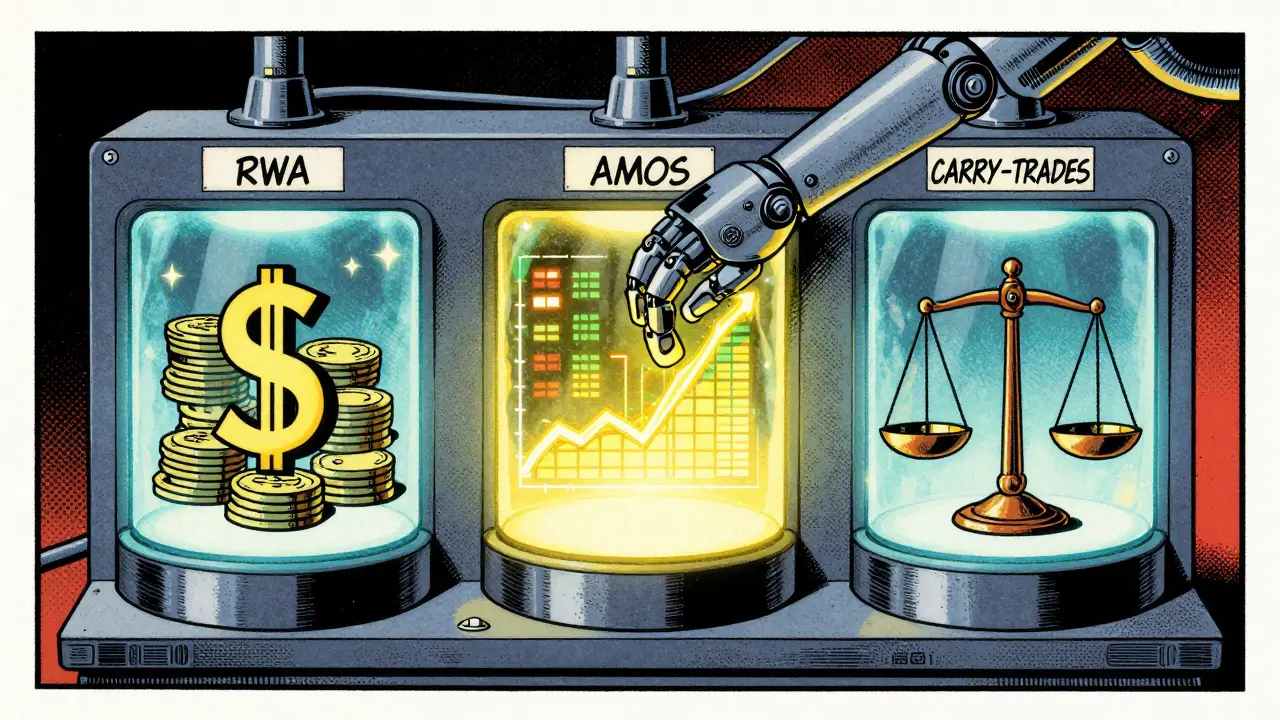
What makes sfrxUSD different from a standard savings account is its benchmark-rate strategy. The protocol doesn't just stick to one way of making money; it rotates between three governance-approved mechanisms to find the best risk-adjusted return:
- Interest on Reserve Balances (IORB) & T-Bills: When traditional finance offers high rates, the protocol allocates funds to Real-World Assets (RWA), specifically short-dated United States Treasury Bills with maturities exceeding 90 days. This bridges the gap between DeFi and the actual US government bond market.
- Algorithmic Market Operations (AMOs): The protocol uses automated strategies to capture inefficiencies in the market, essentially trading the stablecoin's peg to extract profit.
- Carry-Trade Strategies: This involves borrowing an asset at a low rate and investing it in another asset with a higher return, capturing the "spread" in between.
The beauty of this setup is that you don't have to monitor the markets. The Frax Finance ecosystem handles the pivot. If T-Bills start paying more than the AMOs, the yield shifts automatically.
| Feature | Standard Stablecoins (USDC/USDT) | Staked Frax USD (sfrxUSD) |
|---|---|---|
| Primary Goal | Price Stability | Stability + Automated Yield |
| Passive Income | None (unless lent out manually) | Built-in via benchmark strategy |
| Technical Standard | ERC-20 | ERC-4626 (Vault Standard) |
| Redemption | 1:1 with USD/Fiat | Increasing rate to frxUSD |
Market Reality: Price and Performance
If you check a price tracker, you'll notice sfrxUSD doesn't always trade at exactly $1.00. This is normal. Because it is a yield-bearing asset, its price typically trades at a premium relative to the underlying frxUSD. As yield builds up, the token becomes "worth" more than one dollar because it represents the principal plus the earned interest.
Current market data shows a bit of a split depending on where you look. For instance, CoinMarketCap has reported prices around $1.19 with a market cap near $30.4M, while Coinbase has seen it closer to $1.12 with a smaller market cap of roughly $15.39M. These gaps usually happen because different platforms calculate "circulating supply" differently-some count only tokens in active wallets, while others count everything in the vault. Regardless, the all-time high has touched $1.4171, proving that the accumulated yield can significantly push the price above the nominal peg.
Where to Trade and How to Use It
You won't find sfrxUSD on every corner of the crypto world just yet. It isn't tradable on platforms like Crypto.com, and it is primarily an Ethereum-based asset (Contract: 0xcf62F905562626CfcDD2261162a51fd02Fc9c5b6). The vast majority of the action-about 99.95% of recorded trades-happens on Curve Finance, specifically in the sfrxUSD/frxUSD pool. This is where users typically swap their stable assets to enter or exit the yield position.
For a regular user, the "job" of sfrxUSD is simple: capital efficiency. Instead of manually moving funds between different lending protocols to chase a 1% higher APY, you hold one token that targets the highest available risk-adjusted yield on-chain. It turns your stablecoin holding into a productive asset.
The Risks You Should Know
No one gets a "free lunch" in crypto. While sfrxUSD is designed to be safe, it has specific dependencies. First, you are relying on the Frax Finance protocol. If the governance of Frax fails or the protocol suffers a critical bug, your assets are at risk. Second, when the yield comes from T-Bills, you are indirectly exposed to the US Treasury market. While these are considered the safest assets in the world, any systemic shock to the bond market could affect the yield.
There is also the liquidity risk. Because most trading happens on Curve, if that pool were to dry up, exiting a massive position quickly might become difficult, though the direct redemption pathway to frxUSD is designed to mitigate this by allowing users to unstake without typical fees.
Is sfrxUSD a stablecoin?
Yes, but it is a "yielding" stablecoin. While it is pegged to the value of the USD via frxUSD, its market price is often higher than $1.00 because it represents the original deposit plus the interest earned over time.
How is the yield generated?
The protocol automatically switches between three strategies: holding US Treasury Bills (RWA), Algorithmic Market Operations (AMOs), and carry-trade strategies. It always aims for the highest risk-adjusted return available.
Can I redeem sfrxUSD for frxUSD?
Yes. sfrxUSD has a direct redemption pathway. Because it is a non-rebasing token, the rate at which you can redeem sfrxUSD for frxUSD increases as yield is earned.
What is ERC4626 and why does it matter?
ERC4626 is a token standard for yield-bearing vaults. It ensures that different DeFi protocols can easily understand how the vault works, making it easier for sfrxUSD to be used as collateral in lending apps without needing custom integrations.
Where can I buy sfrxUSD?
The most liquid place to trade sfrxUSD is on Curve Finance, specifically using the sfrxUSD/frxUSD pair. It is primarily available on the Ethereum network.
Next Steps for Users
If you are new to the ecosystem, the best way to start is by exploring the Frax Finance dashboard to see the current yield benchmarks. If you already hold frxUSD, staking it for sfrxUSD is a straightforward way to start earning passive income. However, if you are coming from USDC or USDT, you'll need to swap those first via a decentralized exchange like Curve. Always double-check the contract address on Ethereum to avoid scams, and remember that while the yield is automated, the risk of the underlying protocol remains your responsibility.


There are 21 Comments
JERRY ORTEGA
honestly just seems like a cleaner way to handle yield without the constant manual swapping around every week
david head
totally agree! moving money manually is such a pain 🚀 glad there's a way to automate this stuff 📈
Deepak Prusty
The mention of ERC4626 is the only technically relevant part here. Most people don't realize that standardization is the only thing keeping DeFi from being a complete chaotic mess of non-interoperable contracts.
Emma Pease-Byron
Oh, look, another "revolutionary" stablecoin that basically just wraps US Treasury bills. How utterly groundbreaking. I'm sure the risk of a smart contract bug is completely negligible in the eyes of those chasing a few extra basis points.
June Coleman
Right because we all trust a "governance-approved" algorithm to manage our money perfectly while we sleep. Truly a utopian vision of finance
Diana Martín Prieto
If you're looking to get started, I'd suggest just putting a small amount in first to see how the redemption works. It's a great way to build confidence with yield-bearing assets without overexposing yourself right away!
Earnest Mudzengi
RWA integration is just a fancy word for letting the central banks keep their grip on the blockchain. You think T-bills are safe? The whole system is a house of cards and the moment the Fed pivots the liquidity in these vaults will evaporate faster than a ghost. Total surveillance capitalism disguised as yield
Emily 2231
I must concur with the concerns regarding systemic vulnerabilities. It is highly probable that the underlying assets are being manipulated by institutional actors to maintain a facade of stability while the actual value is eroded by inflation
Hugo Lopez
Let's try to keep it positive everyone! 😊 It's an interesting tool for those who want passive income without the stress of active trading. Hope this helps some of you find a good balance! ✨
shubhu patel
I have been observing how different protocols handle their pegging mechanisms for a while now and it seems that the approach Frax is taking with the benchmark-rate strategy is quite sophisticated because it allows the protocol to remain flexible in a volatile interest rate environment which is honestly something that many other stablecoin projects completely overlook in their whitepapers
Patty Levino
Just a heads up for anyone new to Curve, be careful with the slippage if you're moving a large amount of sfrxUSD. It's usually fine but always check the price impact before confirming the swap
Joshua Aldrich
yield is just a flow of energy in a system lol. its cool to see the tech evolve but always remember that the real value is in the utility not just the ticker. also i think there is a typo in the contract address on some sites so stay safe guys
sekhar reddy
OMG the yield potentials here are INSANE!! i cant believe people are still just holding regular usdc when this exists 😱 absolute madness!
Trish Swanson
Curve liquidity is the only real bottleneck here!!!
Suzanne Robitaille
There is something truly poetic about the way we've digitized the concept of a treasury bond into a token that we can trade on a decentralized exchange. It's a bridge between the ancient world of government debt and the futuristic world of smart contracts!
gladys christine
this is the energy we need 💖 just imagine the growth potential when more people realize they dont have to let their money sleep 💥
Alexandra Lance
Imagine thinking a 1.19 price point on CMC is a sign of strength and not just a liquidity mirage 🙄💅 honestly the lack of basic market understanding in this thread is just... breathtaking 🤡
Carmelita Gonzales
it is nice to see options that allow people to earn a bit more without needing to be a professional trader
Susan Payne
The propensity for retail investors to ignore the risks of protocol governance is truly lamentable. One does not simply "automate" financial safety without accepting a profound level of counterparty risk.
Robert Coskrey
I believe that the implementation of the ERC4626 standard is a commendable step toward interoperability... it certainly reduces the friction for integration into other lending platforms!!!
Brooke Herold
Interesting perspective on the RWA side of things.
Write a comment
Your email address will not be published. Required fields are marked *