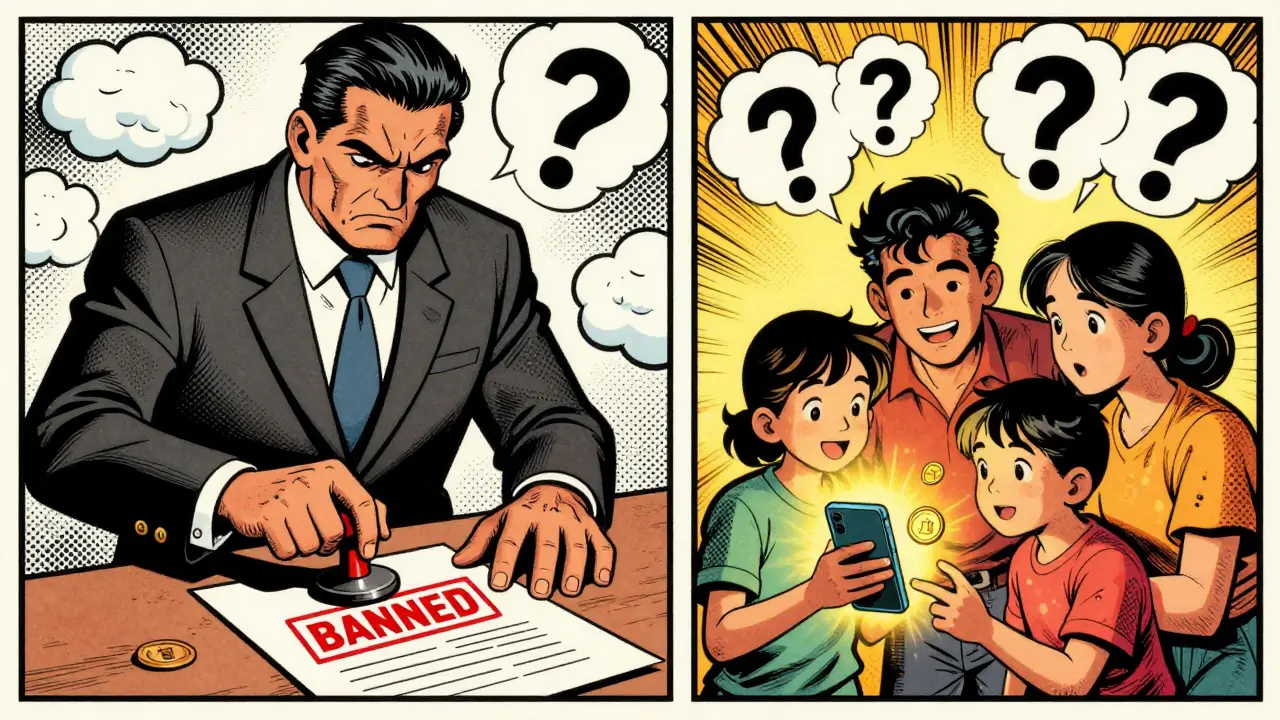
It sounds like a contradiction. How can a country with one of the strictest bans on cryptocurrency in Asia still show up on global adoption charts? The answer lies in the gap between what governments say and what people actually do when their bank accounts don't meet their needs.
In 2025, Bangladesh reported approximately 3.1 million verified crypto users. This isn’t a small number for a nation where using digital assets is technically illegal. It highlights a powerful truth: when traditional financial systems are slow, expensive, or inaccessible, people find workarounds. For millions of Bangladeshis, that workaround is cryptocurrency, specifically stablecoins used to send money home from overseas workers.
The Numbers Behind the Paradox
To understand why this matters, you have to look at the data without the political noise. According to CoinLaw’s 2025 statistics, Bangladesh maintains a user base of 3.1 million people who actively engage with crypto platforms. While this might seem modest compared to giants like India, it represents a significant portion of the digitally connected population.
Global rankings paint an interesting picture. CoinLedger placed Bangladesh at rank 35 in global adoption in May 2025. However, other metrics from Chainalysis and historical data suggest Bangladesh has often ranked higher, sometimes around positions 13-15, depending on how "adoption" is measured. If you count wallet activity, peer-to-peer (P2P) volume, and search interest, the numbers jump significantly. The Coinpedia Global Crypto Adoption Report 2025 lists Bangladesh alongside countries like Turkey and Ethiopia as notable adopters despite regulatory headwinds.
This discrepancy in ranking comes down to definition. Are we counting official exchanges? No, because there aren’t any legal ones. Are we counting individuals holding tokens in non-custodial wallets? Yes. That’s where the real activity lives.
Why People Ignore the Ban
You wouldn’t break the law just to gamble on Bitcoin prices if you could easily trade stocks. But in Bangladesh, the motivation isn’t speculation; it’s survival and efficiency. The primary driver is remittances.
Bangladesh relies heavily on money sent home by its expatriate workforce, particularly those working in the Middle East and Southeast Asia. Traditional banking channels for these transfers are plagued by high fees, slow processing times, and complex documentation. Enter stablecoins.
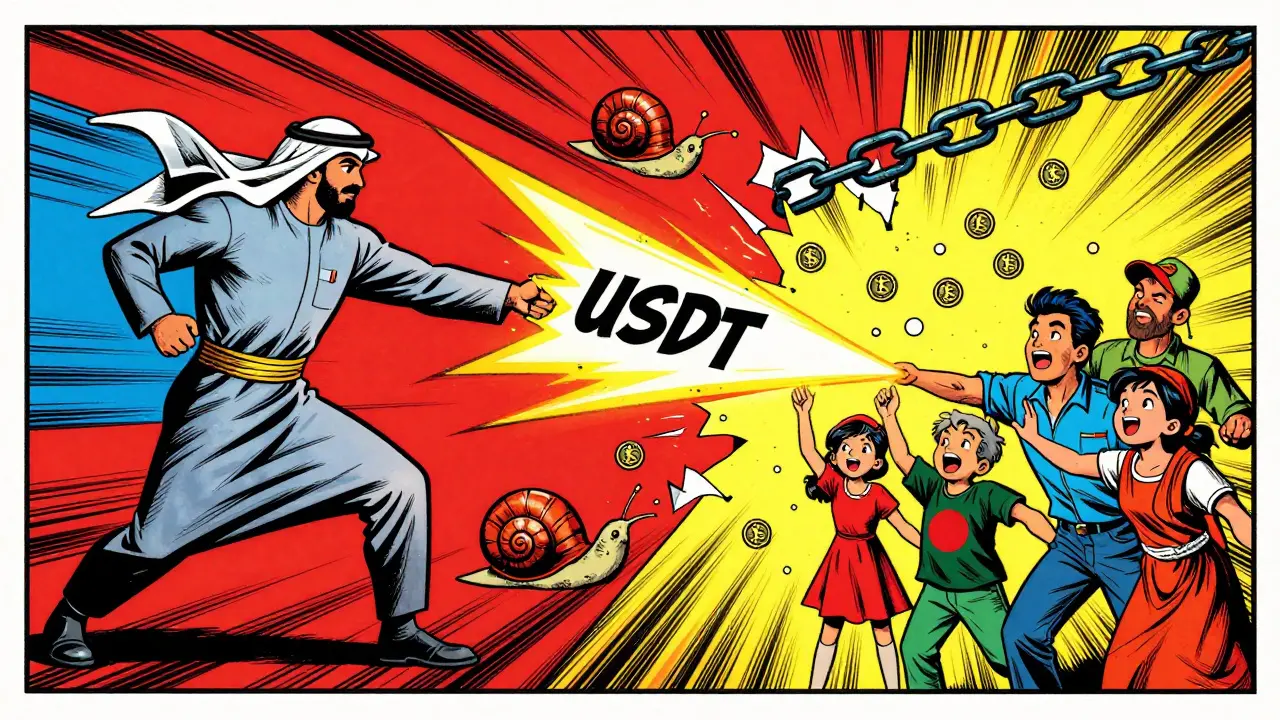
Stablecoins are cryptocurrencies pegged to a stable asset like the US Dollar. Unlike volatile coins such as Bitcoin, stablecoins maintain a consistent value. This makes them perfect for sending salary payments across borders. A worker in Dubai can send USDT (Tether) to a family member in Dhaka in minutes, bypassing traditional wire transfer fees and delays.
This utility creates a demand that regulation cannot simply switch off. When a tool solves a painful problem better than the existing alternatives, people will use it regardless of the legal status. In Bangladesh, the pain of sending money through traditional banks is so great that the risk of using crypto becomes an acceptable trade-off.
How It Works Underground
If buying crypto is banned, how do 3.1 million people get access? They don’t use local banks. They use a shadow infrastructure built on global connectivity.
- International Exchanges: Users sign up for global platforms like Binance or KuCoin. These platforms operate outside Bangladeshi jurisdiction. Users verify their identity with international standards, not local ones.
- Peer-to-Peer (P2P) Trading: This is the most critical component. P2P markets allow users to buy crypto directly from other users using local payment methods like bKash, Nagad, or bank transfers. The platform acts as an escrow service, ensuring safety without needing a local license.
- Non-Custodial Wallets: To avoid exchange risks, many users store assets in self-custody wallets like Trust Wallet or MetaMask. These apps run on personal phones and require no central server, making them hard for regulators to track or block.
- VPNs and Privacy Tools: While internet censorship exists, determined users utilize Virtual Private Networks (VPNs) to access blocked domains or hide their location from restrictive firewalls.
This ecosystem is resilient because it doesn’t rely on a single point of failure. Shutting down one website doesn’t stop the flow of funds; users just move to another platform or method.
Regional Context: South Asia’s Crypto Boom
Bangladesh isn’t alone in this trend. Look at its neighbors. India leads global adoption with an index of 1.000 according to Coinpedia 2025. Pakistan, which also faces strict capital controls, added 5.4 million new crypto users in 2025, bringing its total to 18.2 million. Their drivers are similar: cross-border earnings, freelance payments, and inflation hedging.
| Country | Regulatory Status | Estimated Users | Primary Driver |
|---|---|---|---|
| India | Restricted but tolerated | High (Index 1.000) | Investment & Freelance |
| Pakistan | Strict Restrictions | 18.2 Million | Cross-border Earnings |
| Bangladesh | Complete Ban | 3.1 Million | Remittances via Stablecoins |
The Asia-Pacific region led global crypto growth with 69% expansion in 2025. This regional surge shows that economic pressures-like inflation and limited banking access-drive adoption more effectively than legal prohibitions prevent it. Even Cambodia, with its hybrid digital wallet Bakong, shows that innovative financial tools thrive in complex regulatory environments.

Risks for the Average User
While the system works, it isn’t safe. Operating in a gray market carries significant risks that users must manage daily.
- Legal Uncertainty: The government can change enforcement tactics overnight. Banks may freeze accounts linked to crypto transactions without warning.
- Fraud Scams: Without legal recourse, victims of P2P scams or fake investment schemes have nowhere to go. Police rarely investigate crypto-related fraud seriously.
- Technical Errors: Losing private keys or sending funds to the wrong address means permanent loss of funds. There is no customer support hotline to call.
- Market Volatility: While stablecoins reduce price risk, they carry counterparty risk. If the issuer fails or gets banned globally, the token could lose value.
These risks force users to be highly educated. You can’t just click "buy" and forget about it. You need to understand security best practices, recognize phishing attempts, and stay updated on regulatory news.
The Future of Crypto in Bangladesh
Will the ban lift? Probably not soon. The central bank remains concerned about monetary sovereignty and capital flight. However, the persistence of 3.1 million users suggests that the current approach is ineffective. You can’t outlaw a technology that runs on the internet.
The future likely points toward one of two paths:
- Continued Underground Growth: As long as remittance costs remain high, the black market for crypto will expand. Technology will become easier to use, lowering the barrier for entry even further.
- Regulated Integration: Eventually, the government may realize it can tax and monitor these flows rather than suppress them. We’ve seen this happen in other emerging markets where initial bans gave way to cautious licensing frameworks.
For now, Bangladesh serves as a case study in resilience. It proves that financial innovation is driven by human need, not government permission. The 3.1 million users aren’t rebels; they’re pragmatists looking for a faster, cheaper way to support their families.
Is it legal to own cryptocurrency in Bangladesh?
No. The Bangladesh Bank has issued circulars prohibiting banks and financial institutions from dealing in cryptocurrencies. While owning crypto itself isn't always explicitly criminalized for individuals, trading, exchanging, or using it for payments is considered illegal and can lead to account freezes or legal action.
How do people in Bangladesh buy crypto if it's banned?
Most users rely on Peer-to-Peer (P2P) platforms like Binance P2P. They connect with other users who sell crypto in exchange for local mobile money services like bKash or Nagad. This method bypasses direct bank involvement in crypto transactions, though it still carries risks of account monitoring.
Why are stablecoins popular in Bangladesh?
Stablecoins like USDT are popular because they offer stability. Unlike Bitcoin, their value doesn't fluctuate wildly. This makes them ideal for remittances, allowing overseas workers to send dollars instantly to family members without worrying about exchange rate drops during the transfer process.
What are the biggest risks for crypto users in Bangladesh?
The main risks include legal repercussions such as frozen bank accounts, fraud from unregulated P2P sellers, and technical errors leading to lost funds. Since there is no legal protection for crypto transactions, users bear all responsibility for security and dispute resolution.
How does Bangladesh compare to India in crypto adoption?
India has much higher adoption rates and a more tolerant regulatory environment, leading to greater investment and institutional interest. Bangladesh’s adoption is more niche, driven primarily by necessity for remittances rather than investment opportunities, resulting in a smaller but highly active user base focused on utility.