
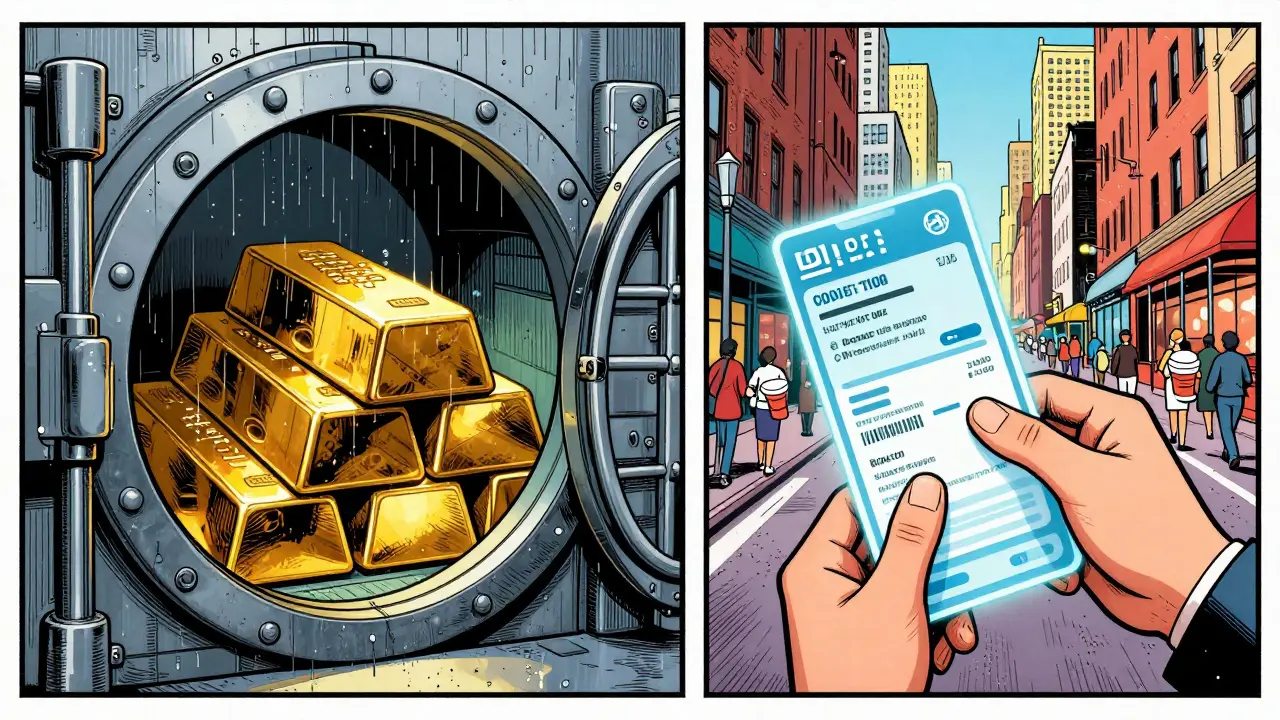
Imagine holding a gold bar in a high-security vault in London, but wanting to use that value to buy a coffee in New York without actually moving the gold across the ocean. You get a digital receipt that proves you own that gold, and you use that receipt to trade for goods. In the blockchain world, that's exactly how wrapped tokens is a tokenized version of a cryptocurrency that allows it to be used on a blockchain other than its native one. By locking an asset on one chain and minting a representative token on another, users can unlock the power of wrapped tokens across different networks without ever selling their original holdings.
The Core Problem: Blockchain Silos
Blockchains are fundamentally isolated. If you have Bitcoin, you can't just "send" it to an Ethereum-based lending protocol because the two networks don't speak the same language. This creates a massive problem for capital efficiency. For years, Bitcoin holders had to choose: either hold onto their BTC and watch from the sidelines, or sell it for ETH to participate in decentralized finance (DeFi). This isn't just a nuisance; it's a liquidity wall that prevents billions of dollars from flowing into innovative financial tools.
This is where wrapping comes in. It creates a bridge of trust. When you wrap an asset, you aren't changing the asset itself; you're creating a proxy. This allows a user to keep the price exposure of their favorite coin while gaining the utility of a different ecosystem. It's the difference between having a car in your garage and having a universal key that lets you drive any car in the city.
How the Wrapping Process Actually Works
The magic happens through a 1:1 backing ratio. To keep the value stable, for every wrapped token created, an identical amount of the original asset must be locked away. This process typically involves three main players: merchants who start the process, custodians who act as the vault, and often DAOs is Decentralized Autonomous Organizations that govern the rules and parameters of the wrapping protocol through community voting.
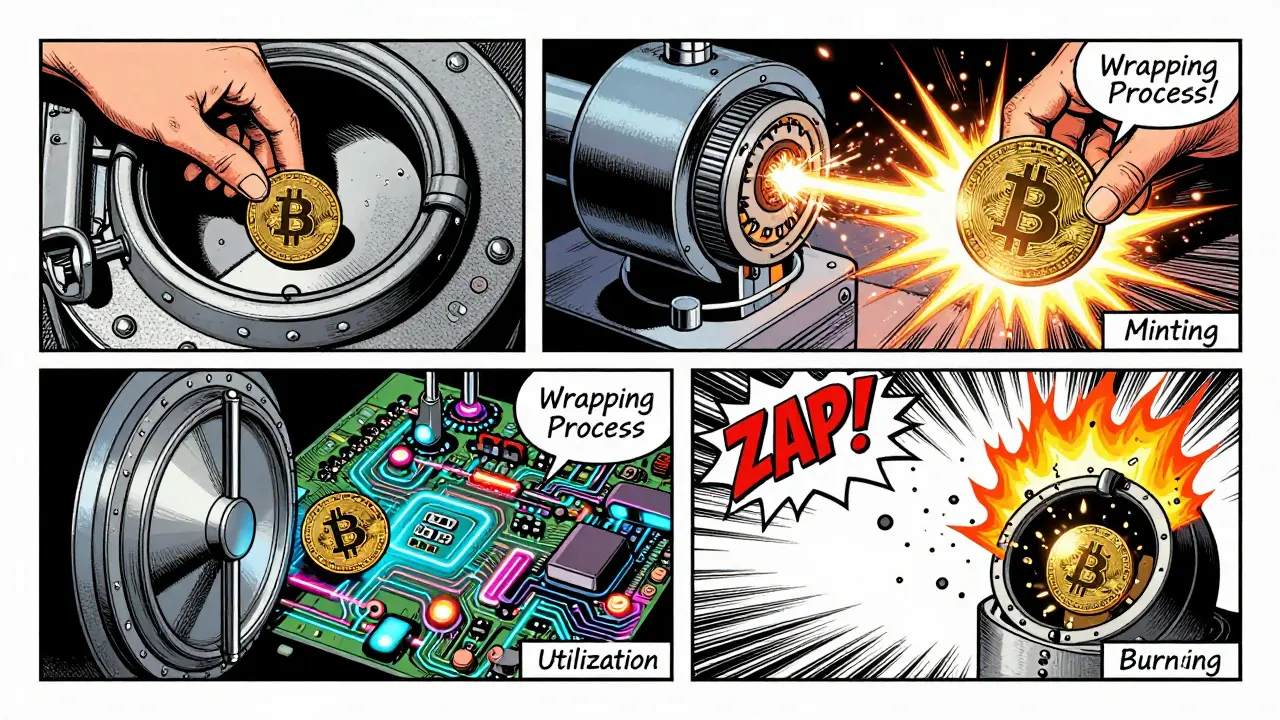
The technical workflow follows a strict cycle:
- Locking: You send your native assets (like BTC) to a trusted custodian.
- Minting: The custodian uses a smart contract to create an equivalent number of wrapped tokens on the target chain (like Ethereum).
- Utilization: You use these tokens in DeFi apps just like any other native token on that chain.
- Burning: When you want your original assets back, you send the wrapped tokens back to the custodian. The smart contract "burns" (destroys) the wrapped tokens and releases the original assets from the vault.
| Feature | Native Token | Wrapped Token |
|---|---|---|
| Network | Only its own native chain | Target chain (e.g., ERC-20) |
| Utility | Limited to native ecosystem | Broad DeFi interoperability |
| Value | Market price | 1:1 peg to native price |
| Risk | Network security | Custodian & Smart Contract risk |
Major Use Cases in the DeFi Ecosystem
The most famous example is Wrapped Bitcoin is an ERC-20 token on the Ethereum blockchain that represents Bitcoin in a 1:1 ratio. Commonly known as WBTC, it allows the world's largest cryptocurrency to finally "do something" besides just sitting in a wallet.
Lending and Borrowing
Instead of letting your Bitcoin sit idle, you can wrap it into WBTC and deposit it into platforms like Aave. Now, your Bitcoin acts as collateral. You can borrow stablecoins against it to fund other investments or cover living expenses, all while keeping your long-term Bitcoin position. You're essentially turning a passive store of value into a productive financial asset.
Yield Farming and Liquidity Pools
Decentralized exchanges (DEXs) like Uniswap is a leading automated liquidity protocol where users can trade tokens without a central intermediary and Curve depend on liquidity providers. By wrapping assets, you can provide liquidity for pairs like WBTC/ETH. This allows you to earn trading fees and reward tokens (yield farming) using assets that originally lived on completely different blockchains.
Expanding Asset Reach
It isn't just about Bitcoin. Other projects use this to gain a foothold in the Ethereum ecosystem. For example, Wrapped Chainlink is a version of the LINK token that enables users to access DeFi platforms beyond the native Ethereum environment. Similarly, Wrapped Filecoin is a tokenized version of FIL that allows holders to engage with financial protocols outside the Filecoin network. This increases the visibility of these tokens, as they appear in more portfolios and trading pairs, which naturally drives up liquidity.
Solving the Interoperability Puzzle
Interoperability is a fancy word for "talking to each other." Without wrapped tokens, the crypto world would be a series of walled gardens. Wrapping breaks those walls down. For instance, Wrapped Tezos is a proxy token that enables XTZ holders to use DeFi applications on networks other than Tezos.
This flexibility allows users to chase the lowest fees. If a new, faster blockchain launches with a great lending app, you don't have to migrate your entire portfolio. You just wrap your assets, move them to the cheaper chain, and keep your exposure to the original asset. It's a strategic move for any serious DeFi user who wants to optimize for both gas costs and yield.
The Trade-offs: Security and Trust
Nothing in DeFi is truly free. When you use a native token, you trust the blockchain's math. When you use a wrapped token, you add a layer of trust. You are trusting the custodian to actually hold the underlying asset. If a custodian disappears with the locked Bitcoin, your WBTC becomes a digital piece of paper with no value.
This is why transparency is everything. The best wrapping protocols provide "Proof of Reserves," which is essentially a public audit showing that the amount of wrapped tokens in circulation perfectly matches the amount of assets in the vault. The risk is shifted from the network to the custodian and the smart contract. If there's a bug in the minting code, the 1:1 peg could break, leading to price volatility.
Beyond Cryptocurrencies: The Future of Wrapping
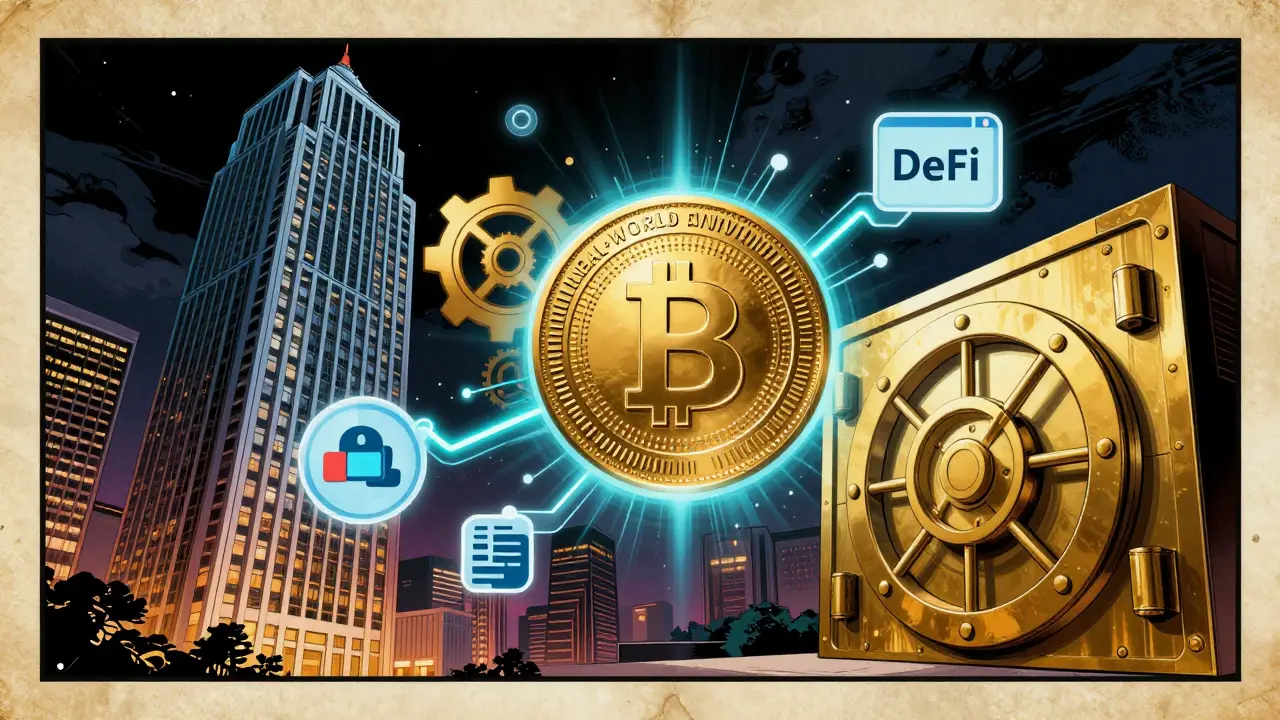
We are already seeing wrapping expand into the real world. It's not just for BTC or LTC. We are moving toward the tokenization of real-world assets (RWAs). Imagine wrapping a piece of real estate or a gold bar into an ERC-20 token. Once it's wrapped, that physical asset can be used as collateral for a loan in a DeFi protocol in seconds. The same logic applies to NFTs; wrapping an NFT allows it to be used in financial applications that normally only accept fungible tokens.
Is wrapping the same as bridging?
They are very similar, but wrapping is a specific type of bridging. Bridging is the general act of moving data or assets between chains. Wrapping specifically involves locking an asset on one chain to mint a representative token on another to maintain a 1:1 value ratio.
Can I lose my original tokens if I wrap them?
Yes, there is a risk. Because you are trusting a custodian or a smart contract to hold your assets, if that custodian is hacked or the contract has a critical vulnerability, you could lose the underlying assets. Always research the custodian's reputation and proof-of-reserve history.
Why would I use Wrapped Litecoin (wLTC) instead of just LTC?
LTC is great for payments, but its native network doesn't have the deep DeFi ecosystem that Ethereum has. By using wLTC, you can bring your Litecoin into Ethereum-based apps to earn interest, provide liquidity, or use it as collateral for loans.
How do I "unwrap" my tokens?
To unwrap, you send the wrapped tokens back to the issuing custodian. The custodian then burns those tokens (removing them from circulation) and releases the equivalent amount of native assets from their vault back to your wallet.
What happens if the price of the native token drops?
The wrapped token follows the price of the native token exactly. If Bitcoin drops by 10%, WBTC also drops by 10%. The wrapping process preserves the value and price movements of the asset; it only changes where that asset can be used.
Next Steps for DeFi Users
If you're new to this, start by identifying which of your assets are currently "idle." If you have a large amount of a token that doesn't have its own native lending market, look for a reputable wrapping service. Check for third-party audits and ensure the project has a transparent way of proving they actually hold the reserve assets. Once you have your wrapped tokens, start with a small amount in a well-known liquidity pool to get a feel for how the rewards and gas fees work before moving larger sums.


There are 13 Comments
Jason Davis
Gud explnation. Most peeple dont realyze the risk of the custodiens though. Its basically just a trust exercise with your money and that can be scary as hell if you aint careful with who u pick
Agnessa Dale
This is such a great way to simplify a complex topic! It's so exciting to see how DeFi is opening up more opportunities for everyone to grow their portfolios.
Prasanna Shembekar
omg the risk part is literally terrifying i cant even sleep thinking about custodians vanishing with my funds
Jessie Tayaban
I totally agree!! Its like... imagine the absolute CHAOS if a major bridge just vanishes overnight. I'd literally scream into my pillow for a week straight lol. But yeah the utility is just too goood to pass up, honestly. Its a wild ride but we are all just gamblling on the tech at this point anyway right??
EDOZIEM MICHAEL
money is but a shadow of value and wrapping is just the shadow of a shadow in a digital cave
Emily H
The explanation regarding the 1:1 backing ratio is quite precise. However, it is imperative to maintain a rigorous standard of due diligence when selecting a custodian. One must meticulously examine the proof-of-reserve audits to ensure the solvency of the wrapping protocol. Furthermore, the smart contract risk cannot be understated, as a single vulnerability could lead to a total loss of the locked collateral. It is highly recommended that users diversify their wrapping providers to mitigate systemic risk. One should also consider the implications of gas fees on the target chain, particularly during periods of high network congestion. In my professional experience, the balance between liquidity and security is the most critical factor in DeFi strategy. Utilizing these instruments without a comprehensive risk management framework is suboptimal. The transition toward tokenizing real-world assets will likely exacerbate these complexities. Therefore, continuous education is the only safeguard against volatility. The conceptual bridge between native assets and wrapped versions is a triumph of engineering, provided the trust layer remains intact. I appreciate the clarity provided in this overview.
Swati Sharma
Totally agree with the points on capital efficiency. Leveraging WBTC via liquidity pools creates an incredible flywheel effect for yield optimization. Using a cross-chain interoperability layer is basically a must for any serious DeFi power user trying to maximize their APY.
Rob Mitchell
Solid breakdown. Just remember to always check the audit reports.
Alan Seiden
Typical American nonsense pushing more complex ways to lose money. The whole concept of "trusting a custodian" in a decentralized world is an absolute joke. Utterly pathetic.
Stanly Hayes
Listen here, you miserable lot! Stop whining about the risks and look at the actual utility. If you're too scared to use a bridge, just go back to your savings account and leave the real gains to the adults!
Akshay Gorad
I believe we should maintain a balanced view on both the risks and the benefits here.
Lauren Abrams
Just observing from the sidelines for now. Seems useful but a bit too much risk for my taste.
Mikayla Murphy
It's interesting how different cultures approach the idea of "trust" in finance. Some prefer the old way, others love this new digital frontier.
Write a comment
Your email address will not be published. Required fields are marked *