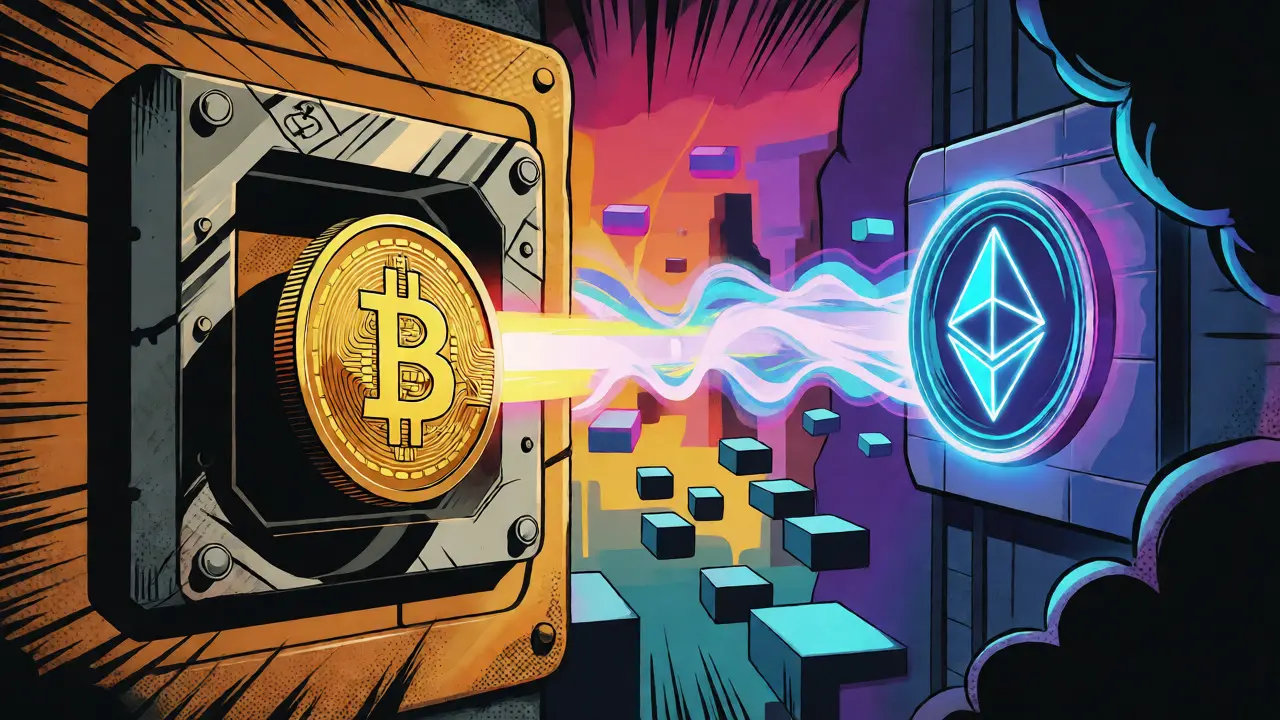
You want Bitcoin on Ethereum. You want to use your Solana earnings in a DeFi protocol on Arbitrum. But you can't just send native BTC into an Ethereum smart contract; the networks don't speak the same language. This is where wrapped assets come in. They are tokenized versions of an asset from one blockchain that live on another. Think of them as IOUs. If you hold WBTC, you hold a claim on real Bitcoin held somewhere else.
But who holds that "somewhere else"? That question defines the entire debate between centralized and decentralized wrapped assets. One model relies on human intermediaries and legal entities. The other relies on code, validators, and cryptographic proofs. Your choice impacts your risk profile, your transaction speed, and how much you trust the system not to freeze your funds or lose your collateral. Let's break down exactly how these two models work, where they fail, and which one fits your portfolio strategy in 2026.
The Core Mechanism: How Wrapping Works
Before we compare the two camps, you need to understand the plumbing. A wrapped asset isn't magic. It’s a two-step process involving locking and minting.
- Lock: You send native Bitcoin to a specific address (the vault).
- Mint: A smart contract on the destination chain creates an equivalent amount of tokens (e.g., 1 BTC = 1 WBTC).
- Burn: When you want your original Bitcoin back, you burn the wrapped token, and the vault releases the native asset.
The critical variable here is who controls the vault. In a centralized model, it’s usually a multi-signature wallet controlled by a company. In a decentralized model, it’s a network of validators or a set of smart contracts governed by DAOs. This distinction drives every difference in security, cost, and user experience.
Centralized Wrapped Assets: The WBTC Model
The most famous example here is Wrapped Bitcoin (WBTC). Launched in 2018, it remains the dominant wrapped asset on Ethereum. Its architecture is straightforward but heavily reliant on trust.
When you buy WBTC, you aren't interacting with a neutral piece of code alone. You are relying on a consortium called the WBTC Consortium. This group includes exchanges like BitGo and various institutional players. Here’s the workflow:
- Custody: Your Bitcoin sits in cold storage managed by BitGo. BitGo is a regulated US-based custodian.
- Minting Authority: Only authorized merchants (like Coinbase or Binance) can request new WBTC be minted. They do this after depositing BTC into the vault.
- Verification: Anyone can check the reserves via proof-of-reserves audits, but these are periodic snapshots, not real-time guarantees.
Why do people use this? Because it works. WBTC has massive liquidity. It trades on almost every DEX. The peg holds tight because arbitrage bots constantly correct price discrepancies. However, the centralization vector is obvious. If the SEC decides BitGo needs to freeze assets, or if the private keys are compromised, your WBTC becomes worthless paper. There is no automatic recovery mechanism coded into the blockchain itself. You rely on the legal and operational integrity of the custodians.
Decentralized Wrapped Assets: The Bridge Protocol Era
Decentralized wrappers aim to remove the human intermediary. Instead of a single company holding the keys, a network of independent nodes validates the transfer. Examples include solutions built on LayerZero, Axelar, or earlier iterations like RenBTC.
In a decentralized setup, when you lock BTC, a quorum of validators must sign off on the fact that the BTC was indeed locked. Once the majority agrees, the smart contract mints the wrapped token. No single entity can unilaterally stop the minting or release the funds.
This sounds ideal, but it introduces different risks:
- Smart Contract Risk: The code governing the bridge is complex. Bugs happen. Remember the Wormhole hack in 2022? Hackers exploited a signature verification flaw, stealing $320 million worth of assets. Decentralized systems shift risk from custody theft to code exploits.
- Validator Liveness: If too many validators go offline simultaneously, the bridge might halt. You could have your BTC locked on the source chain but unable to mint the wrapped version on the target chain until the network recovers.
- Slashing Conditions: To keep validators honest, protocols often require them to stake collateral. If they act maliciously, their stake gets slashed. This aligns incentives but doesn't eliminate the possibility of collusion among a small number of large validators.
Security Models Compared: Custody vs. Code
Let's look at the hard data on risk exposure. Centralized wraps face "counterparty risk." Decentralized wraps face "protocol risk." Which is worse?
| Feature | Centralized (e.g., WBTC) | Decentralized (e.g., LayerZero/Axelar) |
|---|---|---|
| Custody Control | Multi-sig wallets held by corporations (BitGo, Fireblocks). | Distributed across validator networks or light clients. |
| Primary Risk Vector | Hack of custodian, regulatory seizure, insolvency. | Smart contract bugs, validator collusion, consensus failures. |
| Recovery Mechanism | Legal recourse, insurance policies, manual intervention. | On-chain governance votes, emergency pause functions, insurance pools. |
| Audit Frequency | Regular third-party financial audits (monthly/quarterly). | Code audits before launch; ongoing bug bounty programs. |
| Liquidity Depth | Very high; backed by institutional market makers. | Variable; depends on community adoption and LP incentives. |
Notice the asymmetry. Centralized risks are often catastrophic but rare. If BitGo fails, you likely get some money back through bankruptcy proceedings, but it takes months. Decentralized risks are frequent but often contained. A small bug might affect a few users, or a temporary de-peg might last hours rather than months. However, major bridge hacks tend to drain the entire pool instantly.
Performance and User Experience
If you’re trading actively, latency matters. Centralized wraps generally offer faster finality for the initial mint because the custodian can approve transactions quickly once they verify the deposit. There’s no waiting for a global validator quorum to agree. For the user, this means lower fees and quicker access to capital.
Decentralized bridges vary wildly. Some, like those using optimistic rollups or zero-knowledge proofs, take minutes to finalize. Others, like Axelar, use a fast finality consensus that completes transfers in under a minute. But remember: "fast" is relative to the underlying chains. Moving ETH to Polygon via a centralized wrapper might take 5 minutes. Doing the same via a decentralized ZK-proof bridge might take 20 minutes due to proof generation time.
Fees also differ. Centralized providers charge a spread on the exchange rate plus gas fees. Decentralized protocols charge gas fees plus a protocol fee paid to validators. In times of network congestion, decentralized fees can spike unpredictably because you’re competing with other users for block space on both the source and destination chains.

Regulatory Landscape in 2026
We are three years past the peak of the "not your keys, not your coins" mantra being tested by FTX. Regulators now view wrapped assets through a stricter lens. Centralized wrappers like WBTC are increasingly classified as securities or commodities depending on jurisdiction. The US Securities and Exchange Commission (SEC) has scrutinized the control mechanisms of these issuers. If a wrapper is deemed too centralized, it faces higher compliance costs, which are passed on to users.
Decentralized wrappers operate in a gray area. Protocols like Uniswap or Curve facilitate the trading of these assets, but the bridge infrastructure itself is often considered software. This lack of clear classification allows decentralized projects to innovate faster but leaves users uncertain about legal protections. If a decentralized bridge loses your funds due to a hack, do you have any legal standing to sue? Usually, no. You agreed to the terms of service, which likely disclaim liability for smart contract errors.
Which Should You Choose?
Your decision depends on your risk tolerance and use case.
Choose Centralized Wrapped Assets if:
- You prioritize deep liquidity and tight spreads.
- You are moving large amounts of capital and prefer insured, audited custody.
- You are uncomfortable with the technical complexity of managing bridge interactions.
- You believe that established institutions are less likely to suffer from simple coding errors.
Choose Decentralized Wrapped Assets if:
- You value censorship resistance and autonomy.
- You are experimenting with newer ecosystems where centralized options don't exist yet.
- You understand smart contract risks and are willing to accept potential downtime.
- You want to participate in the governance of the protocol securing your assets.
For most retail investors in 2026, a hybrid approach makes sense. Keep your long-term holdings in native assets or highly liquid centralized wraps like WBTC. Use decentralized bridges for short-term yield farming strategies where you can monitor positions closely. Never put more into a single bridge than you can afford to lose while waiting for a fix or a refund.
What happens if the custodian of a centralized wrapped asset goes bankrupt?
If a custodian like BitGo goes insolvent, your wrapped tokens become claims against the estate. You would enter bankruptcy proceedings to recover your share of the underlying Bitcoin. This process can take months or years, and you might only recover a fraction of the value depending on remaining assets and legal priorities. Unlike bank deposits, there is typically no FDIC-style insurance for crypto custodians unless explicitly purchased.
Are decentralized wrapped assets safer than centralized ones?
Not necessarily safer, just differently risky. Decentralized assets eliminate single points of failure regarding custody but introduce significant smart contract risk. Historically, bridge hacks (decentralized risk) have resulted in larger instantaneous losses than custodial breaches (centralized risk), though custodial issues can lead to prolonged freezes. Safety depends on the maturity of the code and the size of the validator set.
Can I convert WBTC back to native Bitcoin directly?
Yes, but you usually cannot do it peer-to-peer. You must send your WBTC back to the designated redemption address or through an authorized merchant/exchange. They will then unlock the corresponding Bitcoin from the vault and send it to your Bitcoin address. This process involves gas fees on both Ethereum and Bitcoin, so ensure you account for both when calculating profitability.
Why do wrapped assets sometimes trade below their underlying asset's price?
This is called a "de-peg." It happens when demand for the wrapped asset drops, or if there are fears about the backing collateral. In centralized models, arbitrageurs usually correct this quickly by redeeming the cheap wrapped asset for the expensive native asset. In decentralized models, if the bridge is congested or paused, arbitrage becomes difficult, allowing the discount to persist longer.
Do I need to pay taxes twice when wrapping assets?
Tax laws vary by country, but in many jurisdictions, swapping native BTC for WBTC is considered a taxable disposal event. You realize a gain or loss based on the price difference at the moment of the swap. Then, when you unwrap later, it’s another disposal event. Consult a local tax professional, as treating wrapping as a non-taxable transfer is becoming harder to justify legally.