
Have you ever stumbled upon a crypto platform that promises low fees and high yields but offers absolutely zero information about who runs it? That is exactly the situation with Dystopia Exchange, a decentralized trading platform focused on efficient swaps and minimal slippage for both stable and volatile assets. It sounds appealing on paper. But when you dig deeper, you hit a wall of silence. No founder names. No launch date. No audit reports. Just a listing on aggregator sites like Criffy and some vague volume data.
In the world of decentralized finance (DeFi), opacity isn't just an inconvenience-it's a red flag. While major exchanges publish their security practices and team backgrounds, Dystopia operates in the shadows. This review breaks down what we actually know, what we suspect, and whether it’s worth risking your capital on this niche protocol in 2026.
The Core Problem: A Complete Information Vacuum
Let’s start with the basics. If you were reviewing a centralized exchange like Binance or Coinbase, you’d expect to see a headquarters address, a regulatory license number, and a list of executives. For a decentralized exchange (DEX), you’d at least expect a GitHub repository, a whitepaper, or a clear governance model. Dystopia has none of these.
Across multiple search results and comparison platforms, there are zero mentions of a founding year, a jurisdiction, or a CEO. There is no LinkedIn profile for a "CTO of Dystopia." There is no Twitter account with thousands of followers discussing roadmap updates. The only concrete evidence of its existence is a listing on Criffy, which describes it as a decentralized trading platform, and a data stub on LiquidityFinder that tracks its volume.
This lack of transparency is a material fact. It means you cannot verify if Dystopia is run by a registered company, a decentralized autonomous organization (DAO), or an anonymous group of developers. In DeFi, anonymity can mean privacy, but it often means accountability is non-existent. If something goes wrong-and in crypto, things often do-who do you call? Who do you sue? With Dystopia, the answer appears to be no one.
| Feature | Dystopia Exchange | Major CEX (e.g., KuCoin) | Top-Tier DEX (e.g., Uniswap) |
|---|---|---|---|
| Founding Team | Unknown / Anonymous | Publicly Listed | Known Developers / DAO |
| Security Audits | None Found | Regular Third-Party Audits | Multiple Public Audits |
| User Reviews | Zero on Trustpilot | Thousands of Reviews | High Community Sentiment |
| Fees | "Minimal" (Unspecified) | Clear Tiered Structure | Standard AMM Fees (0.3%) |
| Regulatory Status | Unclear | Licensed in Multiple Jurisdictions | Non-Custodial (User Responsibility) |
How Dystopia Works: The Technical Guesswork
Since Dystopia doesn’t publish its own documentation, we have to infer how it works based on industry standards and third-party descriptions. Criffy classifies it as a decentralized exchange, which implies it uses smart contracts rather than a central order book. This makes it an Automated Market Maker (AMM).
The platform claims to support "efficient swaps" for both stablecoins and volatile assets. In DeFi terms, this usually means two different pool types:
- Stable-Swap Pools: These use specialized bonding curves (like Curve Finance does) to minimize slippage when swapping similar assets like USDC for USDT. You want near-zero price impact here.
- Volatile Pools: These likely use the standard constant-product formula ($x \cdot y = k$) for trading tokens with fluctuating prices, such as ETH or BTC against stablecoins.
Because no specific blockchain is mentioned, we assume it runs on an Ethereum Virtual Machine (EVM) compatible chain-likely Ethereum, Polygon, or BNB Chain-given its integration with Web3 wallets like MetaMask. Users would connect their wallet, approve token spending, and execute trades directly against liquidity pools. There is no customer support line to help if you send funds to the wrong address. You are on your own.
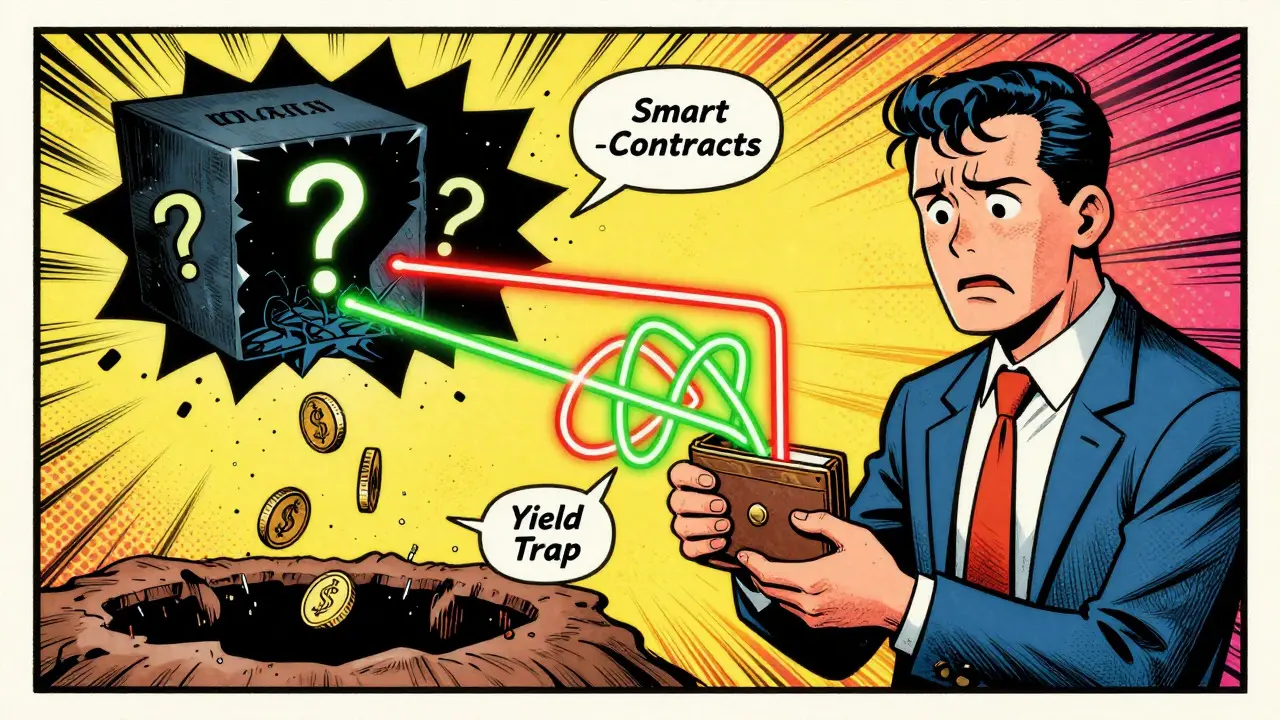
The Yield Trap: What “Dystopia Earn” Really Means
One of the most intriguing aspects of Dystopia is its presence on Criffy’s "Earn Offers" page. This suggests the protocol isn’t just for swapping; it’s designed to generate yield. But how?
In typical DeFi models, yield comes from two sources: swap fees paid by traders and inflationary rewards issued by the protocol. Since Dystopia lists "minimal fees," the swap revenue might be low. To attract liquidity providers (LPs), the platform likely emits a native reward token. However, without a published tokenomics report, we don’t know the supply cap, the vesting schedule, or the distribution mechanism.
This creates a significant risk. If the yield is high but unsustainable, it could lead to a death spiral where early investors dump their rewards, crashing the token price. Without transparent data on Annual Percentage Yield (APY) or compounding schedules, users are essentially guessing whether they’re earning legitimate fees or participating in a Ponzi-like structure fueled by new deposits.
Security Risks: The Black Box Protocol
Security is the biggest concern with Dystopia. In 2026, smart contract audits are not optional; they are mandatory for any credible DeFi project. Major firms like CertiK, OpenZeppelin, or Trail of Bits routinely audit protocols to find vulnerabilities. Dystopia has zero public audit reports.
Think about what this means. An unaudited contract is a black box. It could contain backdoors that allow developers to drain liquidity. It could have logic errors that freeze user funds. Or it could simply be poorly optimized code that costs exorbitant gas fees during network congestion.
Furthermore, governance is unknown. Does Dystopia have a multi-signature wallet controlled by a small group of insiders? Or is it governed by token holders? If it’s the former, the risk of insider manipulation is high. If it’s the latter, where are the voting records? The absence of this information places Dystopia in the highest risk category for DeFi investments.
Who Should Use Dystopia? (And Who Should Avoid It)
Given the lack of data, Dystopia is not suitable for beginners. If you are new to crypto, stick to established centralized exchanges or top-tier DEXs with proven track records. Dystopia requires intermediate to advanced knowledge of Web3, including understanding gas fees, slippage tolerance, and impermanent loss.
It might appeal to:
- Arbitrageurs: Traders looking for pricing inefficiencies between Dystopia and larger exchanges. If Dystopia has lower liquidity, price discrepancies might exist.
- Risk-Tolerant Yield Farmers: Users willing to take on high smart contract risk for potentially higher APYs before the market catches on.
- Privacy Advocates: Individuals who prefer anonymous protocols over KYC-heavy centralized exchanges, provided they accept the security trade-off.
Everyone else should probably stay away until more information becomes available.
Final Verdict: Proceed with Extreme Caution
Dystopia Exchange is a mystery wrapped in a promise. It offers the allure of low fees and yield generation but fails to provide the basic trust signals that serious investors require. In the crypto space, trust is built through transparency, audits, and community engagement. Dystopia has none of these.
Until the project publishes its smart contract addresses, releases an audit report, or reveals its team, it remains a speculative play. If you decide to use it, treat it as a high-risk experiment. Never invest more than you can afford to lose, and always double-check the contract addresses yourself. In DeFi, if it sounds too good to be true and nobody knows who’s behind it, it probably is.
Is Dystopia Exchange a scam?
There is no definitive proof that Dystopia is a scam, but the lack of transparency, anonymous team, and missing security audits make it high-risk. In crypto, obscurity often correlates with higher fraud potential. Treat it with extreme caution until more verifiable data emerges.
What blockchain does Dystopia run on?
The specific blockchain is not publicly confirmed. However, given its integration with Web3 wallets and DeFi aggregators, it likely operates on an EVM-compatible chain such as Ethereum, Polygon, or BNB Chain. Users should verify the network connection in their wallet before transacting.
Are there any security audits for Dystopia?
As of mid-2026, there are no publicly available security audit reports for Dystopia Exchange. This is a significant red flag, as audits are standard practice for reputable DeFi protocols to ensure smart contract safety.
How do fees work on Dystopia?
Criffy describes fees as "minimal," but no exact percentages are published. Typical DEX fees range from 0.01% to 0.30% per swap. Additionally, users must pay gas fees to the underlying blockchain network, which can vary significantly depending on network congestion.
Can I earn yield on Dystopia?
Yes, Dystopia is listed on Criffy’s "Earn Offers" section, suggesting it supports yield farming or liquidity provision. However, specific APY rates, reward tokens, and lock-up periods are not disclosed, making it difficult to assess the sustainability of the returns.

There are 21 Comments
Aryan MISHRA
The lack of audit reports is a critical failure point; unaudited smart contracts are essentially ticking time bombs. The absence of a GitHub repository suggests either extreme incompetence or malicious intent by the developers. You cannot verify the code, therefore you cannot trust the protocol. It is elementary DeFi security hygiene.
Ryan Robinson
i mean its kinda sus but i dont see why ppl are so hating on it lol. maybe they just wanna keep it low key? not everythign has to be loud and proud right? seems like a chill place to swap if u know what ur doing.
Earl Kott65
Oh wow! 🚀 A platform with ZERO transparency?! 😱 This sounds like the plot of a bad sci-fi movie! 🎬 But hey, maybe it’s the next big thing? 🤷♂️ Who needs audits when you have vibes? ✨ Just kidding (or am I?) 😉 Definitely proceed with caution, folks! ⚠️
Ethan Yuwono
it is interesting how we accept opacity in crypto as normal. perhaps we should question the very nature of trust in decentralized systems. if no one knows who runs it does it even exist?
Jack Delasquez
guys stop panicking!! this looks like a great oppurtunity to get in early before everyone else finds out. the fees are minimal which means more profit for us. dont let fear hold you back from making gains!!!
Harman Singh
why is everyone so negative? i feel like people just want to complain instead of looking for the good stuff. its annoying how quick everyone is to call something a scam without trying it first. typical internet behavior.
Qolbina Islami
This is exactly what happens when we don't have proper regulation!!! 🇺🇸 We need strict laws to protect American investors from these shady offshore operations!!! It's an insult to our financial system!!!
SUBHAM CHOUDHURY
Hey there! 👋 Don't worry too much about the risks. Every new project has some unknowns. Just take small steps and learn as you go. You got this! 💪
Joy Kwant
I just feel so drained reading all these comments. Everyone is so aggressive and judgmental. Why can't we just appreciate the innovation? It's exhausting dealing with such negativity online.
amy miranda
It is morally reprehensible that platforms like this operate without accountability. The sheer audacity of hiding behind anonymity while asking for people's money is disgusting. They deserve to fail.
Pernelia Wahkan
I've dug through similar protocols before. Usually, the 'minimal fees' claim is a lure. Check the gas costs on the underlying chain. Often, the savings are illusory due to network congestion during peak times.
Subhash Kashyap Dm
its all part of the grand plan. the elites want you to lose your savings on unaudited dapps. wake up sheeple. dystopia is a psyop to drain liquidity from the masses. follow the money trail.
Billy Cunningham
Just another rug pull waiting to happen 📉
Ed Wallace
There is a certain poetry in the void left by Dystopia. It mirrors the existential uncertainty of the blockchain itself. We trade in shadows because the light reveals too much imperfection.
Joshua Hofford
Look on the bright side! Innovation often comes from unexpected places. Maybe Dystopia is pioneering a new model of privacy-focused finance. Let's support experimentation!
Marcia Albert
It's like watching paint dry, but with higher stakes. I'll stick to my index funds thanks.
Emma Smith
the paradigm shift here is ontological. if the team is anonymous then the entity is non-existent. yet the liquidity exists. this is a ghost in the machine scenario. fascinatingly terrifying.
Ed Mitchell
The government is hiding the truth about this exchange. They want us to believe it's risky so we don't use it. It's a conspiracy to control our wealth. Open your eyes!
Michael Mostyn
One must consider the philosophical implications of trustless systems. If trust is removed, what remains? Perhaps only pure mathematical certainty, which Dystopia fails to provide.
Erica Johnson
Obviously, anyone with half a brain would avoid this. It's basic risk management 101. Why do people ignore obvious red flags? 🙄
Ken G
only the elite understand true value. this is noise for the masses. stay away unless you are prepared to lose everything. simple as that.
Write a comment
Your email address will not be published. Required fields are marked *